Last updated: November 19, 2026
Key Takeaways
- School stays first because class time is fixed and missed work adds up quickly.
- Teens should give a manager a narrow, realistic availability window that fits school and sports.
- Break homework into small blocks instead of treating it like one long evening task.
- A healthy week needs clear limits, steady routines, and one low-pressure block.
Balancing school, sports, and a part-time job is possible when the teen schedule management system is simple, fixed, and honest about limits. In this guide to How Teens Can Balance School, Sports, and a Part-Time Job, the goal is not to fit everything into every day; the goal is to keep grades steady, show up to practice, and avoid a work schedule that eats the sleep teens need. Quick Answer: most teens do best when they protect school first, keep sports practice fixed, and limit work to a realistic number of open hours.
Build a weekly plan around school first

School comes first because class time is fixed, homework is nonnegotiable, and missed work piles up fast. Start with the school schedule, then add sports practice, then place job shifts into the empty blocks.
Use a paper planner, Google Calendar, or the calendar app already on a phone. The tool matters less than the habit: one weekly view, updated every Sunday night for 15 to 20 minutes. Put every class, practice, game, commute, and shift in one place so the week stops living in memory. According to the American Academy of Pediatrics, consistent routines help teens manage responsibilities more smoothly, and the CDC recommends enough sleep for teen health and learning.
A simple order helps:
- Write down school hours for each weekday. Add commute time if the bus, parent drop-off, or train takes 20 to 45 minutes.
- Block sports practice, games, and team meetings exactly as they appear on the team schedule.
- Mark the fixed job shift schedule only where it does not collide with class or practice.
- Reserve homework blocks on 4 or 5 school nights, even if each block is only 45 minutes.
- Leave at least one lighter evening each week with no work shift and no major assignment due the next morning.
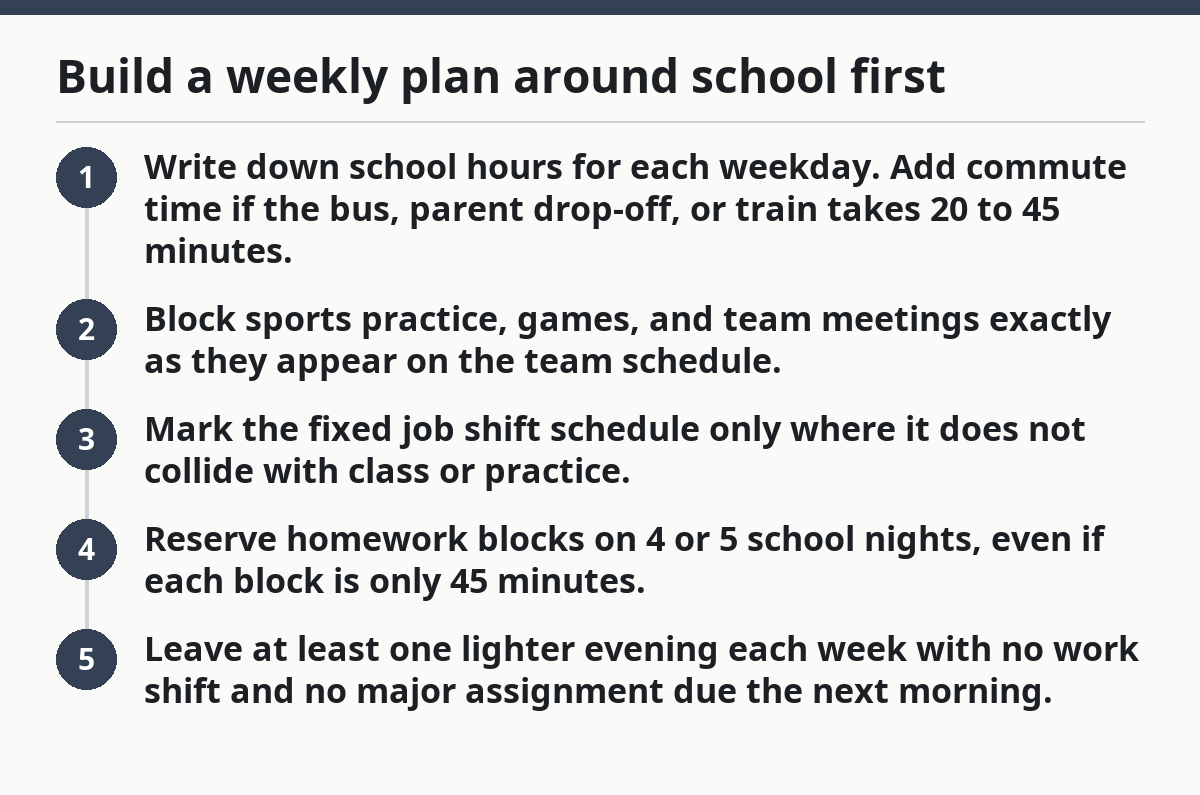
That last step matters because teens do not run well on back-to-back full days forever. A schedule that looks impressive on paper can fail by Thursday if every hour is packed.
The common mistake is filling the calendar with the maximum possible hours and hoping motivation will cover the gap. It usually costs sleep, focus, and a steady mood. A better plan leaves 1 or 2 open hours most days for the unexpected: a longer practice, a group project, a late bus, or just a slower homework night.
If the schedule cannot fit school and sports without squeezing sleep to the edge, the job has to shrink, not the homework block.
How can teens set work availability without wrecking sports?
Teens should give a manager a narrow, realistic availability window that matches the school week and sports season. That means saying what days, start times, and end times actually work, not what sounds ambitious.
Availability is easier to protect before the schedule is built than after shifts are assigned. A teen who has practice until 6:30 p.m. on Tuesdays and Thursdays should not offer Tuesday evening availability just to seem flexible. That turns into constant conflict and last-minute callouts.
A clean way to set availability is to use a 3-part rule:
- School days: only offer the hours after homework, practice, and commute are counted.
- Game days: either keep the day off or offer a short shift only if the employer truly allows easy swapping.
- Exam weeks or playoffs: reduce or remove shifts ahead of time, not the night before.
This is where a parent can help. A parent can look at the full week, catch the overlap between a Saturday shift and a Sunday tournament, and back up the availability limit if a manager pushes for more hours than the teen can safely handle. The U.S. Department of Labor also notes that teen work limits and scheduling rules matter, so it helps to check the basics before agreeing to hours.
A teen should also ask about the shift pattern, not just the number of hours. Two 4-hour shifts on school nights may be easier than one 8-hour shift that runs late. A closing shift that ends at 10 p.m. can be a bad fit during a heavy practice week because it pushes bedtime too far back.
One honest trade-off: being picky with availability can mean fewer shifts. That is not failure. It is the cost of keeping sports and school intact. If a job requires weekday evenings that overlap with practice most of the season, it is the wrong job for this stage of life.
Use homework planning to stop the night-before panic
Homework planning works best when it is broken into small blocks, not treated like one giant evening job. A teen who waits until 8:30 p.m. to “start homework” usually runs into the exact problem the schedule was meant to prevent. If the pattern keeps failing, it can help to check with a teacher, counselor, or parent about workload and priorities.
The best practice is to assign homework to 2 time blocks on school nights: one short block right after school or practice, and one backup block later in the evening. Even 25 to 40 minutes can be enough to start, sort, or finish a task. The point is to reduce the chance that a full assignment gets shoved into the last 20 minutes before bed.
A useful homework routine looks like this:
- Open the planner right after school or at the start of the evening.
- List every assignment due in the next 48 hours.
- Circle the task that takes the longest or has the earliest deadline.
- Do that task first for 30 to 45 minutes.
- Use the final 15 minutes to pack the backpack, charge devices, and prep for the next day.
This is not about perfect productivity. It is about removing decision fatigue. If the teen spends 10 minutes deciding what to do first, the whole night gets shorter.
A common mistake is assuming a free hour after practice is enough for “all homework.” That often fails once a lab report, a reading assignment, and a quiz study session appear at the same time. A better approach is to split schoolwork across the week and keep one 30-minute buffer on the night before a test or major paper is due.
If sports season gets intense, homework may need a stricter rule: no phone until the first 30 minutes of work is done. That small boundary can save the whole evening.
The guide to teen money jobs and earnings belongs on this site’s larger hub, but the schedule on this page is the part that keeps schoolwork from getting crowded out.
What does a healthy school, sports, and work week look like?
A healthy week has clear limits, repeated routines, and at least one low-pressure block of time. It does not look different every day and it does not depend on catching up at midnight.
For many teens, the week works better when it follows a pattern like this:
- 2 or 3 work shifts per week, not 5.
- Homework handled in 30- to 60-minute blocks.
- Sports practice treated as fixed, not optional.
- One evening with no shift.
- One weekend block that stays open for family time, a game, or unfinished schoolwork.
That pattern gives the week shape. It also makes it easier to spot when something is off. If every night starts ending at 10:30 p.m., the schedule has drifted too far.
The problem with a packed week is not just tiredness. It also creates mistakes in small places: forgotten uniforms, missed deadlines, rushed lunches, or a paper submitted with obvious errors because the teen was working off a half-awake brain. Those mistakes cost grades, confidence, and sometimes a team spot if attendance slips.
This is why “balance” should be treated as a moving target, especially in a busy school year. During a playoff week, the job may need to shrink. During a lighter school week, an extra shift may fit. During finals, school takes over. The wrong version of balance is trying to keep the same number of work hours every week of the year.
This section is where many generic articles go wrong: they talk as if a teen can just “manage time better” and everything will work out. Time management helps, but capacity still has limits. If a teen is doing honors classes, varsity sports, and a job with late shifts, the schedule may need fewer work hours, not better color coding.
Burnout warning signs teens should not ignore
Burnout shows up when the schedule starts costing sleep, patience, and focus for more than a few days. A teen does not need a dramatic crisis to know the load is too heavy.
Watch for these signs:
- Dreading school, practice, or work every day
- Needing caffeine just to get through a normal afternoon
- Falling asleep during homework or on the ride home
- More missed assignments, late arrivals, or forgotten items
- Getting irritated over small things that used to be easy
- Losing interest in sports or school tasks that normally mattered
One bad day is not burnout. A pattern that lasts 2 weeks or more is different.
The fix is not usually “try harder.” The fix is subtraction. Cut one shift, shorten one evening, or reduce one extracurricular commitment if the schedule allows it. A parent can help by looking at the full picture without turning it into a lecture. Sometimes the person who is overloaded cannot see the pattern clearly because they are inside it.
Sleep is the first place the schedule shows its damage. If bedtime keeps slipping by 1 or 2 hours because of work, homework, and practice, the week is already too full. Missing sleep costs more than one late assignment ever will.
The honest limitation here is simple: not every teen can do all three things at once for long periods. A part-time job can fit with school and sports, but only if the job stays part-time in a real sense. If the schedule starts to look like a full adult workweek with school bolted on top, something has to give.
For guidance on work-hour limits, teens can check the U.S. Department of Labor’s youth employment page and the U.S. Office of the Surgeon General’s resources on youth sleep and well-being. Those pages are not about scheduling strategy, but they help frame why the schedule cannot be stretched forever.
Fixing a week that is already slipping
A slipping schedule is usually saved by cutting, not by reorganizing every minute. If the teen is already behind, spend 10 minutes resetting the week instead of trying to “catch up” in one heroic night.
Start by identifying the one problem that is causing the most damage. It is usually one of these:
- a late shift on a school night
- too many weekday practices plus work
- homework that has been pushed into the weekend
- no buffer for transportation delays
Then remove one conflict first. For example, if a Tuesday closing shift makes Wednesday morning miserable, try switching to a Saturday afternoon shift. If Friday practice and Saturday work both happen, reduce one of them for the season.
A parent should be part of the reset if transportation, deadlines, or younger-sibling logistics are involved. A teen may know the assignments and sports calendar, but a parent often sees the hidden 20-minute gaps, the car schedule, and the family events that would otherwise collide.
If the job is the main source of conflict, talk to the manager early and keep the message practical: school and sports are fixed, and the teen can work the hours that remain. That is a scheduling boundary, not an excuse.
The worst choice is to pretend the conflict will disappear next week. It usually gets worse. One missed shift leads to another, then homework slips, then sleep falls apart, then sports become harder to sustain. Small course corrections are easier than a full recovery.
What is the smartest long-term way to keep the job worth it?
The smartest long-term approach is to treat the job as one part of a larger week, not the center of it. That means choosing a job with hours that fit the school year, not just the paycheck.
A good fit usually has predictable shifts, a manager who respects availability, and room to reduce hours during exams or sports seasons. A bad fit has late-night closings, constant schedule changes, or pressure to say yes every time a shift opens. Those jobs can pay in stress what they pay in cash.
This is also where teens should be honest about the reason for working. If the goal is spending money, a smaller schedule may be enough. If the goal is saving for a larger purchase, the teen may need to work more during summer and less during the school year. If the goal is work experience, consistency matters more than maximum hours.
The best schedules usually stay boring in the middle of the week. School happens. Practice happens. Homework gets a block. Work has its place. That plain structure beats a chaotic week that looks full but collapses by Thursday.
A good final test is simple: if the teen can keep grades steady, show up to practice, and still get enough sleep most nights, the balance is working. If one of those three starts sliding, the schedule needs trimming, not just better willpower.
How many hours can a teen work safely?
A teen can work only as many hours as still leave room for school, sports, sleep, and recovery. The safe number depends on class load, practice schedule, commute time, and homework, so there is no single number that fits every teen. If work starts pushing sleep or grades down for more than 1 to 2 weeks, the schedule is too full.
How can teens avoid burnout from work and school?
Teens can avoid burnout by protecting sleep, limiting late shifts, and keeping at least one lighter block in the week. The first sign of trouble is usually not a dramatic breakdown; it is a string of small misses, like late homework, irritability, or constant exhaustion. Reducing one shift is often better than trying to push through.
How should teens schedule homework around work?
Teens should schedule homework in 30- to 45-minute blocks before the night gets late. The easiest method is to do the hardest assignment first, then use a second short block for smaller tasks or review. If a shift ends late, homework should move earlier in the day or to a weekend block instead of waiting until bedtime.
Drafted with AI; not yet reviewed by a person.