Last updated: November 20, 2026
Quick Answer: a teen budget often works best when it starts with one week of real spending data and a simple three-part split: spend, save, and needs. Teen money problems usually come down to one thing: cash goes out faster than it comes in. The fix is a simple system that tracks spending, sets a spending limit, and gives every dollar a job before the month starts.
This guide shows how teen cash flow works, where budgets break, and how to build a plan that fits school, part-time work, gifts, and impulse buys in Teen Spending, Budgeting, and Cash Flow — The Complete Guide.
Information only, not financial advice. Money rules, bank rules, and tax rules vary by country and change over time, so a qualified adviser should be consulted for a teen’s own situation.
Key Takeaways
- Teen cash flow is the timing of money in and money out, not just how much money exists.
- A budget fails fast when it ignores irregular income like babysitting, holiday gifts, or shift work.
- A strong teen budget is the one that matches real spending habits, not a perfect spreadsheet.
- Tracking for one month is usually enough to spot leaks like food runs, apps, and small online buys.
- Parents help most when they set guardrails and let teens make some low-stakes mistakes.
What teen cash flow actually means
Teen cash flow is the pattern of money coming in and going out during a week or month. If a teen gets $20 on Friday and spends $18 by Saturday night, the problem is not the total amount — it is timing.
Picture this: you have lunch money on Monday, a babysitting payment on Thursday, and a school trip payment due next week. The money may exist, but not always when the bill arrives. That gap is where stress starts.
Cash flow matters more than “having a budget” because a budget can look fine on paper and still fail on Wednesday. A teen who spends a lot early in the week may be broke long before the next allowance, paycheck, or gift card reload.
The main parts are simple:
- Income: allowance, chores, gifts, babysitting, lawn work, part-time pay
- Fixed spending: bus fare, phone bill if the teen pays it, club dues, subscriptions
- Variable spending: snacks, games, clothes, rides, social plans
- Saving goals: a phone case, concert ticket, emergency cushion, college fund
The catch is that teen income is often uneven. A summer job may pay weekly, while gifts arrive on birthdays and holidays. One useful rule is to treat irregular money carefully, and if a teen’s situation is complicated, a qualified adviser can help with the plan. A budget should use the lowest reliable income, not the best month.
For background on household budgeting concepts, the Consumer Financial Protection Bureau has a solid plain-language overview of budgeting basics, and MoneyHelper in the UK offers practical guidance for young people. The CFPB also has youth-friendly money education pages.
Why a teen budget fails in real life
A teen budget fails when it assumes every dollar is predictable. That is the biggest mistake. Real teen money has gaps, surprises, and one-off expenses that do not show up in a neat monthly plan.
Picture this: you write down “$40 a month for spending,” then the school dance, a game skin, and two lunch outings hit in the same week. The budget did not break because the math was wrong. It broke because the plan ignored timing and one-time costs.
The usual failure points are easy to spot:
- Irregular income: a shift gets canceled, a babysitting job ends, a grandparent gift arrives late
- Hidden spending: in-app purchases, delivery fees, school vending machines, “I’ll pay you back” rides
- No buffer: every dollar is assigned, so one small expense ruins the whole week
- No category limits: everything goes into one pile, which makes overspending hard to see
- No review habit: the teen never checks what happened until the money is gone
The truth is, a teen budget is not a moral test. It is a tool for seeing patterns. If it takes 20 minutes to set up and 5 minutes to check once a week, it is far more likely to work than a complicated spreadsheet that gets abandoned after three days.
A budget also needs a realistic starting point. If a teen earns small amounts here and there, the plan should separate “money to spend now” from “money to save for later.” Mixing those two is a fast way to overspend.
How to set up a teen spending plan that actually works
A workable teen spending plan starts with one month of real numbers, not guesses. List what came in, what went out, and what had to be paid no matter what. Then build the next month from that evidence.
Picture this: you open a notes app, a notebook, or a spreadsheet and write down every dollar for 30 days. That includes cash, card purchases, app payments, and money a parent sends for a specific expense. The goal is to see the pattern, not to judge it.
Here is a simple setup:
- List income sources. Write allowance, chores, job pay, gift money, and side work separately.
- List required spending. Include school supplies, transit, phone costs, lunch, sports, and subscriptions.
- Set spending buckets. Keep fun money, short-term saving, and required spending apart.
- Choose a weekly check-in day. Sunday evening works for many teens because the week is visible.
- Leave room for a buffer. A small leftover amount keeps one mistake from wiping out the month.
The best part is that this does not need fancy software. A paper notebook can work if the teen will actually use it. A phone app can work if it is checked often. The tool matters less than the habit.
One useful rule is to treat irregular money carefully. If a teen gets $100 for a birthday, that is not monthly income. It is one-time money. Putting it all into spending on day one can create regret later, so it helps to plan that money before it disappears.
What should a teen spend on first?
A teen should cover required spending first, then short-term goals, then discretionary wants. That order keeps basic needs and school costs from getting crowded out by impulse buys.
Picture this: you have $60 this week. The urge is to spend it where it feels fun right now. But if next Friday’s bus pass or school lunch money is already due, the fun purchase creates a problem later.
A practical order looks like this:
- Must-pay items: transit, lunch, school fees, club dues, phone contribution
- Near-term goals: shoes, a game, a concert, a birthday gift
- Choice spending: snacks, streaming add-ons, cosmetics, extra rides, online extras
- Savings: emergency cash, longer goals, future school costs
This order is not about making teens miserable. It is about making spending visible. A teen who knows the next $15 is already spoken for is less likely to spend it on small, forgettable purchases.
The hard part is that wants often look small. One $4 snack is not the issue. Five small purchases in a weekend can eat the whole budget. That is why cash flow tracking matters more than single big purchases. Small leaks drain accounts quietly.
If a teen has a part-time job, the rule should be even clearer: use the first dollars for fixed obligations, then divide the rest into spend, save, and give if that fits the family’s values. The exact split differs by household and by country. The important part is consistency.
For a plain-language source on saving and budgeting habits, the FDIC’s Money Smart materials are useful, and the CFPB has youth-friendly money education pages.
How teens track spending without hating it
Teens track spending best when the system takes less than five minutes a day. If it feels like homework, it will get ignored. If it feels like a quick check, it has a chance.
Picture this: after school, you open your phone and log one sandwich, one ride, and one app purchase. That tiny action keeps the week from becoming a mystery at the end of the month.
There are three common methods:
- Notebook tracking: write each purchase by hand
- Notes app tracking: record each amount in a phone note
- Spreadsheet tracking: use categories and totals
The simplest method is often the best starting point. A teen who hates spreadsheets should not be forced into one. A teen who likes numbers may prefer a quick table with categories and totals.
A weekly review should ask four questions:
- What did I spend most on?
- What surprised me?
- What can I skip next week?
- Did I run out before the next money came in?
That review turns spending into feedback. Without it, the same leaks repeat. With it, patterns become obvious.
Here is the catch: tracking only works if cash, card, and app purchases all go into the same system. If one payment method is left out, the numbers lie. That is why “I only spent a little” is often wrong. Small spends pile up fast.
Cash, cards, and apps: which one teaches better habits?
Cash teaches faster, cards are easier to lose sight of, and apps can hide spending inside a few taps. For many teens, cash is the clearest teacher, but cards and apps are often more practical for everyday use.
Picture this: you hand over a bill and feel the money leave your hand. That friction helps some teens slow down. Tap-to-pay does the opposite. It is faster, which is convenient, but it also makes spending feel abstract.
Here is the honest trade-off:
- Cash: easy to see, easy to count, easy to overspend if you carry too much
- Debit card: useful for online purchases and store spending, but harder to feel
- Payment apps: convenient for splitting costs, but they can make tiny purchases feel invisible
Cash works best for teens who overspend on snacks, rides, and small daily extras. The physical limit is obvious. When the envelope is empty, the spending stops.
Cards and apps work best when the teen needs convenience or cannot use cash for every purchase. The downside is that the spending trail is less visible unless the teen checks transactions often. That review step matters more with digital money.
A smart middle path is to use one main spending method and one backup. That keeps the system simple. It also lowers the chance of losing track across three different places.
How parents can help without taking over
Parents help best by setting rules, not by controlling every dollar. A teen needs room to make small mistakes while still having guardrails around the big ones.
Picture this: a parent gives a teen money, then keeps asking about every purchase. That can teach monitoring, but it can also teach secrecy. On the other hand, no structure at all often leads to chaos. The useful middle is clear expectations with regular check-ins.
Good support often includes:
- A clear allowance or contribution rule
- One shared view of major expenses
- A weekly money conversation that stays short
- A plan for what happens when the teen runs out
- A separate rule for gifts or emergency money
The best check-ins are brief and specific. Ask what got spent, what was saved, and what changed. A ten-minute conversation is enough. A long lecture usually is not.
The catch is that the parent’s job changes as the teen gets older. Younger teens may need more structure. Older teens may need more independence, especially if they are working, saving for college, or paying part of their own expenses. The system should grow with the teen, not freeze in place.
Parents should also be honest about what the teen is responsible for. If a phone bill, sports fee, or school trip is the teen’s job, that needs to be clear in advance. Ambiguity creates friction later.
The honest side-by-side: spending now vs saving first
Saving first wins for long-term goals and spending now wins only for small, planned fun money. The right choice depends on whether the money is needed this week or for a goal later in the term.
Picture this: you get paid on Friday and want to spend on Saturday. If the money is meant for a future cost, saving first keeps that goal alive. If the money is pure spending money, waiting can be unnecessary friction.
| Criteria | Spend Now | Save First | Winner for [condition] |
|---|---|---|---|
| Impulse control | Harder to resist small purchases | Creates a pause before spending | Save First for teens who overspend fast |
| Short-term fun | Better for immediate outings and small treats | Delays enjoyment until later | Spend Now for planned fun money |
| Big goals | Often derails them | Protects the goal from small leaks | Save First for a phone, ticket, or trip |
| Cash flow stress | Can leave nothing for later in the week | Reduces the chance of running dry early | Save First when income arrives in chunks |
| Flexibility | Easy to use money as it comes in | Less flexible day to day | Spend Now for small, stable budgets |
| Learning value | Shows the cost of fast choices | Builds patience and planning habits | Save First for teens learning delayed gratification |
| Risk of regret | Higher if a later bill appears | Lower if the goal matters | Save First for any non-negotiable expense |
| Best use case | Movies, snacks, weekend plans | School costs, trip money, larger purchases | Depends on the category |
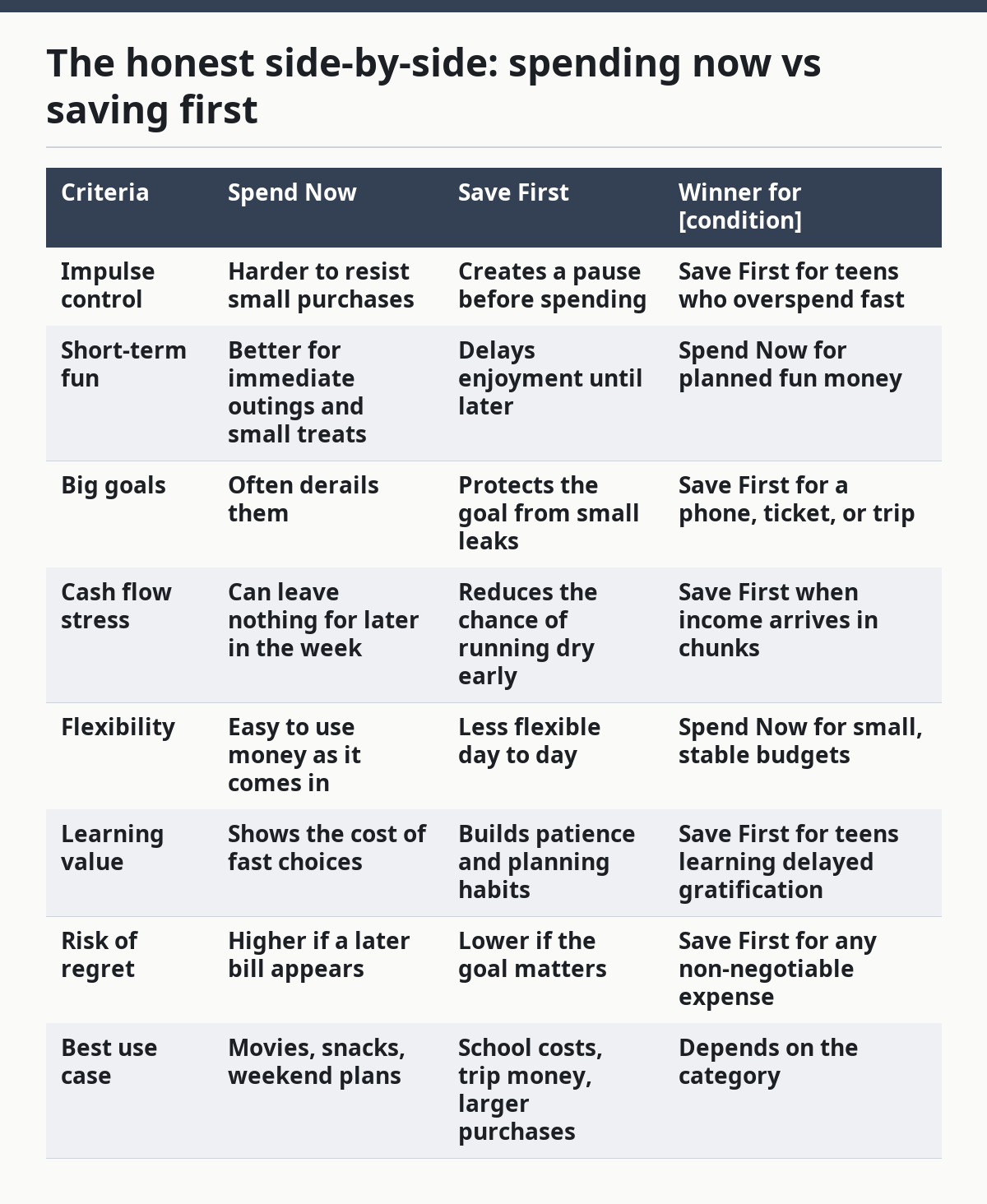
The real answer is not “never spend” or “always save.” It is category by category. A teen who saves every dollar becomes frustrated. A teen who spends every dollar becomes broke.
Which system is right for a teen with irregular income?
A bucket system is usually better than a strict monthly budget when income changes from week to week. It handles uneven pay, gifts, and odd jobs better than a rigid plan that expects the same amount every month.
Picture this: one week brings $30 from babysitting and the next week brings nothing. A rigid monthly budget can panic the teen into guessing. A bucket system simply sends each dollar to a purpose as it arrives.
The buckets can be basic:
- Spend bucket for weekly fun money
- Save bucket for goals and emergencies
- Need bucket for required costs
- Hold bucket for money not yet assigned
This structure gives teen cash flow some breathing room. Money that arrives early does not have to disappear early. Money that arrives late does not have to cause panic.
A strict monthly budget can still work if the teen has steady income. A part-time job with regular hours is easier to plan than a mix of chores, gigs, and gifts. But when income swings around, a bucket setup is less fragile.
The weakness of the bucket method is that it still needs discipline. If every bucket gets raided for random spending, the system collapses. That is why a weekly review is part of the plan, not an optional extra.
Exception scenarios: when the usual advice flips
The standard advice flips in a few cases. That does not mean the budget is wrong. It means the teen’s life has special rules that need to be written down.
Picture this: a teen is saving for a school trip due in six weeks, or pays for a phone line each month, or works only during the summer. Those situations change the order of priorities.
Here are the main exceptions:
- A fixed school deadline comes first. If a payment is due on a specific date, that money should be set aside before anything fun.
- Income is very uneven. A teen with seasonal work should use a bucket system, not a strict monthly number.
- The teen is paying shared costs. If rides, meals, or subscriptions are split with friends, the budget needs a category for group spending.
- The teen is carrying debt or owes money back. Repayment should be listed before new discretionary spending.
The catch is that exceptions are not excuses. They are just different rules. A teen who knows the deadline, amount, and purpose can plan better than one who keeps guessing.
How to build habits that last longer than a phone app
A good money habit is one the teen can repeat during a busy week. That means short steps, visible totals, and one regular check-in. A fancy app with too many tabs often dies after a month.
Picture this: school gets busy, sports practice runs late, and the teen forgets to log spending for three days. The system should survive that. If it cannot survive a normal week, it is too complicated.
Three habits do the heavy lifting:
- Check the balance before spending
- Log purchases the same day
- Review the week on one fixed day
Those habits sound small because they are. That is the point. Teen budgeting is not a one-time project. It is a repeated pattern. The more automatic the steps are, the less mental energy they take.
A teen can also use simple guardrails. For example, keep one card for needs and one for fun money. Or keep a cash envelope for weekly spending. Or set a rule that any purchase above a certain amount gets a one-day pause. The exact rule matters less than the fact that it exists.
The best money habit is the one the teen will keep doing when friends text, plans change, and the week gets messy. That is the real test.
What a teen should do this week
A teen should start by tracking money for seven days, then sort spending into needs, wants, and goals. That single week creates enough data to make the next month clearer.
Picture this: you do not need a perfect plan on day one. You need a starting point. One week of real numbers is enough to show where the money leaks out.
Use this simple sequence:
- Write down every dollar in and out for one week.
- Mark each expense as need, want, or goal.
- Find the three largest spending spots.
- Choose one spot to cut next week.
- Put a small amount aside before spending anything else.
That is enough to begin. Not perfect. Enough.
If the teen has a parent or guardian involved, the next step is a short conversation about what is covered, what the teen covers, and what happens when money runs short. That conversation prevents a lot of confusion later.
FAQ
How much money should a teen save?
A teen should save a portion of money that is meant for later use, but the right amount depends on goals, income, and family rules. There is no single number that fits every country or household. A qualified adviser can help if the teen is saving for a larger goal or handling part-time income.
Is cash better than a debit card for teens?
Cash is easier to see and can make spending feel more real, which helps some teens slow down. A debit card is easier for online purchases and everyday use, but the spending can disappear into quick taps. Many teens do best with one main method and a simple weekly review.
What if a teen keeps overspending?
A teen who keeps overspending usually needs a tighter system, not a harsher lecture. The fix is often a smaller spending limit, fewer payment methods, and a weekly check-in. If the overspending is tied to debt, shared costs, or a family money issue, the right fix can change, so professional advice may help.
Should parents control every purchase?
No. Parents usually help more by setting boundaries and reviewing the bigger picture than by approving every snack or game item. Total control can make teens hide spending, while no structure can leave them guessing. The middle ground is clear limits with regular check-ins.
What is the simplest budget for a teen to start with?
The simplest budget is a three-part plan: spend, save, and needs. A teen writes down what comes in, marks what must go out, and keeps the rest in one or two clear buckets. Simple works better than detailed if the teen will actually keep using it.
Drafted with AI; not yet reviewed by a person.