Last updated: November 20, 2026
Quick answer: teens budgeting for driving costs should plan for the license, insurance, gas, registration fees, and maintenance, not just the car itself. This guide explains How Teens Can Budget for a Car, Driver’s License, and Driving Costs and shows what belongs in the budget without guessing.
Key takeaways
- A teen driving budget should cover one-time costs, like a driver’s license, and ongoing costs, like gas and insurance.
- The first step is to list every driving expense in one place, then separate startup costs from monthly costs.
- A license and car are not the same goal. They create different bills, and each needs its own line.
- Insurance often changes the math the most, so it should be checked before any car decision.
- This is information, not financial advice. For your own situation, consult a qualified adviser or local licensing office, since rates, rules, and coverage details differ by country and change often.
What a teen driving budget needs to cover
A teen driving budget needs to cover the full cost path: getting licensed, getting on the road, and staying on the road. That means driver’s license costs, car insurance, gas, maintenance, registration fees, and small driving-related expenses like parking or tolls where they apply. For local rules and fees, check your licensing authority or a qualified adviser.
Picture this: you’re excited about driving, but every step has a bill attached. The license office wants fees. The car needs fuel. The insurer wants payment before you drive. That is the budget problem, and it is solvable.
A generic “save for a car” plan misses the point. Driving has two layers of cost: the upfront layer and the ongoing layer. The upfront layer might include a permit or road test fee, a learner’s permit, a license card, and any required class or test costs where you live. The ongoing layer is the part that catches people off guard.
- Upfront costs: permit, test, license card, title or registration if a car is already in the picture.
- Monthly costs: insurance, gas, parking, tolls, and routine maintenance.
- Irregular costs: tire replacement, oil changes, inspection fees, and registration renewals.
The truth is, a teen who plans only for the car price is planning for the wrong number. The car is one line. The driving life is the rest.
How do you build a driving costs budget step by step?
You build a driving costs budget by listing every cost, separating one-time from ongoing expenses, and assigning each bill a place in your monthly plan. Start with the costs you know, then fill in the ones that change by location, age, and vehicle.
Picture this: you’re sitting with a notebook or a budgeting app, and you need a clean list before you spend a dollar. That list is the whole job. Without it, the car price swallows the rest of the plan.
-
Write down the license path first. Include the permit fee, road test fee, license card fee, and any class or study material cost you know you need. Verify: every required step from learner’s permit to license is listed. Problem sign: only the final license fee is on the page, which usually means a hidden cost will show up later. For your area’s exact steps, check the licensing authority or a qualified adviser.
-
List the car costs separately from the driving costs. If you are trying to budget for a car too, keep the vehicle price, taxes, title fees, and registration fees on a different line from the day-to-day driving costs. Verify: the car and the road are not mixed together. Problem sign: you can “afford the car” but not the insurance or fuel.
-
Get the insurance number before choosing the car. For a teen driver, insurance can change a lot based on the car, the driver, and the coverage. Call, quote, or compare the policy cost for the exact car type before you commit. Verify: you know the monthly or term cost, not a guess. Problem sign: you are using a “probably around” number instead of a real quote.
-
Estimate gas by your real driving pattern. Look at school trips, work shifts, sports, and weekend driving. Then estimate how often you’ll fill up and what a normal month looks like. Verify: the estimate matches actual miles, not wishful thinking. Problem sign: the budget assumes hardly any driving.
-
Set aside money for maintenance from day one. Maintenance means the regular care that keeps a car usable: oil changes, tires, brakes, fluids, and inspection items where required. Verify: you have a line for both routine and surprise repairs. Problem sign: the budget treats maintenance as “later.” For local schedules, consult a mechanic or adviser.
-
Add registration fees and renewal dates. Registration fees are not a one-time detail in many places; they can come back yearly or on another schedule. Verify: you know when the bill arrives. Problem sign: the renewal date is unknown, so the car sits uninsured or unregistered. Check the date with your local DMV or equivalent office.
-
Include small driving expenses. Parking, tolls, car washes, replacement wipers, or a phone mount can matter. Verify: the list covers the way you actually drive. Problem sign: the budget has no room for ordinary extras.
-
Split the total into startup money and monthly money. Startup money covers the first bills. Monthly money covers the recurring ones. Verify: you can name what must be paid before the first drive and what repeats every month. Problem sign: one pile of savings gets spent too fast.
If the total looks impossible, the budget is doing its job. It is telling you where the pressure is.
What driving costs should teens plan for?
Teens should plan for license fees, insurance, gas, maintenance, registration fees, and a small buffer for driving-related expenses. That list is the core of a teen driving budget, and it is usually bigger than people expect.
Picture this: you have the keys in hand, but the real question is not “Can I drive?” It’s “Can I keep driving next month?” That second question is where a lot of people get stuck.
The main categories are simple, but the details are not.
| Cost category | What it usually covers | Why it matters |
|---|---|---|
| Driver’s license | Permit, test, license card, required class or materials | You cannot skip the paperwork costs |
| Car insurance | Premiums, coverage choices, added driver cost | Often the biggest monthly expense for a teen |
| Gas | Fuel for school, work, and errands | Changes with mileage and fuel price |
| Maintenance | Oil changes, tires, brakes, fluids, inspections | Prevents bigger repair bills later |
| Registration fees | Plate and registration costs, renewals | Can arrive yearly or on another schedule |
| Driving extras | Parking, tolls, car wash, minor supplies | Easy to forget, easy to underbudget |
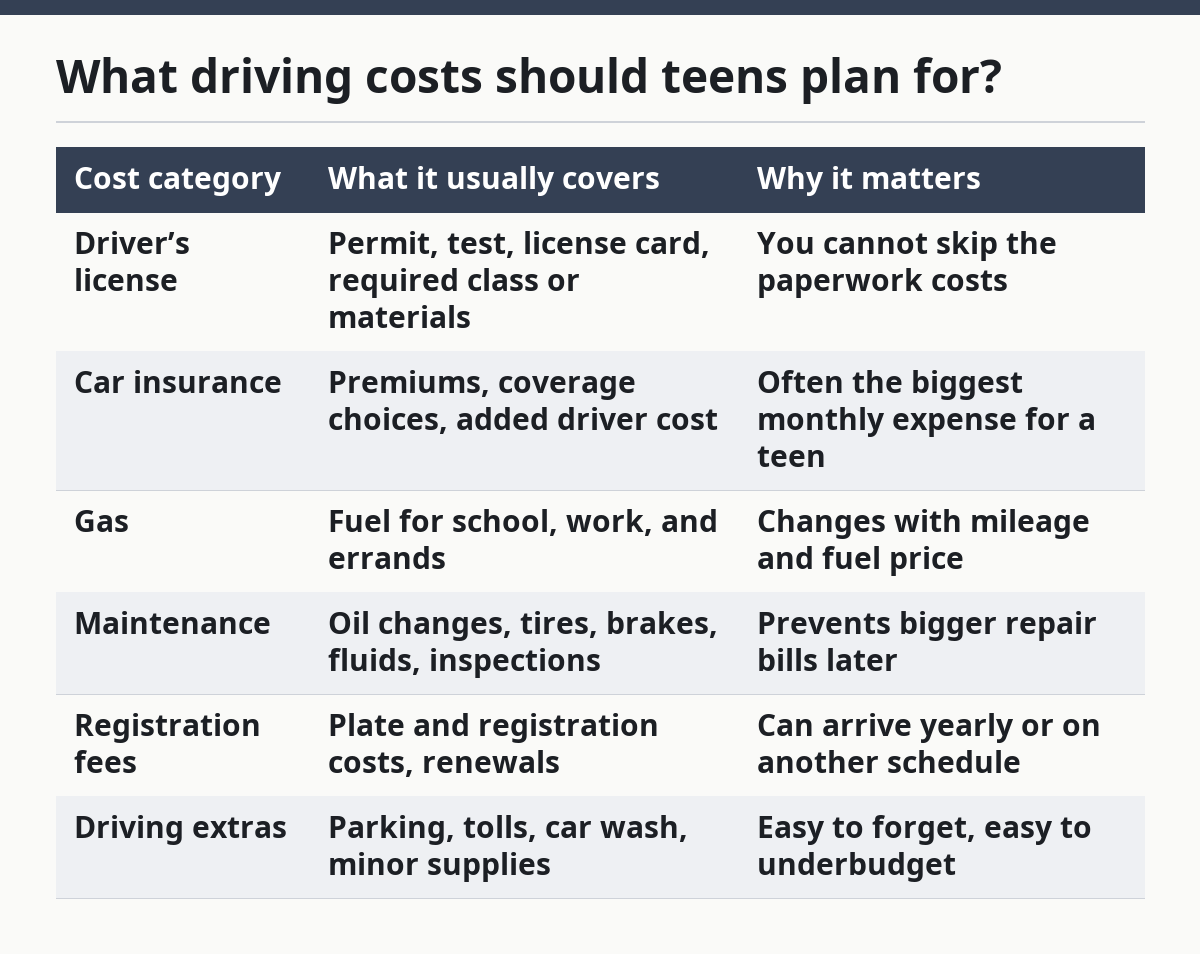
Gas and maintenance are not “extra.” They are part of the cost of having a car that runs. Insurance is not optional in many places, but the rules, minimums, and pricing differ by country and even by region.
For reliable background, I’d point a reader to the Insurance Information Institute’s auto insurance basics and the U.S. Department of Transportation’s teen driving safety resources; both are worth a look when you need the language around coverage and safe driving. Those pages won’t set your personal budget, but they help you understand the moving parts.
How do you save for a first car and license?
You save for a first car and license by dividing the goal into separate buckets and timing the spending. The license comes first for most teens, then the ongoing driving costs, then the car itself if that is still the plan.
Picture this: you’re tempted to treat all driving costs like one big pile. That usually ends with the license paid for and the insurance still missing. Different bills need different buckets.
A useful way to think about it:
- Bucket 1: License costs. Permit, test, card, and class fees go here.
- Bucket 2: Start-up driving costs. First insurance payment, registration, and any inspection fee.
- Bucket 3: Ongoing driving costs. Gas, maintenance, and renewals.
- Bucket 4: Car costs. Only if you are also saving for the vehicle itself.
The order matters. A teen can have a car sitting in the driveway and still not be ready to drive it legally or affordably. That is why the license and the car should not be mashed into one goal.
If money comes in unevenly from chores, birthdays, or part-time work, the fix is not to guess. The fix is to assign a percentage or dollar amount from each payment to the driving budget before the rest gets spent. That keeps the goal from disappearing into weekend spending.
Here’s the catch: if a parent is covering some costs and the teen is covering others, write that split down. A budget with hidden helpers is not a real budget. It is a hope.
What happens if you skip one of these costs?
Skipping one cost can mean the budget breaks at the worst time: right before a test, right before pickup, or right after the car is bought. The most common failure is forgetting that one-time costs and ongoing costs are different.
Picture this: you saved enough for the car or the license, but not both. The bill arrives anyway, and the whole plan gets delayed. That is not bad luck. It is a missing category.
- No insurance line: you may be able to buy or receive a car, but you still may not be able to drive it legally or affordably.
- No maintenance line: the car starts eating the savings later, when oil changes or tires come due.
- No registration line: the paperwork cost shows up after the excitement, not before it.
- No gas line: the car exists, but it cannot reliably get you to school or work.
- No license fee line: you save for the car and still can’t complete the process.
The better move is boring but effective: list the cost, write down when it happens, and decide where the money will come from. For annual bills, check the renewal schedule with your local office or adviser. For monthly bills, treat them like rent for the road.
That simple split stops a lot of stress.
When does the standard plan stop working?
The standard plan stops working when the teen’s driving life is unusual enough that the usual categories no longer fit. In those cases, the budget still works, but it needs a different shape.
Picture this: your situation does not look like the average after-school driver. Maybe you drive long distances, maybe a family member shares the car, or maybe you live where insurance or registration works on a different schedule. That changes the math.
Long commute to school or work: Gas will rise fast — use a mileage-based estimate instead of a rough guess, and track one month before setting the budget.
High insurance quote on the chosen car: The car may not be affordable even if the purchase price looks fine — compare the quote with a different car class before you commit.
Shared family car: Fuel and maintenance may need to be split — write the split down so the teen portion does not vanish into “someone else will handle it.”
License rules in your area require classes or extra testing: The license stage may cost more than expected — include the class fee and retest fee, if there is one.
Irregular income from part-time work: Monthly budgeting gets harder — set aside driving money as soon as you are paid, before non-driving spending happens.
This is where a generic “save more” answer fails. The fix is not more optimism. It is a better category list.
If the costs are getting confusing, go back to the basics: one-time, monthly, and irregular. That three-part split handles most teen driving plans.
The mistakes teens make with driving budgets
Teens usually make the same few mistakes with driving budgets, and each one has a cost. The budget is fine; the missing detail is the problem.
Picture this: you feel close to the goal, then one more bill lands and the plan bends. That bill was probably not random. It was probably left out.
-
Planning only for the car price. The result is a car that comes with bills you never funded. Correct move: budget for insurance, gas, and maintenance before you buy or accept the car.
-
Using a made-up insurance estimate. The result is a budget that looks balanced on paper and fails in real life. Correct move: get a real quote for the exact driver and car when possible.
-
Forgetting registration and license fees. The result is a “finished” plan that still has paperwork costs waiting. Correct move: add every required office fee to the startup list.
-
Ignoring maintenance until something breaks. The result is a larger repair bill later. Correct move: set aside money for routine service and basic wear items.
-
Not separating startup and monthly costs. The result is savings that disappear too early. Correct move: keep one bucket for getting started and another for staying on the road.
-
Leaving no room for small extras. The result is a budget that feels tight every week. Correct move: add a small line for parking, tolls, and other driving-related expenses.
A good teen driving budget is not fancy. It is honest. It tells the truth about the road, not just the car.
How much detail should a good driving budget have?
A good driving budget has enough detail to show what happens before the first drive and during the next 12 months. It should name each bill, the timing of each bill, and who is paying it.
Picture this: you can explain the budget in under a minute, but it still covers the full path. That is the right level of detail for most teen drivers.
At minimum, the budget should show:
- the license path and its fees
- the insurance cost and who pays it
- gas based on real driving habits
- maintenance set-asides
- registration fees and renewal timing
- small extras that come with driving
If a budget has those six parts, it is useful. If it has only “car money,” it is incomplete.
Drafted with AI; not yet reviewed by a person.