Last updated: November 20, 2026
How Teens Can Follow Up After a Job Application works best when it is short, polite, and timed 7 to 10 days after you apply.
A brief email usually beats repeated calls.
The steps below show what to say, when to send it, and how to sound mature without sounding needy.
Key Takeaways
- Wait a little before you reach out. A same-day message feels impatient.
- Send one clear email first if the employer listed an email address.
- Keep the note to the point: who you are, where you applied, and that you’re checking status.
- A phone call makes sense when the posting says to call, or when the business is small and a call is normal there.
- Don’t ask “Did I get it?” right away. Ask for an update or next step.
- If you don’t hear back after one follow-up, leave it alone and keep applying elsewhere.
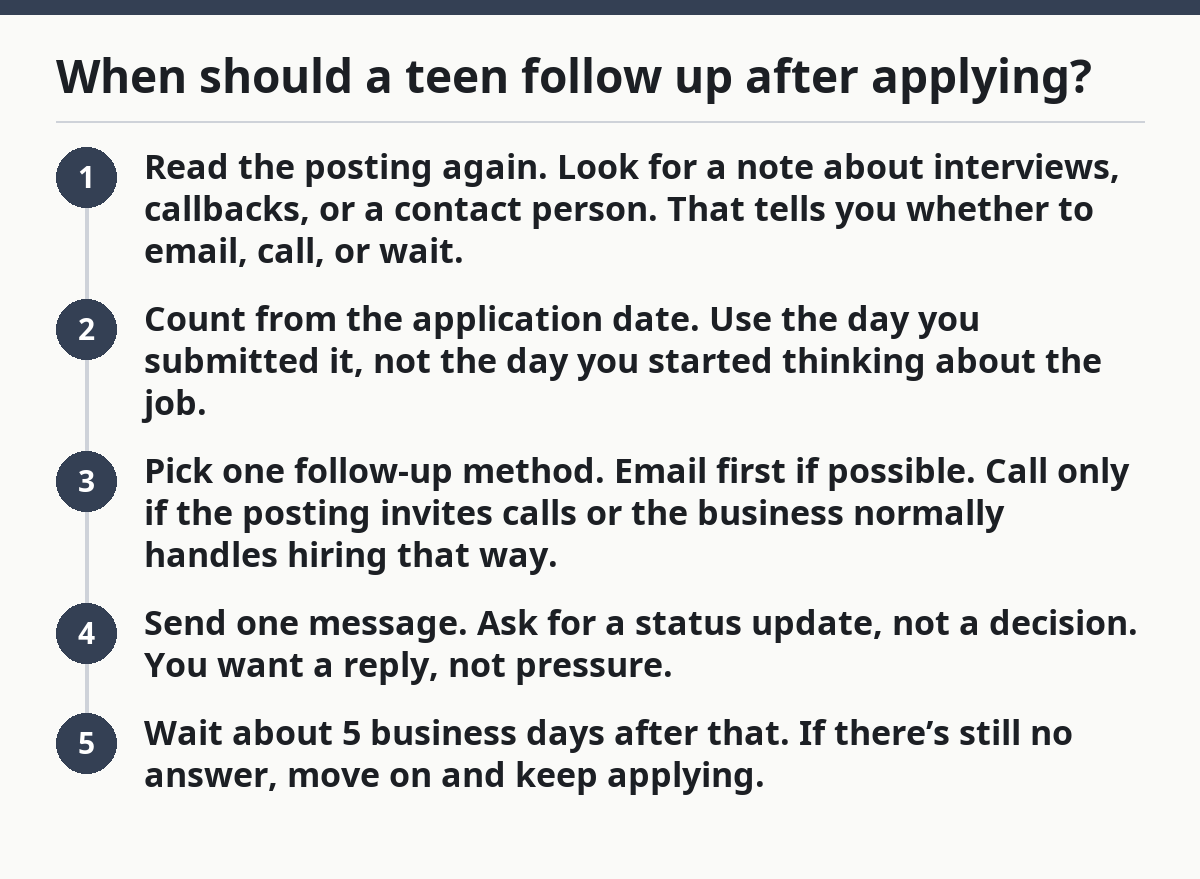
When should a teen follow up after applying?
You should usually follow up 7 to 10 days after the application goes in. If the job post gives a different timeline, use that instead. If the business says “no calls,” respect that and use email only, or wait for their process to play out.
Picture this: you applied on a Monday, and by the next morning you want to know where things stand. That urge is normal. The better move is to give the employer time to sort applications, read schedules, and check availability before you reach out.
Here’s the catch: some places move fast, and some move slowly. A local café might call within 2 days. A store hiring for weekend shifts might take 2 weeks. Your follow-up should match the pace of the workplace, not your nerves.
- Read the posting again. Look for a note about interviews, callbacks, or a contact person. That tells you whether to email, call, or wait.
- Count from the application date. Use the day you submitted it, not the day you started thinking about the job.
- Pick one follow-up method. Email first if possible. Call only if the posting invites calls or the business normally handles hiring that way.
- Send one message. Ask for a status update, not a decision. You want a reply, not pressure.
- Wait about 5 business days after that. If there’s still no answer, move on and keep applying.
A calm follow-up can make you look more organized, not less. That’s especially true for teen jobs where reliability matters as much as experience.
What should a teen say in a follow-up email?
A teen should say their name, the job title, when they applied, and a short question about next steps. Keep it under 100 words if you can. Short notes are easier to read on a phone, and hiring managers often skim email fast.
Picture this: you’re staring at a blank screen, trying not to sound annoying. You do not need a big speech. You need a clean message that gives the employer enough details to find your application in 30 seconds or less.
A good email has four pieces:
- Your full name
- The job title or shift you applied for
- The date you applied
- A polite request for an update
A strong subject line helps too. Try one of these:
- Follow-up on my application for cashier
- Teen job application follow-up — [Your Name]
- Checking in on my application for weekend stock help
Use this basic structure:
- Open with a greeting to the hiring manager or store manager if you know the name.
- Say you applied for the job and list the date.
- Ask if there’s any update on the hiring process.
- Thank them for their time and end with your phone number.
Example:
“Hello Ms. Lee, I applied for the cashier position on Tuesday, and I wanted to check in on the status of my application. I’m still very interested and would be glad to interview if there’s a next step. Thank you for your time, and you can reach me at [phone number].”
Don’t write a long story about school, sports, or why you need the money. That can wait for the interview. Right now, the goal is simple: remind the employer you’re still interested and easy to contact.
How do you follow up on a job application without sounding pushy?
You follow up without sounding pushy by making one contact, using a calm tone, and asking for information instead of demanding a decision. The tone should feel like a note from a responsible person, not a nudge from someone chasing an answer.
Picture this: you’ve checked your email three times in an hour, and the silence feels personal. It usually isn’t. Most hiring managers are juggling schedules, school-year rushes, and other applicants. A polite follow-up respects that reality.
Use these rules:
- One message at a time. Don’t email and call on the same day unless the employer asked for both.
- Use plain language. “I wanted to follow up on my application” works better than “I’m circling back.”
- Ask a small question. “Is there an update on hiring?” is easier to answer than “Can you tell me if I got the job?”
- End with thanks. Gratitude softens the message and keeps the tone professional.
Here’s what sounds pushy:
- “I haven’t heard back yet, and I really need to know.”
- “Can you tell me today?”
- “Just checking again because I’m waiting.”
Here’s what sounds mature:
- “I’m following up to see whether there’s any update.”
- “I’m still interested in the role.”
- “Thank you for your time and consideration.”
Silence after an application is normal, so the follow-up needs to be light. Your message should open a door, not lean on it.
If you already followed up once and got no answer, stop there. A second push within a few days can make a teen look impatient, especially with small businesses where the person reading email is also managing the floor, the schedule, or the cash register.
Should teens call or email after applying?
Teens should usually email first, and call only when the posting says to call or the workplace clearly uses phone hiring. Email leaves a record, gives the hiring manager time to answer, and feels less disruptive during a busy shift.
Picture this: you’re standing outside a shop, phone in hand, wondering if a call will help or hurt. The answer depends on the business. A restaurant with a hiring note that says “please call after 3 p.m.” is different from a corporate store that collects online applications only.
A call works best when:
- The job ad asks for it
- The manager already gave you a number
- The business is small and local
- You need to confirm that your application was received
A call is a worse choice when:
- The posting says “no calls”
- The employer uses an online portal
- You would have to call during lunch rush or a class period
- You get nervous and forget your point halfway through
If you call, write a tiny script first:
“Hi, my name is [Name]. I applied for the [job title] on [date], and I’m calling to check whether the application was received and if there’s an update.”
Then stop talking. Let the manager answer. If they are busy, ask for a better time to call back. A 20-second voicemail is better than a ramble that runs long.
Email still wins most of the time because it is less interruptive and easier to reread. Phone calls can work, but only when the setting fits. A teen who sounds calm in email often seems more prepared than a teen who calls too early and catches someone at the wrong time.
What if the employer never responds?
If the employer never responds after one polite follow-up, move on and keep applying. No reply usually means they’re busy, chose someone else, or never finished the hiring process.
Picture this: you sent the email, waited the right amount of time, and still nothing. That can feel rude. Sometimes it is. More often, it means the place is disorganized, short-staffed, or slow to hire. None of that is about your worth.
The clean way to handle silence:
- Send one follow-up after 7 to 10 days
- Wait another 5 business days
- If there’s still no reply, stop chasing that opening
- Keep your list of applications moving
Do not keep sending “just checking in” messages every few days. That can make a manager avoid your name instead of remembering it. One follow-up says “I’m interested.” Five follow-ups can say “I don’t take hints.”
There’s one more reason to move on: a silent employer is a weak sign of how they handle schedules, training, or communication. A teen needs a first job that teaches good habits, not one that starts with confusion.
The smart move is to keep a simple list:
- Job title
- Date applied
- Follow-up date
- Response, if any
That lets you stay organized without guessing. It also helps you avoid contacting the same employer twice by accident.
If you want a broader view of teen work, the guide to Teen Jobs and Earnings — The Complete Guide can help connect this step to the bigger picture without repeating the same advice.
How can a teen sound professional in a message?
A teen sounds professional by using correct names, full sentences, and a normal greeting. You do not need fancy words. You need clean writing, a respectful tone, and no slang.
Picture this: you’re writing from a phone between classes, and autocorrect keeps fighting you. Slow down for 2 minutes and proofread. A sloppy message can make a good applicant seem careless, even when the actual work ethic is strong.
Use these habits:
- Address the hiring manager by name if you know it
- Use “Hello” or “Dear” instead of “Hey”
- Spell the business name correctly
- Use complete sentences
- End with your full name and a phone number
Avoid these mistakes:
- “Yo, did u see my application?”
- “Any update?”
- “I applied a while ago and haven’t heard anything.”
- Emoji, all caps, or too many exclamation marks
Professional does not mean stiff. It means easy to read. A short, clear note can still sound human:
“Hello Mr. Patel, I applied for the weekend cashier position last Thursday and wanted to check whether there’s any update. I’m still very interested. Thank you for your time.”
That message works because it is specific, polite, and short enough to read in one glance. It also gives the employer the exact details needed to find the application without digging through a pile of emails.
The truth is, teen applicants are often judged on tone as much as on experience. A clean follow-up can show that you show up on time, pay attention, and know how to communicate. That matters in jobs where you’ll work with customers, a manager, and a schedule all at once.
FAQ
When should a teen follow up after applying?
A teen should usually follow up 7 to 10 days after applying unless the job post gives a different timeline. If the employer says not to call or email, follow that instruction. If the business is very small and hiring fast, a shorter wait can make sense, but one polite message is enough.
Should teens call or email after applying?
Teens should usually email first because it is less disruptive and creates a written record. Call only if the job posting asks for a call, a manager gave you a phone number, or the workplace clearly expects phone contact. If you do call, keep it brief and polite.
What do you say in a job follow-up message?
A teen should say who they are, what job they applied for, when they applied, and that they wanted to check on the status. The message should be short, polite, and specific. A simple request for an update works better than asking if you got the job.
Drafted with AI; not yet reviewed by a person.