Last updated: November 19, 2026
Quick answer: the best teen banking and spending accounts are usually teen checking or controlled spending accounts with a debit card, parent alerts, spending limits, and no surprise overdraft fees. For the 2025 family that wants real-world practice with money, the right setup depends on age, supervision, and the account’s fee rules. In this Teen Banking and Spending Accounts: The Complete Guide, the goal is to match the product to the teen’s maturity and the parent’s tolerance for mistakes.
Teen banking works best when the parent wants guardrails and the teen needs real-world practice with money. The right setup is usually a teen checking or spending account with a debit card, parent alerts, spending limits, and no surprise overdraft fees. A pure prepaid card is safer in some cases, but it gives less room to learn.
I write on consumer banking and personal finance products, with a focus on how account features, fee structures, and family controls actually change day-to-day use.
What problem a teen money setup is supposed to solve
Teen banking is meant to do three things at once: let a young person spend independently, let a parent keep watch, and avoid the fee traps that punish small balances. That sounds simple until the wrong product creates the very problems it was supposed to prevent.
A solid teen money setup usually includes a debit card, mobile app access, parent notifications, transfer controls, and the ability to lock or replace the card quickly. Many teen-focused products are built on a custodial or joint structure, while others are linked to a parent’s main account. The details matter. A teen who gets paid for babysitting or part-time work needs different features than a middle-schooler who only needs lunch money and gas-card style spending limits.
The key choice is not “bank or no bank.” It is how much independence the teen should have, and how much risk the parent is willing to accept. A 16-year-old with a job may need ACH transfers, direct deposit, and cash withdrawal access. A 12-year-old may do better with strict category controls and no ability to overdraw. That distinction is where generic advice usually falls apart.
The best setup is the one that matches the teen’s maturity, spending habits, and the parent’s tolerance for mistakes. If the goal is to teach budgeting, the product should expose the teen to real balances and transactions. If the goal is containment, it should behave more like a controlled wallet with hard limits.
For rules on youth financial accounts and consumer protections, the Consumer Financial Protection Bureau’s youth financial education materials and account guidance are worth reading, along with the Federal Deposit Insurance Corporation’s consumer banking resources. The CFPB’s prepaid card rules are also useful because many families compare a teen banking account with a card that works more like stored value than a bank account.
Is a teen checking account or a prepaid card better?

A teen checking account is better for most families because it teaches real banking behavior; a prepaid card wins only when the main goal is tight spending control with the fewest moving parts. The difference is not academic. It changes how money enters the account, what fees can happen, and how much the teen can learn from the experience.
A teen checking-style product usually behaves like a standard deposit account with extra controls. The teen can often swipe a debit card, view balances in an app, and sometimes receive direct deposit. That makes it useful for paychecks, allowances, and routine spending. It can also introduce the teen to concepts they will meet later anyway: pending transactions, holds, refunds, and card replacement.
A prepaid card is more limited. Money has to be loaded first, and spending stops when the stored balance is gone. That is a strength when the parent wants a hard ceiling. It is also a weakness, because prepaid products often have more friction around loading cash, moving money in and out, and handling merchant disputes. Some cards still carry activation, monthly, reload, or inactivity fees depending on the issuer and program terms, so “prepaid” does not automatically mean cheaper.
Here is the practical split: if the teen is old enough to earn money, make online purchases, and learn from a real transaction history, the checking-style option usually wins. If the teen is younger, loses cards often, or needs a fixed allowance with no chance of overdraft-style mistakes, prepaid can be the cleaner choice.
The main downside of teen checking is control creep. Some products allow purchases, ATM use, peer-to-peer transfers, or cash withdrawals unless the parent disables them. That flexibility is useful, but it also means the parent must actually review the settings and not assume the default is safe.
How teen banking and spending accounts usually work
Teen banking usually works through either a teen checking account, a parent-linked spending account, or a custodial account with built-in card controls. The right structure depends on age, legal ownership, and how much independence the parent wants to give.
A teen checking setup is often a real deposit account with a debit card and mobile access. The parent may be a joint owner, a co-signer, or the controlling adult on a linked family platform. The teen can often see balances, receive alerts, and spend where debit cards are accepted. This is the closest thing to a “real” bank experience, and that is why it is useful.
A spending account is usually narrower. It may sit inside a fintech platform rather than a traditional bank charter, or it may be a sub-account under a parent’s main relationship. In many cases, the parent can move money in instantly from a linked funding source, then set card limits or turn the card off. That is helpful for younger teens, but it can also mean the product is less suitable for check deposits, cash deposits, or long-term savings.
Custodial accounts add another layer. The adult typically retains legal control, which can be good for supervision but less ideal if the teen needs privacy or wants to practice more independent money management. Once the teen reaches the age of majority, the account structure may need to change, and that transition is where many families get caught off guard.
The right question is not “Can the teen spend?” It is “Can the teen spend, save, and learn at the level that matches their age without exposing the family to avoidable fees or loss of control?” That is the real design test.
Teen checking vs spending card: the honest side-by-side

Teen checking wins for families that want a true banking education. A controlled spending card wins for parents who care more about limit-setting than full banking function.
| Criteria | Teen checking account | Parent-controlled spending account | Winner for this condition |
|---|---|---|---|
| Daily spending flexibility | Works at merchants, online, and sometimes ATM networks | Often card-based with tighter controls | Teen checking for older teens |
| Overdraft risk | Can exist unless overdraft is disabled or unavailable | Usually lower because spending stops at the loaded balance | Spending account for younger teens |
| Direct deposit | Often supported, which helps with jobs | Sometimes supported, but not always | Teen checking for working teens |
| Parent visibility | Alerts and app access are common, but depth varies | Usually strong dashboard controls and notifications | Spending account for supervision |
| Cash access | Often available through ATM access or cash deposits depending on provider | Often limited or unavailable | Teen checking for cash-heavy use |
| Merchant disputes and refunds | Usually closer to standard debit-card processes | Varies by program and network | Teen checking for broader use |
| Learning value | Better for teaching budgeting, reconciliation, and banking habits | Better for teaching limits and impulse control | Teen checking for education |
| Simplicity for parents | More features mean more settings to manage | Usually easier to configure | Spending account for simplicity |
| Age fit | Better for mid- to older teens | Better for younger teens | Spending account for younger children/teens |
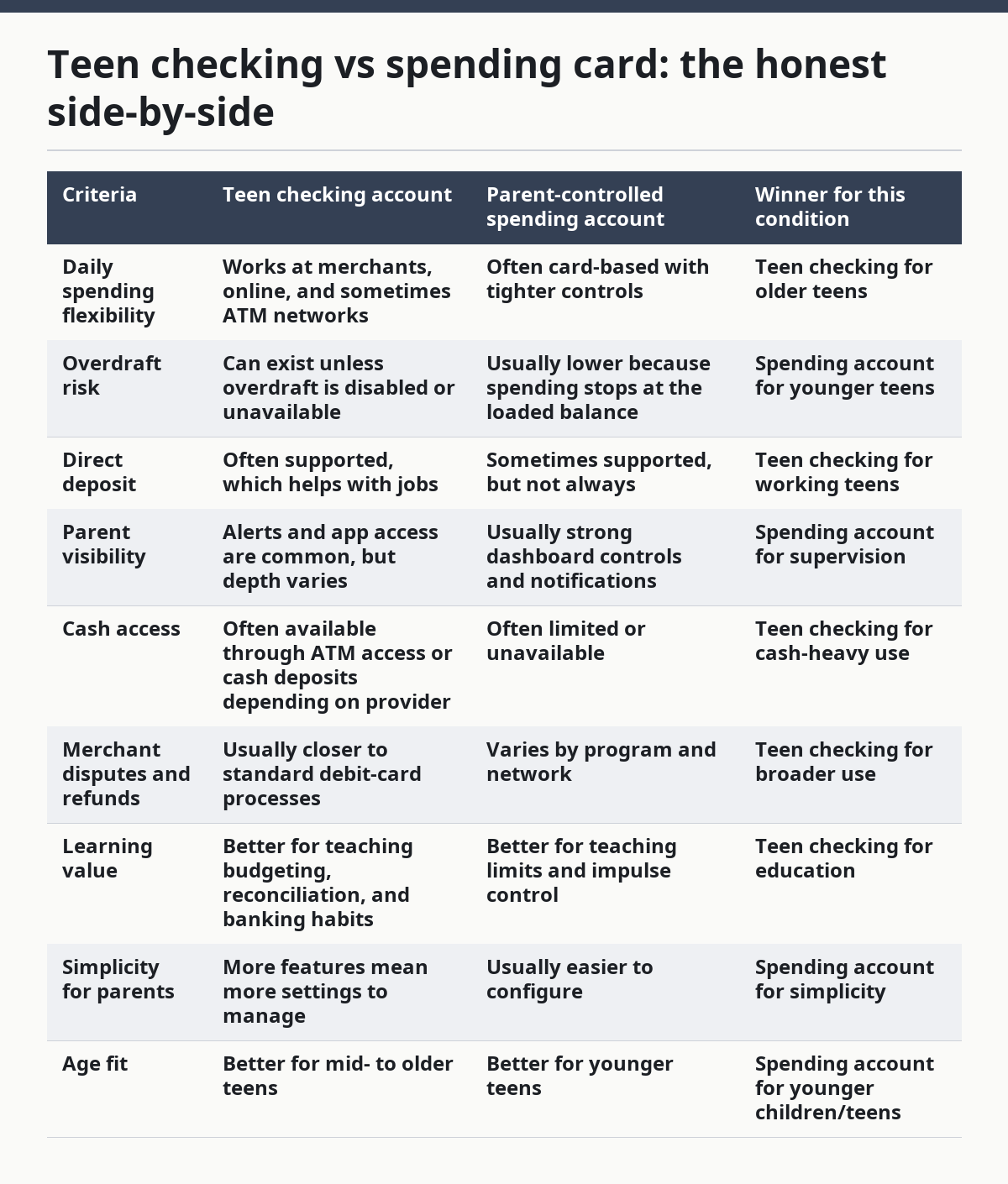
The table hides the biggest trade-off: the more the account looks like a real bank product, the more responsibility it gives the teen. That is a feature, not a bug, if the teen can handle it. It is a mistake if the parent mainly wants a locked-down allowance tool.
One more point matters here: standard bank protections and product disclosures differ from fintech program terms. A prepaid or app-based spending product may rely on a partner bank, and the limits, holds, and fees live in the program agreement. The Consumer Financial Protection Bureau’s prepaid card guidance is useful here, because many families assume every card works like a debit card from a branch bank. It does not.
Which teen banking setup fits a young beginner?
A tightly controlled spending account is the better fit for a young beginner because it reduces the number of ways money can go wrong. For a child who is just learning to track an allowance, the goal is not full banking sophistication; the goal is visible, low-risk practice.
A younger teen often does better with three features: a fixed loading method, instant parent alerts, and a simple rule that spending cannot exceed the balance. That makes each purchase visible and each mistake small. If the child tries to spend more than is available, the system should reject the transaction instead of creating an overdraft, a negative balance, or a pile of fees.
That said, this setup has limits. A spending account is not ideal if the child needs to deposit cash from birthday gifts, cash a check from a school job, or learn how direct deposit works. It also can become annoying if the parent needs to micromanage every transfer. The more constraints you add, the more you turn the product into a digital allowance tool rather than a true financial account.
The best match is a family that wants structure first and financial independence later. This is common for middle-school age users, or for teens who have not yet shown they can keep track of a card. If the child is losing cards, spending impulsively, or not ready to understand holds and pending transactions, a constrained product is the safer call.
The weak spot is that the child may outgrow it quickly. That is why I would not choose a narrow spending tool as the long-term answer for a teen who has a job, a recurring paycheck, or the maturity to manage a real balance.
Which teen checking setup fits an older teen?
A teen checking account is the better fit for an older teen because it mirrors the money systems they will use as an adult. A 15-, 16-, or 17-year-old who earns money, pays for rides, buys school supplies, or shops online needs more than a locked wallet.
The best reasons to choose teen checking are practical. Direct deposit matters if the teen has a part-time job or freelance income. ATM access matters if they need cash for games, transportation, or school events. Debit-card dispute procedures matter if an online order never arrives or a merchant charges incorrectly. A real checking relationship can also make it easier to move from parental oversight to self-management over time.
The drawback is that a true checking setup can create false confidence. If the teen can spend, transfer, and withdraw funds, the account can also be emptied quickly. Some products avoid overdrafts, but others still have ways to generate fees or lock the card after suspicious activity. Parents also need to monitor whether peer-to-peer transfers are enabled. A teen who can send money instantly to the wrong person is not getting a learning experience; they are getting a lesson in regret.
This option fits the teen who is ready to read transaction history, wait for pending charges to clear, and keep track of account balances without constant reminders. It is not the right choice for a teen who still treats money like a pile of interchangeable taps on a phone; if that describes your child, it may be worth checking with a financial professional or the account issuer about whether a more controlled setup is safer.
The right expectation is simple: teen checking should feel like training wheels, not a toy. If the family can handle periodic check-ins and the teen can handle responsibility, this is the stronger long-term tool.
How much control should a parent keep?
A parent should keep enough control to prevent loss, fraud, and fee surprises, but not so much control that the teen never learns to make mistakes. That balance is the hardest part of teen money management, and it changes with age.
For younger users, full visibility is reasonable. The parent should be able to see deposits, purchases, ATM withdrawals, and transfers. Card lock and open should be easy. Spending alerts should arrive instantly, not the next day. If the product cannot do those basics, it is too weak for family use.
For older teens, too much control can backfire. If every purchase must be approved, the teen never learns how to budget on their own. A better model is threshold-based control: the parent gets notified over a certain amount, but does not approve every low-dollar purchase. That supports independence while still catching large or unusual transactions.
The practical danger is assuming one control setting fits every stage. A 13-year-old and a 17-year-old should not be managed the same way. A younger child may need merchant restrictions, a smaller card limit, and no ATM access. An older teen may need those restrictions relaxed so the account can function like real money.
This is also where parents should look closely at the product’s lock features. Some platforms let the card be frozen instantly from the app. Others require a support call. That difference matters after a lost wallet or a suspicious charge. A fast freeze feature is not a luxury; it is a core safety tool.
The honest costs, limits, and fine print to check first
The right teen money product can still be a bad fit if the fee schedule is messy or the controls are weaker than the marketing suggests. The first thing to read is the program agreement, not the ad copy.
Look for five things before opening anything: monthly fees, ATM fees, cash-loading fees, replacement card fees, and whether overdrafts are possible at all. If the product is a fintech-branded spending account, check which bank actually issues the card and whether deposit insurance coverage applies in the way the provider says it does. The FDIC’s deposit insurance resources explain why the issuing structure matters.
You should also check whether the listing actually says the teen can receive direct deposit, make person-to-person transfers, or deposit cash. Many products imply broad usefulness but quietly exclude one or more of those functions. That becomes a problem the first time a teen tries to put a paycheck in the account or use it for an after-school job.
The trade-off is simple: more features usually mean more rules. A product with broad functionality may require more parent oversight, more careful setup, and more reading of disclosures. A simpler spending card may be easier to manage but less useful once the teen starts earning money.
I would be wary of any offer that hides key terms behind a “learn more” link and does not plainly state fee triggers, card replacement timeframes, or transfer limits. If the product description needs detective work, the family will probably dislike the account later too.
Exception scenarios: when the verdict flips
The overall recommendation flips in a few real situations, and those exceptions matter more than brand claims or app screenshots. A spending account can be the better answer if the teen is under 14 and the parent mainly wants allowance control with hard limits, especially when there is no need for direct deposit or ATM access.
The verdict also flips if the teen cannot yet manage a balance without constant help. In that case, a basic, card-only setup that rejects spending above the loaded amount is better than a checking-style product that invites overdraft confusion or accidental transfers. Simpler is safer when the user is still learning.
A third exception is a teen who needs cash-based flexibility. If the teen often receives cash gifts, pays for local activities in cash, or needs regular ATM access, a teen checking-style product with deposit and withdrawal capability is usually the right tool. A narrow spending card will get in the way.
The fourth exception is a family that wants privacy to be minimal and supervision to be maximal. In that situation, a jointly controlled bank product may be better than a teen-centric fintech interface, because the parent may prefer bank statements, branch access, and traditional fraud handling.
These exceptions do not cancel the main recommendation. They just change the age, behavior, or money flow enough to make a different structure smarter.
So which one should you choose?
Choose a teen checking account if the teen is old enough to earn money, needs direct deposit or ATM access, and can handle a balance without constant supervision. Choose a parent-controlled spending account if the teen is younger, the budget is fixed, and the priority is strict guardrails over banking flexibility. Neither if the family has not read the fee schedule, the card controls, and the transfer rules; in that case, the setup is too opaque to trust.
That is the cleanest answer. A real teen banking setup should match the teen’s age and responsibility level, not the marketing language of the product. If the account is meant to teach financial skills, pick the option that exposes the teen to real banking behavior. If the account is meant to contain risk, pick the one that makes overspending impossible or close to it.
What to ask before opening the first teen money product
A teen money product is only as good as the answers to a few plain questions: Can money be loaded instantly? Can the card be frozen from the app? Can the teen receive direct deposit if needed? Are ATM withdrawals allowed, and what do they cost? Is there any overdraft risk at all?
I would also ask whether the parent can set spending alerts, category restrictions, and transfer limits without calling support. If the product cannot do those things, the family will spend more time working around the account than using it.
One more question matters in practice: what happens when the teen turns 18? Some accounts convert cleanly. Others force a new application, new disclosures, or a change in ownership structure. That transition is worth planning for now, because it is easier to start with the end in mind than to untangle a half-working setup later.
A teen banking product should teach money habits, not create administrative chores. The right choice is the one that gives the teen enough freedom to learn and gives the parent enough control to keep mistakes small.
Key takeaways
- Teen checking is the stronger long-term tool for older teens, especially those with jobs or regular deposits.
- Controlled spending products work better for younger users who need hard limits and simple oversight.
- The fee schedule matters as much as the app design; hidden costs can erase the benefit of a “free” account.
- Direct deposit, ATM access, card freezes, and transfer controls are the features that change day-to-day usefulness.
- The wrong product for this age group either gives too much freedom too soon or blocks normal money use.
- Read the program terms before opening anything, because the fine print decides what the account can actually do.
Drafted with AI; not yet reviewed by a person.