Last updated: November 19, 2026
Quick answer: the best first teen jobs are usually simple, supervised part-time roles with set hours and a clear paycheck. Teen jobs, work readiness, and first paychecks — The Complete Guide is about choosing work that teaches basics, pays on time, and fits around school.
A teen’s first job should do two things: pay real money and teach the basics of showing up, getting paid, and keeping a schedule. This guide is for the teen, parent, or caregiver who needs the plain version of how work, readiness, and that first paycheck fit together. It covers job types, what “ready” actually means, what the paperwork looks like, and how to avoid the mistakes that turn a first job into a mess.
Key takeaways
- A first job should be simple enough to learn fast and structured enough to teach habits.
- A regular W-2 job with a manager, a schedule, and a pay stub is often a strong first option.
- Work readiness is less about “acting grown” and more about showing up, following directions, and handling money basics.
- First paychecks can look smaller than expected because taxes and other deductions come out before take-home pay.
- The biggest early mistakes are overcommitting hours, ignoring school, and not reading the pay stub.
What should a first teen job do?
A first teen job should build habits, not just fill time. The job needs to be simple enough that a beginner can learn it in a few shifts, and structured enough that the teen knows when to work, who to report to, and when payday arrives. In practice, that means a cashier role, food service job, grocery bagging, retail stocking, babysitting with clear expectations, or similar work with direct supervision.
That kind of job matters because first jobs teach the parts that school rarely covers: clocking in, writing down hours, asking questions without disappearing, and getting paid on time. The U.S. Department of Labor’s youth employment rules are a good reminder that work for minors is meant to fit around school and safety limits, not replace them. See the Department of Labor’s youth employment page: https://www.dol.gov/agencies/whd/youthrules
A first job is wrong for a teen if it depends on vague promises, unpaid “trial work,” or cash-only arrangements that leave no record. It is also wrong if the hours are so late or so long that school starts slipping. The job should add structure, not chaos. If the job does not come with a supervisor, a payroll system, and a clear schedule, it is probably a bad first choice.
For example, a first job that teaches a teen to clock in at 4:00 p.m. and leave at 8:00 p.m. can be more valuable than a flashy title that has no training. The goal is not status. The goal is a clean start.
What teen jobs are actually worth taking?
The teen jobs worth taking are the ones with a clear boss, a clear task, and a clear paycheck. That usually means jobs where the work is repetitive at first, because repetition makes training easier. A teen learns faster when the same tasks show up every shift instead of facing a different puzzle every day.
Here is the real trade-off: the easiest jobs to get are not always the best jobs to keep. A flexible neighborhood job may sound ideal, but if the employer changes plans at the last minute or pays in cash without records, the teen loses the chance to learn payroll, tax withholding, and accountability. A conventional hourly job is often better because it creates a paper trail and a routine.
The Department of Labor says federal child labor rules limit the kinds of work and hours that minors can do in the U.S., with stricter limits for younger teens and more freedom as teens get older. That matters because a job can be legal and still be a poor fit if the schedule is too late, too physical, or too far from home. A job that looks “cool” on paper can become a bad fit fast if it collides with school nights or transportation limits.
What is usually worth taking:
- a regular retail, food, or grocery job with posted shifts
- a summer or after-school job with set hours
- a campus or community job with a known supervisor
- a short, defined babysitting or lawn-care job with written expectations
What is usually not worth taking:
- cash-only work with no record
- any job that asks for unpaid prep work
- any arrangement that keeps changing hours at the last minute
- work that makes school performance slide
A good teen job should be boring in the right way. Boring usually means predictable, and predictable is what lets a beginner succeed. If a job already sounds confusing in the interview, it will usually feel more confusing once the teen starts.
How do you know if a teen is work-ready?
A teen is work-ready when they can handle the basics of a job without constant rescue. That means they can arrive on time, follow a short list of instructions, ask a question before making a costly mistake, and keep track of hours, pay, and shifts. Work readiness is less about confidence and more about follow-through.
The first sign of readiness is simple: can the teen keep a schedule for 2 to 4 weeks without repeated reminders? If the answer is no, a job may still be possible, but the teen probably needs a smaller commitment, fewer hours, or more adult support. A first job is a bad place to discover that mornings are a problem when the shift starts at 7 a.m.
The second sign is communication. A ready teen can text or tell a manager early if they are sick, late, or confused. That does not mean perfect polish. It means the teen can say, “I do not understand this,” before the mistake happens. That single habit saves jobs.
The third sign is money sense. A teen does not need a finance degree, but they should know the difference between gross pay and take-home pay, and they should know that a paycheck is not the same as all the money earned. The IRS explains withholding on the Form W-4 and paycheck withholding basics: https://www.irs.gov/individuals/tax-withholding-estimator and https://www.irs.gov/forms-pubs/about-form-w-4
A teen is not work-ready yet if they:
- miss schoolwork already
- cannot keep track of a phone charger, lunch, or schedule
- freeze when speaking to adults about simple problems
- expect a first job to be easy money with no effort
That does not mean “not ready forever.” It means the first job should start smaller, with clearer expectations. Readiness is built by doing.
Should a teen choose a regular job or gig work?
A regular job usually wins for a first paycheck because it teaches the full system: schedule, supervision, withholding, and a pay stub. Gig work can fit an older teen with strong self-management, but it is weaker as a first job because it often has looser rules, less training, and more confusion about taxes and payment timing.
| Criteria | Regular part-time job | Gig or informal work | Winner for this condition |
|---|---|---|---|
| Training | Usually built in | Often minimal | Regular job |
| Schedule | Fixed shifts | Flexible but less predictable | Regular job for school balance |
| Pay record | Pay stub and payroll trail | Sometimes cash or app-based | Regular job |
| Tax handling | Withholding is often handled through payroll | Teen may need to track income carefully | Regular job |
| Supervision | Manager on site | Often self-managed | Regular job for beginners |
| Skill building | Shows up, time clock, customer service | Hustle, sales, self-direction | Depends on the teen |
| Legal clarity | Easier to verify | Can be murky without written terms | Regular job |
| Flexibility | Less flexible | More flexible | Gig work for older teens |
| Risk of confusion | Lower | Higher | Regular job |
| Best first-job fit | Strong | Weak | Regular job |
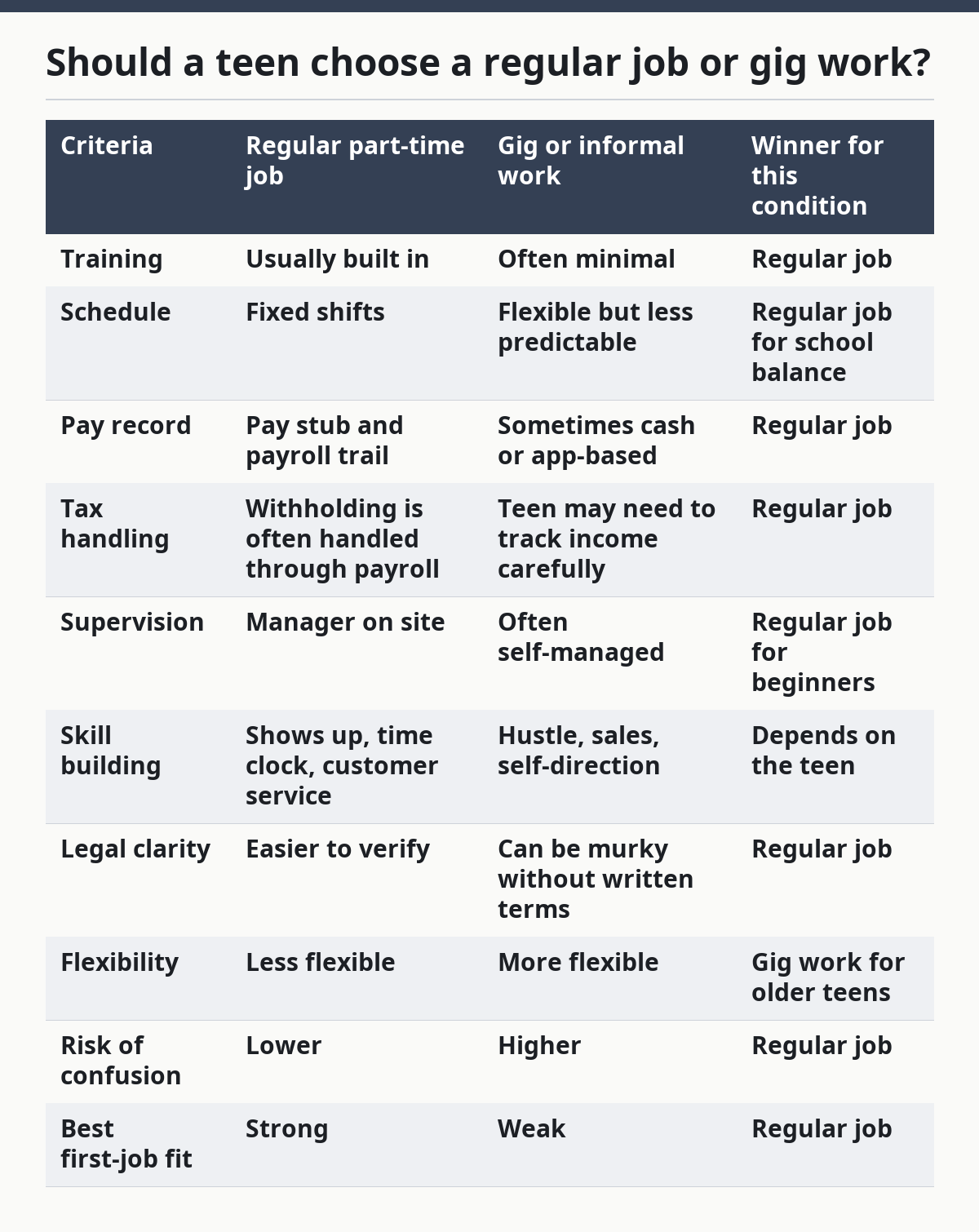
The regular job wins for most teens because the structure does the teaching. A teen can see the same shift start time, the same manager, and the same pay cycle. That repetition matters more than freedom at this stage.
Gig work has strengths, though. It can fit around sports, band, or family obligations better than a fixed schedule. It can also suit a teen who already has strong time management and understands that “flexible” often means “no one is going to remind you.” The drawback is that gig work can hide real problems until later. A teen may not realize they need to save part of the money for taxes or that inconsistent work makes budgeting harder.
The best choice depends on the teen’s age, school load, and maturity. For a first job, a regular W-2 role is often the safer pick. Gig work is better as a second step, not the opening move.
What paperwork comes with a first paycheck?
A first paycheck usually comes with payroll forms, tax withholding, and a pay stub that shows what was earned and what was taken out. That paperwork may look boring, but it is the proof that a teen is being paid through a real system, not just handed money at the end of a shift.
In the U.S., a first-time employee usually fills out a Form W-4 for withholding and may also need state forms, depending on the state. The paycheck then shows gross pay, deductions, and net pay, which is the money that actually lands in the account or gets handed over.
A teen should learn three lines on a pay stub right away:
- gross pay: the full amount earned before deductions
- deductions: amounts taken out for taxes or other items
- net pay: the amount left after deductions
This matters because a teen who sees a $200 shift total and expects $200 in the bank may feel cheated when the deposit is smaller. The paycheck is not wrong; the expectation was.
Direct deposit is often easier than paper checks because it reduces the chance of lost checks and gives a cleaner record. Some employers still offer paper checks, and that can work, but it is slower and easier to misplace. A teen who uses direct deposit should still read the pay stub and keep track of the date money arrives, because deposit timing can vary by payroll cycle.
One more important point: tips, bonuses, and commissions can change a paycheck. If the job includes any of those, the teen should ask how they are reported and when they are paid. Confusion at this stage usually comes from not asking the question before the first shift.
How much should a teen expect from a first paycheck?
A teen should expect the first paycheck to be smaller than the number they earned on paper. That is normal because taxes and other deductions can reduce take-home pay, and the pay cycle may not line up with the first week worked. A teen might work one or two weeks before the first deposit ever shows up.
That lag is one of the biggest surprises in teen work. The teenager does the shift in real time, but payroll runs on a schedule. If the employer closes payroll on a Friday and pays the following week, the teen may wait longer than expected. That delay is not a sign of a problem by itself.
The right lesson is simple: never spend “earned” money before the paycheck arrives. A teen who counts future wages as already available can end up short for lunch, gas, or a school fee. The safer habit is to treat each paycheck as a plan, not a promise. If budgeting or tax questions come up, a parent, caregiver, or tax professional should help the teen check the numbers against the pay stub and IRS guidance.
A teen should also know that some jobs deduct items beyond taxes if the employer has a valid reason and the paperwork supports it. That can include uniform costs or other agreed items in some jobs, though rules vary by place. The safer move is to ask for a written explanation before accepting any deduction.
For budgeting, the first paycheck should usually go to three things:
- a small savings bucket
- a spending amount the teen can use without stress
- a note of what the paycheck actually looked like, so the next one is easier to predict
That habit turns one check into a pattern. A teen who learns the pattern early is less likely to be shocked by the second or third payday.
What makes a job a bad first job?
A job is a bad first job when the money looks better than the structure. If the hours are random, the manager is unclear, and the pay record is messy, the teen will spend more energy managing confusion than learning work skills. A first job should be demanding enough to teach, not chaotic enough to drain.
There are a few clear warning signs. The first is pressure to start right away without paperwork. The second is a promise of “easy cash” with no schedule or written terms. The third is a setup where the teen is told to bring supplies, work off the clock, or wait indefinitely for payment. Those are not small flaws. They can lead to unpaid labor, tax confusion, and a bad first experience that makes future jobs harder.
A bad first job is also one that asks too much too soon. If the commute is long, the hours are late, and the school load is heavy, the job can start hurting grades, sleep, and family life. A paycheck is not worth much if it costs the teen the energy to keep school on track.
Some jobs fail for a simpler reason: they do not match the teen’s life stage. A younger teen may need a job with close supervision and short shifts. An older teen may be ready for more responsibility, but still needs balance. A job that ignores that difference is the wrong fit.
If the job feels unclear before the first shift, it will not get clearer after the first paycheck. Unclear jobs stay unclear.
What should a parent or teen ask before saying yes?
A parent or teen should ask four questions before accepting a first job: what are the hours, who supervises, how is pay handled, and what forms are needed. Those questions sound basic, but they prevent the most common first-job problems. A 10-minute conversation can save weeks of frustration.
The hours question matters because school, transportation, and sleep all hinge on timing. The supervision question matters because beginners need someone who can explain tasks and fix mistakes early. The pay question matters because a teen needs to know whether the job uses direct deposit, paper checks, or some other system. The forms question matters because payroll often needs tax and identity paperwork before a first check can be processed.
A smart follow-up is to ask, “What does a normal first week look like?” That gives a clearer answer than “What is the job like?” A first week includes training, the first schedule, and the first chance to ask practical questions. It also shows whether the employer has a real onboarding process or is improvising.
The teen should also ask what happens if a shift must be missed. A job that punishes every family conflict or school event is too rigid for a first job. A good beginner job can handle one emergency without drama.
Before saying yes, look for three signals:
- clear shifts
- clear pay method
- clear person to ask for help
If those three are missing, the job is not ready for a beginner. That is a reason to keep looking, not a reason to settle.
When should the choice flip?
The choice flips when the teen already has strong self-management, needs unusual flexibility, or has a work setup that is tightly controlled and legal. In those cases, gig or informal work can make more sense than a regular after-school shift. That is the exception, not the default.
Here are the main flip cases:
- The teen has a packed schedule. If sports, music, caregiving, or long travel make fixed shifts hard, flexible work can fit better.
- The teen already handles money and deadlines well. Some older teens can manage self-directed work without much supervision.
- The work is simple and written down. A yard job, babysitting arrangement, or seasonal project can work if expectations, timing, and pay are clear in advance.
- The teen needs a short-term bridge. A temporary job may be better than a long commitment while waiting for a better role.
Even then, the warning stays the same: flexibility does not remove the need for records. A teen should still keep track of hours, pay, and agreement terms. The more informal the work, the more important the notes become.
The choice should also flip away from work entirely if school is already suffering or if the teen is too overwhelmed to manage both. A first job is useful, but not if it causes the rest of life to wobble. In that case, the right move is to delay the job, shrink the hours, or wait for a better fit.
What is the best first-job path?
The best first-job path is a regular part-time job with clear hours, payroll, and supervision, plus a simple budget plan for the first two paychecks. That path gives the teen the cleanest lesson in how work, taxes, and money actually fit together.
Choose a regular job if the teen needs structure, is new to work, or would benefit from seeing a real pay stub. Choose flexible work if the teen already manages time well and truly needs schedule control. Neither is good if the job hides the pay, ignores the schedule, or threatens school performance.
The right first job should answer three questions fast: when do I work, who do I ask, and when do I get paid? If those answers are clear, the job is probably a good start. If they are not, keep looking.
Choose a regular part-time job if the teen is new to working, needs structure, and wants a clean payroll trail. Choose gig or informal work if the teen is older, self-directed, and needs schedule flexibility more than supervision. Neither if the job is vague, cash-only, or likely to damage school, sleep, or safety.
What questions do parents and teens ask most?
How many hours should a teen work?
The safest answer is: enough to learn, not so much that school slips. In the U.S., federal rules set different hour limits for minors depending on age and school status, so the exact number depends on the teen’s age and local rules. A short after-school shift is often easier to manage than a long weekend block. For age-specific guidance, see the U.S. Department of Labor’s youth rules page: https://www.dol.gov/agencies/whd/youthrules
Should a teen open a bank account for their first paycheck?
Yes, if the teen is old enough and the parent or guardian can help with setup where needed. A bank account makes direct deposit easier and gives the teen a place to save part of each paycheck. It also makes it simpler to see what was actually paid.
What if the first paycheck is smaller than expected?
That is common, especially if taxes were withheld or the pay period did not cover a full two weeks. The teen should compare the hours worked with the pay stub and ask the employer to explain any deduction that is not clear. A smaller first check does not always mean there was an error.
Can a teen work and still do well in school?
Yes, if the job is limited and the schedule is realistic. A teen who works a few set shifts and protects homework time can usually manage both better than a teen with changing hours and late nights. The job should fit around school, not take it over.
What is the best first job for a shy teen?
A job with a simple script and repetitive tasks is usually best. Stocking, bagging, back-room prep, or a small retail role can be easier than a high-contact sales job. The main goal is to start with something that builds confidence without putting too much social pressure on day one.
Drafted with AI; not yet reviewed by a person.