Last updated: November 19, 2026
Quick answer: a teen can usually ask after 30 to 90 days of reliable work, after training ends, or at a review, and the strongest request is specific about hours or pay.
Key Takeaways
- Decide whether you want more shifts, higher pay, or both, since each asks for a different answer.
- Ask after training or a clear work milestone, not on day one or in a rush.
- Keep the request brief, specific, and tied to the work you already do.
- Show visible results, not just effort, when you ask for more hours or better pay.
Teen job negotiation at a first job is mostly about timing, proof, and tone: ask after you have shown up reliably, and ask for a specific change, not a vague “can I get more?” If you want more hours or better pay at a first job, the safest move is to make the request after a strong shift, a finished training period, or a performance review, then give your manager one clear reason and one clear ask.
Teen job negotiation starts with the right goal

Teen job negotiation works best when you decide whether you want more shifts, a higher hourly pay, or both, because those are not the same request. More hours are often easier to get than a raise, since a manager can move a person onto the shift schedule without changing payroll rates. Better pay usually takes stronger proof: dependable attendance, speed, accuracy, and a clean 90-day or 6-month work record if the store uses formal reviews.
The difference matters. If the location is short on coverage for Friday nights or Saturday mornings, you may get extra hours even if a raise is off the table. If the store is fully staffed, asking for a pay bump may be more realistic than asking for 15 more hours a week, because the manager can approve a smaller payroll change than a larger schedule change. Some teens make the mistake of asking for “more of everything” in one sentence. That can sound unfocused. Pick one main target and make the other the backup.
A good first question is simple: what problem am I solving for the manager? If the answer is “I can reliably cover two extra closing shifts” or “I have learned the register and can handle the rush without help,” the request becomes easier to say yes to. If the answer is “I need more money,” that is honest, but it is weaker on its own. Managers often respond better to value than to need.
This is also the point to be realistic about the job itself. A small shop with 2 or 3 employees may not have spare shifts. A chain store with a 20-person team may have room to rework the schedule. If your role is seasonal, hours may rise only when school breaks or holidays hit. That does not mean you should stay silent; it means you should ask in a way that fits the setting.
When should a teen ask for a raise or more shifts?
A teen should ask after a proof point, not on the day of hire, and not during a busy rush. The best times are often after training ends, after 30 to 90 days of solid work, or right after a performance review when your manager is already thinking about your work. If the job has no formal review cycle, use a quiet time: the end of a shift, a slower weekday, or a scheduled one-on-one with your manager.
Timing matters because a request is easier to hear when the manager has recent evidence in front of them. If you have worked 6 weeks, never missed a shift, and learned a second task like closing the register or stocking without reminders, that is a clean moment to ask. If you ask during your first two shifts, you may sound impatient. If you ask after you have been late three times, the answer will probably be no, even if your request is fair.
A raise usually needs a stronger timing cue than more hours. Pay conversations make more sense when you can point to a change in responsibility: you now open the store, train new staff, handle more customers, or work faster with fewer errors. More hours can be requested sooner, especially if you are flexible on nights, weekends, or a 4-hour weekday shift that is hard to fill.
Do not ask on a day when the manager is dealing with complaints, a call-out, or a payroll deadline. A request made in a parking lot after a chaotic shift often gets brushed aside. Instead, ask for 10 minutes at a calm point. That simple move often changes the quality of the answer.
One honest limitation: if the business is reducing labor or cutting hours for everyone, asking for more shifts may not help. In that case, asking for the best available shifts can still work, but the request should be modest and specific.
What to say to your manager without sounding awkward

The cleanest ask is short, specific, and tied to the job you already do. Start with a direct sentence, name the change you want, and then give one reason based on your work record. The goal is not a speech; it is a 30-second conversation that sounds calm in person.
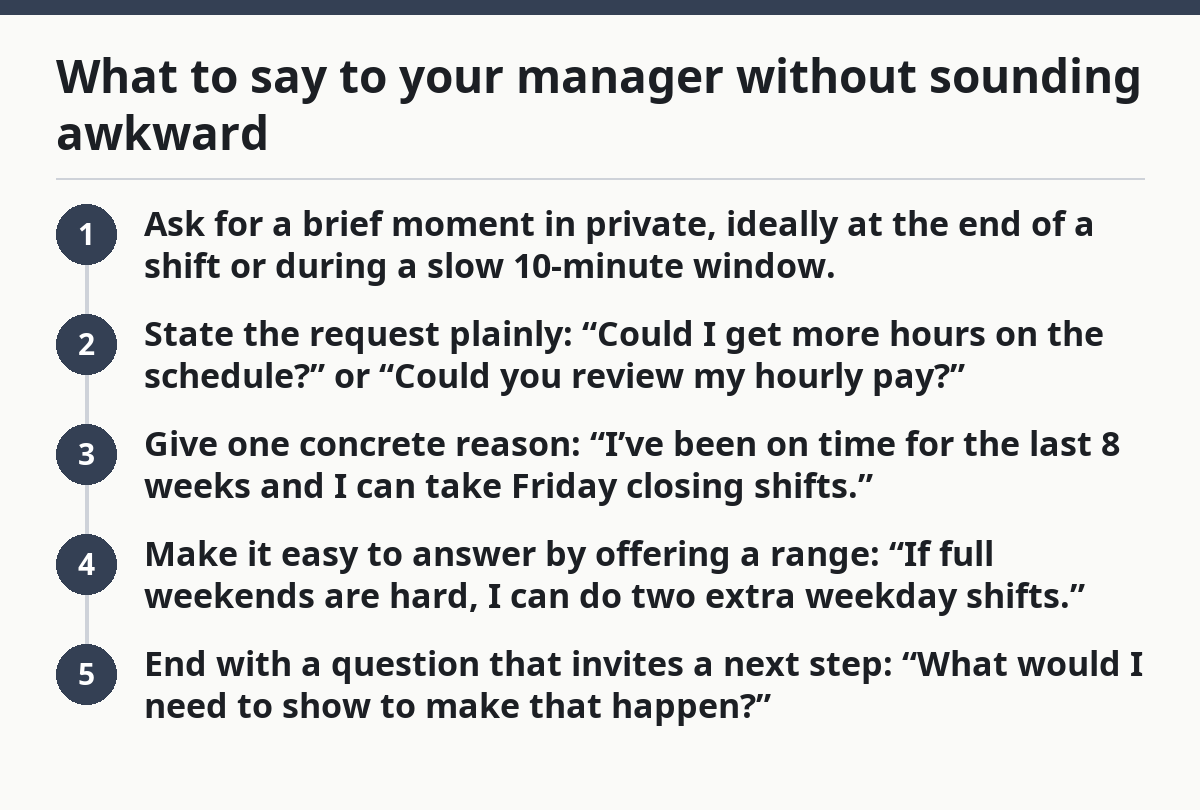
Use this structure:
- Ask for a brief moment in private, ideally at the end of a shift or during a slow 10-minute window.
- State the request plainly: “Could I get more hours on the schedule?” or “Could you review my hourly pay?”
- Give one concrete reason: “I’ve been on time for the last 8 weeks and I can take Friday closing shifts.”
- Make it easy to answer by offering a range: “If full weekends are hard, I can do two extra weekday shifts.”
- End with a question that invites a next step: “What would I need to show to make that happen?”
A useful script for more hours: “I like working here, and I’m looking for more hours. I’m available on Tuesday, Thursday, and Saturday nights, and I can take 4- to 6-hour shifts. Is there a way to add me to the schedule more often?” That works because it names the shift schedule, gives specific availability, and shows you are trying to solve a staffing need.
A useful script for pay: “I wanted to ask about my hourly pay. I’ve learned the closing tasks, I’m reliable, and I’m covering more responsibility now. Is there a time we could talk about a raise or a pay review?” That keeps the request respectful and practical.
What not to say: “I need more money” by itself, “Everyone else gets more than me,” or “If you don’t raise my pay, I’ll quit.” Those lines create pressure without evidence. They usually make the manager defensive. If you are angry, wait a day.
A small but useful detail: speak to the manager who controls the schedule or pay, not just the most familiar supervisor. At many jobs, the person who likes you is not the person who can approve the change.
How to show you earn extra hours or higher hourly pay
You earn a stronger answer by pointing to work the manager can see, not by talking about effort in general. Attendance, speed, accuracy, and attitude are the four things that usually matter most in a first job. If you want more hours or better pay, make one of those visible for 2 to 6 weeks before you ask.
Keep a few simple notes for yourself. Write down the days you covered a late shift, learned a new task, or handled a rush without help. You do not need a fancy log. A notes app or a paper calendar is enough. The point is to remember concrete examples when you talk to your manager. “I have been available for every Saturday this month” is stronger than “I work hard.” If you want help deciding how to frame that kind of example, a school counselor, career adviser, or other professional can help, and the U.S. Department of Labor’s YouthRules! site has job-safety and work guidance for young workers.
If your job has a performance review, treat that as your opening. Bring up your request in the review itself or at the end of it. That is the moment when your manager is already weighing your value against the current schedule and budget. If the job does not have a review, create your own milestone: after 30 shifts, after 3 months, or after you learn a second station.
The strongest evidence is tied to a business need. Examples include:
- You can close without supervision.
- You can cover a 5 p.m. to 9 p.m. shift on school nights.
- You are willing to work one weekend day each week.
- You can train on a second station, like cash register, stock, or food prep.
That kind of proof helps because it gives the manager a reason to rearrange the shift schedule for you. It also makes your request easier to defend if the manager has to justify it to a higher-up.
There is a trade-off here. If you ask too soon, you may look unproven. If you wait too long, the schedule may settle around other people and your request becomes harder to fit in. A lot of teens miss the window because they assume good work will speak for itself. It often does not. You still have to ask.
How to ask for more shifts when the schedule is tight
You ask for more shifts by offering flexibility on the exact days the manager struggles to cover. If you say you can work “anytime,” the request sounds vague. If you say “I can do Friday nights and Sunday mornings,” it becomes useful. The ask should be built around the store’s gaps, not your ideal hours alone.
Before you ask, learn the shift schedule pattern. You do not need access to payroll or a staffing spreadsheet; you only need to notice which shifts are hardest to fill. At retail jobs, that may be evenings or weekends. At restaurants, it may be the dinner rush or closing. At a grocery store, it may be the after-school block from 3 p.m. to 7 p.m. Once you see the pattern, ask for those shifts directly.
A good script is: “I noticed you often need help on Saturday evenings. I can take those shifts regularly, and I’d like to be scheduled for more hours if there’s room.” That works because it sounds like a solution, not a complaint. If you have another commitment, state it clearly: “I can’t do every weekday, but I can reliably do two extra closing shifts.”
If the answer is “not right now,” ask for a fallback. “What schedule change would make me a better fit for more hours?” is a better follow-up than repeating the same request. You may hear that hours go to the most senior workers first, or that the store only adds hours after sales increase. That is useful information, even if it is not the answer you wanted. See also how to get a teen job and teen interview tips for related advice.
One mistake is overpromising. If you say you can take every open shift and then back out twice, your credibility drops fast. Another mistake is asking only once and assuming that is enough. In a busy store, managers forget. A polite check-in after 2 or 3 weeks is normal.
If your job posts the schedule a week ahead, ask before the new schedule is built. If it posts two weeks ahead, ask earlier. Timing your request to the planning cycle gives you a better chance than asking after the schedule is already printed.
How to ask for better pay without making it a fight
You ask for better pay by framing it as a review of your current value, not as a complaint about your paycheck. The goal is to connect your hourly pay to the work you now handle. If you have learned more tasks, taken more responsibility, or become the person the manager can count on during busy periods, that is the case to make.
Start with a calm sentence: “I’d like to talk about my pay rate.” Then say why now: “I’ve been here 4 months, I’ve learned the closing routine, and I’m handling more than I did when I started.” That is enough to open the conversation. You do not need to prove your whole worth in one minute.
If the manager asks what rate you want, have a number or range in mind before you speak. You do not need to guess wildly. Think about a reasonable increase for your role, not a dramatic jump. If you do not know what is possible, ask what the next pay step looks like and what milestones lead to it. A clear next step is better than forcing an exact figure if you do not have one. For context on wages and youth jobs, see the U.S. Department of Labor’s youth employment rules and the Fair Labor Standards Act fact sheet.
Be ready for one of three answers:
- Yes, with a review date.
- Not now, but after a set milestone.
- No, because pay decisions come from above or follow a fixed scale.
Any of those can still be useful if you get a timeline. “Talk to me in 2 months” is not a yes, but it is a concrete follow-up. Write it down immediately so you do not lose the date.
This is the point where a lot of teens make a wrong turn. They treat a raise like a test of whether the manager likes them. It is not. It is a business decision, so if you want guidance on whether your situation is typical, consult a parent, counselor, or another professional and check a source such as the U.S. Department of Labor. If the answer is no, that may reflect payroll rules, not your value. The honest drawback is that some first jobs have almost no room for negotiation. In those places, more hours may be possible even when a raise is not, and sometimes the only real answer is to build experience and ask again later.
For more money advice tied to earning, the hub on teen money jobs and earnings is the better next stop than guessing your way through pay talk alone.
What to do if the answer is no
If the answer is no, ask for the reason, the next step, and the review date. Those three pieces turn a dead end into a plan. A manager might say the schedule is full, the budget is fixed, or raises happen only at a 6-month review. That is frustrating, but it tells you what to do next.
Use this follow-up: “What would I need to do for you to reconsider in the next month or two?” That question keeps the door open without sounding pushy. If the answer is about reliability, fix attendance. If it is about skill, ask to learn a second task. If it is about timing, return at the next review.
Do not argue on the spot unless the manager is clearly being inconsistent with what they told you before. Even then, keep it brief. A defensive reaction can damage the next request more than the first rejection itself. The better move is to leave with a date and a standard to meet.
If the job keeps saying no after you have met the benchmarks, the limitation may be the job, not you. Some first jobs never negotiate much on pay or hours. In that case, the useful skill is not persuasion; it is recognizing when the ceiling is fixed and deciding whether to stay for experience or look later for a job with more room to grow.
When should a teen ask for a raise?
A teen should ask for a raise after a clear proof point, such as 30 to 90 days of reliable work, the end of training, or a performance review. The best moment is when the manager has recent examples of stronger responsibility, like closing shifts, training help, or fewer errors. Asking too early usually weakens the case.
Drafted with AI; not yet reviewed by a person.