Last updated: November 19, 2026
Quick Answer: A teen saving for college spending money should set a specific dollar target for move-in costs and the first month on campus, then divide it by the number of weeks left before school starts.
College spending money is the cash you use for the stuff tuition does not cover: snacks, laundry, bus fares, club dues, basic toiletries, a last-minute notebook, or a pizza night with friends. If you want to arrive on campus with money already set aside, the fix is simple in theory and specific in practice: pick a dollar target, tie it to a timeline, and route summer or part-time earnings into that goal before they disappear into everyday spending.
What college spending money actually has to cover
College spending money covers personal expenses that show up after move-in, not the bill the school sends for tuition and housing. That distinction matters because a teen can save “for college” for years and still land on campus short on the cash needed in the first 30 days.
Start with the things that appear right away. Move-in costs can include bedding you forgot, toiletries, a phone charger, over-the-door storage, local transit money, and a few meals before your dining plan starts working the way you expect. After that come campus spending items that never fit neatly into tuition: printing, laundry, club dues, coffee, snacks between classes, a student ID replacement, and trips home if those are your responsibility.
A useful target is not “as much as possible.” It is a savings goal built around the first semester or first month. If you only save for one part of the picture, save for the gap between arrival and the first time you can refill your wallet easily. That gap is where stress usually shows up.
This page stays focused on college spending money on purpose. It is not a guide to long-term tuition planning, and it is not the same thing as a teen emergency fund. If you need the broader money-planning map, the teen saving and goal planning hub is the place to start.
A good rule is to think in buckets:
- Move-in costs: one-time purchases in the first week or two.
- Personal expenses: toiletries, laundry, medicine you buy over the counter, and the random items that make dorm life work.
- Campus spending: food, printing, entertainment, small fees, and local transportation.
The mistake to avoid is treating all of this as “extra.” Extra money has a way of vanishing before move-in day, so it is wise to label the goal clearly and, if needed, check with a parent, guardian, or financial professional about the best way to keep it separate. Naming the use case keeps the goal real.
How much college spending money should a teen save?

A teen should save enough to cover the first stretch of campus expenses without borrowing from family every week. That means setting a number that matches the school, the dorm, and the kind of life the student expects to live.
There is no universal dollar amount that fits every student, and that is the honest answer. A commuter student with a paid meal plan needs less than a student living across the country with no car and a long list of move-in purchases. The right target depends on three variables: distance from home, how much of food and transit are already covered, and whether the student tends to spend on convenience.
A practical way to set the number is to make three mini-estimates:
- Arrival costs: bedding, laundry supplies, toiletries, and any dorm gear you still need.
- Monthly personal expenses: food gaps, coffee, laundry, printing, and transit.
- Buffer: a cushion for the first 2 to 4 weeks while you figure out routines.
If you want a fast estimate, start with one month of personal expenses plus move-in costs. If the school is far from home, add a little more for the first break, because travel money can be part of spending money too. If the student has a very tight budget and meal plan coverage, the number can be smaller, but it should still be enough to avoid zeroing out by the second week.
Who this approach is not for: a teen trying to cover a full gap between financial aid and the cost of attendance. That is a bigger job with a different plan. This page is about spending money, not tuition replacement.
A good target is one a teen can realistically reach in 3 to 9 months. A huge goal sounds responsible and then turns into a dead file in a notes app. A smaller, specific goal gets funded.
Build your college spending money goal in 5 steps
You can build the goal by listing expenses, pricing them, and turning the total into a monthly target. That is the cleanest method because it turns a vague wish into a savings plan with deadlines.
-
List the first things you will need.
Write down 10 to 15 items you expect to buy in the first 2 weeks. Include dorm basics, toiletries, laundry soap, a shower caddy, snacks, and any local transit pass. The result is a real shopping list instead of a guess. -
Put a price range next to each item.
Use store websites or receipts from home. A set of 8 to 10 small items gives you a sharper picture than one giant estimate. If you do not know the exact price, use a conservative range rather than a fantasy bargain. -
Add 1 month of personal expenses.
This is the part many teens skip. It is not glamorous, but it covers coffee runs, printing, and the stuff that happens when one dining hall meal is not enough. If a student expects to spend $20 a week on extras, that can be folded into the target as part of the monthly estimate. -
Decide whether parents or guardians will cover any part of it.
If a parent is paying for move-in bedding or giving $100 toward the first month, write that down before you start saving. Otherwise the goal gets inflated, then resented, then ignored. -
Divide the total by the number of weeks you have left.
If you have 20 weeks until move-in and need $400, the weekly target is $20. That number is easier to work with than one big lump sum because it tells you what to earn or set aside each week.
This method works because it connects the goal to a calendar, not a mood. It also keeps you from saving for every possible campus expense at once. A teen does not need to predict every latte and laundry cycle for the next 8 months. A solid first-semester cushion is enough to start.
If you want a checkpoint, review the list after 30 days. If one item looks off by a lot, adjust the number before the semester starts instead of pretending the estimate was perfect.
Where teens can get the money without wrecking daily spending

The easiest source of college spending money is money that already arrives in chunks: summer earnings, birthday cash, job paychecks, and parent contributions. The trick is not finding money somewhere mystical. It is keeping the money from getting absorbed by random spending.
Summer earnings usually work best because the time window is clear. If you work 8 to 12 weeks, set a fixed share of each paycheck for the college goal before you touch the rest. A simple split works better than a promise to “save what is left,” because what is left tends to disappear into food delivery, streaming upgrades, and small purchases you forget the next day.
Parent contributions can be useful if they are specific. A parent might cover move-in costs while the teen funds campus spending. That arrangement is cleaner than asking for “help with college” in a vague way. It also reduces arguments later because each person knows which bill belongs to whom.
Birthday money, graduation gifts, and one-off cash can speed things up, but they should not be the only plan. Those sources are uneven, and a goal built on gifts is fragile. Treat them as bonus deposits, not the base, and if the arrangement is unclear, talk it through with a parent or guardian before counting on it.
Here is the trade-off: the more you redirect into college spending money, the less you have for current fun. That is the point, but it still stings. A teen who saves every paycheck may get frustrated and quit; a teen who saves 20% may stay consistent for months. Consistency beats heroics.
A few practical ways to protect the money:
- Put it somewhere you do not use for daily spending.
- Move money on payday, not at the end of the month.
- Keep a separate running total in a notes app or spreadsheet.
- Label the goal plainly: “college spending money,” not “general savings.”
That last part matters more than it sounds. The clearer the label, the harder it is to justify spending the money on something unrelated.
For rates, rules, or account features, the Consumer Financial Protection Bureau has plain-language guidance on teen banking and saving, and the Federal Deposit Insurance Corporation’s Money Smart for Young People materials are a solid place to learn the basics. See also How to Open a Teen Savings Account and How to Budget Your First Paycheck.
How to keep the savings from disappearing before move-in day
You keep college spending money intact by making it inconvenient to spend and easy to track. That sounds simple because it is, but the details matter.
The first protection is separation. If the money sits in the same place as lunch money and weekend money, it will get blended together in your head. A separate savings bucket, even if it is inside the same bank, reduces the chance that a “small” purchase eats the goal. The point is not fancy finance. The point is friction.
The second protection is timing. Move money on the same day you get paid or the same day you receive cash. A 10-minute transfer beats a vague promise to save later. If you wait until the end of the month, the month will win.
The third protection is naming the job. A teen saving for a laptop, concert tickets, and college spending money at once creates confusion. One goal should have one purpose. If campus spending is the priority, do not make it compete with unrelated purchases unless the budget allows both.
Common mistakes cost real money:
- Saving without a target: the money gets spent because no one knows what it is for.
- Forgetting move-in costs: you arrive on campus and buy basics at the highest-stress time.
- Counting gift money twice: you plan on money that never arrives, then fall short.
- Using the goal as a backup fund: the budget feels flexible until the first emergency pizza order.
What to do instead is boring, and boring works. Write the target down. Put a deadline next to it. Check it once a week for 5 minutes. If you get cash, deposit it quickly. If you get paid on Fridays, make Friday the transfer day.
This is also the place to be honest about who the plan is not for. If a teen has no reliable income and no parent contribution, a large college spending goal may not be realistic before move-in. In that case, the better move is a smaller, starter goal and a plan to earn more during the first semester.
A simple timeline that fits a teen schedule
A 3-month timeline works for a small goal, and a 6- to 9-month timeline works better for most students. The useful part is not the exact number of months; it is matching the goal to the time left before move-in.
If college starts in August, begin by late winter or spring if possible. That gives time for summer earnings to finish the job. If move-in is close, start with a short-term version: cover the first week and one month of basics, then build from there.
A timeline becomes useful when it has checkpoints:
- Month 1: decide the target and list the first expenses.
- Month 2: start automatic or same-day transfers.
- Month 3: review the goal and cut anything unrealistic.
- Last month before move-in: keep the money untouched and match it to your arrival shopping list.
A short timeline changes the strategy. If you only have 6 weeks, you cannot rely on tiny amounts and hope they add up. You need bigger deposits from summer work, gifts, or parent help. If you have 9 months, you can spread the goal out and make each deposit smaller.
The cleanest version is a calendar-based plan tied to paydays. For example, if you get paid every 2 weeks, divide the target by the number of paychecks left. That makes the goal concrete and keeps the college spending money separate from day-to-day spending.
The mistake here is waiting for “the right time” to start. There usually is no perfect time. There is only the semester before school and the semester after it. Start with the next paycheck, even if the first transfer is modest.
A first-semester spending plan that actually works
A first-semester spending plan works when it treats college spending money like a tool, not a reward. The goal is to arrive with enough cash to handle the unplanned, the awkward, and the boring without having to scramble.
Use the money in this order:
- Move-in and setup
- Weekly personal expenses
- Campus spending you chose ahead of time
- Buffer for surprises
That order keeps essentials from getting buried under convenience spending. It also stops the common pattern where a teen spends heavily during orientation week and then wonders why laundry money is gone by week 3.
The strongest version of this plan includes one written rule: no spending from the goal unless the item is on the list or clearly replaces something on the list. If the list says toiletries, a hoodie, and laundry money, a movie ticket is not part of the goal unless there is room after the essentials are covered.
This is where the savings plan becomes real. The money is not just “for college.” It is for the first semester of actual life on campus, which is messier and more expensive than people expect. That is why the goal should be specific, time-bound, and smaller than a full college budget.
If the plan is working, the teen should still have money left after the first few weeks, not just a stack of receipts. That leftover cash is the sign that the goal was sized correctly.
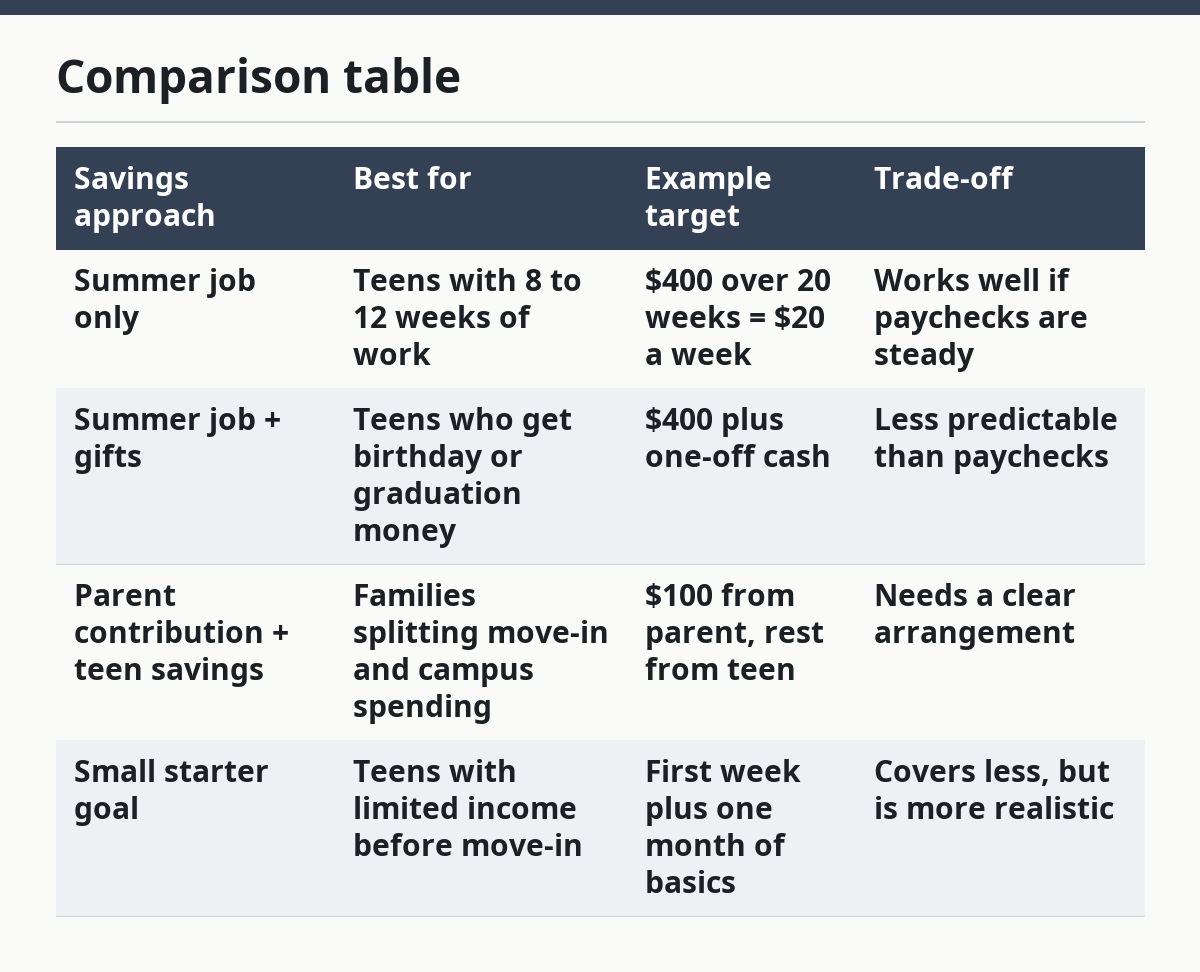
Comparison table
| Savings approach | Best for | Example target | Trade-off |
|---|---|---|---|
| Summer job only | Teens with 8 to 12 weeks of work | $400 over 20 weeks = $20 a week | Works well if paychecks are steady |
| Summer job + gifts | Teens who get birthday or graduation money | $400 plus one-off cash | Less predictable than paychecks |
| Parent contribution + teen savings | Families splitting move-in and campus spending | $100 from parent, rest from teen | Needs a clear arrangement |
| Small starter goal | Teens with limited income before move-in | First week plus one month of basics | Covers less, but is more realistic |
Key Takeaways
- College spending money is the cash for the first non-tuition costs, not the whole bill for school.
- The best goal covers move-in needs, personal expenses, and a small buffer for the first month.
- A teen can fund it through summer work, gifts, and parent contributions if each source has a clear job.
- Saving on payday and separating the money from daily spending are the two habits that matter most.
- A 3- to 9-month timeline usually works better than trying to save everything at once.
FAQ
How much college spending money should a teen save?
A good starting point is enough to cover move-in costs and the first month of small campus expenses, then divide that total by the number of weeks left before school starts.
What should college spending money be used for?
It should cover personal costs like toiletries, laundry, snacks, local transit, printing, and other non-tuition expenses that show up after move-in.
Is it better to save a little every week or wait for summer work?
Saving a little every week helps, but summer work, birthday money, and parent contributions can speed up the goal if the money is separated right away.
How do teens keep college spending money from getting spent too early?
Keep it in a separate savings bucket, move it on payday, and label the goal clearly so it is not confused with daily spending money.
What if a teen cannot save enough before move-in?
Start with a smaller goal, such as the first week and one month of basics, and then build the rest during the first semester.
Drafted with AI; not yet reviewed by a person.