Last updated: November 20, 2026
Quick Answer: 3 controls matter most. A teen debit card and spending controls setup works best when it includes a hard spending limit, instant alerts, and cash rules that are easy to enforce. Teen Debit Card and Spending Controls — The Complete Guide is about choosing a card that lets a teen spend while keeping the balance visible and bounded. Teen debit card controls can stop surprise charges, cap spending, and let a parent see where money goes without handing over full cash. The setup that fits best is the one that lets a teen spend, but not wander past a clear limit. The sections below settle which controls matter, which ones are theater, and what to check before opening anything.
Key Takeaways
- The right teen card should block overspending before it happens, not after the bill arrives.
- Spending limits, merchant blocks, cash access rules, and instant alerts solve different problems.
- A parent who wants more visibility usually needs a parent app, not just a card.
- Cash withdrawal and peer-to-peer transfers are where many teen cards get messy.
- The wrong fit is a card that looks simple but hides weak controls or vague fees.
What problem are you actually trying to solve?
Teen debit card and spending controls are for two jobs at once: letting a teen spend in the real world and keeping the adult from finding out too late that the balance is gone. If the goal is just “teach money,” a prepaid card can work. If the goal is “stop overspending on snacks, rides, and apps,” the control set matters more than the card brand.
Here’s the catch: not every “teen card” is built the same. Some are real debit cards linked to a checking-style account. Others are prepaid or app-based cards with a parent dashboard. The label on the front matters less than the controls behind it.
A useful setup usually gives you three things: a hard spending limit, a way to block certain merchants or categories, and alerts that arrive fast enough to matter. If a card only sends a weekly summary, that is not control. That is a receipt.
- Spending cap: stops a purchase once the balance or limit is reached
- Merchant control: blocks places like gambling, alcohol, or online stores if the provider supports categories
- Alerts: sends a text or app notice when money moves
- Card lock: freezes the card if it is lost or abused
- ATM rule: limits cash access, which is where many budgets slip
The most useful teen card is usually not the one with the fanciest app. It is the one that makes bad spending impossible or at least annoying. That difference saves arguments.
Which spending controls matter most on a teen card?
The most useful controls are spending limits, merchant blocks, real-time alerts, and cash rules. Those four cover most of the damage, and they do it without turning every purchase into a debate.
Picture this: you want your teen to buy lunch, school supplies, and a bus ride, but not game credits or late-night fast food. A decent control stack can do that with a few settings, not a lecture every Tuesday. That is the point.
The first control to check is the daily or weekly limit. Some cards let a parent set a hard cap; others only let the teen spend up to the available balance. A hard cap is better because it gives you a ceiling even if extra money lands in the account.
The second control is merchant blocking. If the provider supports merchant category codes, you may be able to stop certain types of purchases. That is more precise than locking the whole card, and it works better for older teens who need freedom with guardrails.
The third is alerts. Instant alerts are the difference between “I saw it right away” and “I discovered three weird charges two days later.” If the app only updates slowly, the control is weaker than it sounds.
The fourth is cash access. ATM withdrawals are hard to track because cash disappears in the real world. A card that allows ATM use without a low limit is a hole in the bucket.
- Best for younger teens: strong limits, merchant blocks, no ATM access
- Best for older teens: spending cap plus alerts, with limited cash access
- Best for chores and allowance: scheduled transfers and automatic allowance tools
- Best for travel or school lunches: card lock, low cash withdrawal limit, quick notifications
The truth is, a teen card without cash rules is only half controlled. That is where budgets get loose.
What is the real difference between a teen debit card and a prepaid card?
A teen debit card is usually tied to a checking-style account, while a prepaid card is funded in advance and often behaves more like a spending envelope. The difference sounds small, but it changes fees, deposits, and how much control you get.
Picture this: you want to load $50 for the week, let your teen spend it, and make sure no overdraft fee shows up later. A prepaid card often fits that job better because the balance is the limit. A debit card can be better if you want direct deposit, a fuller banking setup, or a path toward a normal checking account later.
The trade-off is plain. Debit cards can be more flexible, but that flexibility can also create confusion if the linked account allows extra features or overdraft exposure. Prepaid cards can be simpler, but some come with reload fees, inactivity fees, or clunky transfer rules. Read the fee schedule, not the marketing page.
A teen debit card makes sense when you want:
- a real bank-like setup
- direct deposit for allowance, jobs, or gifts
- longer-term use beyond one school year
- a smoother move into adult banking later
A prepaid card makes sense when you want:
- a tight spending envelope
- no overdraft risk
- a quick way to fund only what is needed
- less exposure if the card number is compromised
One important note: some teen debit products are not traditional debit cards at all. They are custodial or parent-managed accounts with debit access. That structure can be useful, but it also means the control features depend on the provider’s app and rules.
- Debits strengths: broader banking tools, direct deposit, better habit-building
- Prepaid strengths: harder spending ceiling, simpler budget, lower risk of overshoot
- Debit weaknesses: possible fee complexity, more room for accidental misuse
- Prepaid weaknesses: fewer banking features, transfer limits, fee traps
If the teen is 13 or 14, the simpler setup usually wins. If the teen has a job or babysitting income, the more bank-like option starts to make sense.
How do parent controls actually work in the app?
Parent controls work by pairing a card with a dashboard that can approve transfers, set limits, freeze the card, and review transactions. The app is where most of the control lives, not on the plastic itself.
Picture this: your teen is at a store, and the purchase gets denied. That can happen because the balance is too low, the merchant category is blocked, the card is frozen, or the teen hit a daily limit. The app is what decides those rules.
The first thing to look for is transfer control. Some apps let a parent move money instantly. Others schedule allowance weekly or monthly. Scheduled transfers are better if you want spending to feel planned instead of reactive.
The second thing is visibility. The better apps show merchant name, amount, time, and sometimes category. If the app only says “card purchase,” the data is too vague to coach from.
The third thing is approval settings. A few teen products let the parent approve large purchases, block card types, or require advance permission for online spending. Those features matter more than a flashy interface.
The fourth thing is freeze and unfreeze. You want this to be one tap, not a customer service call. If the card is lost at school, speed matters.
- Best app controls: instant lock, spending cap, alerts, category blocks
- Best coaching tools: merchant names, spending summaries, savings buckets
- Weak app signs: delayed updates, unclear labels, hidden fees, slow transfers
- Better for busy parents: automatic allowance and preset limits
A strong app does not just show what happened. It helps prevent the next mistake. That is the difference between monitoring and management.
What fees and fine print can ruin a teen card?
Fees can ruin the value of a teen card faster than a bad spending habit. The usual trouble spots are monthly fees, ATM fees, reload fees, replacement card fees, and charges for faster transfers or international use.
Picture this: the card looks free until your teen needs cash, loses the card, or you move money three times in a week. That is when the little charges show up and turn a budget tool into a drain.
Monthly fees are the first thing to check. Some teen cards charge a flat fee to keep the account open or keep parent controls active. That can be fine if the control set is strong, but a fee is hard to justify on a weak product.
ATM fees matter if your teen ever uses cash. A card may advertise free spending and still charge for withdrawals or out-of-network ATM use. That is a common gotcha.
Reload or transfer fees are another trap. If the only way to fund the card is via a paid transfer or instant load, the card costs more every month than the landing page suggests.
Replacement card fees and expedited shipping fees are easy to ignore until the wallet disappears. Read the fee schedule before the first transfer, not after the first loss.
- Look for: no monthly fee or a fee tied to strong features
- Watch for: ATM charges, reload fees, transfer fees, replacement fees
- Read closely: foreign transaction rules and cash advance language
- Avoid: any card whose control features sit behind a pile of small charges
The truth is, a teen card with excellent controls can still be a bad deal if every useful action costs money. That is not budgeting. That is leakage.
How much control is too much?
Too much control is when the teen cannot make normal spending choices without repeated permission, and too little control is when the card behaves like cash with a logo. The right amount depends on age, trust, and spending habits.
Picture this: a 13-year-old needs lunch money and a ride home, while a 17-year-old needs to buy school supplies, snacks, and maybe cover a co-op shift meal. Those are not the same use case. The controls should not be the same either.
For younger teens, a tight setup is sensible. That usually means low limits, merchant blocks, no ATM access, and alerts to the parent only. The point is to protect the balance while habits are still forming.
For older teens, the better setup gives room to make small mistakes. They may need online purchases, cash for small emergencies, and a chance to see the result of overspending. If every purchase gets denied, the lesson becomes frustration, not judgment.
A good rule: if the teen earns money, spends it, and can explain the last three transactions, the card can probably be a little looser. If the teen is still surprised by basic balance math, the controls should stay tight.
- Too much control looks like: constant approvals, blocked normal purchases, no room for independent choices
- Too little control looks like: cash access without limits, no alerts, no merchant rules
- Right-sized control looks like: spending cap, alerts, a few category blocks, and a way to freeze fast
Here’s the catch: control is not the same as trust. A card can protect money without turning every purchase into a family argument. That is the sweet spot.
When should you skip a teen debit card entirely?
You should skip a teen debit card if the teen has no steady spending pattern, if the provider’s fee list is messy, or if the controls are weaker than a plain cash envelope. A card is not always the smartest tool.
Picture this: the teen loses things often, rarely uses cash, and mostly needs money for one predictable school lunch. In that case, a small monthly transfer, a reloadable prepaid option, or even a simple cash budget may be cleaner than a full card setup.
Another reason to skip it is poor app design. If the parent dashboard is hard to use, if transfers lag, or if alerts arrive late, the tool creates more stress than it saves. A control system that no one checks is just decoration.
The final reason is merchant and ATM confusion. If the card blocks ordinary purchases by mistake or lets cash slip out too easily, the family will spend more time fixing the tool than using it.
- Skip the teen card if: spending is tiny and predictable
- Skip it if: fees are high relative to use
- Skip it if: the teen is too young to manage a physical card
- Skip it if: the app gives weak alerts or poor visibility
On the flip side, if the teen has variable spending, wants independence, or earns money from a part-time job, a controlled debit card starts to make real sense. That is where the category earns its keep.
How do you choose the right setup fast?
Choose the setup by starting with the hard limits: cash access, spending caps, and alerts. Then decide whether you need bank-style features or just a safe spending tool.
Picture this: you are comparing three products and all of them promise “parent controls.” That phrase means almost nothing until you ask what can actually be blocked, what can be tracked, and what costs extra.
The quickest filter is this:
- Can you set a real spending limit?
- Can you block cash withdrawals or keep them very low?
- Do alerts arrive immediately after a purchase?
- Can you lock the card from the app?
- Are the fees simple enough to explain in one minute?
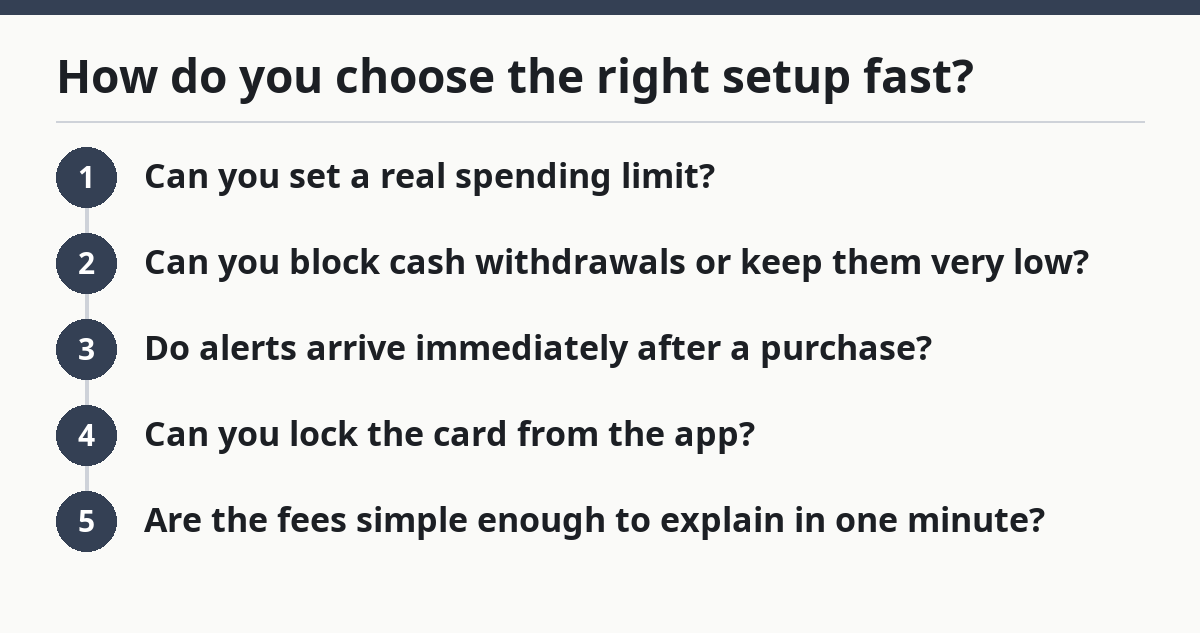
If the answer is yes to all five, the card is probably worth a closer look. If two or more answers are vague, keep shopping.
Use this rule of thumb:
- Choose a debit-style teen card if you want bank-like features and a path to fuller banking
- Choose a prepaid teen card if your main goal is a hard spending ceiling
- Choose neither if the provider hides fees, allows too much cash access, or offers weak app controls
You do not need the most features. You need the few features that stop the exact mistakes your teen is likely to make.
Which teen card controls should matter most by age?
Age changes the control mix because the goal changes. A younger teen needs more guardrails; an older teen needs more independence with visible limits.
Picture this: a middle-school student is buying lunch and school supplies, while a high-school student may need gas, work lunches, and online orders. The same control settings will frustrate one and fail the other.
For ages 13 to 14, prioritize hard limits, no ATM access, and alerts to the parent only. Merchant blocking matters here because impulse spending can happen fast and with little context.
For ages 15 to 16, add some spending freedom. Let the teen see the balance and learn to pace purchases. A small cash limit can work if the teen is responsible with it.
For ages 17 to 18, focus on realism. The teen should be able to manage ordinary purchases, track spending, and handle a card like a near-adult. The controls should teach self-management, not dependence.
- 13–14: tight cap, merchant blocks, no cash withdrawals
- 15–16: moderate cap, alerts, limited cash, online purchase rules
- 17–18: broader freedom, fast alerts, fewer blocks, stronger budgeting habits
This is where many generic guides get it wrong: they talk about “kids” as if a 13-year-old and an 18-year-old need the same setup. They do not. One is learning rules. The other is rehearsing adulthood.
The honest verdict
Choose a debit-style teen card if you want bank-like features, direct deposit, and a card that can grow with a teen who is earning money. Choose a prepaid teen card if your main goal is a hard spending ceiling and simpler control. Neither if the fee sheet is muddy, the app is weak, or cash access is too easy.
Picture this: you want a tool that keeps spending visible and bounded without turning every purchase into a crisis. The right choice is the one that matches the teen’s age, money habits, and need for independence.
The cards that win here are the ones that combine a real limit, fast alerts, a freeze button, and a clean fee structure. The cards that lose are the ones that talk about control but make the parent hunt through menus to use it.
- Best fit for younger teens: prepaid or parent-managed setup with strict controls
- Best fit for older teens: debit-style card with clear app visibility and controlled freedom
- Best fit for cash-heavy habits: neither, unless the ATM rules are tight
- Best fit for messy fee schedules: none of them
That is the cleanest way to think about it. The card is not the point. The control is.
What should I check before I open one?
Check the fee schedule, the app controls, the cash rules, and whether alerts are instant. If those four are weak, the card is not worth much, no matter how polished the homepage looks.
Picture this: you are one step from signing up, and the site says “great for families.” Good. That still tells you nothing about ATM limits, merchant blocks, or whether you can freeze the card in a second.
The fine print should answer these questions clearly:
- Is there a monthly fee?
- Are ATM withdrawals allowed?
- Can I set spending caps?
- Can I block categories or merchant types?
- Do alerts arrive right away?
- Is there a fee for replacement cards or instant transfers?
A strong teen debit card does not hide the answer to any of those. A weak one does.
For general consumer guidance on debit cards and fees, the Consumer Financial Protection Bureau is a solid place to check. For safer money habits, the FDIC also has plain-language guidance on managing youth banking and deposit accounts.
Can a teen debit card help build money skills?
Yes, if the controls are paired with real rules and regular review. A card alone does not teach money; the weekly conversation around it does.
Picture this: your teen sees a balance drop after a few small buys and has to decide what gets skipped next. That moment is the lesson. The card makes the trade-off visible.
The better setup shows the teen three things: how much came in, how much went out, and what is left. If the app shows merchant names and categories, even better. That makes the spending pattern easier to discuss without guesswork.
What should not happen is passive monitoring. If you only check the app after a problem, the card is just a cleaner version of cash. The value comes from review, not from surprise.
- Good teaching use: weekly review, visible balance, fixed allowance
- Poor teaching use: random top-ups, no conversation, no spending pattern
- Best habit builder: a teen who sees consequences before the money is gone
A teen debit card works best when it has enough control to prevent harm and enough freedom to create learning. That balance is the whole game.
FAQ
What spending controls should a teen debit card have?
A good teen debit card should have a spending cap, instant alerts, a freeze button, and some way to limit cash access. If the provider supports merchant blocks, that is even better because it can stop certain kinds of purchases without shutting the whole card down.
Is a prepaid card better than a teen debit card?
A prepaid card is better when you want a strict spending envelope and no overdraft risk. A teen debit card is better when you want bank-style features, direct deposit, and a setup that can grow with the teen. The better choice depends on whether simplicity or flexibility matters more.
Can I block certain stores on a teen card?
Some providers let a parent block categories or merchant types, but not all do. That feature depends on the app and the card network rules behind it. If store blocking matters to you, check for it before opening the account, not after.
Should a teen have ATM access?
Only if cash use is part of normal life and the withdrawal limit is low. ATM access is one of the easiest ways for spending to slip out of view. If a teen does not truly need cash, blocking it is usually the cleaner move.
What is the biggest mistake parents make?
The biggest mistake is choosing a card for the app design or marketing instead of the actual controls. A flashy dashboard means very little if the card has weak limits, fuzzy alerts, or surprise fees. The control list matters more than the logo.
Drafted with AI; not yet reviewed by a person.