Last updated: November 19, 2026
Quick Answer: the teen account fees and money movement — The Complete Guide usually comes down to four cost points: monthly fees, ATM fees, transfer fees, and service fees. A teen account can look free and still charge for out-of-network ATM use, instant transfers, wires, or replacement cards. In many setups, ACH takes one to three business days. Internal transfers are usually faster.
Key Takeaways
- Teen account fees usually come from monthly charges, ATM use, transfers, and service add-ons.
- The most common pattern is no monthly fee, with charges appearing outside preferred channels.
- Teen accounts usually move money four ways: transfers, card purchases, ATM withdrawals, and P2P payments.
- A bank-linked teen checking account often fits families that want fewer surprises at checkout.
Teen accounts are usually cheapest when they stay inside one bank or app, but money movement can trigger fees, delays, or outright blocks if the transfer route is wrong. The real question is not just “what does the account cost?” It is “how does money get in and out without surprise charges or failed transfers?” Teen account fees and money movement matter because a low sticker price can still lead to small repeated charges.
The first thing to check: what can actually cost money?
The answer is usually a mix of monthly account fees, ATM fees, transfer fees, and service fees tied to the way money moves. A teen account can look free on the surface and still cost money if it charges for paper statements, out-of-network ATM use, instant transfers, wire transfers, or replacement cards.
I look at teen banking as a two-part decision: the account itself and the rails it uses. “Money movement” means the paths money takes: ACH transfers, card-funded transfers, debit card purchases, P2P payments, ATM withdrawals, mobile check deposit, and sometimes wire transfers. Each path has its own rules, and some are limited for minors. Teen account fees and money movement should be evaluated together, not separately.
One more thing matters: parent controls. Many teen accounts are custodial or linked to a parent account, so the parent may be the legal owner or joint owner. That can change who can move money, who can freeze the account, and who is liable for fees. If a bank’s teen product is backed by a checking account rather than a prepaid card, it may also be covered by the bank’s standard fee schedule. Read that fee schedule, not just the marketing page. For example, the CFPB explains that account features and controls can differ sharply by product type.
A good starting point is the Consumer Financial Protection Bureau’s explanation of youth and checking accounts, which is useful for spotting fee traps and account-control issues: https://www.consumerfinance.gov/consumer-tools/bank-accounts/ . For transfer rules, the Federal Reserve’s Regulation E overview is worth reading because debit-card and electronic transfers have different protections than cash or paper checks: https://www.federalreserve.gov/consumerscommunities/consumer-protections.htm
Which fees show up most often on teen accounts?
The most common fee pattern is simple: no monthly fee, but a fee if the teen uses the account outside the bank’s preferred channels. That usually means out-of-network ATMs, instant transfer services, replacement cards, overdrafts or declined transactions, and wire transfers.
Monthly maintenance fees are the first line item to eliminate. Many teen accounts waive them if the account meets age rules or has a linked parent account, but not all do. If the bank charges a monthly fee, the account is usually a weaker choice unless there is a clear offset, such as strong ATM access or built-in spending controls.
ATM fees are the next big one. The bank may waive its own fee but not the operator’s surcharge, or it may limit reimbursements to in-network ATMs only. For a teen who buys snacks, rideshares, or school items in cash, ATM access matters more than a fancy budgeting screen. Teen account fees and money movement often become most visible at the ATM.
Transfer fees are easy to miss. ACH transfers are often free but slower, while instant transfers through app-based services may carry a fee or a percentage-based charge. Wire transfers are the most expensive option in many consumer bank systems, and many teen accounts do not support outgoing wires at all. That is not a flaw by itself; it is often a safety feature. But if a family expects to send rent help, tuition money, or urgent funds by wire, the account may not fit.
Overdrafts deserve special scrutiny. Many teen products block them entirely, which is good. A teen account that permits overdrafts can create fees faster than most families expect, especially if debit card authorization and final settlement do not match up. The safer product is the one that declines the transaction or lets a parent move money in before a fee hits.
How money movement really works in a teen account
Money moves through teen accounts in four main ways: linked transfers, card spending, ATM withdrawals, and person-to-person payments. The best account for a 14-year-old who gets allowance is not automatically the best account for a 17-year-old who needs to pay for gas and sports travel. Teen account fees and money movement vary with age and use.
Linked transfers are usually the backbone. A parent can move money from a parent checking account to the teen account, often by ACH transfer or an internal bank transfer. Internal transfers are the cleanest option because they are typically faster and less likely to get flagged. ACH transfers are still standard, but they can take one to three business days in many bank systems. If the teen needs money on Friday night, ACH timing matters.
Card spending is the easiest path for day-to-day use. It also creates the least friction, which is good until a card is used where the teen should not be spending. Some teen accounts let the parent freeze the card, set merchant limits, or get transaction alerts. Those tools matter more than a fee table if the account is meant for learning, not just storage.
ATM withdrawals are the most physical form of money movement, and also the most failure-prone. A teen account may allow withdrawals only with a debit card and only at certain ATMs. If the bank charges operator fees or limits reimbursements, that cash withdrawal can become a small but real leak in the budget.
P2P payments are where families need to read carefully. Some teen accounts allow sending money to approved contacts only, while others tie the teen to the parent’s P2P network. A younger teen may not be allowed to receive money from strangers or send funds to unknown accounts at all. That restriction is not a bug; it is part of the safety design.
The Honest Side-by-Side
A bank-linked teen checking account often fits families who want a real bank account with fewer surprises at the register. A prepaid-style teen card or app-linked account wins for families who want tighter controls and are willing to accept narrower movement options.
| Criteria | Bank-linked teen checking | Prepaid/app-based teen card | Winner for this condition |
|---|---|---|---|
| Monthly fee | Often waived for teens, but not always | Often marketed as no monthly fee, but check add-ons | Teens who need the lowest base cost |
| ATM access | Usually broader if the bank has a large network | Can be more limited or surcharge-heavy | Cash-heavy teens |
| Outgoing transfers | Usually better for ACH and scheduled transfers | Often more limited or tied to app rules | Families moving money on a schedule |
| Instant access to funds | Good for internal transfers, slower for ACH | Sometimes faster inside the app, but may cost extra | Parents who need same-day movement |
| Overspending risk | Can be controlled, but not always tightly | Usually tighter caps and controls | Young teens who are still learning limits |
| Cash deposit ability | Often possible at bank branches or ATMs | Frequently limited or unavailable | Teens paid in cash |
| Paper checks | Sometimes available | Usually not supported | Older teens who need checks for school or camp |
| Parent oversight | Strong, especially in joint or custodial setups | Often very strong through app controls | Parents who want alerts and freezes |
| Chance of hidden fees | Lower if the fee schedule is clear | Higher if instant transfers and cash access are used often | Families who value predictable costs |
| Best fit age | Usually better for older teens who can manage a full account | Usually better for younger teens or first-time users | First banking setup |
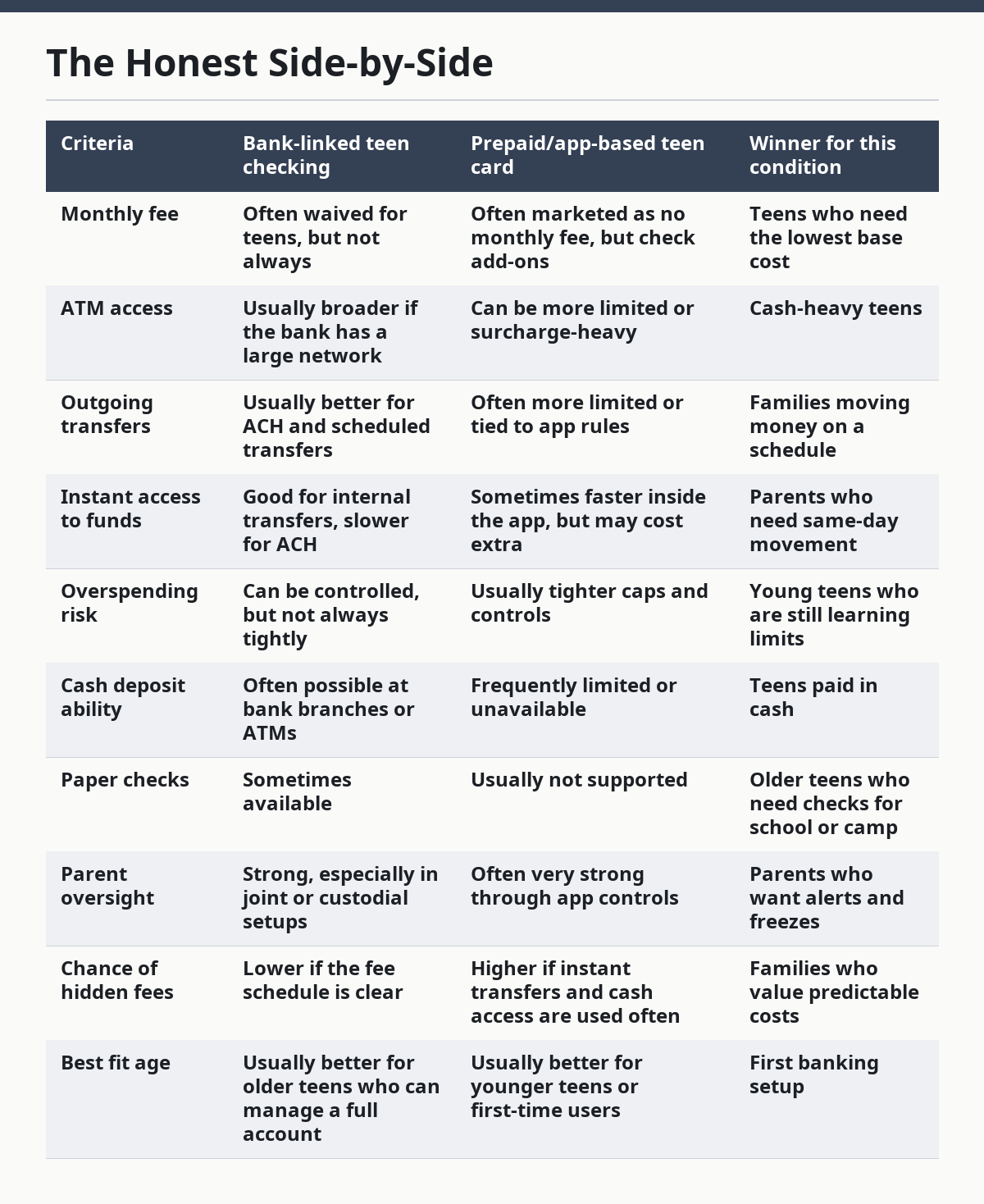
The table points to a practical rule: if the teen needs normal banking behavior, a bank-linked account usually wins; if the goal is strict control and simple spending, a prepaid or app-based teen card can be safer. The weakness of the bank-linked option is that it can be too much account for a younger teen. The weakness of the prepaid/app option is that money movement can be boxed in, so moving cash around may become annoying or costly. Teen account fees and money movement are easier to predict when the account matches the teen’s real habits.
Bank-linked teen checking: who should actually use it
A bank-linked teen checking account usually fits older teens, especially those who already need to handle part-time pay, school expenses, or travel money. The reason is simple: it behaves more like a real checking account, so the teen learns the same habits they will need later, including balancing available funds and understanding transfer timing.
This option usually makes the most sense when the family wants direct deposit, ACH transfers, cash withdrawals, and possibly check writing. It is also the better choice if the teen needs access to a broad ATM network or if the parent wants a familiar bank relationship instead of a standalone app. Many major banks offer teen or student checking variants, and those accounts are often available through the bank’s branch network and online banking platform, which gives the family more than one service channel. In practice, teen account fees and money movement can be simpler when everything stays in one bank.
The downside is that “real bank account” also means real bank rules. Some bank-linked teen products still charge for out-of-network ATM use, replacement cards, wire transfers, or paper statements. If the teen regularly uses cash or needs frequent instant transfers, those fees can pile up. The account can also be too flexible for a 13-year-old who needs simple guardrails. That is where overdraft risk, merchant exposure, and spending mistakes matter more than a polished interface.
A bank-linked teen account is wrong for a family that wants a very small blast radius. If the parent wants a closed system with tight caps, no paper checks, and very limited ways for money to leave the account, a full checking product may be more freedom than necessary. It is also a poor fit if the bank’s fee schedule is full of footnotes or if the ATM network is weak in the family’s neighborhood.
Prepaid and app-based teen cards: where they win and where they fail
A prepaid or app-based teen card wins when control matters more than full banking features. The main appeal is that the account is built around limits: spending caps, alerts, card freezes, and parent oversight are usually front and center. For a younger teen, that is often the right trade. The account can function as a training wheel system before a full checking account becomes useful.
The strongest use case is allowance, chores, small purchases, and travel money that needs to be kept on a short leash. If the teen mostly pays by card and the parent wants to approve transfers from a phone, this setup is easy to manage. It also reduces the chance of a large overdraft-style mistake because many prepaid systems do not allow spending beyond the balance.
The trade-off is money movement. A prepaid-style account may make it harder to deposit cash, send money to outside accounts, or receive funds from a wide range of sources. Some systems also limit ATM access, which means cash withdrawals can be inconvenient or expensive. If the teen is paid in cash from babysitting, yard work, or informal gigs, that cash has to go somewhere, and this type of account may not be the easiest landing place.
This option is wrong for families that need a full financial hub. It does not fit well if the teen must deposit cash often, write checks, accept complex transfers, or use banking services that look and feel like a standard checking account. It can also become annoying if the app’s transfer rules are too rigid. The convenience of the control layer should not hide the fact that the account may be narrower than it first appears.
How to avoid fees when moving money in and out
The best fee-avoidance move is to choose the transfer method that matches the account’s design instead of forcing money through the most expensive lane. Internal transfers between parent and teen accounts are usually the cleanest. ACH is the next best option for non-urgent movement. Instant transfer should be reserved for real urgency, not routine allowance funding. Teen account fees and money movement are often lowest when the family uses the account’s default rails.
Cash handling is where many families bleed small fees. If the teen is receiving cash, ask whether the account can accept cash deposits at a branch, bank ATM, or partner retail location. If not, the family may need a different account entirely. An account that cannot reasonably take in cash is not a good fit for a teen who gets paid that way.
ATM use should be planned, not improvised. If the bank has a fee-free network, use it. If it does not, consider whether the teen really needs cash at all. For most everyday spending, a debit card or mobile wallet is simpler and safer than repeated withdrawals.
The last fee trap is replacement service. A lost card, a paper statement request, or an expedited card replacement can carry a charge. That is not a reason to avoid the account, but it is a reason to set the teen up carefully from the start: enable alerts, turn on card locks, and keep the card in a dedicated place. Good setup saves more money than chasing the lowest headline fee.
When does the choice flip?
The overall recommendation flips in four situations. First, if the teen is under 15 and mainly needs allowance plus parent-controlled spending, the prepaid or app-based card often wins because it is easier to limit. A checking account can be too open-ended for that stage.
Second, if the teen gets paid in cash every week, the bank-linked account wins only if it supports low-friction cash deposits. If it does not, the right answer may be a different bank entirely, or a cash-friendly account structure.
Third, if the teen needs outgoing transfers for school, travel, or shared family expenses, the bank-linked account is usually better because ACH and scheduled transfers are more mature there. The app-based card can work, but only if its transfer rules do not block normal life.
Fourth, if the family is already using a bank with a broad ATM network and a clear teen fee schedule, there is less reason to accept the narrower feature set of a prepaid card. In that case, the checking account is the cleaner long-term setup.
These situations are not edge cases. They are the situations that decide whether the account helps the teen learn, or just adds friction.
The verdict: which one should you choose?
Choose bank-linked teen checking if the teen needs cash deposits, ACH transfers, ATM access, or a path toward normal banking habits. Choose prepaid or app-based teen cards if the teen is younger, the parent wants hard spending limits, and the family does not need full banking features. Neither if the teen must move cash in and out often and the product cannot clearly explain its fee schedule and transfer rules.
That is the clean decision. The right account is the one that matches how money actually moves in the family, not the one with the slickest app screen. Teen account fees and money movement are easiest to manage when the product fits the teen’s age and cash flow.
Can a teen account have no monthly fee and still charge for transfers?
Yes, and that is common. An account can waive its monthly maintenance fee while still charging for out-of-network ATM use, instant transfers, wire transfers, or replacement cards. The base account may be free, but the money movement layer is where fees appear.
Is it safer to use a teen account than a regular debit card?
Usually yes, because teen accounts often add parent controls, alerts, and spending limits. That said, safety depends on the setup. A badly configured teen account can still allow purchases, transfers, or cash withdrawals that the family did not expect.
What is the cheapest way to move money into a teen account?
An internal transfer from a linked parent account is usually the lowest-cost option, followed by standard ACH transfer. Instant transfer is convenient but may cost extra, and cash deposit methods depend heavily on the bank’s network and branch access.
Should a 16- or 17-year-old use a teen account or a normal checking account?
A teen account is better if the parent still wants oversight and the teen does not need a full standalone banking relationship yet. A normal checking account makes more sense when the teen is already handling direct deposit, regular bill payments, or frequent money movement without much parental control.
Do teen accounts let minors send money to friends?
Sometimes, but not always. Many teen accounts limit person-to-person payments, restrict recipients, or require parental approval. That limitation is common because banks and apps try to reduce fraud, mistaken transfers, and unauthorized spending.
Drafted with AI; not yet reviewed by a person.