Last updated: November 20, 2026
Quick Answer: A teen monthly spending plan works best when it has 5 parts: school costs, lunch, transportation, debit card spending, and a small reserve. How Teens Can Build a Monthly Spending Plan Around School, Lunch, and Transportation starts with those categories so money is assigned before the month gets busy.
A monthly spending plan helps teens cover school, lunch, and transportation without guessing at the end of the month. The How Teens Can Build a Monthly Spending Plan Around School, Lunch, and Transportation approach is to sort fixed costs first, then leave room for lunch, bus fare, gas money, and debit card spending. The steps below show how to set it up and what to check before money runs short.
Information only, not financial advice. Rates, limits, school rules, and card terms vary by country and can change, so a qualified adviser should be consulted for your own situation.
What a monthly spending plan should cover
A monthly spending plan for a teen should cover the money that gets used up on ordinary student life: school costs, lunch, transportation, and a little flexible spending. If you leave out one of those buckets, the plan looks neat on paper and fails by the second week.
A few common school months can feel tight when lunch costs, bus fare, and school fees all land close together. How Teens Can Build a Monthly Spending Plan Around School, Lunch, and Transportation works better when those costs are named before the month starts. It also tells you what gets paid first.
A simple setup usually includes these categories:
- School expenses: supplies, notebooks, lab fees, club dues, uniforms, and any required printing.
- Lunch money: cafeteria meals, packed-lunch items, or money loaded onto a school meal system.
- Transportation: bus fare, train fare, rides from a parent, or gas money if you drive.
- Spending money: small extras such as snacks, a cheap coffee, or a debit card purchase.
- Reserve: a small amount for a missed bus, forgotten lunch, or a school fee that appears mid-month.
You do not need a complicated budget app to start. A notebook, a notes app, or a simple spreadsheet works fine if you can update it 2 or 3 times a week.
What should a teen include in a monthly spending plan?
A teen should include fixed costs, repeat costs, and a small buffer in a monthly spending plan. Fixed costs are the amounts that do not change much from week to week, like a bus pass or a lunch top-up. Repeat costs change less often than daily spending but still show up every month, like school supplies or club fees.
You may only have a few dollars left after essentials, so the plan has to make each dollar do a job. How Teens Can Build a Monthly Spending Plan Around School, Lunch, and Transportation is easier when the monthly amount is divided before the week begins.
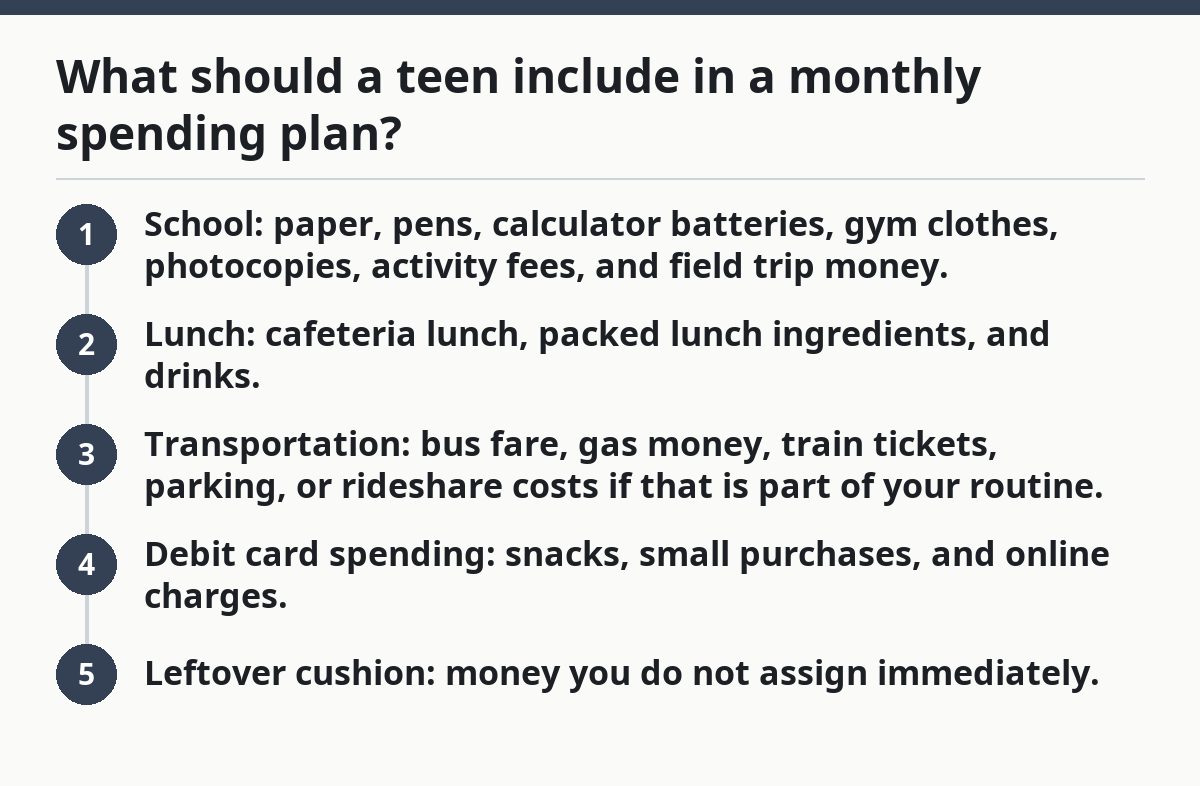
Use these categories when you set it up:
- School: paper, pens, calculator batteries, gym clothes, photocopies, activity fees, and field trip money.
- Lunch: cafeteria lunch, packed lunch ingredients, and drinks.
- Transportation: bus fare, gas money, train tickets, parking, or rideshare costs if that is part of your routine.
- Debit card spending: snacks, small purchases, and online charges.
- Leftover cushion: money you do not assign immediately.
A lot of generic advice skips the cushion. That is a mistake. A monthly spending plan with zero slack breaks the first time lunch costs more than usual or the bus route changes for a day.
For a solid reference on teen money habits and basic budgeting ideas, the Consumer Financial Protection Bureau has plain-language material on budgeting and youth money management, and the Money Advice Service in the UK offers useful budgeting guides for young people. For budgeting basics, see the CFPB’s budgeting resources at https://www.consumerfinance.gov/consumer-tools/budgeting/ and the MoneyHelper budgeting guide at https://www.moneyhelper.org.uk/en/money-troubleshooters/starting-to-budget/budget-planner.
How do you build the plan step by step?
You build it by listing your monthly needs, assigning amounts to each category, and checking the total against the money you actually have. Start with the basics, not the fun stuff.
A good way to begin is with what already happened last month. How Teens Can Build a Monthly Spending Plan Around School, Lunch, and Transportation becomes clearer when you use real costs, not guesses.
- List every school-related cost for the month. Write down supplies, club dues, uniform items, test fees, and any school payment due before the month ends. Verify that each item has a date or a usual pattern. A problem shows up if you rely on memory and forget a fee that arrives on the 12th.
- Write down your lunch cost pattern. Count how many school days you actually need lunch money for, including half-days and early dismissals. Verify whether you buy lunch every day or only on certain days. A problem shows up if your lunch line spending changes by $1 or $2 a day and you ignore it.
- Separate transportation from spending money. Put bus fare, train fare, gas money, or parking in its own line. Verify whether it is a daily cost, weekly cost, or monthly pass. A problem shows up if you mix ride money with snack money and run out before the week is over.
- Set a limit for debit card spending. Choose a small monthly amount for card purchases, then record each charge the same day. Verify that you can name what the card is for. A problem shows up if the card becomes a dumping ground for every small purchase.
- Add school extras that repeat. Include one-off charges that happen often enough to matter, like club snacks, spirit wear, or printing fees. Verify that these are not already covered somewhere else. A problem shows up if you count the same expense twice.
- Leave a buffer. Hold back a small amount for a late bus, a forgotten lunch, or a supply you had to replace. Verify that the buffer is still untouched at mid-month. A problem shows up if you spend it in the first few days on extras.
- Total the categories and compare them to your available money. Add school, lunch, transportation, debit card spending, and the buffer. Verify that the total is no more than the money you have for the month. A problem shows up if the total looks neat but exceeds your actual cash.
- Track spending twice a week. Check your plan on two fixed days, such as Wednesday and Sunday. Verify the remaining balance in each category. A problem shows up if you only look at the plan after the money is already gone.
If the total is too high, trim the flexible categories first. Lunch, snacks, and debit card spending usually give the most room without breaking school needs.
How do you budget for school expenses?
You budget for school expenses by treating them as planned costs, not surprise costs, and a qualified adviser can help if school charges are affecting a larger family budget. School charges often feel random, but many of them repeat by term, season, or activity.
A lab fee, art supply list, or gym uniform replacement can arrive with very little warning. How Teens Can Build a Monthly Spending Plan Around School, Lunch, and Transportation works better when those costs are placed in the plan before they show up.
Start with the items school expects from you:
- notebooks, folders, pencils, pens, and printer paper
- class fees or lab fees
- club dues or activity costs
- uniforms, gym clothes, and replacement items
- field trip money or permission-related costs
- printed work, if your school still charges for it
The trick is to spread the cost across the month instead of pretending it will stay small. If a school item is only needed once, you can still reserve money for it now. That keeps it from eating your transportation money later.
A common mistake is to put school costs in the “miscellaneous” bucket. That bucket disappears first. Give school its own category so you can see what it actually costs and whether it needs more room next month.
How do you handle lunch, bus fare, and gas money in the same plan?
You handle them by splitting each one into its own line and checking how often it happens. Lunch is food spending, bus fare is transportation, and gas money is not the same as pocket cash.
You can run out of ride money fast if lunch and transport are drawn from the same pile. How Teens Can Build a Monthly Spending Plan Around School, Lunch, and Transportation avoids that by keeping categories separate from the start.
Use these rules:
- Lunch: plan for school days only, and count any day you usually buy food at school.
- Bus fare or train fare: treat it as a commuting cost, not spending money.
- Gas money: if you drive or help cover fuel, set a clear amount for that and keep it apart from snacks.
- Back-up ride money: if you sometimes need a ride app or extra fare, keep a small reserve for that use only.
This matters because transportation is often non-negotiable. You cannot skip getting to school just because you wanted a snack. Lunch is more flexible, but it still needs a slot in the plan or it becomes a leak.
If your lunch changes often, use a weekly average and review it each Friday. If your bus fare is fixed, keep it in a separate envelope, note, or card balance. The format matters less than the separation.
What if the plan keeps falling apart?
The plan is probably too vague, too crowded, or too dependent on memory. Most teen spending plans fail because they try to cover school, food, and transportation with one loose number.
The usual pattern is simple: a few small charges, one higher lunch day, and one ride cost can wipe out a loose plan. How Teens Can Build a Monthly Spending Plan Around School, Lunch, and Transportation is more stable when the categories stay separate.
When should a teen change the structure?
A teen should change the structure when the same kind of expense keeps breaking the plan. If lunch overruns every week, the lunch category needs more space. If bus fare is draining the debit card, transportation needs its own line item. If school fees keep appearing, they need a school bucket with room for them.
Use these signs as your cue to change the setup:
- Lunch money is gone by midweek: lunch is under-budgeted — move more into food spending and reduce snack money.
- Gas money keeps coming from debit purchases: transportation is mixed with spending — split it into its own category.
- School fees surprise you each month: school costs are being treated as one-time costs — build them into the monthly plan.
- You cannot explain where the money went: tracking is too loose — write down each purchase the same day.
- The same category keeps going negative: the limit is too low — raise that line and reduce another one.
When a category fails the same way 2 or 3 months in a row, the answer is not to “try harder.” The answer is to change the structure.
The mistakes teens make with monthly spending plans
The worst mistakes are usually simple. They are also expensive in a small-budget way, which means they matter fast.
A plan that looks fine on paper can still break as soon as lunch, transportation, and school costs begin landing in the same week. How Teens Can Build a Monthly Spending Plan Around School, Lunch, and Transportation avoids that by making the categories visible early.
- Mixing lunch and spending money. The result is snack purchases eating the lunch budget. The better alternative is a separate food line.
- Ignoring school fees until they arrive. The result is money pulled from bus fare or lunch. The better alternative is a school category with room for repeat charges.
- Using the debit card for everything. The result is no clear record of where money went. The better alternative is to record card spending the day it happens.
- Making one monthly number and nothing else. The result is no control over categories. The better alternative is to split the budget into school, lunch, transportation, and flexible spending.
- Skipping the check-in. The result is discovering the shortage when it is too late. The better alternative is a 2-times-a-week review.
- Leaving no cushion. The result is one missed bus or one extra fee causing a chain reaction. The better alternative is a small reserve that stays untouched unless needed.
A spending plan does not need to be fancy. It needs to be specific enough to survive a normal school month.
A simple monthly spending plan you can keep using
A simple monthly spending plan is the one you can repeat next month without starting over. If the system takes more than a few minutes to update, it is too complicated for daily school life.
A clean version can stay small and still work. How Teens Can Build a Monthly Spending Plan Around School, Lunch, and Transportation only needs a few categories to stay usable.
A clean version might look like this:
- school costs
- lunch
- transportation
- debit card spending
- reserve
That is enough for most teens. If you need more detail, add one extra line for snacks or school activities, but do not split every purchase into its own bucket. Too many tiny categories make the plan hard to keep up with.
This is the same reason basic budgeting methods work: they are easy to review, and they show trouble early. A plan only helps if you can check it in under 5 minutes.
For more on the bigger picture of teen budgeting, the hub page on Teen Budgeting and Goal Planning — The Complete Guide can sit above this how-to and connect the pieces without repeating them.
Key takeaways
- Put school, lunch, transportation, and debit card spending in separate buckets.
- Treat school fees as planned costs, not random surprises.
- Keep bus fare and gas money away from snack money.
- Review the plan at least twice a week so small shortages show up early.
- If one category keeps failing, change the structure instead of forcing it.
Frequently asked questions
What should a teen include in a monthly spending plan?
A teen should include school costs, lunch, transportation, and a small amount for flexible spending. Those are the categories that usually shape day-to-day school money. A reserve line helps when a fee or ride cost appears with little warning.
How do you budget for school expenses?
You budget for school expenses by listing the costs that repeat during the month and setting money aside before they show up.
Drafted with AI; not yet reviewed by a person.