Last updated: November 21, 2026
Quick answer: A teen following up after a job interview with a thank-you message should send one short note within 24 hours, usually by email, and keep it to about 3 to 5 sentences. How Teens Can Follow Up After a Job Interview With a Thank-You Message works best when the note is short, polite, and specific. The message should be sent soon after the interview, sound natural, and mention one specific detail from the conversation.
Key takeaways
- A thank-you message is not a second interview; it is a quick follow-up that shows good job interview etiquette.
- Email is usually the safest choice for most teen jobs, while a text message works only if the interviewer used text first or clearly said it was okay.
- The note should be short, clear, and personal enough to show the teen paid attention.
- One specific detail from the interview makes the message feel real instead of copied from a template.
- A thank-you message can help, but it cannot fix a weak interview or change the need to wait for the hiring manager’s next step.
What should a teen send after the interview?
A teen should send a thank-you email after the interview unless the interviewer clearly invited a text message instead. The message is a small professional step, not a long letter, and it usually works best when it is sent the same day or the next day.
This is the right time to be polite and direct. A teen does not need to write a full story about why the job matters or list every strength from the interview. One or two short paragraphs are enough, and the goal is to leave the interviewer with a good final impression.
A thank-you message does three jobs at once. It says thank you for the interviewer’s time, reminds the hiring manager who the teen is, and confirms interest in the role. That matters after a first interview, when the interviewer may have spoken to several candidates in the same week.
The subject line should be plain. “Thank you for the interview” or “Thank you for your time today” is strong enough. A playful line or too much excitement can look careless.
For a teen, the biggest mistake is overexplaining. A 6-sentence email that sounds calm and specific will usually do more than a 2-paragraph essay stuffed with praise. The message should feel like a note from a prepared person, not a speech.
For basic business email structure, a useful writing reference is Purdue OWL’s guide to business letters and email formats: Purdue OWL business letters. For general interview follow-up advice, Indeed’s career guide also covers the thank-you note format: Indeed thank-you letter after interview.
Should a teen send a thank-you email or a text message?
A teen should usually send a thank-you email, because email is the standard choice for job interview follow-up and looks more professional in most hiring settings. A text message is better only when the interviewer used text to set up the interview, answer questions, or ask for follow-up that way.
Here is the simple comparison.
| Option | Best for | Good sign | Risk |
|---|---|---|---|
| Thank-you email | Most teen jobs, formal interviews, hiring manager follow-up | Looks organized and polite | Can sound stiff if copied from a template |
| Text message | Jobs that already use text, fast-moving hiring, direct permission | Feels quick and personal | Can seem too casual if no one asked for it |
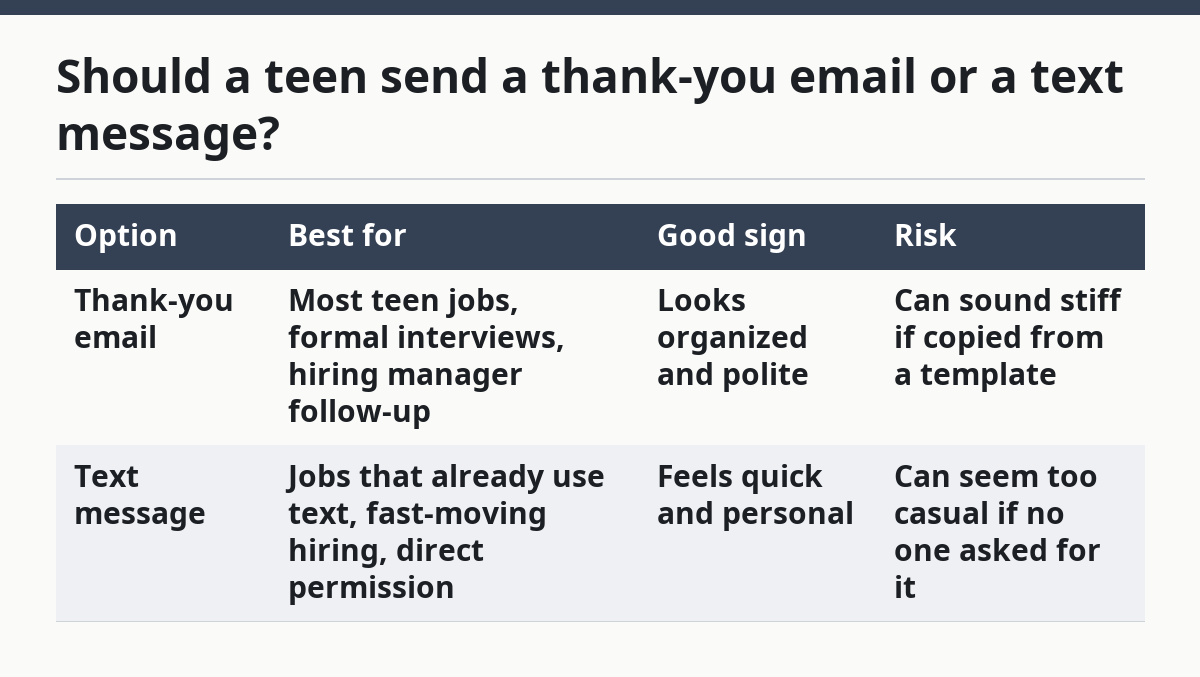
Email gives the teen room to write a full sentence, include the job title, and keep the message neat. It also fits a 24-hour follow-up window without interrupting the interviewer’s day. If the teen interviewed for a retail job, camp job, office helper role, or any job where the hiring manager already used email, email is the safer default.
Text can work, but it should be used carefully. A text should be very short, should not contain emoji or slang, and should only go to the number the interviewer already used for hiring. If the teen is unsure, email is the better choice.
A teen should not send both a text and an email unless the interviewer used both channels first and the teen has a clear reason. Double follow-up can feel pushy, even if the message is polite. One good message beats two messages that repeat the same thing.
Email usually fits a teen’s follow-up because it gives a little more room for the job title, the thank-you line, and one interview detail. Text is still useful when the hiring process already moved by text. For more teen job communication basics, see the related guide on teen job interview etiquette.
How long should the message be and what should it say?
A thank-you message should be about 3 to 5 short sentences, and it should say thank you, restate interest, and mention one detail from the interview. That length is long enough to feel thoughtful and short enough that the hiring manager can read it in under a minute.
A strong message follows a simple 4-part order:
- Say thank you for the interview.
- Mention the job title or the time of the interview.
- Add one specific detail from the conversation.
- Close by saying the teen is still interested and willing to provide more information.
A teen does not need fancy language. Plain words are better than sentences that sound copied from a guide. The best notes sound like a real person who listened carefully.
Here is a simple structure a teen can use:
- Hello [Name],
- Thank you for meeting with me about the [job title] position.
- I liked learning about [specific detail from the interview].
- I am still very interested in the job and appreciate your time.
- Sincerely, [Teen’s name]
The specific detail matters. It could be a part of the schedule, the team setup, the store’s focus, or one job duty the interviewer described. That one detail helps the interviewer remember the conversation and shows the teen was paying attention.
A teen should avoid three things: copying a long template word for word, writing like a friend on social media, and adding too many promises. A line like “I’m the best person for this job” can sound pushy. A line like “I really enjoyed learning about the weekend shifts and the training process” feels more grounded.
The note also should not try to solve every question the interviewer asked. If there was a tough moment in the interview, the thank-you message is not the place for a long defense. The follow-up should stay light, respectful, and useful.
A short note works because it can be read quickly and still feel personal. For interview follow-up help, a school counselor or career advisor can also review the wording before it is sent.
How can a teen write the note without sounding fake?
A teen can write a note that sounds real by using the interviewer’s name, one detail from the interview notes, and a plain tone that matches how the conversation went. If the interview felt formal, the message should be formal. If it was friendly, the tone can still be warm without turning casual.
The easiest way to keep it real is to use the teen’s own words for the middle sentence. Instead of writing “It was wonderful to connect with you in a meaningful way,” the teen can say “I liked hearing about the after-school schedule and the training you give new hires.” That sounds natural because it comes from the actual conversation.
Here is a practical step-by-step method:
- Open the teen’s interview notes and find the interviewer’s name, job title, and one detail mentioned in the conversation.
- Write one clean subject line for email, such as “Thank you for the interview.”
- Draft 3 to 5 sentences that say thanks, restate interest, and mention the detail from the interview.
- Read the note out loud once. If any line sounds like a speech or a commercial, cut it.
- Check the spelling of the interviewer’s name, the company name, and the job title before sending.
This process takes only a few minutes, but it can help prevent one common problem: a message that sounds polite yet generic. Interviewers notice generic notes because they could be sent to any job. A note with one real detail from the interview feels more credible. For more on clear professional writing, see Purdue OWL business letters.
A teen should also match the level of formality in the job setting. A thank-you note for a restaurant host position may be warm and short. A note for an office internship, even a teen one, should sound a little more polished. That difference matters because tone is part of job interview etiquette.
The main limit here is simple: sounding natural is harder if the teen waited several days and forgot the details. That is why the interview notes matter. A few words written right after the interview are better than memory alone.
What mistakes make a thank-you message weaker?
A thank-you message gets weaker when it is late, too long, too casual, or too vague, and each mistake can make the teen look less organized than another candidate. None of these errors is fatal on its own, but they chip away at the good impression the interview created.
The first mistake is waiting too long. A message sent much later than the interview can feel like an afterthought. The teen should send it while the conversation is still fresh, because that timing keeps the message tied to the interview.
The second mistake is writing a paragraph that tries to impress instead of communicate. Long notes bury the useful part. The hiring manager is not looking for a mini-essay; the person wants a quick, clear thank-you.
The third mistake is being too casual. A line like “Hey, thanks again :)” may fit a friend, but it can look sloppy in a job setting. Even for a teen job, a hiring manager usually expects full words, correct names, and no slang.
The fourth mistake is sending a message that could fit any interview. If the teen removes the job title and the specific detail, the note becomes forgettable. A generic thank-you message can still be polite, but it loses most of its value.
The fifth mistake is treating the message like a second pitch. In general interview guidance, the thank-you note should not repeat the entire interview or argue for the job again in heavy detail. That can make the teen sound anxious. A short note that confirms interest is enough. For more detailed follow-up guidance, Indeed’s interview advice also recommends keeping the note brief: Indeed thank-you letter after interview.
A useful rule is this: if the note needs more than one screen on a phone, it is probably too long. The best teen follow-up is tidy, specific, and easy to read. That is what makes it feel mature.
What should a teen do after sending it?
A teen should wait for the hiring manager’s next step, keep checking email or text messages, and avoid sending extra follow-ups unless the interviewer gave a timeline. The thank-you message is the last thing the teen should do right away, not the first of many pings.
If the interviewer said they would decide by a certain day, the teen can use that date as a guide. If no date was given, the safest move is to wait instead of asking every day for an update. That kind of pressure can hurt a good first impression.
This is where interview notes matter again. If the teen wrote down the name of the interviewer, the job title, and any next-step wording, the wait feels less confusing. A clear note such as “They’ll call by Friday” is easier to trust than memory alone.
A teen should also keep the message visible in the sent folder. That makes it easy to remember what was said if a reply comes later. If the hiring manager answers with a question, the teen can respond quickly and keep the same polite tone.
A teen should stay patient after sending the thank-you message. That keeps the follow-up tied to the interview instead of turning into repeated outreach. A note like this is one step in teen job readiness, not the whole process.
The message does not force a decision. It simply keeps the teen present in the hiring process and shows good habits that matter in a first job. That is why this page belongs in a larger teen work-readiness guide: it is one small step that teaches how to act like a reliable worker before the first shift even starts.
If you want the bigger picture of teen job readiness, the hub page on teen jobs, income, and work readiness pulls those parts together without repeating the same follow-up advice here.
Should a teen send a thank-you message after an interview?
Yes, a teen should usually send a thank-you message after an interview because it shows respect and keeps the conversation fresh in the hiring manager’s mind. A short email is the safest choice in most job settings. It does not need to be long; a few clear sentences are enough.
How long should a thank-you message be?
A thank-you message should be short enough to read in under a minute, usually just a few sentences. The teen should thank the interviewer, mention the job, and include one detail from the conversation. If the message fills more than one phone screen, it is probably too long.
What should a thank-you note say after a first interview?
A thank-you note after a first interview should say thank you, restate interest, and mention one specific part of the interview. It should sound polite and simple, not dramatic or overly formal. A line about the schedule, training, or a task discussed in the interview makes the note feel real and careful.
Is email better than text for a teen’s follow-up?
Email is usually better for a teen’s follow-up after a job interview because it is more standard and easier to keep professional. Text can work if the interviewer already used text or gave permission for it. If the teen is unsure, email is the better default.
What if the teen does not know what to write?
If the teen does not know what to write, the easiest approach is to use three parts: thank the interviewer, mention one interview detail, and restate interest in the job. A short note with plain words is better than waiting too long for a perfect version.
Drafted with AI; not yet reviewed by a person.