Last updated: November 21, 2026
Quick Answer: for most teens, the choice comes down to 2 things — a part-time job if steady hours and a predictable paycheck matter more, or a one-time gig if a flexible schedule matters more. How Teens Can Decide Between a Part-Time Job and a One-Time Gig is mostly about matching work to school, sports, and family commitments. A part-time job usually gives more structure; a one-time gig gives more freedom and less long-term commitment.
Key takeaways
- A part-time job fits teens who want repeat hours, a manager, and a clear routine.
- A one-time gig fits teens who want short commitments and schedule flexibility.
- Pay is usually easier to predict with a part-time job because the hours repeat.
- Taxes can be simpler to understand with a regular job, while gigs may bring extra self-employment tax questions.
- If a teen cannot promise the same hours every week, the gig option is usually the safer pick.
What is the real difference here?
The real difference is commitment: a part-time job ties a teen to an employer’s schedule, while a one-time gig ends after one task or one event. That difference changes almost everything else, from training to pay timing to how much a teen can count on the work. The U.S. Department of Labor’s YouthRules! pages are a good place to review youth work rules before choosing a job type, and the department says 14- and 15-year-olds have hour limits under federal law.
A part-time job is better when a teen wants a set routine and a chance to learn how a workplace runs over time. A one-time gig is better when the teen needs freedom and does not want a standing shift every week. The wrong choice is the one that fights the rest of the teen’s life, especially school, sports, chores, or family responsibilities.
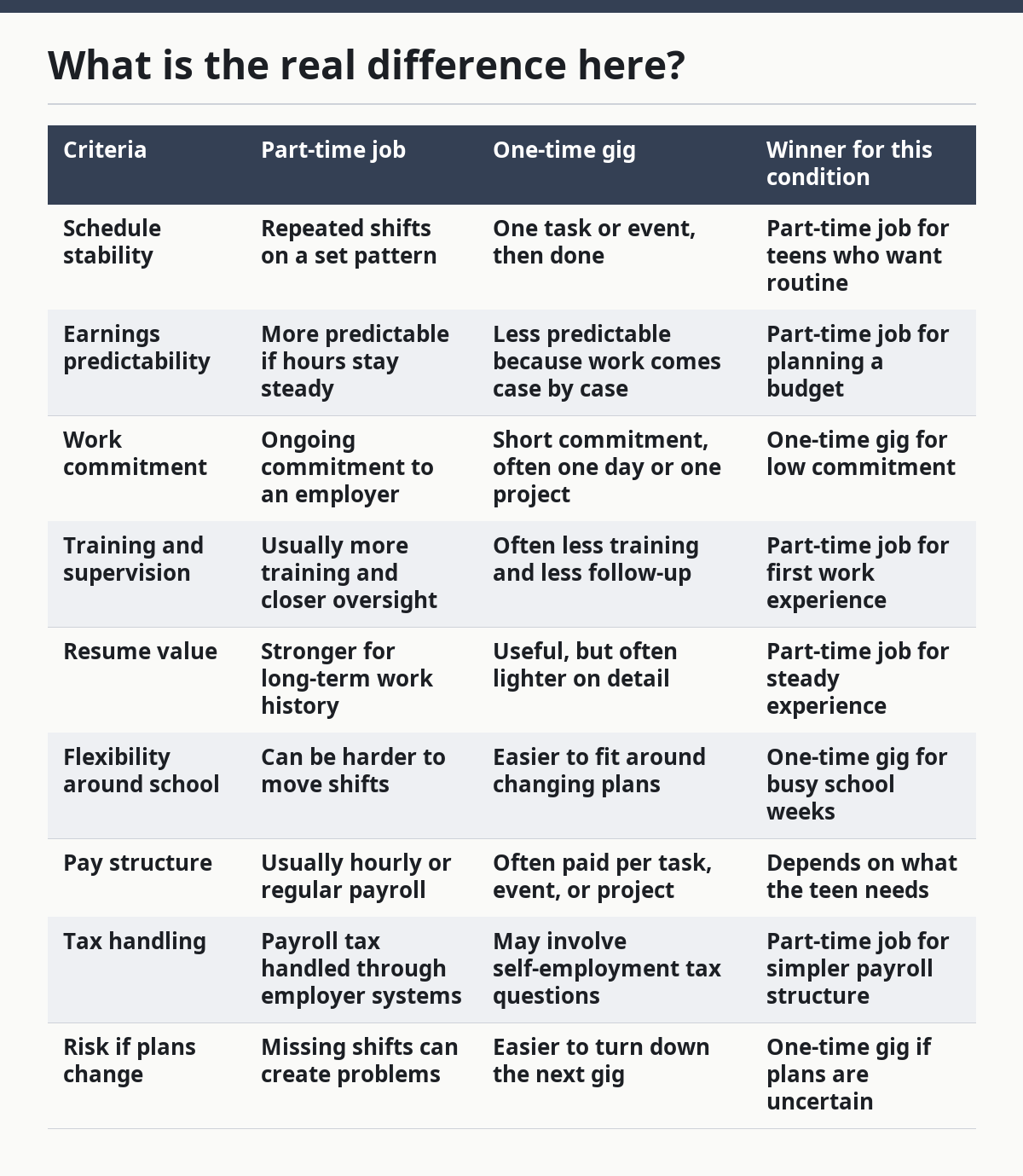
Here is the comparison that matters most:
| Criteria | Part-time job | One-time gig | Winner for this condition |
|---|---|---|---|
| Schedule stability | Repeated shifts on a set pattern | One task or event, then done | Part-time job for teens who want routine |
| Earnings predictability | More predictable if hours stay steady | Less predictable because work comes case by case | Part-time job for planning a budget |
| Work commitment | Ongoing commitment to an employer | Short commitment, often one day or one project | One-time gig for low commitment |
| Training and supervision | Usually more training and closer oversight | Often less training and less follow-up | Part-time job for first work experience |
| Resume value | Stronger for long-term work history | Useful, but often lighter on detail | Part-time job for steady experience |
| Flexibility around school | Can be harder to move shifts | Easier to fit around changing plans | One-time gig for busy school weeks |
| Pay structure | Usually hourly or regular payroll | Often paid per task, event, or project | Depends on what the teen needs |
| Tax handling | Payroll tax handled through employer systems | May involve self-employment tax questions | Part-time job for simpler payroll structure |
| Risk if plans change | Missing shifts can create problems | Easier to turn down the next gig | One-time gig if plans are uncertain |
When does a part-time job win?
A part-time job wins when a teen can keep the same schedule for weeks at a time and wants the biggest learning payoff from working. That is the better choice for someone who can say yes to a fixed shift and stick with it. It is also the better option for teens who want to learn how an employer sets rules, trains workers, and expects follow-through.
That stability has a real upside. A regular shift makes it easier to plan around homework, sports practice, and family time because the pattern is known in advance. It can also help a teen build a work history that looks steady, which matters more than a single short task when a future employer wants proof that the teen can show up.
The weakness is the same thing that makes it strong: commitment. If school starts pushing later hours, if a sport adds weekend events, or if family plans change often, a part-time job can start to feel tight. Missing shifts or asking for frequent changes can create stress for both the teen and the employer.
A part-time job is not the best choice for a teen who needs to keep weekends open or who cannot promise a repeat schedule. It is also not ideal for a teen who wants to work only once in a while. In those cases, the structure that helps one student can become a burden for another.
When does a one-time gig win?
A one-time gig wins when the teen’s schedule changes a lot and the main goal is flexibility, not routine. That makes it a better fit for teens who cannot commit to the same hours every week or who want work that ends after one event, one day, or one assignment. The smaller commitment is the whole point.
This option also reduces the pressure of being “on” every week for the same employer. A teen can take a gig when there is room and skip it when school, travel, or family needs get busy. That is useful when the teen wants to earn money without locking into a standing shift that might become a problem later.
The downside is uneven pay. A gig can bring money fast, but it may not come on a reliable schedule. That makes it harder to budget for something that needs regular payments, like saving from each paycheck for a goal with a fixed deadline. The teen also gets less practice with an ongoing boss relationship, which means less training and fewer chances to learn a workplace over time.
A one-time gig is not the best choice for a teen who wants a predictable paycheck or who needs a clear path into a first job. It is also weaker for building a long, steady work record. One short task can still count, but it does not teach the same habits as showing up week after week.
How do taxes and paychecks differ?
Taxes and paychecks differ because a part-time job usually runs through an employer’s payroll, while a one-time gig may raise self-employment questions. For a regular job, the employer typically handles payroll withholding. For a gig, the teen may need to sort out tax responsibilities differently, which is why the IRS self-employment pages matter.
That difference matters even when the work itself looks simple. A paycheck from a part-time job usually feels more familiar because the employer does the payroll setup. A gig can pay quickly, but the teen may have to keep better records and pay closer attention to how the money is reported. The IRS explains self-employment tax on its Self-Employed Individuals Tax Center, and that is the kind of page a teen or parent should read before assuming the gig side is easier.
The trade-off is plain: a job is usually cleaner on the payroll side, while a gig can be messier even when the work is short. That does not make gigs bad. It just means the money side is not always as simple as “one task, one payment.”
For teens, this is one of the biggest reasons to pick the job if the goal is a first work experience with fewer moving parts. A gig can still make sense, but it asks for more attention to records and tax handling.
Which option teaches more?
A part-time job usually teaches more because the teen repeats the same workplace habits over time. That includes showing up on time, taking direction, handling customers, and working with the same employer again and again. Repetition is where many first-job lessons stick.
A one-time gig teaches a different lesson: how to finish a task and move on. That can still matter, especially for teens who want practice with responsibility and quick turnarounds. But the learning is narrower because the teen may not get the same kind of feedback, training, or team experience that comes from staying in one job longer.
This is why a job is often the stronger choice for a teen who wants a first real work reference or a fuller resume. The employer can point to a longer stretch of work, not just one completed assignment. A gig can help, but it is usually less convincing as proof that the teen can handle regular responsibilities.
There is one exception. If the teen already has a heavy load from school and activities, the best lesson may be learning to balance time without overcommitting. In that case, the smaller footprint of a gig can be the smarter first step.
Part-time job vs one-time gig: who should choose what?
A part-time job is better for a teen who can keep a repeat schedule, wants a steadier paycheck, and wants stronger experience with an employer. A one-time gig is better for a teen who needs flexibility, does not want an ongoing commitment, and would rather work around school than build a fixed weekly routine.
The recommendation is not vague. If the teen can handle the same hours most weeks, choose the job. If the teen cannot promise that, choose the gig. The decision should follow the calendar, not the wish for the “best” option on paper.
When should a teen change course?
A teen should change course when the first choice starts colliding with real life. If a part-time job starts causing missed classes, late homework, or constant schedule stress, a one-time gig may fit better. If a gig leaves the teen with too little work, too much uncertainty, or no clear routine, a part-time job may be the better move.
Another reason to switch is experience. A teen who starts with a gig may later want steadier income and more learning. A teen who starts with a job may later need more freedom during sports season or exam weeks. The first choice does not have to be permanent.
The clearest warning sign is this: if the teen cannot explain when they are free for the next few weeks, a part-time job may be the wrong pick. If the teen can explain a stable weekly pattern, a job usually makes more sense than chasing one-off work.
For a broader map of teen money topics, the hub on teen jobs, income, and work readiness is the right place to go next, including pages on teen jobs, summer jobs, and teen money basics.
Which one should a teen choose first?
Choose a part-time job if school hours are stable, the teen wants regular pay, and the teen can commit to a repeated schedule. Choose a one-time gig if the teen’s week changes often, the teen wants short commitments, or the teen cannot promise ongoing shifts. Neither if the teen is already overloaded and would have to sacrifice sleep, schoolwork, or basic obligations to make either one work.
Which is better for a teen first job?
A part-time job is usually better for a teen first job because it teaches the basics of showing up, following a schedule, and working with an employer over time. A one-time gig can still be useful if the teen needs flexibility, but it gives less practice with repeat responsibility and less steady guidance.
What is easier to fit around school?
A one-time gig is usually easier to fit around school because it does not require the same weekly commitment as a part-time job. A part-time job can still work if the hours are fixed and predictable, but it becomes harder when tests, sports, or club events change week to week.
How do taxes differ between a job and a gig?
A part-time job usually runs through employer payroll, while a one-time gig may involve self-employment tax issues. The IRS has guidance on self-employment tax, and that matters because gig income may require more recordkeeping. A parent or teen should review the tax rules before assuming the payment setup is the same.
Drafted with AI; not yet reviewed by a person.