Last updated: November 19, 2026
Quick answer: a teen budget works best when you track every dollar you get, split it into 3 to 5 simple categories, and plan for the next 7 days instead of a whole month. Start with what money you actually have, not what you hope will show up.
What a teen budget needs to do
A teen budget needs to tell you three things: how much money you have, what you must spend it on, and what you can still spend without running out. That is the part most people skip.
This is not adult household budgeting. A teenager often has irregular income from chores, babysitting, gifts, allowance, or part-time work, and the amount may change every week. That means a monthly budget can feel fake. A week-by-week budget usually works better because it matches the way the money arrives.
A good teen budget also has a low-stress setup. It can be done on paper, in a notes app, or in a simple spreadsheet. You do not need an expensive app or a complicated system to make it work. If a budget takes more than about 10 minutes a week to update, most teens stop using it.
The point is control, not perfection. If you know that $20 is for lunch, $10 is for weekend spending, and the rest is for a specific goal, you stop guessing and start choosing. That is the whole job of a teen budget.
If you want a broader foundation for how money works, the hub on [how money works for teens] should sit next to this guide, not instead of it.
How do I start a teen budget?
Start by writing down the money you already have and the money you expect before the next reset, such as the next Friday or the next payday.
Use this in order:
- List every source of income for the next 7 days. Include allowance, cash gifts, chore money, babysitting, tutoring, or part-time shifts. Write the amount you have now and the amount you expect, then circle the money that is already in your hand or account.
- Separate fixed spending from variable spending. Fixed spending is the same each week or month, like a school lunch contribution, a phone bill you pay to a parent, or a bus pass. Variable spending changes, like snacks, rides, or hanging out with friends. When this works, the fixed items are obvious and the variable items are the ones left over.
- Choose 3 to 5 categories only. A teen budget gets easier when it has fewer buckets: spending, saving, school, fun, and one sinking fund. If you use 8 categories, you will spend more time sorting than budgeting.
- Assign every dollar a job. Give each dollar a category before you spend it. If you have $30, decide now how much goes to spending, how much stays in cash, and how much sits in a debit card balance or envelope for later.
- Check the total against your actual balance. Your categories should add up to the money you truly have. If they do not, cut a variable category first, not the money for school or a planned bill.
When this step works, your budget fits on one page and you can explain it in under a minute. If you cannot do that, it is too complicated.
Build the budget around irregular income
A teen budget should be built on your lowest reliable amount, not your best week.
That is the trick for irregular income. If you get $15 one week and $60 the next, do not budget as if the $60 week is normal. Use the smaller, steadier number as your base and treat extra money as bonus money, and if your situation is not typical, consider checking with a financial counselor, parent, or other qualified professional before you lock in the plan. That keeps your budget from breaking the first time income drops.
A simple way to handle this is to split money into two layers:
- Base money: the amount you can count on most weeks
- Bonus money: cash that shows up sometimes, such as birthday money, extra shifts, or a one-time payment
Base money should cover the things that matter most, even if it is only $10 or $20 at a time. Bonus money can go to a sinking fund, a bigger goal, or extra fun spending. A sinking fund is just money set aside for a known future expense, like a yearbook, a sports fee, or a school trip.
This is where a budget gets real. If you wait until the week you need the money, the purchase feels expensive all at once. If you save a little each time, the same expense feels smaller because it is spread out.
One honest limitation: if your income changes every week, a strict “save 20 percent” rule may not fit. A percentage can be useful, but only after you cover the basics you actually need. The better rule is to fund your next known expense first, then save what remains.
A cash-based envelope method can help here. Put cash into separate envelopes labeled with your categories. Cash makes spending visible, which helps if you tend to lose track of card swipes or small purchases. The downside is that cash is less convenient online and does not help if your money is already in a debit card account. If you use a card, the same idea still works as digital buckets in a notes app or spreadsheet.
How to budget as a teenager with the envelope method
The envelope method works for teens when it stays simple: one envelope per category, one week at a time.
You do not need a stack of 12 envelopes. Start with 3 or 4:
- Spending
- Saving
- School
- Sinking fund
Put cash in each envelope at the start of the week. If you use a debit card instead of cash, label the categories on paper and treat the card balance as your total pool, and if you are unsure how to structure it, it can help to ask a parent, guardian, or financial professional for guidance. The method is the same either way: once the envelope is empty, that category is done until the next refill.
This works best for categories with clear limits. Spending $12 on snacks is visible. A digital subscription or a card payment can hide the same amount because it does not feel like cash leaving your hand. That is why some teens use cash for fun money and a debit card for anything they must pay online.
The envelope method is not for everything. It is awkward for recurring bills that do not fit neatly into a week, and it can be too rigid if your parent pays some costs directly. It also fails if you keep borrowing from one envelope to cover another and never write the transfer down. If you do that, the envelopes stop being a budget and become a guessing game.
To keep it useful, give each envelope a rule. For example: spending money can be used anytime, school money is only for school items, and sinking fund money is not touched unless the thing you saved for is due. That one rule does more than fancy category names.
Track spending before it disappears
A spending tracker works only if you log purchases the same day, because small amounts vanish fast.
Use a notebook, a phone note, or a spreadsheet with four columns: date, item, category, amount. That is enough. If you want to make it even easier, keep the tracker in the same place you keep your budget so you do not have to search for it.
Write down every purchase under a small amount threshold, even if it feels silly. A $3 snack, a $5 ride share from a parent, or a $2 school purchase can make a category drift faster than you expect. You do not need to track every penny forever, but you do need a full picture for a week or two before the system starts to make sense.
A good tracker shows patterns. After 2 or 3 weeks, you may notice that “fun” is really snacks, drinks, and small online buys. That matters because one category often hides another. If you only label spending as “miscellaneous,” the budget gives you no useful signal.
This is also where fixed vs. variable spending becomes practical. Fixed spending should repeat with little change. Variable spending should be the first place you cut if money runs low. If you track for a few weeks, you can see which costs are truly fixed and which ones only feel fixed because they happen often.
The downside of tracking is friction. If you make the log too detailed, you will quit. If the tracker takes more than 2 minutes per purchase, it is probably too complicated for a teen budget.
How to plan week to week without getting stuck
Week-to-week planning means you decide what this week’s money must do before you spend on extras.
Start each week with three questions:
- What money is available right now?
- What has to be paid before next week?
- What can wait?
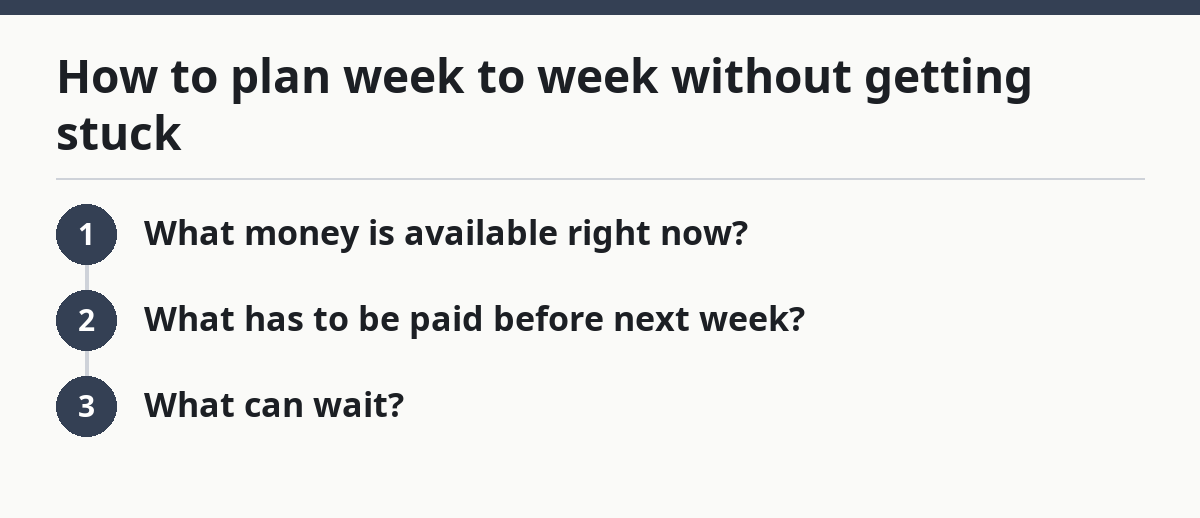
That gives you a real order. First, cover anything tied to school, transportation, or a known promise. Next, set aside sinking fund money for a future cost that is already coming. Last, decide what is left for spending.
A weekly plan works better than a monthly one because a teenager’s money often arrives in chunks. A monthly budget can look neat on paper and still fail in real life if the cash comes in on different days. Weekly planning reduces that mismatch.
Use a simple pattern:
- Monday or the day your money arrives: count cash and card balance
- Set aside fixed spending first: anything you already know you need
- Refill one sinking fund: even a small amount matters
- Leave room for one flexible category: fun, food, or personal spending
The trade-off is that weekly planning feels less “finished” than a monthly budget. It changes more often. That is not a flaw; it is the point. Teen budgets should be flexible enough to handle a canceled shift, a birthday gift, or an unexpected school cost.
If you are tempted to plan for the whole semester, stop. A shorter cycle is easier to manage and gives you faster feedback. You learn more from four weekly checks than from one giant plan that sits untouched for 3 months.
Common teen budgeting mistakes and what they cost
The biggest teen budgeting mistake is treating every dollar like it should be spent this week, and a teen budget only works if you resist that impulse.
That turns a budget into a leak. Money meant for a field trip, a replacement charger, or a gift gets swallowed by snacks and impulse buys. The fix is to name a category before you spend, even if the category is only “later.”
Another common mistake is using a budget that is too detailed. If a teen budget has separate buckets for every tiny thing, it becomes annoying to update and easy to abandon. The cost is not just time. It also creates fake precision, where the budget looks smart but does not actually guide decisions.
A third mistake is ignoring cash and card together. Many teens use cash for some purchases and a debit card for others, then only track one of them. That breaks the budget because the totals no longer match reality. The fix is to record both in one tracker, even if one is cash and the other is electronic.
A fourth mistake is saving only what is left over. In practice, “left over” often becomes nothing. If you have a sinking fund goal, move a small amount into it first, then spend what remains. Even $5 at a time is more useful than waiting for a perfect leftover.
This is not the right system for someone who hates tracking and never wants to look at numbers. If that sounds like you, a budget will still help, but only if it is extremely short and visible. The simpler the system, the more likely it survives a busy school week.
A teen budget example that stays small
A good teen budget can fit on one index card and still cover the basics.
Here is a simple structure:
- Income: write what you have now and what is likely to come in this week
- Fixed spending: school costs, transit, or anything promised
- Variable spending: snacks, outings, extras
- Sinking fund: one future cost
- Holdback: a small amount you do not assign yet
The holdback matters because teen income is irregular. If you assign every dollar immediately, the first surprise expense forces you to raid another category. Keeping even a small unassigned amount gives you breathing room.
Use cash for categories you overspend on easily, and use a debit card for money you need to keep available without carrying it around. If you keep both, the budget should show where each dollar lives. The money itself does not care whether it is cash or card; the budget does.
A teen budget is not supposed to make spending feel bad. It is supposed to make spending intentional. If you can look at your categories and know what is safe to use, the budget is doing its job.
Key Takeaways
- A teen budget works best when it follows how teen money actually arrives: unevenly and in small amounts.
- Start with the money you have now, then sort it into a few clear categories instead of dozens.
- The envelope method helps when you want spending limits you can see, especially for cash.
- A spending tracker only works if it is simple enough to use the same day.
- Weekly planning is usually a better fit than monthly planning for teens with irregular income.
How does a teen make a simple budget?
A teen makes a simple budget by listing current income, choosing a few categories, and assigning money to each one before spending. Start with 3 to 5 buckets, such as spending, saving, school, and a sinking fund. If the plan takes more than 10 minutes to update, it is probably too detailed.
How much should a teen save each month?
A teen should save an amount that fits the money actually coming in, not a fixed number copied from adult advice. If income is irregular, it is better to save from bonus money or set aside a small amount each time you get paid. For bigger future costs, a sinking fund is usually more useful than a percentage rule.
What is a good budget for a teenager?
A good budget for a teenager is one that matches weekly income, covers known costs, and leaves room for normal spending without overshooting. It should be simple enough to use with cash or a debit card and flexible enough to handle changes. If it helps you stop guessing, it is a good budget.
Drafted with AI; not yet reviewed by a person.