Last updated: November 19, 2026
Key Takeaways
- Teen paycheck taxes are taken out before the teen gets paid, so the first check can look smaller than the hourly rate.
- Federal income tax is the amount withheld toward the worker’s yearly federal tax bill.
- The W-4 form tells payroll how much federal income tax to withhold from a teen’s wages.
- A first pay stub is easiest to follow when the teen reviews wages, taxes, and final pay in order.
Quick Answer

Teen taxes on a first paycheck usually mean federal income tax, social security tax, and medicare tax are withheld before the money is paid out. The first check can be lower than expected because withholding starts right away, and the amount depends on the W-4 form and the pay period dates.
Teen paycheck taxes are usually smaller and simpler than a first-time worker expects, but they still show up as deductions on a pay stub. This guide on How Teen Taxes Work on a First Paycheck explains what those deductions mean, how the W-4 form affects withholding, and when a refund is possible. It is information, not financial advice; tax rules change by country and over time, so a qualified adviser or tax professional should be consulted for your own situation.
Who this guide is for
This guide is for a teen who has just started a job, gotten a first pay stub, and wants to know why the gross pay and the net pay are different. It assumes there is already a job offer or first shift, a pay stub or online payroll screen to inspect, and basic contact details for payroll. It also assumes the reader is in a country where wages can be subject to federal income tax, social security tax, and medicare tax; those names are used here because they are the standard U.S. payroll terms.
This is not the right article if the question is about budgeting that paycheck, negotiating hours, or choosing how to spend the money. It is also not a substitute for a tax professional if the teen has more than one job, unusual tax status, or cross-border income. A first paycheck can be straightforward, but the details depend on the employer’s payroll system, the W-4 form, and local law.
The right way to read this is simple: look at the wage statement line by line, match each deduction to the name of a tax, and check whether the withholding looks reasonable for the information that was given on the W-4. The official IRS page on Form W-4 is the place to verify the current federal form, and the Social Security Administration explains how social security wages are reported.
How teen paycheck taxes are taken out

Teen paycheck taxes are withheld before the money reaches the teen, which is why a first check can feel smaller than the hourly wage suggests. The paycheck usually starts with gross pay, which is the amount earned before deductions, and then subtracts taxes and any other withholdings. The result is net pay, which is the amount actually paid out.
The core idea is withholding. Withholding means the employer sends part of the wage to the government instead of paying all of it directly to the worker. On a typical pay stub, the tax lines may include federal income tax, social security tax, and medicare tax. Some states and cities also take income tax, but those rules vary, and not every teen will see those lines on the first stub.
A teen usually completes a W-4 form when starting a job. That form tells payroll how much federal income tax to withhold based on the information entered there. It does not decide whether tax is owed forever; it sets the amount taken from each paycheck during the year. If the form is left incomplete or filled out in a way that does not match the teen’s situation, withholding can be too high or too low.
The first pay stub can be confusing because pay periods do not always line up neatly. A weekly payroll cycle, for example, may cover 7 days of work, while a biweekly cycle covers 14 days. A teen who starts in the middle of a pay period may see only part of a week’s wages, then still see taxes taken from that smaller amount. That is normal. What is not normal is a stub that lists deductions the teen never authorized, or a pay amount that does not match the hours worked.
What does each deduction on a pay stub mean?
Each deduction on a pay stub has a name, a purpose, and a place on the form, and the three most common tax lines are federal income tax, social security tax, and medicare tax. Federal income tax is the amount withheld toward the worker’s federal tax bill for the year. Social security tax funds the old-age, disability, and survivor system. Medicare tax helps fund hospital insurance under the federal Medicare program. Those are payroll taxes, and they are not the same thing as a store receipt or a sales tax.
The pay stub usually shows these items in a fixed order, but the exact layout depends on the payroll software. A common format includes gross pay, then pre-tax deductions if any, then taxes, then post-tax deductions, then net pay; if the stub is unclear, the IRS Publication 15 and a payroll professional can help confirm the order. Some stubs also show year-to-date totals, which are helpful because they show how much has been withheld since January 1.
A first-time worker should not assume every deduction is a tax. Union dues, retirement contributions, uniforms, and health-plan premiums can appear too, depending on the job. A 16-year-old filing a first W-4 may see only the federal line, while another teen may see all three payroll taxes plus state withholding. The difference is not proof that one stub is wrong. It usually reflects the employer, the state, and the form on file.
The important check is whether the names line up with the right category. If “federal income tax” is listed, that is a withholding item. If “social security” appears, it should match the payroll tax category, not a voluntary deduction. A paycheck with a line labeled “miscellaneous tax” or “training fee” deserves a question to payroll immediately, because vague labels are how errors hide.
What is the W-4 form for teens?
The W-4 form tells payroll how much federal income tax to withhold from a teen’s wages. It is the federal withholding certificate, and for a new hire it is usually completed once at the start of the job and updated if the teen’s situation changes. The IRS publishes the current version and instructions, and employers use that information to calculate withholding under the payroll system.
The form matters because withholding is not the same as the final tax bill. A teen with too much withheld may get some back later as a tax refund after filing a return, while a teen with too little withheld may owe money at tax time. The W-4 does not create the tax; it adjusts the amount taken out during the year.
For a teen, the form is often simple, but simple does not mean careless. The information has to be accurate enough for payroll to process it correctly: name, address, tax filing status if required by the form, and any other requested details. If a teen has more than one job or a parent claims the teen as a dependent, the W-4 can become more sensitive to errors. That is one reason the IRS instructions matter more than guesswork.
A common mistake is to treat the W-4 like a one-time form with no consequences. In reality, it can change the size of each paycheck immediately. If the withholding is set too high, the teen gets less money each pay period. If it is set too low, the teen may have a surprise when tax filing season arrives. That trade-off is the whole point of the form, and it is why payroll offices ask for it before the first check is issued. If the teen is unsure, the IRS instructions or a tax professional are the safest reference.
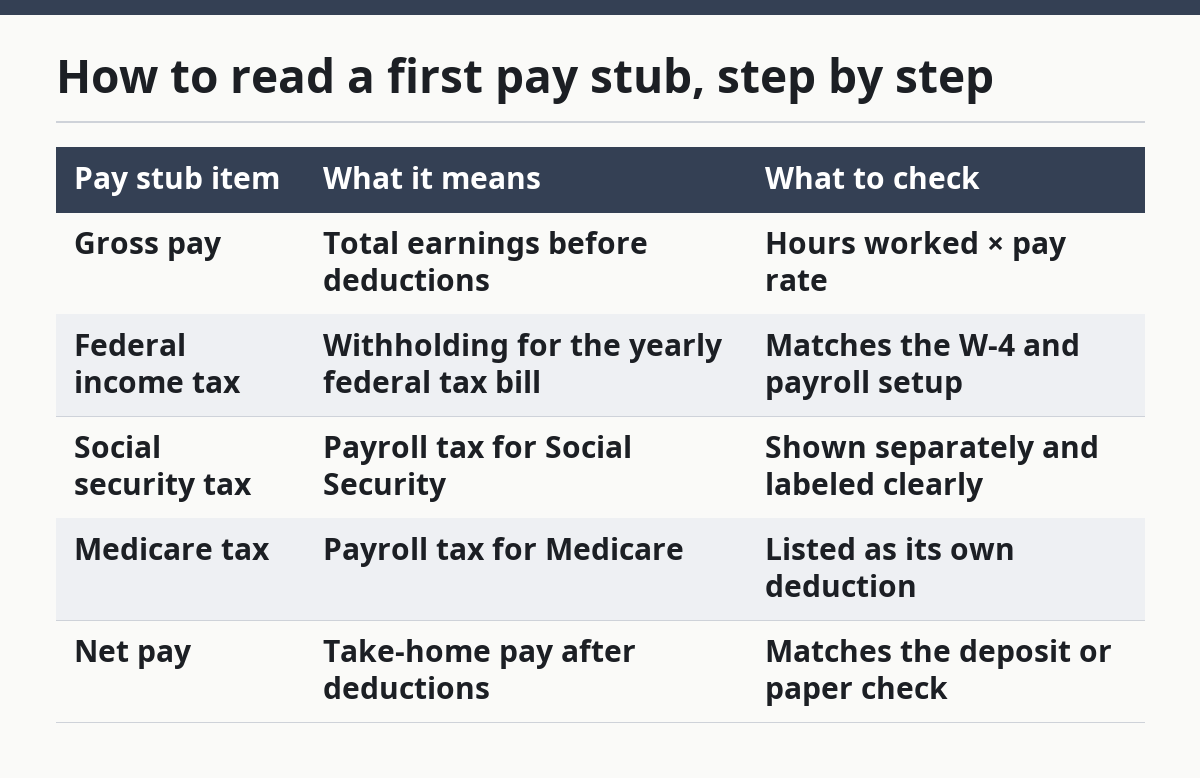
How to read a first pay stub, step by step
A first pay stub is easiest to understand when the teen checks it in order, from wages to taxes to final pay. The cleanest method is to compare the stub with the hours worked, the pay rate, and the W-4 on file, then see whether the deductions match the labels. A payroll error is often visible in the first 10 minutes if the numbers are read carefully.
| Pay stub item | What it means | What to check |
|---|---|---|
| Gross pay | Total earnings before deductions | Hours worked × pay rate |
| Federal income tax | Withholding for the yearly federal tax bill | Matches the W-4 and payroll setup |
| Social security tax | Payroll tax for Social Security | Shown separately and labeled clearly |
| Medicare tax | Payroll tax for Medicare | Listed as its own deduction |
| Net pay | Take-home pay after deductions | Matches the deposit or paper check |
- Find gross pay first: locate the total earnings before deductions, usually labeled “gross,” then verify it matches the hourly rate multiplied by hours worked for that pay period. If the job pays $15 per hour and the stub shows 8 hours, the gross should reflect that exact 8-hour block. If the gross is off, the problem is usually hours entered wrong, unpaid training time, or the wrong pay rate in the payroll system.
- Check the pay period dates: read the start and end dates, which may cover 7, 14, or 15 days depending on the employer. Verify the dates include the shift or shifts worked. If the dates skip the first shift, the missing pay may simply roll to the next check; if they include work that was not done, payroll needs a correction.
- Identify federal income tax withholding: look for the line that says “federal income tax” or “FIT.” Verify that some amount was withheld if the form on file called for it. If the amount looks unusually large relative to the size of the check, the W-4 may have been completed in a way that increases withholding.
- Identify social security tax: look for the social security line, often labeled “OASDI” on payroll systems. Verify that it is listed separately from federal income tax. If it is missing entirely when it should be present, the payroll setup may be wrong or the job may be in a special category that needs review.
- Identify medicare tax: look for the medicare line, sometimes shown as “MED.” Verify that it appears as its own deduction and not bundled into a generic tax line. If the line is there but the amount does not match the rest of the payroll record, ask payroll to explain the calculation.
- Scan for state or local tax lines: if the state or city has income tax, the stub may show it. Verify the location matches the worksite and the teen’s residency rules. If the job is in a state without income tax, a state tax line may still appear if the payroll setup is tied to another jurisdiction by mistake.
- Check non-tax deductions: look for items like uniforms, benefits, retirement, or other employer deductions. Verify that each line has a reason the teen agreed to. If there is an unfamiliar deduction, the correct response is not to guess; it is to ask payroll for the code and an explanation.
- Compare net pay with the deposit or check: confirm that the final net amount equals what was deposited or printed. If the bank deposit is smaller, or larger, or if a check bounces against the stub amount, the payroll issue may involve timing, a reversal, or a split payment.
A good result is not “no taxes at all.” A good result is a pay stub whose numbers are traceable: hours worked, gross pay, deductions listed by name, and net pay that matches the actual deposit. If any one of those pieces cannot be traced in 5 minutes, the stub deserves a follow-up.
Why is my first paycheck smaller than I expected?
Your first paycheck is often smaller because taxes start immediately, and because the first pay period may not cover a full schedule of work. A teen who expected to take home the hourly wage times every hour worked is usually seeing the difference between gross pay and net pay for the first time.
The most common reason is withholding. Federal income tax, social security tax, and medicare tax can all come out before the money is deposited. If the teen also has state or local withholding, the gap gets wider. Another reason is timing: a weekly or biweekly payroll cycle may pay for only part of the work already completed, while the remaining hours roll into the next pay date.
Another source of surprise is the W-4. If the form was filled out so payroll withholds more federal tax, the first check can shrink even if the hourly wage is correct. The opposite can also happen: too little withholding may make the check look bigger than expected, but that can create trouble later if the annual tax bill is higher than planned.
The practical check is simple. Compare the gross pay on the stub with the hours and rate, then compare the deductions with the labels. If the numbers add up, the paycheck is probably working as designed. If they do not, the issue is likely with payroll setup rather than with the tax law itself.
When standard guidance does not apply
Standard payroll guidance stops working when the teen’s situation changes the tax picture in a material way. In those cases, a payroll office or qualified tax adviser can help interpret the form and the withholding pattern for that specific job.
More than one job at once: Withholding can be too low if two employers each calculate taxes as if they were the only job — ask payroll how the W-4 should reflect the extra income.
Summer work plus another source of income: A teen who has wages and another taxable income source may owe more than a single paycheck suggests — review the full return before assuming the withholding is enough.
State or city tax rules differ from the federal rule: Local income tax can change the net pay even when the federal lines look ordinary — check the pay stub for a separate state or city line and verify the work location.
The first paycheck covers a partial period: A short first pay stub can make every deduction look inflated compared with the hours worked — confirm the pay period dates before deciding anything is wrong.
The teen is claimed as a dependent: Dependency status can affect how the W-4 is completed and how much federal tax is withheld — use the IRS instructions rather than guessing based on another person’s paycheck.
The stub includes an unfamiliar deduction code: Unclear labels can signal a benefit, a garnishment, or a payroll error — ask for the code definition before accepting it as normal.
When any of those situations is present, the generic “check the stub and move on” advice is not enough. The consequence of guessing is usually a mismatch between the amount withheld and the amount actually owed later.
The mistakes teens make with first-check taxes
The biggest mistake is reading net pay as if it should equal gross pay minus only one deduction. That mistake leads to confusion the first time federal income tax, social security, and medicare all appear together. The correct alternative is to read the whole deduction section, not just the final deposit.
Another common error is filling out the W-4 too quickly. A form completed without understanding the withholding effect can produce a first paycheck that is either too small or unexpectedly large. The correct alternative is to use the current IRS instructions and check what the employer asks for on the form.
A third mistake is assuming the first stub tells the whole story. Year-to-date totals, prior shifts, and pay period timing can change the picture. A careful teen looks at the whole record before drawing a conclusion.
Drafted with AI; not yet reviewed by a person.