Last updated: November 19, 2026
Key Takeaways
- The main teen account fees are maintenance, overdraft, ATM, paper statement, replacement card, and foreign transaction charges.
- Do not rely on the headline promise alone.
- Overdraft fees are especially risky for teens learning to track balances, because one purchase can cost more than the item.
- ATM fees can stack when a teen uses an out-of-network machine, since both the bank and ATM owner may charge.
Teen bank account fees are usually small on paper and annoying in practice: a $3 monthly charge, a $2.50 ATM fee, a $35 overdraft fee, or a $15 replacement card charge can drain a teen balance fast. The fees worth watching first are the ones that repeat, trigger by accident, or show up after a small mistake. For teen bank account fees, the details matter early.
The bank account fee types that matter most for teens
The fees that matter most are monthly maintenance, overdraft, ATM, paper statement, replacement debit card, and foreign transaction fees. Those are the charges that can hit a teen balance without much warning, and they are the ones to check before opening the account.
A teen checking setup can look “free” at first glance, then charge for ordinary use. That happens when the bank waives one fee but not the others, or when the teen uses an out-of-network ATM twice in a month and pays for both withdrawals. A fee schedule is usually where the truth lives, not the marketing page.
The fee list to scan usually includes:
- monthly maintenance fee
- overdraft fee or overdraft transfer fee
- ATM fee, especially out-of-network
- paper statement fee
- replacement debit card fee
- foreign transaction fee
The Consumer Financial Protection Bureau has a plain-English overview of bank fees on its consumer pages, and the FDIC also explains how deposit accounts work. Those are useful references because they describe the fee categories banks are allowed to use and the disclosures consumers should expect. If a bank’s fee table is hard to find, that is already a warning sign. See the CFPB at https://www.consumerfinance.gov/consumer-tools/bank-accounts/ and the FDIC at https://www.fdic.gov/resources/consumers/deposit-insurance/.
One thing a generic guide often misses: “teen” does not automatically mean “fee-free.” Some banks waive certain fees for minors, but many still charge if a parent’s linked relationship ends, if paper statements are selected, or if the teen uses cash machines outside the bank’s network. A careful read of the fee schedule before signing anything, then again after the account is opened, is the best way to confirm the terms.
How do I spot a monthly fee before I open a teen account?
You spot a monthly fee by finding the bank’s fee schedule and looking for the exact words “monthly maintenance fee,” “service fee,” or “monthly account fee.” If the fee is waived, the waiver rules matter as much as the amount.
Do not stop at the headline promise. A bank may advertise no monthly fee, then attach a condition such as one direct deposit, a minimum balance, a linked parent account, or monthly electronic statements. For a teen, the key question is whether the waiver is automatic or depends on behavior that is hard to maintain.
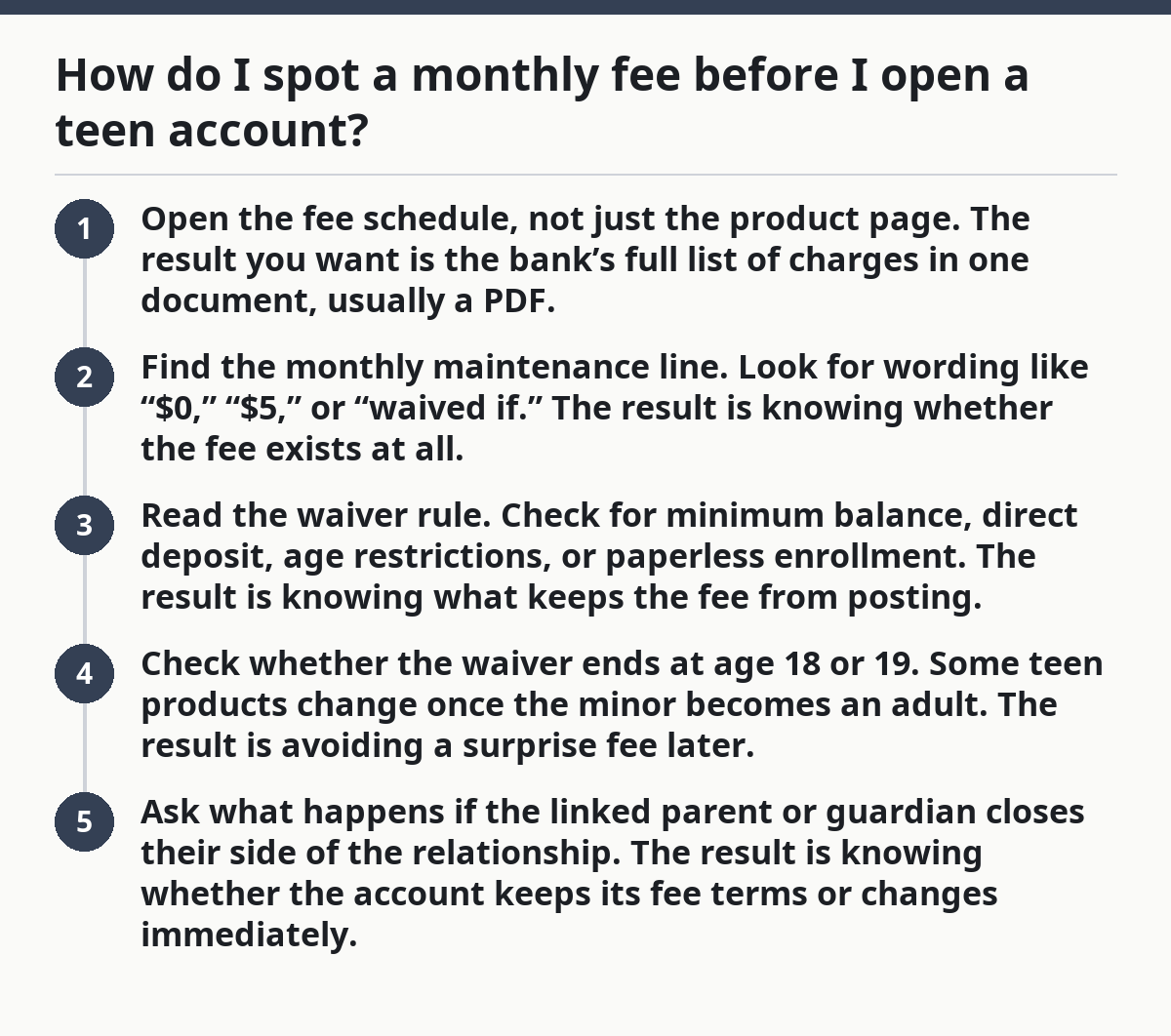
Use this 5-step check before opening the account:
- Open the fee schedule, not just the product page. The result you want is the bank’s full list of charges in one document, usually a PDF.
- Find the monthly maintenance line. Look for wording like “$0,” “$5,” or “waived if.” The result is knowing whether the fee exists at all.
- Read the waiver rule. Check for minimum balance, direct deposit, age restrictions, or paperless enrollment. The result is knowing what keeps the fee from posting.
- Check whether the waiver ends at age 18 or 19. Some teen products change once the minor becomes an adult. The result is avoiding a surprise fee later.
- Ask what happens if the linked parent or guardian closes their side of the relationship. The result is knowing whether the account keeps its fee terms or changes immediately.
A monthly fee is the easiest one to underestimate because it looks small. A charge of even a few dollars every month becomes a steady drain, and the teen does not have to make any “bad” decision to incur it. That makes this fee more important than flashy rewards or perks on a basic teen account.
The CFPB’s consumer resources on bank fees are a good place to compare fee language, especially when the marketing page and the fee schedule seem to say different things. Read the schedule first, then decide if the product is still worth it. The same advice applies to teen bank account fees across the whole account.
Overdraft fees: the charge that sneaks up fastest
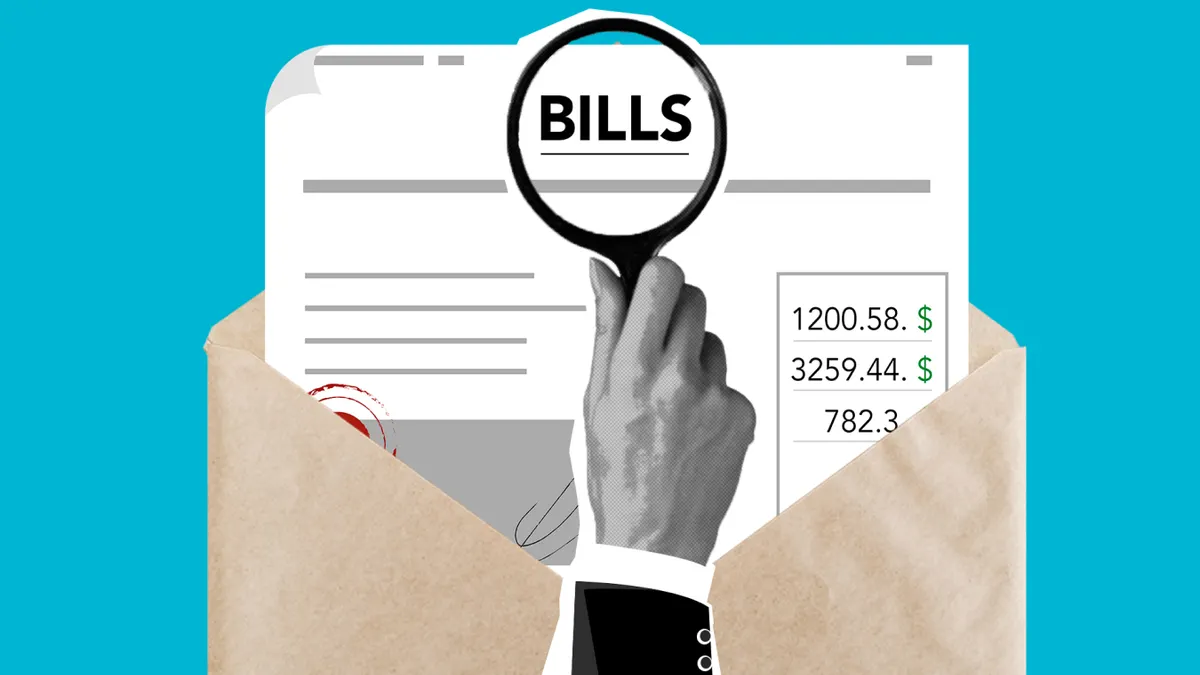
Overdraft fees are the most dangerous fee for a teen who is still learning to track a balance, because one purchase can cost far more than the item bought. If the bank allows overdrafts, the fee can post after a card swipe, an ACH debit, or an ATM withdrawal that goes past the available balance.
A lot of teen products try to reduce this risk, but the details matter. Some banks decline transactions instead of paying them. Some offer no-fee overdraft protection transfers from a linked parent account. Some still charge if the debit card is used after the balance hits zero. Overdraft rules vary by bank and by transaction type.
Here is what to check in the fee schedule and deposit agreement:
- whether debit card purchases can overdraft at all
- whether ATM withdrawals are included
- whether ACH payments can overdraft
- whether the bank charges a per-item overdraft fee
- whether there is a daily limit on overdraft charges
- whether there is a “returned item” or NSF fee instead
The wording matters because two banks can handle the same shortfall differently. One may decline the purchase and charge nothing. Another may approve the purchase and add a fee. A third may approve the transaction only if a linked transfer covers the gap. If the bank uses phrases like “we may pay” or “we may decline,” that means the account holder still needs to read the fine print.
This is the fee category where a teen should be most cautious about “just this once” spending. A $7 lunch can turn into a much larger hit if the account is short by even a small amount and the bank charges a separate overdraft fee for each item. That is a real trade-off: overdraft protection can prevent embarrassment, but it can also create a fee cycle if the backup source is not funded.
ATM and cash withdrawal fees that catch teens off guard
ATM fees are a problem when the teen uses a machine outside the bank’s network, because the charge can come from the ATM owner, the bank, or both. The first fee to watch is the out-of-network ATM fee; the second is any surcharge the machine itself adds on screen before the withdrawal goes through.
This is one of the easiest costs to miss because the bank app may show the withdrawal total only after the cash is taken out. A teen who withdraws cash once a week can build a steady stream of fees just by using the nearest machine instead of the bank’s network machine. If the bank reimburses some ATM fees, the reimbursement rules matter just as much as the promise.
A clean way to check the cost is to look for these three lines:
- “ATM fee” or “out-of-network ATM fee”
- “foreign ATM fee,” if the card works outside the U.S.
- any statement about reimbursement limits or eligible withdrawals
A fee can appear even when the bank advertises free checking. Free checking often means no monthly maintenance fee, not free cash access everywhere. That difference matters for teens because they are more likely to use the closest cash machine, not the cheapest one.
One useful habit is to look at the bank’s ATM locator before opening the account. If there is only one machine nearby and the teen regularly moves around school, sports, or work locations, out-of-network withdrawals may become the default. In that case, an account with a wider ATM network or fee reimbursements can be more valuable than one with a nice app and a narrow network.
The CFPB’s explanations of bank fees and account disclosures are worth reading here because ATM charges are often buried in the schedule rather than the sales copy. The real cost of cash access is not always obvious until the first withdrawal. For comparing teen bank account fees, ATM access should be part of the decision from the start.
Paper statement, replacement card, and foreign transaction fees
Paper statement fees, replacement debit card fees, and foreign transaction fees are smaller than overdraft charges, but they still matter because they hit for routine reasons. A teen can trigger one by choosing mail delivery, losing a card, or buying something online from a merchant processed outside the U.S.
Paper statement fees are straightforward: some banks charge if statements are mailed instead of sent electronically. The cost is often small, but it is usually pure waste on a teen product if the teen already uses mobile banking. The smarter move is to pick e-statements unless a paper copy is genuinely needed for a parent or guardian’s records.
Replacement debit card fees are worth checking because cards get lost, bent, swallowed by an ATM, or stolen. Banks may replace a card for free once and charge after that, or charge for expedited shipping even if the replacement itself is free. If the fee schedule separates “replacement” from “rush delivery,” read both lines.
Foreign transaction fees are the one many people miss. A teen might not travel abroad, but online shopping can still trigger a foreign transaction fee if the merchant or processor is based outside the United States. That fee is usually a percentage of the purchase amount, so it can add up on a few larger transactions. If the teen buys from overseas game stores, clothing sites, or digital services, this fee deserves attention.
These charges are not always deal-breakers. They become a problem when they stack. A teen with paper statements, a lost card, and a few ATM withdrawals can pay three separate fees for one month of ordinary life. That is why a fee review should cover the whole schedule, not just the biggest headline charge.
The FDIC’s material on deposit accounts and the CFPB’s consumer guidance are both useful when comparing how fees are disclosed. If a bank makes it hard to find the replacement-card or foreign-transaction line, that is a clue that the cost is not customer-friendly. Teen bank account fees should be visible before anyone signs up.
What a teen should compare before saying yes
The best comparison is not “Which account is free?” but “Which fee is least likely to show up in real life?” That question usually gives a better answer because it matches how a teen actually uses money.
A teen who mostly pays by card and checks a balance in an app should focus on monthly fees, overdraft rules, and card replacement charges. A teen who uses cash should focus on ATM fees and network size. A teen who buys from overseas sellers should focus on foreign transaction fees. The right account is the one where the likely fees fit the actual habits.
A simple comparison pass takes about 10 minutes:
- Read the fee schedule.
- Mark every fee tied to everyday use.
- Check the waiver rules for monthly fees.
- Check whether overdrafts are allowed or blocked.
- Compare ATM access near school, work, and home.
- Look for paper statement, replacement card, and foreign transaction charges.
- Only then look at extras like rewards or budgeting tools.
This order matters because extras can hide the real cost. A bank can offer a nice app and still charge more than a plain product with better fee rules. For a teen, the cheapest-feeling account is not always the cheapest account.
One honest limitation: some teen banking products are designed to be controlled by a parent, not fully independent. That can lower risk, but it also means the fee setup may change when the teen ages out. If the product is built to transition later, read the adult fee schedule too. Otherwise the account can turn from low-cost to expensive with almost no warning. That is especially important when comparing teen bank account fees over time.
A short checklist for reading the fee schedule in 2 minutes
You can spot the most important costs in under 2 minutes if you know exactly where to look. The fee schedule is the document that answers the real question, and it is usually more useful than the homepage or app screenshots.
Here is the fastest scan:
- Find the monthly maintenance fee line first.
- Look for overdraft or NSF language next.
- Check ATM charges for out-of-network use.
- Search for paper statement fees.
- Find replacement card and expedited shipping charges.
- Scan for foreign transaction fees if online or travel spending is likely.
If a fee is waived, read the waiver conditions right away. If a fee is “up to” a certain amount, treat that as real cost, not decoration. If the schedule uses a long list of exceptions, assume the bank expects some customers to miss them.
A teen bank account should be easy to use and hard to misuse. When the fee list is simple, that usually means fewer surprises later. When the fee list is long, buried, or full of conditions, the account may still be usable — but only if the teen and parent are willing to read every rule.
For broader context on how teen checking fits into the rest of teen money choices, the hub on teen banking and spending accounts is the right next stop.
What fees do teen bank accounts charge?
Teen bank accounts can charge monthly maintenance fees, overdraft fees, ATM fees, paper statement fees, replacement debit card fees, and foreign transaction fees. Some banks waive one or more of these, but the waiver usually has conditions. The fee schedule, not the marketing page, is the place to confirm what actually applies.
How do I avoid bank fees as a teen?
Avoid bank fees by choosing a product with no monthly maintenance fee, using in-network ATMs, keeping enough money in the account to prevent overdrafts, signing up for e-statements, and replacing a lost card quickly. The most effective move is to read the fee schedule before opening the account so the obvious charges are known up front.
Are teen checking accounts usually free?
Teen checking accounts are often marketed as free, but “free” usually means free of one specific fee, not free of every charge. Many accounts still charge for out-of-network ATM use, paper statements, replacement cards, or overdrafts. The fee schedule determines whether the account is truly low-cost in everyday use.
Drafted with AI; not yet reviewed by a person.