Last updated: November 19, 2026
Quick Answer: A student checking account and a teen account are usually different products, and the split often starts at 18: student checking is typically for older students, while teen accounts are usually for minors with parent or guardian oversight. A student checking account is usually an adult-style checking account with student-friendly terms, while a teen account is usually built around a minor’s age and a parent’s control. That difference sounds small, but it changes who can open it, who can move money, and how the bank policy works if the child turns 18.
If the goal is to avoid a bad mismatch, the answer is simple: pick the account category that matches the child’s age and independence level, not the label that sounds more appealing. For a broader map of school-age banking, the hub on teen banking and spending accounts can help, but this page is focused on the naming and access gap families most often miss.
Key takeaways
- A student checking account is typically aimed at college-age customers, not younger teens.
- A teen account usually means a minor can bank with a parent or guardian attached to the relationship.
- The biggest differences are age rules, debit-card control, parent access, and what happens when the child reaches 18.
- Bank policy matters as much as the product name; two banks can use the same label and still run very different rules.
- The right choice depends less on the word “student” or “teen” and more on whether the child needs supervised banking or independent banking.
What a student checking account usually is
A student checking account is usually a checking account for someone in college or a similar school setting, and it is often structured more like a normal adult checking product than a youth account. That matters because bank policy may treat the customer as the legal owner, with fewer parent controls than a teen account; families should check the institution’s policy or consult a financial professional if they are unsure.
The label is not standardized across the entire industry. One bank may offer a student checking account only to people in a specific age range or with proof of enrollment, while another may use the word “student” for a limited-fee version of regular checking. The term of art is that the account is school-linked, not childhood-linked.
This is where families get tripped up. A student checking account is not automatically a minor’s account, and it is not automatically the best first bank product for a 15-year-old. In many cases, it is meant for someone who can already manage a debit card, direct deposit, and monthly fees without parental permission.
The upside is independence. The downside is that the child may lose the supervision that makes a teen account safer. If a student is already 18 and needs a place for a part-time job paycheck, FAFSA-related refunds, or campus spending, student checking can fit well. If the child is still under 18, it may not fit at all unless the bank says so in writing.
For a family trying to match school-age banking to real life, this is the first filter: student checking is about the student status, not just the fact that someone is young.
What a teen account is built to do
A teen account is usually built for a minor, and the parent or guardian often stays tied to the relationship through alerts, permissions, or joint access. That makes it the better choice for middle school and high school banking, where the goal is to learn money habits without giving up all guardrails.
The real strength here is control. A teen account usually lets a parent monitor spending, move money in, set limits, or receive alerts. Some banks also make debit-card use or online transfers more restricted than they would be in a student checking account. That structure is the point: it gives the teen practice without handing over full independence on day one.
The trade-off is freedom. A teen account can feel limiting once the child starts handling a paycheck, school travel, or regular online purchases. If a bank policy requires parental approval for certain transfers or account changes, that can become annoying fast once the teen is acting more like an adult customer.
This option is best for families who want a bridge between cash and full banking, not a final destination. It is also the safer fit when the child is under 18 and the parent wants oversight that a standard adult checking account would not provide. In plain terms: a teen account wins when supervision is the feature, not the bug.
It can be the wrong fit for an 18-year-old freshman who needs direct deposit and fewer friction points. It can also be too restrictive for a teenager who already manages a monthly budget with little help. In those cases, a student checking account often makes more sense.
The real difference between a student checking account and a teen account
The difference is not just the name. It is the legal and operational setup behind the name.
A student checking account usually assumes the customer can act more independently. A teen account usually assumes the customer still needs a parent or guardian in the loop. That difference affects age requirements, card controls, who gets statements, and whether the teen can move money without a second set of hands on the account.
| Criteria | Student checking account | Teen account | Winner for this condition |
|---|---|---|---|
| Typical age focus | Usually college-age or older school-age customers | Usually minors, often 13–17 depending on bank policy | Teen account for under-18 banking |
| Parent access | Often limited or none, depending on policy | Commonly built in through alerts, co-owners, or controls | Teen account when supervision matters |
| Legal independence | More like adult checking | More restricted for minors | Student checking for older teens or 18+ |
| Proof needed | May require school enrollment or age status | May require age and a parent/guardian | Depends on the child’s age |
| Debit-card freedom | Usually broader | Often more limited | Student checking for independent spending |
| Transition at 18 | Often already aligned with adult banking | Often needs conversion or re-titling | Student checking for a near-adult |
| Fee structure | Can be reduced or waived, but rules vary by bank | Can also be low-fee, with youth-specific terms | Depends on bank policy |
| Direct deposit use | Usually straightforward | Sometimes more controlled | Student checking for payroll |
| Learning structure | Less guided | More guided | Teen account for first-time banking |
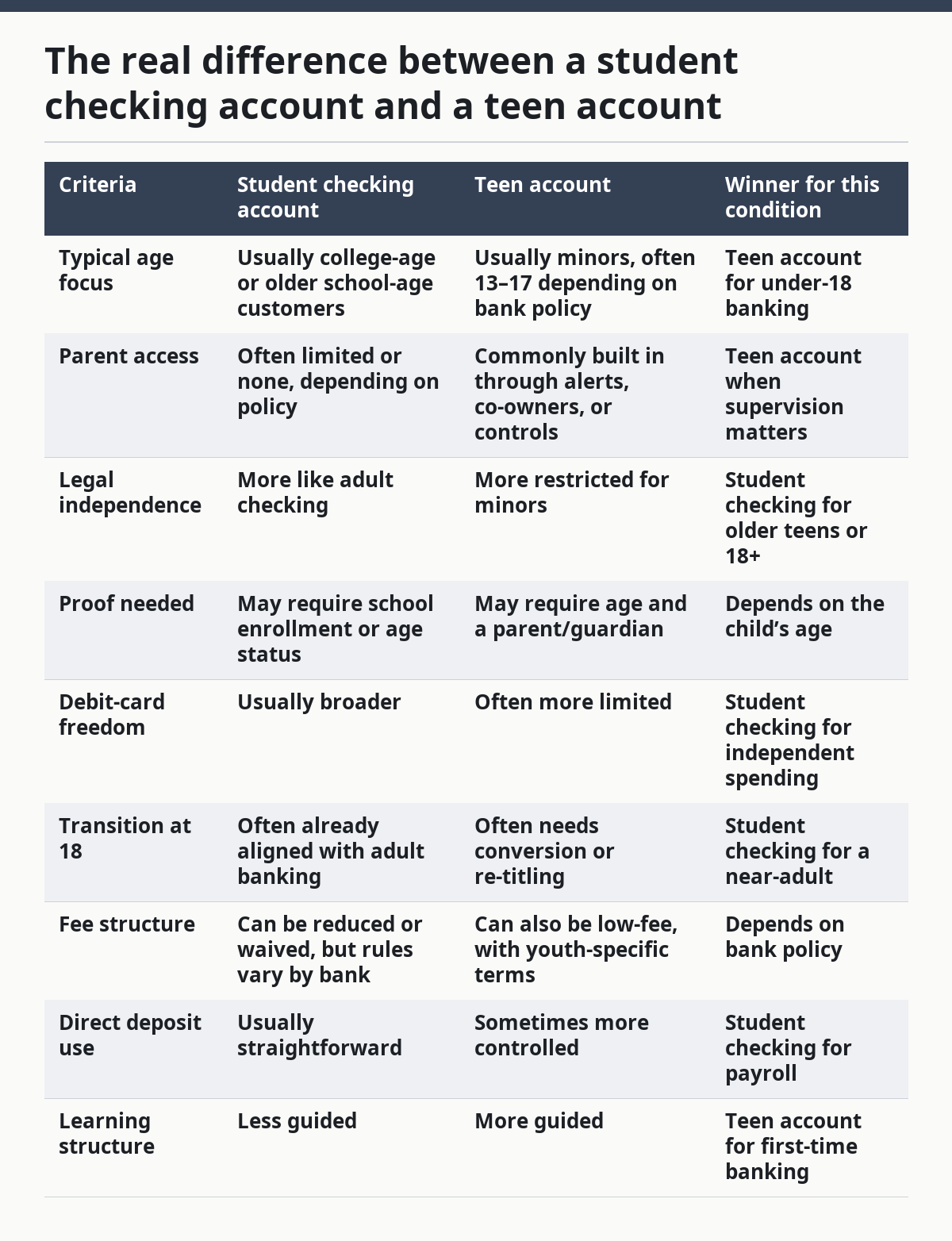
A generic article would stop there and say “both are checking accounts.” That misses the part families actually care about: the bank policy behind each label changes who can sign, who can monitor, and how quickly the child can bank on their own. That is why two products with the same debit card can still serve very different ages.
Which one wins for a younger teen?
A teen account wins for a younger teen, especially one who is still in middle school or early high school and does not need full independence yet. The main reason is control. A 13-year-old does not usually need the same banking freedom as a college freshman, and a teen account is designed around that reality.
This is also where a student checking account can be the wrong tool. If the bank expects the customer to manage the relationship alone, the child may hit friction at the exact moment a parent wants guardrails. That can show up in transfer limits, identity checks, or a lack of joint visibility. The consequence is simple: the parent loses oversight just when the teen is still learning basic habits.
A teen account also tends to fit the emotional side of the problem. Many families want the child to practice saving for lunch money, rides, school events, or the first job, but they do not want a fully open adult-style setup. A teen account is built for that middle ground.
The weakness is that the controls can feel annoying once the child starts earning regular income. If the teen gets a weekend job, the parent may end up fielding every transfer or approval request. That is not a flaw; it is the purpose of the product. But it does mean a teen account is best for a stage, not a forever solution.
For a younger teen, the recommendation is clear: choose the account that is designed for supervised banking, even if the student label sounds more grown-up.
Which one wins for an older student?
A student checking account wins for an older student, especially someone who is 18 or close to it and already managing school expenses, a paycheck, and online purchases. The reason is freedom. At that stage, the person usually needs a standard checking setup more than a training-wheel version.
A student checking account often makes daily banking easier. Direct deposit, debit-card spending, bill payment, and peer-to-peer transfers are usually simpler when the account belongs to the student outright. That matters for campus life, where money moves in small bursts and timing matters. A child who is now legally an adult usually does not want a parent hovering over every transfer.
The downside is obvious: less oversight. A student checking account can become a bad fit if the student is not ready to manage overdrafts, card security, or digital spending on their own. The label “student” does not solve impulse spending, and it does not replace budgeting. If the bank policy offers reduced fees but no guardrails, the student still has to carry the discipline.
This option is also the better bridge to adult banking. Once the student graduates or ages out of a youth product, moving into a student checking account can prevent awkward conversions later. In other words, it matches the real transition from dependent to independent banking.
A student checking account is not the better choice for a 15-year-old who still needs a parent attached to the relationship. It is the better choice for an older student who needs fewer permissions and more normal banking behavior.
When the choice flips: exception scenarios
The general rule is simple, but a few scenarios flip the verdict.
If the bank policy makes a student checking account unusually restrictive, the teen account may be the better long-term setup even for an older teen. A product name does not matter if the fine print makes everyday use painful.
If the student is already 18 and fully responsible for deposits, bills, and card use, the teen account is usually too small a container. An adult-style student checking account, or plain checking, fits better.
If a younger teen receives regular money from work, not just allowance, the family may need to move sooner than planned. A teen account can still work, but only if the parent is comfortable with its controls and transfer limits.
If the child is away at school but still needs parent visibility for tuition-related cash flow or emergency funding, the “student” label alone is not enough. The better choice is whichever product gives the needed access structure, even if that means staying in a youth-oriented setup a little longer.
A useful outside reference point is the Consumer Financial Protection Bureau’s guidance on youth financial products and the FDIC’s consumer education on bank accounts; both are worth reading before signing anything, because age rules and access features change by institution. A bank branch can explain its own policy, but it cannot change the product category.
The verdict: which one to choose and why
Choose a student checking account if the child is 18 or close to it, needs direct deposit or regular debit-card use, and does not need a parent attached to every move. Choose a teen account if the child is under 18, still needs supervision, or is only beginning to handle money alone. Neither if the bank policy does not clearly state age rules, parent access, and transition terms in writing.
That is the cleanest answer. The label matters, but the access model matters more. A student checking account is the right tool for independence. A teen account is the right tool for supervision. Mixing them up creates the exact problems families are trying to avoid.
Is a student checking account the same as a teen account?
No, they are usually different products with different age and access rules. A student checking account is typically aimed at older students and often behaves more like adult checking, while a teen account is designed for minors and usually includes parent or guardian involvement. The exact bank policy still matters, because names are not standardized across every institution.
Who qualifies for a student checking account?
Usually a student who meets the bank’s age and enrollment rules qualifies, often someone in college or near college age. Some banks ask for school enrollment, student status, or a specific age range, while others simply offer a lighter-fee version of checking to younger adults. The institution’s own policy should be checked before applying.
Should a teen choose student or teen banking?
A teen should usually choose teen banking if the child is under 18 or still needs parental oversight. A student checking account fits better when the teen is older, more independent, and ready for adult-style banking. The decision depends on age, supervision needs, and whether the child is using the account for allowance or regular income.
Drafted with AI; not yet reviewed by a person.