Last updated: November 19, 2026
Quick Answer: For many teens, the best first-job target is a 6 to 12 hour-a-week local, predictable shift that fits school and transport. Teen income and first-job choices — The Complete Guide starts with that simple rule because small first paychecks are usually easier to manage when the job is close, legal for your age, and steady enough to plan around. The right choice is the job that gives you steady hours without wrecking grades or transport. The sections below settle which jobs make sense, which ones don’t, and what to look at before you say yes.
Key takeaways
- A teen’s first job should fit the school week first, not the other way around.
- Cash tips, hourly pay, and commission all work differently; the “best” one depends on how steady you need the money to be.
- Transportation, age rules, and parent permission can matter as much as the pay rate.
- The smartest first jobs usually teach one of three things: customer service, basic tools, or reliability.
- A job that looks good on paper can still be the wrong move if the commute is long or the schedule is unstable.
What first job should a teen actually pick?
A good first job for many teens is one with fixed hours, simple duties, and a short commute, because that combination protects school time and makes the paycheck easier to predict. A job with a fancy title but unstable shifts can cause more stress than it’s worth. Here’s the catch: the “best” job is not the one that sounds most impressive.
Picture this: you’re balancing homework, practice, and a Saturday shift, and you need money that arrives without constant drama. A practical starting point is often retail, food service, grocery work, babysitting, lawn care, tutoring, or a local shop job. Those jobs are common for a reason. They’re easier to explain on a résumé, and they build habits that matter in the next job too.
Teen income usually starts in one of three forms:
- Hourly pay: best when you want predictable paychecks.
- Tips: can raise income, but the amount can swing a lot by day and season.
- Task pay: common in babysitting, yard work, and odd jobs; useful when you want short bursts of work instead of a schedule.
The truth is, first-job choice should be less about status and more about fit. A teen who can only work 8 to 12 hours a week needs a different job than one who can work after school plus weekends. A job with $1 more an hour is not automatically better if it adds a 40-minute bus ride each way.
The simple filter that saves mistakes
Before applying, check these four things:
- Hours: Can the schedule fit school nights and weekends?
- Pay shape: Is it hourly, tipped, commission-based, or per task?
- Commute: Can you get there safely without depending on someone else every day?
- Skill gain: Will this job help with the next one, or is it a dead end?
If one of those fails hard, keep looking. Instead of forcing a bad fit, use that filter to compare each option honestly.
Which teen jobs pay best for reliability?
The most reliable teen jobs are hourly jobs with set shifts, because the paycheck is easier to plan around than tips or commission. Grocery stores, chain restaurants, movie theaters, warehouses that hire younger teens only in allowed roles, and some retail stores usually fit this pattern. The exact pay varies by location and minimum wage law, so check the current rate where you live.
Picture this: you want money for gas, school clothes, or a phone bill, and you can’t gamble on a slow night. Hourly work gives you a floor. If you work 10 hours, you know what the base pay will be before taxes. That matters when you’re just starting out and don’t have savings to absorb a bad week.
Jobs that can pay more on a good day often look better than they are. A tipped job may outperform a basic hourly job on busy weekends, but it can also drop fast during school seasons or bad weather. Commission work can be even trickier. If you’re new, new to work, or new to sales, pay tied to performance can be shaky.
Best for predictable income:
- Grocery bagging and cart work
- Stocking and facing shelves
- Fast-food or quick-service shifts
- Movie theater work
- Lifeguarding or camp work when certification is in place
Less predictable:
- Restaurant serving
- Sales with commission
- Event work
- Seasonal stands
- Babysitting with irregular families
The right question is not “Which job pays the most?” It’s “Which job pays consistently enough that I can count on it?” That one answer keeps a lot of teens from taking the wrong first job.
Teen income and first-job choices by job type
The best teen job type depends on what you need more: time, money, or skill. A school-heavy teen should favor work that is close by and easy to schedule. A teen with a summer opening can take on longer shifts and more physically demanding work.
Picture this: you’re comparing three offers, and each one sounds fine until you look at your week. One job pays a little better but needs evening availability. One is close but only offers short shifts. One is farther away but builds a real skill. The best choice depends on what problem you’re solving first.
| Job type | Best for | Pay style | Common upside | Common downside | Best fit |
|---|---|---|---|---|---|
| Grocery or retail | Stable schedules | Hourly | Predictable shifts, basic customer service experience | Repetitive tasks, standing for long periods | Teen who needs regular hours |
| Fast food / quick service | Fast hiring | Hourly + sometimes tips | Easy entry, many locations | Stress at rush times, late shifts | Teen who wants quick start |
| Babysitting | Flexible evenings | Per job or hourly | Good short-term money, trusted reputation | Unsteady demand, child care responsibility | Teen with family network |
| Yard work / lawn care | Seasonal cash | Per job | Can pay well for short jobs | Weather risk, physical work | Teen who likes independent work |
| Tutoring | Skill-based income | Hourly | Higher pay if school skills are strong | Needs confidence and subject strength | Teen good in math or reading |
| Lifeguarding | Summer stability | Hourly | Clear role, resume value | Certification, responsibility, heat exposure | Teen who can certify and work outdoors |
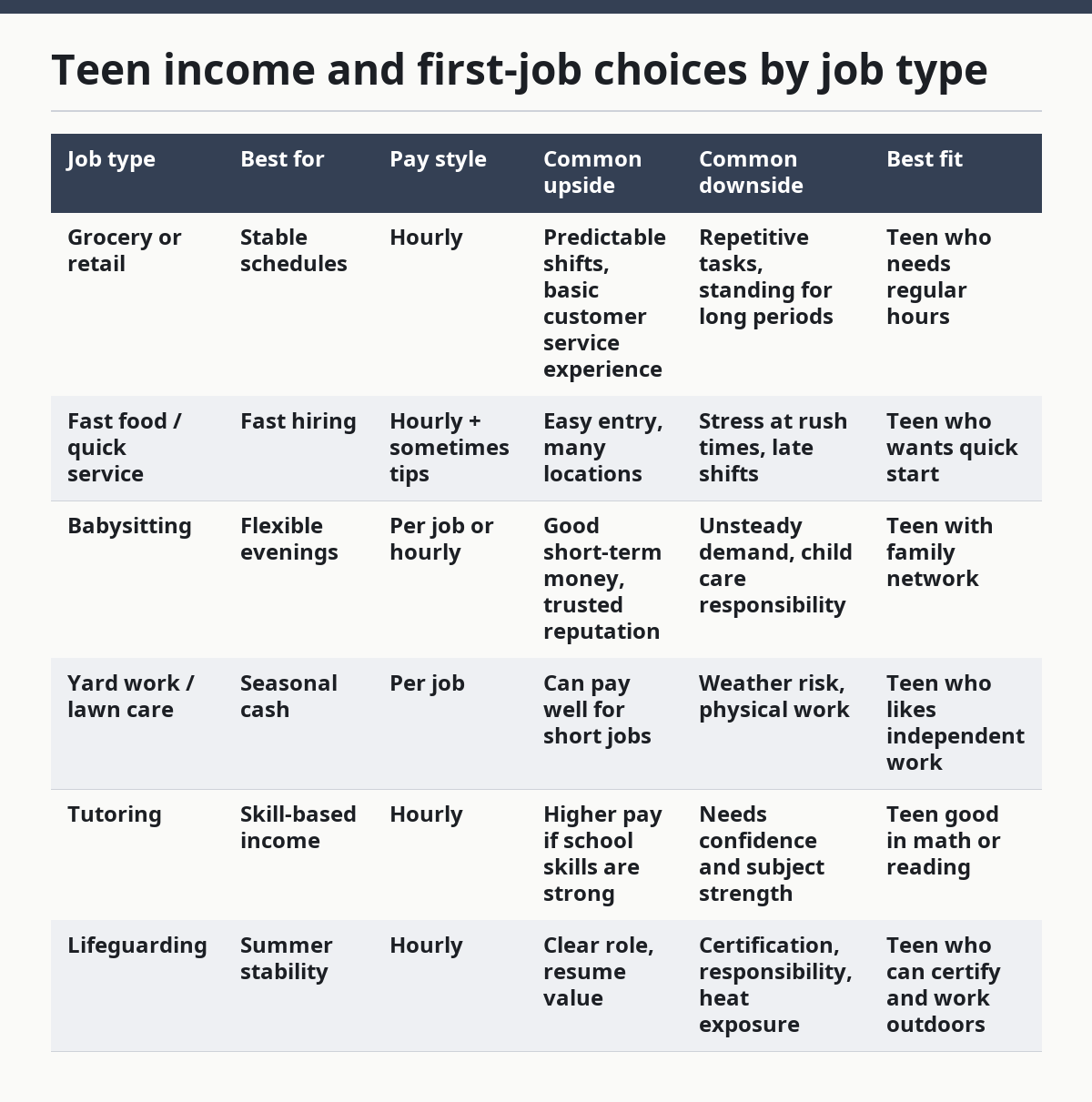
Here’s the catch: a “better” job on paper can be a worse job in real life if the commute eats the money. A $12-an-hour job five miles away may leave you with less usable income than a $10-an-hour job down the street if rides are a problem.
The jobs that help a résumé most
The strongest early résumé builders teach you to show up, work with adults, and handle customers without melting down. Retail, grocery, food service, tutoring, and lifeguarding all do that in different ways. Tutoring is especially good if you want to later apply for scholarship work, campus jobs, or internships.
How much can a teen earn without wrecking school?
A teen can earn enough to matter without working so much that grades drop, but the exact amount depends on hours, transportation, and local pay rules. A safer starting point is usually a part-time schedule with predictable shifts and at least one full day off each week.
Picture this: you’re trying to pay for small extras, but you still need enough sleep to get through school. That’s the real balancing act. A first job should support life, not swallow it. If your schedule turns every week into a scramble, the income starts costing more than it returns.
The biggest mistake is chasing too many hours too early. A lot of first jobs look tempting because they offer more shifts, but more shifts often mean less energy, less homework time, and more missed family or sports plans. That can drag down both school and job performance.
A better plan is simple:
- Start with 6 to 12 hours a week if school is heavy or the commute is long.
- Add hours only after you know how your body and schedule handle the work.
- Put school nights first, not last.
- Keep one backup plan for rides, because transportation breaks more jobs than laziness does.
The truth is, teen income is easiest to keep when the job is close, the manager is predictable, and the shift pattern stays the same. That’s why local jobs often beat “higher paying” jobs that require long travel or late returns.
What affects teen income besides the pay rate?
Four things shape real earnings more than most teens expect:
- Taxes and deductions: take-home pay is less than the posted wage.
- Transportation costs: gas, bus fare, or rides cut into income.
- Unpaid time: waiting for a ride or getting ready for work still costs time.
- Schedule quality: a short, steady shift can be better than a longer chaotic one.
If you’re calculating whether a job is worth it, use the money left after transport and lost time, not just the hourly rate. Instead of looking at the sticker pay alone, compare the usable amount you actually keep.
What should a teen look for before accepting a first job?
A teen should check schedule, safety, commute, training, and the person who will supervise the work before accepting anything. If the employer won’t explain those clearly, that’s a warning sign.
Picture this: you’ve got an offer, and everyone around you wants you to say yes fast. Before the first shift starts, slow down and ask the questions that matter. A bad first job teaches bad habits fast.
Ask these questions:
- What hours do you expect during school weeks?
- How far in advance are schedules posted?
- Is training paid?
- Who do I report to?
- What happens if I have a school event or exam?
- How do breaks work?
- Is transportation an issue for late shifts?
The biggest red flags are simple. Vague schedules, pressure to ignore school, cash-only pay without clear records, and unsafe late-night travel are all reasons to walk away. If the manager gets annoyed by normal questions, that signal is worth taking seriously.
A teen who asks clear questions often looks more mature than a teen who just says yes. Employers like reliability. They also like someone who understands boundaries.
A quick checklist before you say yes
- The job fits your school week.
- You can get there and back safely.
- The pay type is clear.
- You know who supervises you.
- You can explain the job to a parent or guardian without confusion.
If one of those is missing, keep looking.
When should a teen choose self-employment instead?
A teen should choose self-employment when local jobs are hard to reach, the schedule is very tight, or a skill already exists that other people will pay for. Babysitting, dog walking, lawn work, snow shoveling, tech help, and tutoring are the usual starting points.
Picture this: you don’t have a car, your week changes all the time, and the nearby stores aren’t hiring. A small service business can make more sense than a formal job. You control the time, the location, and sometimes the pay. Those trade-offs matter.
Self-employment pays only when the work shows up. There’s no manager handing you a shift, and there’s no guaranteed hourly floor. You also have to handle messaging, timing, trust, and sometimes equipment. If you miss a job, the damage goes straight to your reputation.
Self-employment works best when:
- You already know families in the neighborhood.
- You can do the work safely.
- You can explain the service in one sentence.
- You’re fine with uneven income.
It does not work well when you need steady cash every week, when you have no way to get repeat customers, or when you need outside structure to stay on track. Some teens do better with a boss. That’s not a flaw. It’s a fit issue.
The honest side-by-side: hourly job vs. flexible gig work
An hourly job wins for most first-time teen workers because it gives structure, predictable money, and fewer surprises. Flexible gig work wins only when school, transport, or family duties make a fixed shift impossible.
Picture this: you’re choosing between a store job and babysitting, and both sound workable. The store gives consistency. Babysitting may pay more on a single night, but the work comes and goes. The real question is which one matches your life as it is, not as you wish it were.
| Criteria | Hourly job | Flexible gig work | Winner for this condition |
|---|---|---|---|
| Predictable income | Steady base pay | Varies by request | Hourly job |
| School schedule fit | Can be rigid | Often easier to move | Flexible gig work |
| Skill building | Customer service, teamwork | Responsibility, trust, independence | Tie |
| Ease of starting | Application and interview | Depends on family network | Flexible gig work |
| Transportation needs | Often fixed location | Often nearby or local | Flexible gig work |
| Stress level | Can be supervised and routine | Can be uncertain and solo | Hourly job |
| Long-term résumé value | Recognized by employers | Good if described well | Hourly job |
| Chance of last-minute cancellation | Lower | Higher | Hourly job |
The truth is, the winner changes only when your life has a sharp limit. If you need reliable money, take the hourly job. If you need control over when you work, the flexible gig may fit better. If you need neither, don’t force it.
Why hourly work usually wins first
Hourly work usually wins because it teaches timekeeping, shift discipline, and customer interaction in a setting that repeats. That repetition matters. A teen who learns to handle a register, a schedule, or a closing routine has a cleaner path to the next job.
What are the exception cases where the answer flips?
The usual advice flips when the teen already has a strong local network, a very tight schedule, or a rare skill that can earn more than store work. In those cases, a flexible or skill-based job can beat a standard hourly job.
Picture this: you’ve got exams, sports, and family duties all packed together, and a fixed shift would break the week. Or you’re strong in algebra and can tutor middle schoolers for better money than a chain store would pay. That’s when the usual rule bends.
Case 1: You can’t get reliable transportation
If a job needs daily rides and you can’t control those rides, the job is fragile. A local babysitting or yard-care setup may work better because it removes the commute problem.
Case 2: You already have a marketable skill
If you can tutor math, fix simple tech issues, or do safe lawn work well, self-employment may earn more for less time. That’s not automatic money. It’s skill plus trust.
Case 3: School and family duties change every week
A flexible gig can beat a scheduled job when your calendar is unstable. The trade-off is that your income will be less predictable.
Case 4: A teen needs job structure
Some teens do better with an outside schedule than with open-ended work. In that case, a set-shift job is the better choice even if the pay looks modest.
The exception rule is simple: if consistency is your main need, choose structure. If flexibility is your main need, choose local gig work. Don’t mix the two and hope it works out.
The verdict: which first job should a teen choose?
Choose an hourly local job if you need steady money, simple scheduling, and résumé value. Choose flexible gig work if your school week is crowded and you already have a trusted client network. Neither if the commute is long, the hours are late, or the job asks you to sacrifice school.
That is the plain answer. A teen’s first job should make life easier, not harder. The best job is usually close by, legal for your age, and boring in the right way. Boring means predictable. Predictable means usable.
Where should a teen look first?
A teen should look first at nearby grocery stores, quick-service restaurants, local shops, recreation centers, libraries, and neighborhood families who need help. These are the places where first jobs most often fit a school schedule and teach useful habits.
Picture this: you’re making a short list instead of a giant search. A focused hunt saves time and keeps the choice grounded in real life. Start with places you can reach easily, then compare the schedule and the job duties.
A good first pass looks like this:
- Walk or ride past nearby stores and check if they’re hiring.
- Ask family friends about babysitting, yard work, or tutoring.
- Look at school bulletin boards or local community pages.
- Use official labor and teen-employment guidance from the U.S. Department of Labor and your state labor agency to check age rules before applying.
- Compare each option against school time, commute, and pay type.
The best first job is rarely the one that appears first online. It’s the one that fits your actual week. That sounds simple, but it keeps teens from taking jobs that look fine until the second week, when homework and transport start fighting the schedule.
Is teen income worth it if the paycheck is small?
Yes, teen income is worth it if the job teaches money habits, work habits, and time habits that last longer than the paycheck. Small earnings can still matter when they cover clothes, lunch money, savings, or a first phone bill.
Picture this: the amount in the envelope is not huge, but it is yours. A first job shows how work feels, how schedules run, and how money disappears if you don’t track it. Those lessons are worth more than the first few paychecks alone.
A small paycheck still helps when it does three things:
- Covers a real cost you would otherwise ask someone else to pay.
- Gives you practice with saving part of each check.
- Teaches you how to say yes to some things and no to others.
The mistake is expecting teen income to solve everything. It won’t. It will, however, make the next job easier to get and the next money decision less random.
FAQ
How many hours should a teen work during school?
A teen should work enough hours to earn money without crowding out sleep, homework, and one real day off. For many students, a small part-time schedule is the safer start, especially during heavy school weeks or sports seasons.
Is babysitting a good first job?
Babysitting is a good first job if the teen is responsible, has family trust, and can handle simple emergencies. It’s not a good fit for someone who needs steady weekly income or who isn’t comfortable supervising younger children.
What’s better: hourly pay or tips?
Hourly pay is usually better for a first job because it is more predictable. Tips can raise earnings, but they can also swing a lot by day, season, and location.
Should a teen choose the highest-paying job?
Not by itself. A higher rate can be a bad deal if the commute is long, the hours are late, or the job hurts school performance. The better choice is the one with the best mix of pay, safety, and schedule fit.
What if no one will hire me yet?
Start with local gig work, family contacts, or short jobs like yard work, babysitting, or tutoring. A first paid job often comes from a connection, not a perfect application. Keep the goal small: get one real work reference, then build from there.
Drafted with AI; not yet reviewed by a person.