Last updated: November 19, 2026
Key Takeaways
- Teens can find nearby openings by checking storefronts, asking inside businesses, and revisiting a few job sites every 2 to 3 days.
- Complete every application neatly and consistently; missing details can slow things down.
- Follow up after 2 to 5 days with a short, polite call or visit.
- First jobs are often best at places with routine tasks, clear shifts, and part-time hiring needs.
Your first teen job search starts with one goal: find places nearby that hire beginners, then make it easy for a manager to say yes. A local search often works best when you combine nearby businesses, a short application, and a polite follow-up in person or by phone. The job search is usually simpler than it looks, but it still takes a plan.
What a first teen job search looks like

A first teen job search is usually local, simple, and repetitive: you identify 10 to 20 nearby employers, apply to the ones that match your age and schedule, and follow up within a few days. That is the real work, not “finding the perfect job.”
The mistake many teens make is starting with job boards only. Online listings can help, but they are not the whole market. A neighborhood grocery store, coffee shop, ice cream shop, hardware store, movie theater, garden center, restaurant, or family-owned shop may hire first-time workers without ever posting a polished ad. A store manager often cares more about whether you show up, speak clearly, and can work the hours they need than about a long work history.
This search is not for every teen. If you need remote work, highly flexible hours, or a job far from home, the local route may feel limited. It also is not the right page for building a resume from scratch or comparing side hustles; the job search itself is the focus here.
Think of the search as a 2-week sprint. In the first few days, map nearby places within a 10- to 15-minute walk, bike ride, or car ride. Then apply, follow up, and keep a list so you do not waste time reapplying to the same place. The teens who move fastest usually get there by being organized, not by being the loudest.
Where can teens look for openings near them?
Teens can look for openings near them by checking local storefronts, asking inside businesses, and scanning a few reliable job sites every 2 to 3 days. A combined search is often more useful than relying on only one method.
Start with the places you pass every week. Look for “Now Hiring” signs, handwritten notes in windows, and job posters taped near the entrance. Those signs can disappear fast, so if you see one, act the same day if possible. A manager who is already looking for help is easier to approach than a place that seems closed to new hires.
Then build a small list of local businesses that often need entry-level help:
- grocery stores
- fast-casual restaurants
- coffee shops
- ice cream and dessert shops
- pharmacies
- movie theaters
- retail stores
- car washes
- garden centers
- hardware stores
Job boards still matter. Search on major job sites with terms like “teen,” “part-time,” “after school,” “weekend,” and your city or ZIP code. Sort by distance if the site lets you. The point is not to apply everywhere; it is to find places close enough that getting there will not become a problem after the first week.
A school counselor, career center, teacher, coach, or family friend can also point to employers that regularly hire younger workers. One personal referral does not guarantee a job, but it can tell you which businesses are worth your time.
The trade-off here is speed versus certainty. In-person leads are often faster, but job boards show more options. If you only use one method, you shrink your odds.
How do teens ask for a job?

Teens ask for a job by being brief, polite, and specific: say you are looking for your first job, ask who handles hiring, and offer to fill out a job application on the spot. That approach works better than launching into a long speech.
If you walk into a business, pick a slower time. Mid-morning on a weekday, usually between 9 and 11 a.m., is often better than a rush hour, lunch rush, or weekend crowd. You want a store manager or shift lead who has a minute to talk.
Use this simple script:
- Walk in clean and ready, with a pen and a small notebook.
- Ask, “Hi, are you hiring right now?”
- If they say yes, ask, “Who should I talk to about an application?”
- If the manager is there, say, “I’m looking for my first job and wanted to ask if you hire teens.”
- If they hand you an application form, take it to a quiet spot and complete it neatly the same day.
- If they say to apply online, ask for the exact website name and the best contact person.
Keep your answer short when they ask about availability. “I can work after school on weekdays and most Saturdays” is stronger than a vague “I’m flexible.” If you have school sports, band, or family obligations, know your limits before you walk in.
A few things cost teens opportunities fast. Walking in during a lunch rush makes you easy to brush off. Mumbling or staring at the floor can make a manager doubt you will handle customers. Forgetting the business name, the manager’s name, or the next step leaves you looking unprepared.
Do this instead: arrive calm, make eye contact for a second or two, and leave with one clear next step. Even if they say no, you now know whether they keep applications on file, use an online system, or only hire during a certain season.
What should go on the application form?
The application form should be filled out completely, neatly, and consistently, because a missing phone number or messy date can slow the process more than you expect. For a first job, the form is often the first real test of whether you can follow directions.
Most applications ask for basic details: name, contact information, school, availability, previous experience, and references. If you do not have a long work history, that is normal. Do not fake one. Use school activities, volunteer work, babysitting, yard work, pet care, tutoring, or sports if the form asks about responsibility or experience.
A useful rule is to answer every question that applies and write “N/A” only when the form truly gives you no good answer. For dates, use the same format throughout the form. If you start with month/day/year, keep it that way. Small inconsistencies can make an application look rushed.
References matter more than many teens expect. A reference is usually an adult who can speak to your reliability, like a teacher, coach, youth leader, camp supervisor, or neighbor you have helped regularly. Ask permission before listing anyone. A reference should not be surprised when a manager calls.
One common mistake is leaving the “availability” section vague. A manager may pass over an application that says only “anytime.” Better to list exact blocks, such as “Mon–Fri after 3:30 p.m.” and “Sat 10 a.m.–4 p.m.” If your schedule changes seasonally, mention that when you hand in the form.
Another mistake is crossing out mistakes heavily. A clean replacement form looks better than a page full of scribbles. If the business gives only one paper copy, ask for a fresh one if you make an error. That is normal and usually costs you nothing but a few extra minutes.
How can teens follow up after applying?
Teens can follow up after applying by waiting 2 to 5 days, then calling, visiting, or asking at the desk in a polite, short way. A good follow-up shows interest without pressuring the staff.
If you applied in person, use this sequence:
- Write down the business name, the date, and who you spoke with.
- Wait a few days if they did not give you a same-day answer.
- Return during a slower time, like mid-morning or early afternoon.
- Ask, “I applied on [day]. I wanted to check whether you had a chance to review it.”
- Keep the conversation under 2 minutes unless they invite more questions.
If you applied online, call the store or visit the location and ask for the person handling hiring. Some chains route hiring through a central system, so the store may only be able to confirm that your application was received. That is still useful. It tells you whether you need to wait, reapply, or speak with a manager.
Following up is not the same as nagging. Calling every day can work against you, especially in small businesses where the same manager handles customers, schedules, and interviews. One calm follow-up is usually enough unless they tell you a specific date to check back.
The cost of skipping follow-up is simple: your application can sit on a stack. The cost of overdoing it is worse: you can seem impatient. The middle path is best. Be memorable for being easy to deal with, not for being persistent in a way that creates extra work.
If the answer is no, ask one useful question: “Is there a better time of year to apply here?” That turns a rejection into information. Many teens land a first job by learning when a place actually hires, not by applying once and disappearing.
Which places are best for a first-time teen applicant?
A first-time teen applicant usually does best at businesses with predictable tasks, clear shifts, and an obvious need for part-time help. That usually means places where a manager can train someone in a few hours, not weeks.
A first job is often easier at businesses with repeatable work: stocking shelves, running a register, bagging items, bussing tables, wiping counters, folding clothes, or restocking supplies. You do not need a fancy title. You need a job that teaches punctuality, customer service, and basic responsibility.
Look for places with one of these signs:
- many customers but simple tasks
- weekend or evening hours
- a visible team of several workers
- seasonal rushes, such as summer or holidays
- repeated help wanted signs over time
Avoid aiming first at places that usually expect specialized skills or advanced availability. A very small business may be friendly but understaffed, which means the owner has less time to train you. A very busy chain may have a formal online process and fewer opportunities to speak directly with a manager. Both can still work, but they are less forgiving for a beginner.
This is where honest trade-offs matter. The easiest first job is not always the highest paying or the most exciting. It may be the one closest to your house, with the simplest schedule, and the least confusing application process. That is a good deal for a first job because the real goal is getting hired and learning how work feels.
If a place looks like a bad fit because the commute is long or the shifts conflict with school, skip it. A first job should fit into your life without turning every school night into a scramble.
Keep your search organized so you do not lose track
A teen job search works better when you track each application on one page or in a notes app, because memory gets sloppy after the third or fourth place. The system can be simple: business name, contact person, date applied, method, and follow-up date.
A paper notebook works fine. So does a phone note or spreadsheet. Pick one tool and use it every time. A job search with 8 applications can become confusing fast if you cannot remember which store manager told you to call back Friday and which one asked you to apply online.
Use a basic format like this:
- business name
- address
- how you applied: in person, online, or by phone
- date applied
- who you spoke with
- follow-up date
- result
That record helps you avoid duplicate effort and makes you look organized when you return. If a manager asks, “When did you apply?” you can answer without guessing. If you do get an interview, the same notes give you a quick summary of what each place said.
One useful habit is to batch your search. Spend 30 to 45 minutes at a time making one round of applications instead of drifting in and out of the process. Job searching gets easier when it has a set routine. It feels less personal, and that is a good thing. A first job search is a process, not a judgment on your worth.
For a wider look at teen money jobs and earnings, the hub can help you compare the next step once the search is done. Here, the goal stays narrower: find the first job near you and get a manager to take your application seriously.
Where can teens apply for jobs?
Teens can apply at local businesses, chain stores, restaurants, grocery stores, theaters, and other nearby places that hire part-time help. A good first pass is any employer within a short walk, bike ride, or easy ride from home or school. If a place posts openings online, apply there too, but do not ignore the businesses with signs in the window. For more guidance, see the teen jobs near me page and the part-time jobs for teens page.
How do teens ask for a job?
Teens ask for a job by keeping the request short and direct: say you are looking for your first job, ask whether they are hiring, and ask who handles applications. A manager usually responds better to a calm, clear question than to a long explanation. If they give you a form, complete it neatly and ask when to follow up. For a sample approach, the how to ask for a job guide can help.
What should teens say in a first job application?
Teens should say the truth about availability, school schedule, and any experience that shows responsibility, even if it was not paid work. It helps to include sports, volunteering, babysitting, tutoring, yard work, or club leadership when the form asks for experience or references. A complete, clean application is usually stronger than an overstuffed one. For related advice, see the teen resume examples page.
What can help a teen search near home?
According to the U.S. Bureau of Labor Statistics, about 1.2 million young people ages 16 to 19 were unemployed in July 2024, which is one reason a local search can take persistence. The BLS youth labor force page is a useful source for current numbers and labor-market context, while the U.S. Department of Labor YouthRules! site explains rules for young workers.
Which sources can help with teen hiring rules?
State law and local policy can change age limits, hour limits, and work permits, so check official guidance before you apply. The YouthRules! site and your state labor department are the most reliable places to confirm those details.
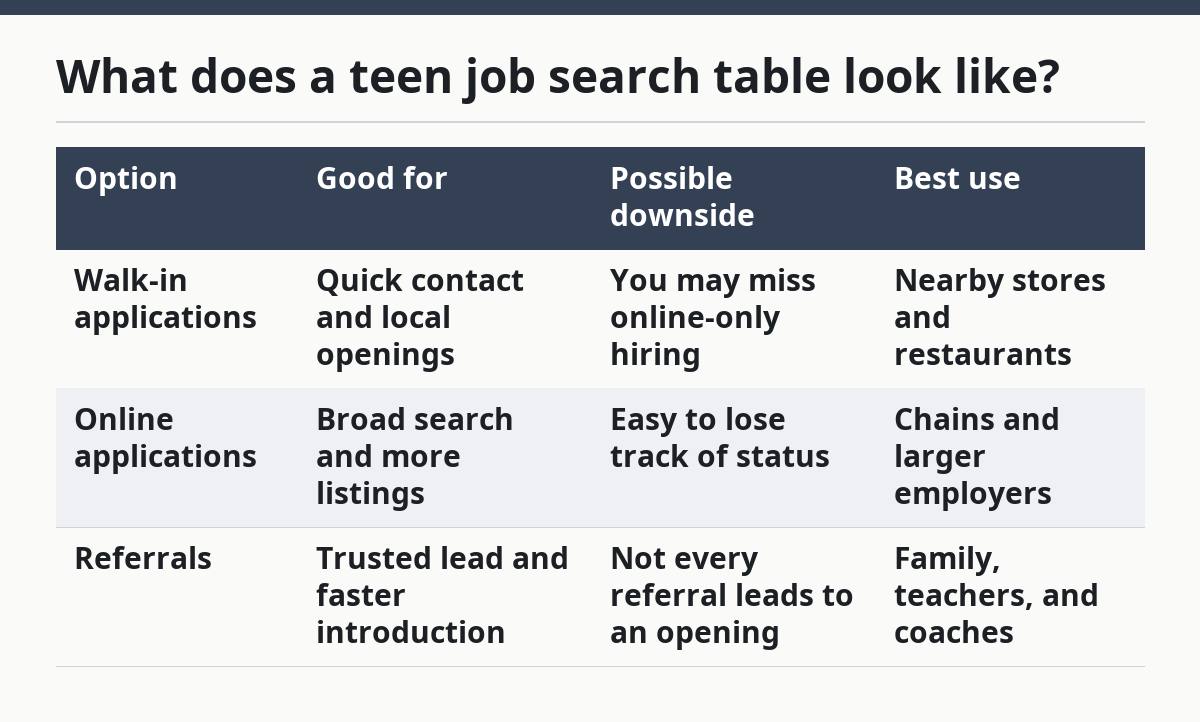
What does a teen job search table look like?
A simple comparison can help you decide where to start your teen job search.
| Option | Good for | Possible downside | Best use |
|---|---|---|---|
| Walk-in applications | Quick contact and local openings | You may miss online-only hiring | Nearby stores and restaurants |
| Online applications | Broad search and more listings | Easy to lose track of status | Chains and larger employers |
| Referrals | Trusted lead and faster introduction | Not every referral leads to an opening | Family, teachers, and coaches |
How should teens decide where to start?
Teens should start with places close to home, businesses with clear part-time needs, and employers that match school hours. That usually means combining local storefronts, job sites, and a short follow-up plan so the search stays active and organized.
Drafted with AI; not yet reviewed by a person.