Last updated: November 19, 2026
Quick Answer: For most teens, a legal, nearby hourly job is the most practical starting point, and the amount you can earn usually depends on your hours, local wage rules, and transportation costs. In this teen money jobs and earnings guide, the best choice is the one that matches the hours you can work, the rules in your state, and the kind of cash you need now: a steady hourly job for predictable income, or a flexible side gig if school and sports leave your schedule chopped up. I write about teen work, wages, and labor rules, and the biggest mistake I see is teens chasing “easy money” without checking age limits, permit requirements, or the real costs of transportation, uniforms, and taxes.
Key takeaways
- The fastest path to usable money is often a local hourly job with a fixed schedule, not a “hustle.”
- Your earning ceiling depends more on hours, local minimum wage, and school-night limits than on the job title.
- Paid work is safer when it is legal for your age, supervised, and tied to a real employer or platform.
- A job that looks high-paying can still be bad if it eats every evening, needs equipment, or pays irregularly.
- If you are under 16, the best options are often neighborhood-based, seasonal, or family-adjacent work.
- If you are 16 to 18, the best options widen fast, but so do safety risks and scheduling conflicts.
What teen money jobs are actually worth it?

The jobs that are worth it are the ones that convert your available hours into money with the fewest hidden losses. That usually means babysitting, pet care, lawn work, tutoring, lifeguarding, retail, restaurant work, grocery stores, delivery only where legal, and seasonal roles like holiday help or summer camp support. The teen money jobs and earnings conversation always comes back to this: the “best” job is not the one with the most hype; it is the one you can keep for 8 to 12 weeks without burning out or getting sidelined by school.
For most teens, the biggest driver of earnings is not skill alone. It is access. A teen with a bike, a short walkable neighborhood, and parents who can approve evening shifts can make more from odd jobs than a stronger student with no transportation. A teen in a suburb with several chain stores may do better with a minimum-wage cashier role than with a fancy online gig that pays only after fees. That practical reality matters more than internet advice that treats every job like a startup, so it is smart to consult a parent, school counselor, or labor office and to check an official source such as the U.S. Department of Labor’s YouthRules page: https://www.dol.gov/agencies/whd/youthrules
One useful way to think about teen earnings is this: jobs with a clear hourly rate are easier to plan around, while jobs paid per task can bring bigger bursts of money but also more dead time. Babysitting at night can produce good money per hour. Lawn care can be strong in spring and summer, then collapse in winter. Tutoring can pay well if you are genuinely strong in one subject, but it depends on trust and reputation. Retail pays less glamourously, but the schedule is often predictable and the work is easy to understand.
The wrong jobs for many teens are the ones that require upfront spending, vague promises, or adult-level liability. Be careful with anything that asks you to buy inventory, post money for a “starter kit,” or pay for a course before you earn. Be equally careful with jobs that look flexible but really demand late-night hours, strange meetups, or vague cash arrangements. Those are not side jobs; they are risk with a sticker on it.
A simple rule helps: if the job cannot be explained in one sentence to a parent, teacher, or counselor, it probably needs more scrutiny. A real teen job should have a clear task, a clear pay method, and a clear way to stop if it becomes unsafe.
How much can a teenager realistically earn?
A teenager can earn anything from pocket money to a serious part-time paycheck, but the real number depends on three things: legal hours, local wage levels, and how many jobs you can actually hold at once. In the U.S., the federal minimum wage is $7.25 per hour, but many states and cities require more, so the floor changes by location. You should check your state labor department before you plan around any number.
At a basic level, hourly math is brutally honest. If a job pays at a modest hourly rate and you work a few short shifts a week, the money adds up slowly. If you can work more consistent hours, the same job becomes meaningful fast. A teen working 10 hours a week has a very different monthly result from one working 20 hours a week, even at the same rate. That is why schedule matters more than job title.
Babysitting, tutoring, and pet care can pay above entry-level retail rates in some neighborhoods, but they are uneven. One customer may want you every Friday night; another may need you once a month. That makes them useful for extra cash, not always for stable budgeting. Retail, food service, and grocery work usually pay more consistently, but the pay is often closer to the legal floor unless you have late shifts, specialized responsibilities, or a local market with higher wages.
There is also a hidden earnings issue that most generic articles skip: teens often lose money to the job itself. Gas, bus fare, snacks during shifts, a required shirt, or child-care-like supplies for a service job can cut into take-home cash. If your job requires a drive across town for a 2-hour shift, the “hourly rate” may be misleading. After transport and time loss, the real return can be much lower.
The safest way to estimate earnings is to work backward from the weekly schedule you can sustain during school. If you can handle 6 to 10 hours without damaging sleep or grades, that is often a healthier starting point than chasing the biggest dollar figure. For many teens, steady income beats occasional big paydays because it is predictable, legal, and easier to keep.
If you want a number to aim for, build your own range rather than copying someone else’s. Use your local minimum wage, your likely weekly hours, and your transportation costs. That gives you a number that is actually usable.
Which jobs fit under 16, and which ones don’t?

Under 16, the best jobs are usually neighborhood jobs with short shifts and minimal machinery, because the law and the school calendar keep squeezing the options. Babysitting, pet sitting, dog walking, yard work, washing cars, house sitting with supervision, simple errands for neighbors, and tutoring younger kids are common examples. These jobs often fit because they are local, task-based, and easier to schedule around school nights.
This age group should avoid anything that involves dangerous equipment, heavy lifting, late-night shifts, or unclear supervision. A job that seems harmless online may still be a problem if it requires driving, operating power tools, entering strangers’ homes alone, or handling cash in risky settings. Child labor laws vary by state, and some work that sounds ordinary can be restricted for younger teens. The U.S. Department of Labor explains youth employment rules here: https://www.dol.gov/agencies/whd/youthrules
The strength of under-16 work is flexibility. You can often fit a one-hour dog walk, a 90-minute babysitting stint, or weekend yard work into a school week. You also build references quickly if you show up on time and communicate clearly. The weakness is ceiling. You may work hard for relatively modest money, and your customer base is usually family, neighbors, teachers, or friends of family. That makes trust easier, but it can also make the work inconsistent.
This stage is not for teens who want a polished resume entry with stable shifts and employee benefits. It is for someone who needs legal, low-overhead ways to start earning and learn how money works. If the goal is to gain experience before your first official job, this is the right lane.
The job becomes wrong for you if the work starts to feel like a second household responsibility. If your parents are negotiating with customer arrangements, driving you everywhere, or fixing scheduling mistakes, the job may be too complicated for your age or your current support system. A simple job is a better job at 14 or 15.
What changes once you are 16 to 18?
Once you are 16 to 18, the range opens up sharply, and the best money often shifts toward standard employer jobs. Retail, grocery, food service, movie theaters, recreation centers, summer camps, and some office or clerical work become realistic. This is the age where a teen can usually start building a work history that looks normal to future employers and colleges.
The big advantage here is consistency. A store schedule or restaurant shift plan can give you predictable weekly income, and that matters when you want to save for a phone, driving lessons, a laptop, or college application costs. Another advantage is growth. You can often learn customer service, stocking, point-of-sale systems, food prep, or front-desk work, which transfers into future jobs. That is a real edge over one-off gigs.
The downside is that the job can start to own your week. A 4-hour shift can become a 5-hour block once you add commuting, waiting, closing tasks, and last-minute schedule changes. School sports and exam periods can make this much harder. Many teens underestimate how draining a standing shift is after six hours of classes. If your grades are already fragile, a job with fixed peak hours may be a bad fit.
This age range is also where labor rules still matter a lot. Some jobs, even in a store or restaurant, may have hour restrictions for minors. Night work, long shifts, or machine-heavy tasks can be off-limits depending on age and state law. The safest move is to ask the employer directly what tasks minors actually do, then verify the rules with your state labor office if anything sounds close to a line.
A teen 16 to 18 who wants the most useful kind of money should favor jobs with a clean schedule, a manager who respects school, and a workplace that trains employees instead of improvising. That usually beats chasing the highest theoretical hourly rate. A job that teaches punctuality, customer handling, and cash management can be worth more than one that just pays slightly more on paper.
The honest side-by-side
The better choice for most teens is the one that matches their real week, not the one that sounds most impressive. Hourly jobs win when you want dependable pay and a normal work record. Side hustles win when you need flexibility and can get customers close to home. The table below shows where each one actually fits.
| Criteria | Hourly teen job | Side hustle / gig | Winner for this condition |
|---|---|---|---|
| Schedule predictability | Usually fixed shifts with a manager | Often irregular and customer-driven | Hourly job for school-year stability |
| Fast start | May require an application and onboarding | Can start with one neighbor or family referral | Side hustle for immediate cash |
| Legal clarity | Easier to verify through employer and labor rules | More likely to be informal or misunderstood | Hourly job for younger teens |
| Earning consistency | More even week to week | Can swing sharply by season | Hourly job for budgeting |
| Upfront costs | Usually low, sometimes uniform required | Can need supplies, transport, or tools | Hourly job if cash is tight |
| Earnings ceiling | Limited by hourly rate and hours | Can rise if you build repeat customers | Side hustle for strong reputation |
| Skill building | Teaches workplace habits and customer service | Teaches sales, trust, and independence | Tie, depending on goals |
| Safety oversight | Manager, coworkers, procedures | Often alone or with households | Hourly job for cautious teens |
| Flexibility around exams | Depends on manager, but shifts are known | Easier to pause or accept fewer jobs | Side hustle during exam weeks |
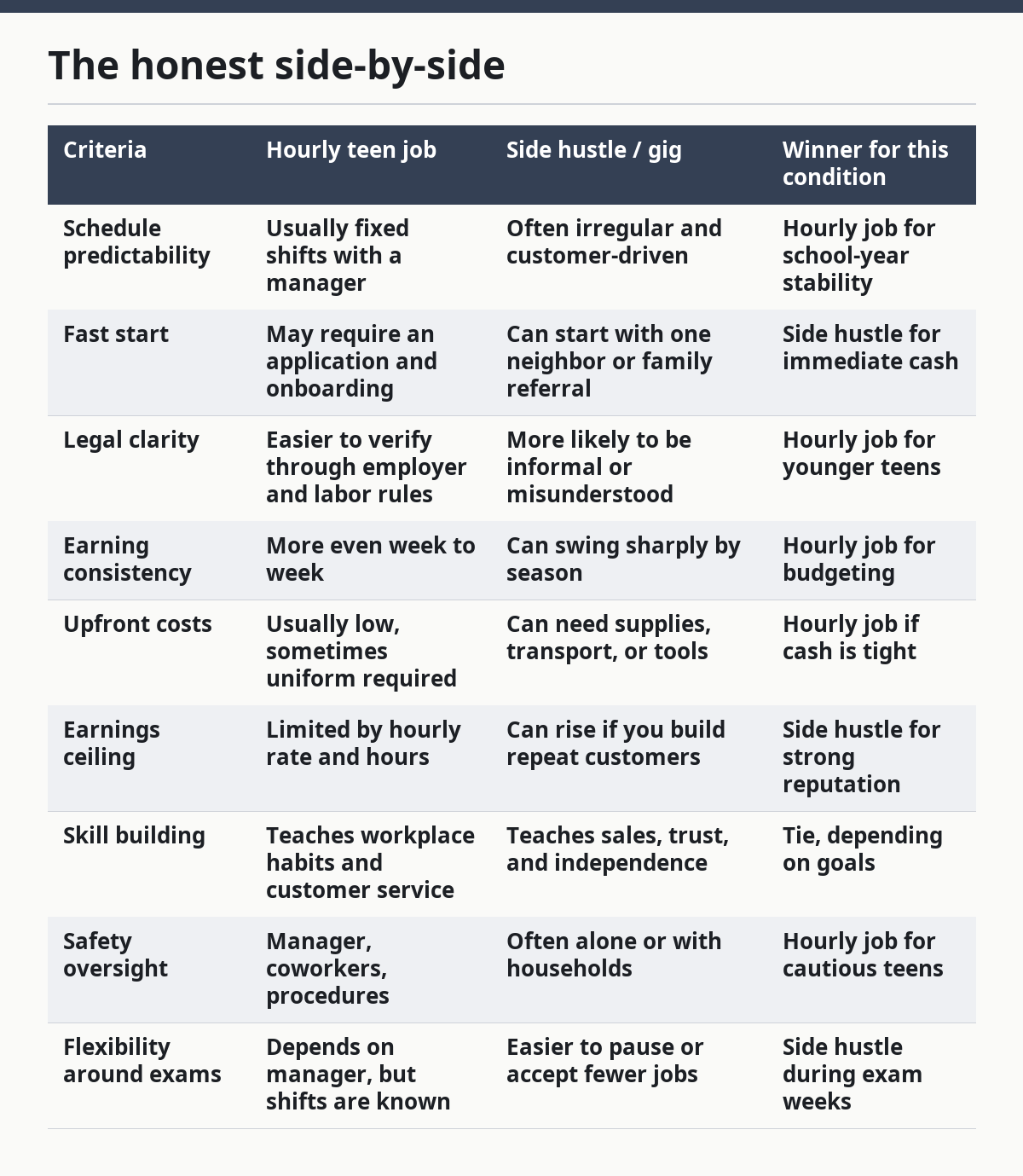
The hour-based job wins for most teens because the math is cleaner and the risk is lower. The side hustle wins when the teen already has trust, transportation, and a small local network. Neither is automatically better. The right answer depends on whether the teen is trying to build stable income or simply patch together cash around school.
This comparison is where a generic article usually fails. It praises “flexibility” without admitting that irregular work can mean unpaid waiting, cancelled appointments, and awkward price talks. It also praises “job security” without admitting that a fixed shift can trap a teen in a bad schedule. A real recommendation has to say both things.
The specific jobs that usually make the most sense
The best teen job for money is usually the one closest to home, easiest to explain, and hardest to mess up. Babysitting is strong if you are mature, reliable, and comfortable with children. Pet care is strong if you have trustworthy neighbors and a pet-friendly area. Tutoring is strong if you have real strength in math, reading, writing, or a language. Retail and food service are strong if you want steady pay and broad availability.
Babysitting can be especially good because families often need evenings and weekends, which fit school days better than daytime work. The trade-off is responsibility. You are not just “watching kids”; you are taking on safety, bedtime routines, food rules, and emergency judgment. If you are not comfortable being the adult in the room for several hours, skip it.
Pet care is often underrated. Because pet sitting and dog walking are repeatable, they can be a cleaner fit than babysitting if you have trustworthy customers and a calm routine. The downside is weather, no-shows, and the need to be physically present even when nothing exciting happens. A wet winter week can turn a promising side hustle into a slog.
Tutoring works best when you are genuinely good at one subject and can explain it in plain language. It is not for anyone who simply got a high grade once. Parents want proof of reliability, and younger students need structure. If you can make algebra or essay planning feel simpler, this can pay well relative to the time spent.
Retail, grocery, theater, and restaurant jobs are usually the most useful “first real jobs.” They provide regular pay, references, and a predictable path into more hours. They are not glamorous, and the work can be repetitive. But they teach the basics of showing up, handling customers, and staying calm when the line is long.
If I had to choose one category for a teen who wants the best all-around combination of legal safety, resumability, and consistent income, I would pick a standard employer job first, then add a local side gig only if the schedule still has room. That sequence reduces chaos.
What most teens get wrong about earning money
The biggest mistake is confusing gross pay with usable money. A teen may hear “$15 an hour” and imagine freedom, then lose part of that to transport, food on shift, a required polo shirt, a haircut for a customer-facing role, or tax withholding if the employer treats the job formally. Money that sounds big at first can vanish fast if the job is far away or the schedule is unstable.
The second mistake is taking on jobs that look easy but depend on trust the teen has not earned yet. A first-time sitter who shows up late, forgets house rules, or ignores message replies can lose a customer after one bad night. A teen who wants to tutor without preparation can damage a reputation quickly. In both cases, the first few jobs matter more than the headline pay.
The third mistake is accepting unsafe work because the pay sounds good. If a listing wants you to work alone late at night, meet in odd locations, or use an app that hides too much about the customer, the risk is too high. Teens should not treat every paid task as equal. Legality, supervision, and adult oversight still matter.
The fourth mistake is treating a job like a personality test. A teen does not need to find a “dream job” at 15. They need to find a job that is legal, tolerable, and repeatable. That can be a cashier role, a dog-walking route, or two regular babysitting nights a week. The goal is to build money habits, not a life mission statement.
If you want the cleanest strategy, start small, keep the work local, and protect school time first. A teen who can keep a job for six months without missing class has already done something valuable. That consistency is worth more than a flashy wage claim.
When the advice changes completely
The recommendation flips if the teen needs income fast, has almost no transportation, or lives in an area with strong family/neighborhood networks. In that case, one-off local work can beat a formal job because it starts sooner and costs less to maintain. Babysitting, yard work, and pet care can be better than a store job when getting to work is the main obstacle.
The advice also changes if the teen has a special skill and a strong proof point. A student who is excellent in algebra, piano, Spanish, coding, or essay writing may earn more from tutoring than from retail, especially if local families are already asking for help. The key word is proof. A real skill with a real explanation can justify a higher rate better than a generic promise.
Another flip happens when the school year is already overloaded. During exams, marching band season, sports tournaments, or a heavy AP load, the best “job” may be a very small one or no job at all. A teen who can only work 3 to 4 hours a week may be better off saving energy for school and picking up a seasonal job in summer.
The final flip is safety. If a job requires travel through unsafe areas, late-night solo work, or contact with strangers you cannot vet, it is the wrong choice even if the pay looks attractive. That is not a personal preference; it is a practical boundary. No earnings target is worth a dangerous setup.
These exceptions are why a blanket “best job” answer is often wrong. The right choice changes when the teen’s schedule, skill level, and location change.
What should a teen pick first?
Choose a standard hourly job if the teen needs steady money, a predictable schedule, and a legal, well-defined workplace. Choose a local side hustle if the teen needs maximum flexibility, already has trust in the neighborhood, and can keep the work small and safe. Neither if the job would cut into sleep, school, or safety to the point that the money stops being worth it.
That is the cleanest answer. For most teens, the first paid work should be boring in the best way: legal, repeatable, close to home, and easy to explain. Once that foundation is in place, side jobs can add extra cash without turning life into a logistics problem.
Where to check the rules before you start
The right job can still be the wrong job if it breaks youth labor rules. That is why a teen should check official guidance before accepting hours, especially if the job involves evenings, food service, machinery, or very young workers. The U.S. Department of Labor’s YouthRules page is a useful starting point: https://www.dol.gov/agencies/whd/youthrules
For state-specific wage and hour rules, the state labor department is usually the next stop. Those offices explain minimum wage, permitted hours, and work permit rules where they apply. If a parent, manager, or neighbor gives advice that conflicts with the official rule, the official rule wins.
The practical point is simple. A teen who checks the rules first avoids the most expensive mistake in this whole topic: getting paid for a job that should not have been accepted in the first place. If there is any doubt, ask a parent, school counselor, or labor office before the first shift.
Drafted with AI; not yet reviewed by a person.