Last updated: November 20, 2026
Quick Answer: For most families, the safest Teen Banking Account Safety and Access setup is the one with card controls, instant alerts, and parent recovery access; a parent-managed teen account usually fits younger teens best, while a more flexible setup fits older teens with jobs. Teen banking account safety and access comes down to who can move money, reset access, and see the activity. The right setup gives a teen room to learn without giving a stranger — or a frustrated parent — the keys to the account.
This guide sorts out the access rules, the safety settings, and the choices that actually matter for Teen Banking Account Safety and Access — The Complete Guide.
What a teen banking account needs to do first
A good teen account should let a parent or guardian approve, monitor, or block transfers while the teen can still use a card, app, or direct deposit. If the account can’t control those three things, it’s not really a teen account — it’s just a regular checking account with a label.
Picture this: you’re setting up your teen’s first account the night before a school trip, and you want them to pay for lunch without giving them a way to empty the balance at 11 p.m. That’s the real test. The account has to balance spending access, alerts, and recovery if the phone gets lost.
A strong setup usually includes:
- card controls in the app
- instant transaction alerts
- the ability to freeze a card fast
- shared visibility for the parent
- limits on transfers, ATM use, or overdrafts
The catch is that not every bank gives you all five. Some teen products focus on visibility but give weak controls. Others make transfer rules clear but hide the real fees in the fine print. A parent needs both safety and speed, not one without the other.
For a broader account checklist, the CFPB’s consumer tools on bank accounts are useful to cross-check before you open anything: https://www.consumerfinance.gov/consumer-tools/bank-accounts/
How much access should a teen actually get?
A teen should get enough access to learn, but not enough access to create a mess the parent has to clean up. That usually means card spending, account balance checks, and maybe mobile deposit — not full control over every move in the account.
Here’s the line I draw: if the teen can send money to anyone, add a new external account, or change login recovery details without parent approval, the account is too open for most younger teens. For an older teen with steady income, that may be fine. For a 13-year-old, it usually isn’t.
Because of that, it helps to think in layers:
- View only — the teen can check balance and activity.
- Spending access — the teen can use a card and maybe pay friends.
- Transfer access — the teen can move money in and out.
- Admin access — the teen can change security settings, beneficiaries, or linked accounts.
A good teen setup keeps the adult in layers 3 and 4. The teen usually belongs in layers 1 and 2, with some carefully limited 3 if the bank supports it. That split is the whole point.
Teen debit cards, bank cards, and app access: what’s the real difference?
The safest teen account pairs a card with app controls in many families, because the card spends money and the app shows the damage. A card alone is weak. App access alone is weak too, because it teaches balance-checking but not real-world payment habits.
Picture this: your teen is at a store, and the card works fine, but the app shows no alerts until hours later. That delay matters. If a card is stolen, the first hour is the one that saves the most trouble. A bank that offers instant push alerts, card lock, and merchant detail in the app is giving you real safety tools.
The practical difference looks like this:
- Debit card: lets the teen spend from the account, but can expose the balance if the card is lost.
- App access: lets the teen learn account habits and check cash flow.
- Parent controls: let the adult stop spending, set limits, or review activity.
A lot of generic advice says “teach responsibility.” That’s too soft. Safety comes from design. If the app can’t lock the card in seconds, or if alerts are buried in email, the setup is weaker no matter how responsible the teen is.
What to look for in app safety
- biometric login on supported phones
- two-factor authentication
- instant alerts for card purchases and transfers
- the ability to freeze and unfreeze a card
- clear activity logs with merchant names
If a bank offers only password login and basic balance checks, it’s behind. If it offers card lock, alerts, and parent oversight in one place, it’s much better for a first account.
Who should control the login and recovery details?
The parent should control the recovery details until the teen is old enough to manage account lockout, lost devices, and password resets without help. That usually means the adult should own the email tied to account recovery, at least at first.
Here’s the catch: many account problems are not spending problems. They’re access problems. The teen forgets a password, loses a phone, or gets locked out after changing devices. If the account recovery path goes only through the teen’s phone number, one lost device can freeze the whole account.
A safer setup uses:
- a parent email for recovery
- a teen login for day-to-day use
- separate device approvals where possible
- a password manager the adult can help manage
- alerts sent to both phone numbers or emails, if the bank allows it
This is also where banks differ in a big way. Some teen products treat the parent as a co-owner or custodian with strong control; others treat the adult as a helper with limited oversight, and families should consult the bank’s account agreement or a qualified professional before assuming how authority works. That difference affects who can close the account, change beneficiaries, or move money. Read the ownership rules before you open anything.
If the teen needs independence for summer work or college prep, that may push you toward a structure with clearer transfer rights. If the main goal is supervised practice, tighter parent recovery control is smarter.
How to keep the account safe from fraud, scams, and phone loss
The safest teen account is the one that assumes the phone will get lost and the card will get skimmed; that is a practical assumption, not a guarantee. Teen accounts are often used in stores, at school events, and on small apps where quick taps happen fast and mistakes do too.
A strong safety setup should include:
- card lock in the app
- alerts for every purchase over a set amount, if offered
- the option to freeze cash withdrawals
- zero liability language for unauthorized card use, where applicable
- a way to replace the card without reopening the whole account
The bank’s own security page matters here. The Consumer Financial Protection Bureau explains how debit card fraud timing and reporting can affect liability, so the sooner a card is reported missing, the better the result can be. See the CFPB’s debit card guidance at https://www.consumerfinance.gov/consumer-tools/debit-cards/ for a plain-language overview.
Phone loss is just as important. If the app is the only way to access the account, a dead phone can become a real risk if there is no backup device or recovery path. Keep the parent’s login on a separate device. Keep the teen’s recovery email current. And don’t let the card PIN become the same four digits the teen uses everywhere else.
Safety steps that matter most
- turn on push alerts before the first purchase
- store the card PIN in a safe place, not in the phone notes app
- check whether ATM withdrawals can be limited
- review whether Zelle, P2P transfers, or external transfers are allowed
- confirm how fast the bank can issue a replacement card
The best part is not that teen banking is perfect; it is that a teen account can be easier to audit than cash, because the digital trail makes mistakes easier to catch.
What fees and limits can trip you up?
A teen account can look free and still cost money through ATM fees, foreign transaction fees, overdrafts, replacement cards, or out-of-network use. The fee sheet is where many “friendly” teen accounts stop being friendly.
Picture this: the teen uses a debit card at an ATM near a concert venue and gets hit with two charges — one from the ATM operator and one from the bank. That’s not a rare edge case. It’s a common teen mistake because the spending moment feels small and fast.
Check these items before opening the account:
- monthly maintenance fee
- ATM network and surcharge rules
- cash deposit rules
- overdraft or negative balance policy
- transfer limits
- replacement card fee
- paper statement fee, if any
A lot of teen banking advice skips this. That is a bad move. Fees are access rules in disguise. If the account blocks overdrafts but still allows small negatives that must be repaid, a parent may not realize the teen can spend past zero. If ATM access is allowed but expensive, the teen may learn the wrong habit: pay extra for convenience.
The safest choice is the account with the clearest fee structure and the fewest traps, especially if the teen is younger or just starting work.
For fee cross-checking, the FDIC’s consumer resources on bank accounts and fees are a useful second source: https://www.fdic.gov/resources/consumers/consumer-assistance-topics/bank-accounts.html
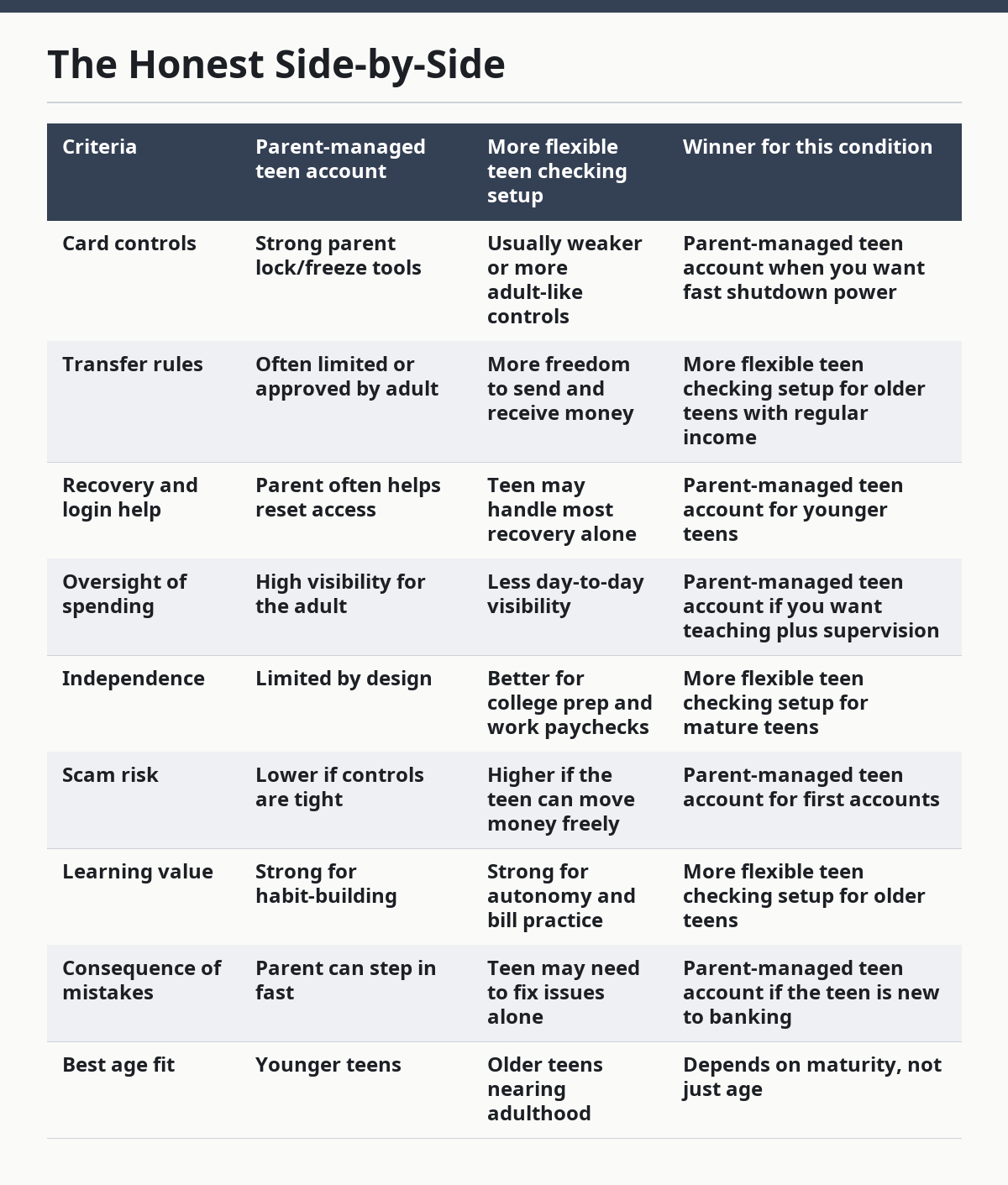
The Honest Side-by-Side
The right account choice depends on whether you want more control or more independence. A parent-managed teen account wins for younger teens and first-time users. A more flexible teen checking setup wins for older teens with jobs, regular expenses, and a real need to move money on their own.
The truth is, “teen banking” covers two very different jobs. One is training wheels. The other is near-adult banking with guardrails. Mixing them up causes trouble.
| Criteria | Parent-managed teen account | More flexible teen checking setup | Winner for this condition |
|---|---|---|---|
| Card controls | Strong parent lock/freeze tools | Usually weaker or more adult-like controls | Parent-managed teen account when you want fast shutdown power |
| Transfer rules | Often limited or approved by adult | More freedom to send and receive money | More flexible teen checking setup for older teens with regular income |
| Recovery and login help | Parent often helps reset access | Teen may handle most recovery alone | Parent-managed teen account for younger teens |
| Oversight of spending | High visibility for the adult | Less day-to-day visibility | Parent-managed teen account if you want teaching plus supervision |
| Independence | Limited by design | Better for college prep and work paychecks | More flexible teen checking setup for mature teens |
| Scam risk | Lower if controls are tight | Higher if the teen can move money freely | Parent-managed teen account for first accounts |
| Learning value | Strong for habit-building | Strong for autonomy and bill practice | More flexible teen checking setup for older teens |
| Consequence of mistakes | Parent can step in fast | Teen may need to fix issues alone | Parent-managed teen account if the teen is new to banking |
| Best age fit | Younger teens | Older teens nearing adulthood | Depends on maturity, not just age |
Which teen banking setup is safer for most families?
The safer default for most families is the parent-managed teen account, because it limits damage from mistakes and gives the adult real control over cards and transfers. The better long-term setup is the more flexible teen checking account once the teen has a job, understands fees, and can handle account recovery.
Picture this: your teen is 14, needs a card for school lunch, and doesn’t need to send money to friends. That is a parent-managed account case. Now picture a 17-year-old with a weekend job, a car, and regular paydays. That teen may need the flexibility to transfer money, pay for gas, and handle direct deposit without constant approval.
Choose parent-managed if the main goal is safety, visibility, and easy intervention. Choose more flexible if the main goal is independence, direct deposit, and real budgeting practice. Choose neither if the bank can’t offer alerts, card lock, or clear fee rules — because then the account is too weak for either job.
The best choice is not the one with the flashiest app. It’s the one that matches the teen’s real life:
- younger teen, first account: tighter controls
- older teen, job income, school travel: more freedom
- frequent phone loss or poor follow-through: tighter controls
- strong budgeting habits and reliable communication: more freedom
That’s the decision line. Everything else is marketing.
When should you rethink the setup entirely?
You should rethink the setup if the teen needs features the account doesn’t actually protect. A teen product is not the right fit when the family needs business-like payment power, adult joint ownership, or complex transfer access.
Here are the exception scenarios where the usual answer flips:
- The teen has regular income from work and pays recurring expenses. A more flexible setup may be better because the teen needs direct deposit, transfers, and bill-like habits.
- The teen loses phones often or ignores alerts. Tight controls matter more than convenience, so the parent-managed model stays safer.
- The adult wants the account to build college-readiness, not just spending control. A more open account can better teach responsibility with less hand-holding.
- The bank can’t freeze the card or limit transfers in real time. Skip that product entirely and find one with stronger control tools.
A generic article would tell you to “compare features,” but that is too vague for Teen Banking Account Safety and Access. The real question is whether the account can survive the way your teen actually uses it. If the answer is no, the setup is wrong no matter how polished the app looks.
For the CFPB’s broader guidance on bank accounts and safe account use, the agency’s consumer tools are a solid place to cross-check the fine print: https://www.consumerfinance.gov/consumer-tools/bank-accounts/
The questions parents ask right before opening the account
The best teen banking question is not “Which bank is best?” It’s “Who can move money, who can lock the card, and who can fix a mistake at 9 p.m.?” Answer that first, and the rest gets easier.
Can a teen banking account be safe if the teen has their own card?
Yes, if the card has limits and the app has controls. A card without instant alerts, freeze options, or clear spending logs is much riskier than one with those tools.
Should the parent have access to the teen’s login?
The parent should have recovery help and oversight, but not necessarily full login access if the bank offers better shared controls. The key is backup access for lockouts, lost phones, or fraud, not constant snooping.
What is the biggest mistake families make?
They pick an account for the app look instead of the control rules. A slick interface does nothing if the teen can’t be supervised or the parent can’t stop a card fast.
Is a teen account better than cash?
For most families, yes. A teen account leaves a trail, can send alerts, and is easier to freeze than cash in a wallet. Cash still helps with small habits, but it gives no fraud protection.
When should a teen move to a regular checking account?
When the teen can manage login recovery, track fees, handle direct deposit, and understand transfers without constant help. That change is about maturity and money habits, not birthdays alone.
Key Takeaways
- Safety comes from control, not just from having a bank app.
- A younger teen usually needs card locks, alerts, and parent recovery help more than transfer freedom.
- An older teen with income may need direct deposit, transfers, and more independence.
- The fee sheet matters as much as the app, especially for ATM use and overdrafts.
- If the bank can’t freeze the card or set clear limits, it’s the wrong fit.
Drafted with AI; not yet reviewed by a person.