Last updated: November 19, 2026
Quick answer: Teens should dispute an unauthorized charge as soon as they spot it, and a simple 3-step approach usually works best: check the transaction record, contact the merchant if the charge looks like a billing error, then file the dispute with the bank or card issuer.
If a teen sees a charge they did not make, the charge dispute process starts with checking the transaction record, contacting the merchant, and then filing a dispute with the bank or card issuer. The goal is to report it fast, save proof, and give the issuer enough detail to reverse the charge if it is truly unauthorized.
Key takeaways
- Start with the transaction record: date, amount, merchant name, and any receipt or message tied to the charge.
- Contact the merchant first if the charge looks like a simple billing error, but move on quickly if it is clearly unauthorized.
- Use the bank or card issuer’s dispute form or phone line, and ask for a case number.
- Save screenshots, emails, and call notes in one folder so the story does not get lost.
- Report the problem as soon as it appears; waiting makes the trail harder to follow.
- This guide is for the charge dispute itself, not for replacing a lost card or locking a phone.
What an unauthorized charge means in the charge dispute process
An unauthorized charge is a payment on a card or account that the teen did not approve. That can include a store purchase, an online order, a subscription renewal, or a test charge that turned into a real charge.
A generic “I don’t recognize this” complaint is not enough for the bank or card issuer. The issuer needs details from the transaction record: the exact amount, the date, the merchant name as it appears on the statement, and anything the teen bought around the same time. A charge from “ABC DIGITAL 877-555-0000” may look unfamiliar even when it came from a service the teen actually used, so the name on the statement matters.
This is also where a teen should separate three problems. An unauthorized charge is one thing. A merchant billing mistake is another. A card being lost or stolen is a different issue and belongs on a different page. Mixing them up slows the case because the bank may route it to the wrong department.
The strongest disputes are specific. “$14.99 on March 6 from STREAMMAX” is better than “random charge.” If the teen can point to a deleted email, a cancelled trial, or a message that shows they never ordered anything, that helps the card issuer see the pattern quickly.
For money-safety basics beyond this process, the teen money safety and fraud protection hub is the right starting point.
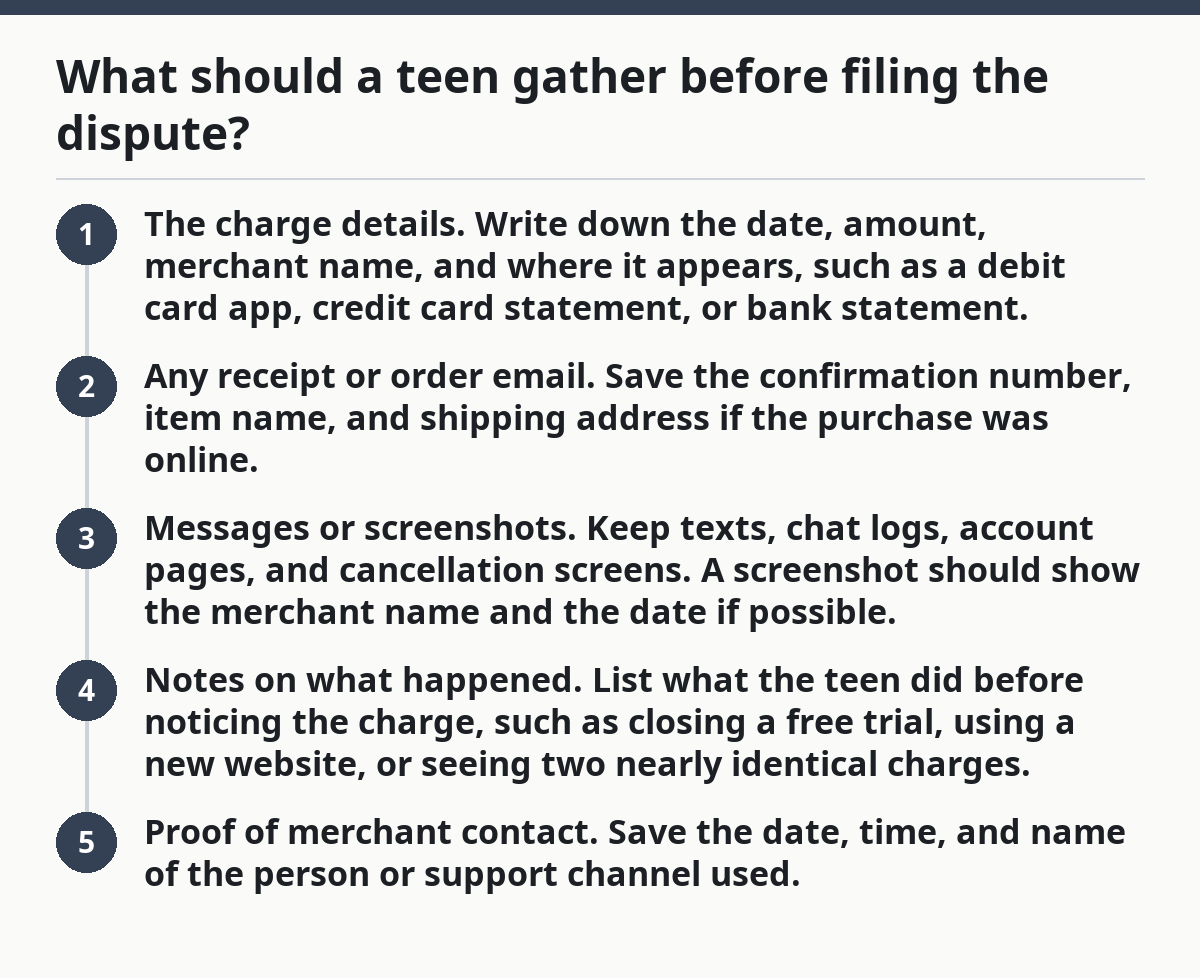
What should a teen gather before filing the dispute?
A teen should gather the transaction record, any proof of contact with the merchant, and a short timeline before filing the dispute. That prep usually takes 10 to 15 minutes and can save days later.
Before calling the bank or filling out a form, collect these items in one place:
- The charge details. Write down the date, amount, merchant name, and where it appears, such as a debit card app, credit card statement, or bank statement.
- Any receipt or order email. Save the confirmation number, item name, and shipping address if the purchase was online.
- Messages or screenshots. Keep texts, chat logs, account pages, and cancellation screens. A screenshot should show the merchant name and the date if possible.
- Notes on what happened. List what the teen did before noticing the charge, such as closing a free trial, using a new website, or seeing two nearly identical charges.
- Proof of merchant contact. Save the date, time, and name of the person or support channel used.
A simple notes app is enough if it is organized. One page titled “charge dispute” with bullet points usually works better than scattered photos in a camera roll. If the teen can, they should also save files as PDFs or images in one folder named with the date, such as 2026-10-dispute.
The common mistake is waiting until the issuer asks for proof. By then, a deleted email or expired chat may be gone. Another mistake is sending too much unrelated material. Ten clear screenshots are better than 80 random ones. The bank or card issuer wants proof that connects the charge to a billing error or unauthorized use, not a long story with no dates.
Should teens contact the merchant first?
Yes, teens should contact the merchant first when the charge looks like a billing error, but not when the charge is clearly unauthorized and needs immediate dispute handling. A quick merchant contact can sometimes fix the problem in 1 business day, especially for duplicate charges, cancelled subscriptions, or wrong amounts.
The reason to start with the merchant is simple: some merchants can refund a mistaken charge faster than a formal dispute can move through the bank system. If the merchant recognizes the error, the teen may get a refund or written confirmation that supports the charge dispute.
Use the merchant’s support page, help email, or phone line. Ask for three things:
- the merchant’s explanation of the charge,
- whether they can reverse it,
- and a case or ticket number.
Keep the message short and factual. “I was charged $29.99 on April 12 for an order I did not place. Please review and tell me whether you can refund it.” That sentence gives the merchant the exact charge and the request.
Do not argue for half an hour on a call if the answer is clearly no. A 5-minute contact that gets a written response is more useful than a long conversation with no record. Save the date, time, and name of the representative if they give it.
This step is not right for every case. If the teen already knows the charge is fraudulent or the merchant is unhelpful, the bank or card issuer should be contacted right away so the dispute clock starts. The trade-off is speed: merchant contact may solve the issue faster, but it can also waste time if the charge needs formal escalation.
How do teens file the charge dispute with a bank or card issuer?
Teens file the charge dispute with the bank or card issuer by calling the number on the card or statement, using the online dispute form if one is available, and then giving the exact transaction details. The first goal is to get a case number or confirmation that the dispute was opened.
Here is the order that usually works best:
- Call the number on the back of the card or the statement. Ask for disputes or fraud support. If phone menus are confusing, use the online banking app or website to look for “dispute a charge” or “report a problem.”
- State the charge clearly. Give the amount, date, merchant name, and why it should be removed. Say whether it was unauthorized or billed in error.
- Ask what evidence they want. Some issuers accept screenshots, merchant emails, or order confirmations through a secure upload page, and a parent, guardian, or other trusted adult can help confirm what the issuer accepts. For the safest guidance, check the issuer’s help page or ask the issuer directly before sending files.
- Submit the dispute form. Fill in every required field carefully. If the form asks for the last 4 digits of the card, transaction date, and reason code, match them to the transaction record exactly.
- Save the confirmation. Write down the case number, the date, the method used, and the name of the representative if one was given.
- Follow any next-step instructions. The issuer may ask for a signed statement, an affidavit, or more documentation within a set period.
A teen should expect the bank or card issuer to ask the same question in different ways: what happened, when, where, and why the charge is not theirs. That repetition is normal. It helps the issuer classify the case correctly.
One mistake that hurts disputes is guessing. If the teen is unsure whether the merchant billed twice or whether a family member used the card, say that clearly instead of inventing certainty. Another mistake is missing the issuer’s deadline for documents. If they ask for a statement within 10 days, send it within 10 days, not “soon.”
How long should teens wait before reporting fraud?
Teens should report an unauthorized charge as soon as they see it, ideally the same day or within a few days. Waiting makes it harder to trace the transaction, gather merchant responses, and meet the bank’s reporting window.
The exact time limit depends on the card issuer and account type, so teens should check the account rules and report the charge without delay. If a teen is staring at a charge they do not recognize, the clock already matters. Calling the bank or card issuer early can stop the case from becoming a paperwork problem later.
Timeliness matters for evidence too. Merchant email threads can disappear, app messages can get archived, and a statement may update after a billing cycle closes. If the teen notices the charge on a Monday, they should not wait until the end of the month to act. Even a 2-day delay can make the story harder to reconstruct.
There is a trade-off here. Reporting quickly is good, but filing a sloppy dispute is not. A fast report with the wrong merchant name or no date can slow everything down. The better approach is quick and precise: charge amount, date, merchant, and one-sentence reason.
For a teen, this is also a place to involve a parent or guardian if account access requires it. That is not about giving up control; it is about getting the issue on record quickly if the account setup requires adult help for communication or form signing.
What evidence saves the dispute when the issuer asks for proof?
The strongest evidence is whatever ties the charge to the merchant, the account, and the teen’s timeline. A bank or card issuer can use a short chain of proof much faster than a pile of unrelated screenshots.
The strongest items are:
- the transaction record showing the charge,
- an order confirmation or receipt,
- merchant chat or email saying the charge will be reviewed,
- a cancellation notice if the charge followed a cancelled service,
- and screenshots of the merchant page, billing page, or account history.
A paper trail with dates is more useful than a broad explanation. For example, a screenshot that shows a subscription cancelled on May 2, followed by a May 4 charge, is stronger than a paragraph saying, “I cancelled it already.” If the teen used a merchant app, save the in-app receipts before logging out or deleting the account.
Keep the evidence in one folder and label it by date. If the dispute stretches over 2 weeks or more, adding new proof becomes easier when the files are organized. A simple naming system like 2026-04-12_receipt or merchant-chat-1 avoids confusion when the bank asks for a follow-up.
The common mistake is sending blurry screenshots or cropped images that cut off the merchant name and timestamp. Another is relying only on memory. Memory fades fast; the transaction record does not. If a parent or guardian helps, make sure the same facts appear in every message so the issuer does not see mixed explanations.
For card-dispute rules and complaint basics, the Consumer Financial Protection Bureau’s guidance on billing errors and credit card disputes is a useful reference, and the Federal Trade Commission’s fraud reporting guidance helps explain what counts as unauthorized use. The CFPB also explains how billing disputes work under federal rules, and the FTC offers a separate fraud-reporting page that is useful for unauthorized charges. For more context, see the CFPB and FTC pages on billing errors and credit card disputes and reporting identity theft and fraud.
What if the bank or card issuer says no?
If the bank or card issuer says no, the teen should ask for the reason in writing and then correct any missing evidence or wrong transaction details. A denial can be the end of the charge dispute process, but it can also leave room to fix a missing detail or file a follow-up appeal.
Start by asking these questions:
- Did the issuer classify it as unauthorized, a billing error, or a merchant dispute?
- Was any document missing?
- Was the claim filed too late?
- Was the merchant name entered wrong?
If the answer was no because of missing proof, send the proof once. If it was denied because the charge appears legitimate, compare the merchant name, order date, and device use again. Sometimes a subscription renews under a different brand name, and that can be mistaken for a stranger’s charge.
If the issuer offers an appeal or reconsideration, use it. Keep the follow-up short, factual, and organized. A 1-page timeline often works better than a long complaint. If the teen used a merchant support case number already, include it.
This page is not the place for card replacement or phone-security steps, so I will keep the focus on the dispute itself. The bottom line is that a teen should not stop at the first no if the documentation is strong and the charge is genuinely unauthorized.
Do teens need a parent to dispute a charge?
Teens sometimes need a parent to dispute a charge. Some teens can start the dispute themselves if they are authorized users or if the account and issuer allow it, but many banks and card issuers require a parent or account holder to finish the form or sign the statement. The best move is to check the account rules and start the report immediately.
What evidence should be saved?
Save the transaction record, any receipt or order email, merchant messages, and screenshots that show dates and amounts. A short timeline of what happened also helps. If the teen contacted the merchant, keep the case number and the exact wording of the response.
How long do disputes take?
It depends on the bank or card issuer and the kind of charge. Some merchant fixes happen in a few days, while formal disputes can take longer and may involve follow-up documents. The teen should keep checking messages and mail for requests so the case does not stall.
Drafted with AI; not yet reviewed by a person.