Last updated: November 20, 2026
Volunteer work helps future jobs when it gives you skills, proof, or references a future employer can use. This guide on How Teens Can Know If a Volunteer Opportunity Helps With Future Jobs shows how to tell the difference between a volunteer role that just fills a Saturday and one that can strengthen a resume, an application, or a recommendation.
The fastest way to judge a volunteer role
Picture this: you’re staring at two volunteer sign-up forms, and one looks meaningful but vague. A quick way to judge a volunteer role is to ask whether it gives you job-like tasks, a real reference, or a skill you can name later.
A good volunteer role does at least one of those things, and the better ones do all three. It is not about sounding impressive. It is about whether the job market can recognize what you did.
- A volunteer role helps future jobs when it gives you something a future employer can read, verify, or trust.
- The most useful roles teach skills you can name on a resume.
- The strongest roles connect you with an adult who can later act as a reference.
- Vague “help out where needed” roles usually have less resume value.
- Leadership, teamwork, and reliability matter when the task is simple.
What future employers actually notice in volunteer experience
Picture this: you want your volunteer work to count, but you’re not sure what adult hiring managers even care about. The answer is simple: future employers care about proof of behavior, not just good intentions.
They look for clues that you can show up on time, follow directions, work with people, and finish tasks without being chased. A volunteer role becomes useful when it gives you clear examples of those things.
A teen who restocks shelves at a food pantry every Tuesday for 3 months has something stronger than “I volunteered.” That person can talk about consistency, organization, and handling a routine. A teen who shows up once for a one-time cleanup has less to show, even if the work was real.
Here’s the catch: employers usually don’t care that the cause was noble unless the role also taught something usable. A volunteer shift at a fundraiser can still help if you handled check-in, money, signs, or guest questions. Those are work skills in plain clothes.
What makes a role useful:
- A set schedule, such as 2 hours every week
- Tasks you can describe in one sentence
- An adult who supervised you
- Some responsibility you handled on your own
- A chance to solve small problems, not just stand around
What makes a role weak for jobs:
- No clear duties
- No adult who knows your work
- Only one short event with no follow-up
- Work that is hard to explain on a resume
The strongest roles are often the ones that let you point to specific work, and that is why clarity matters.
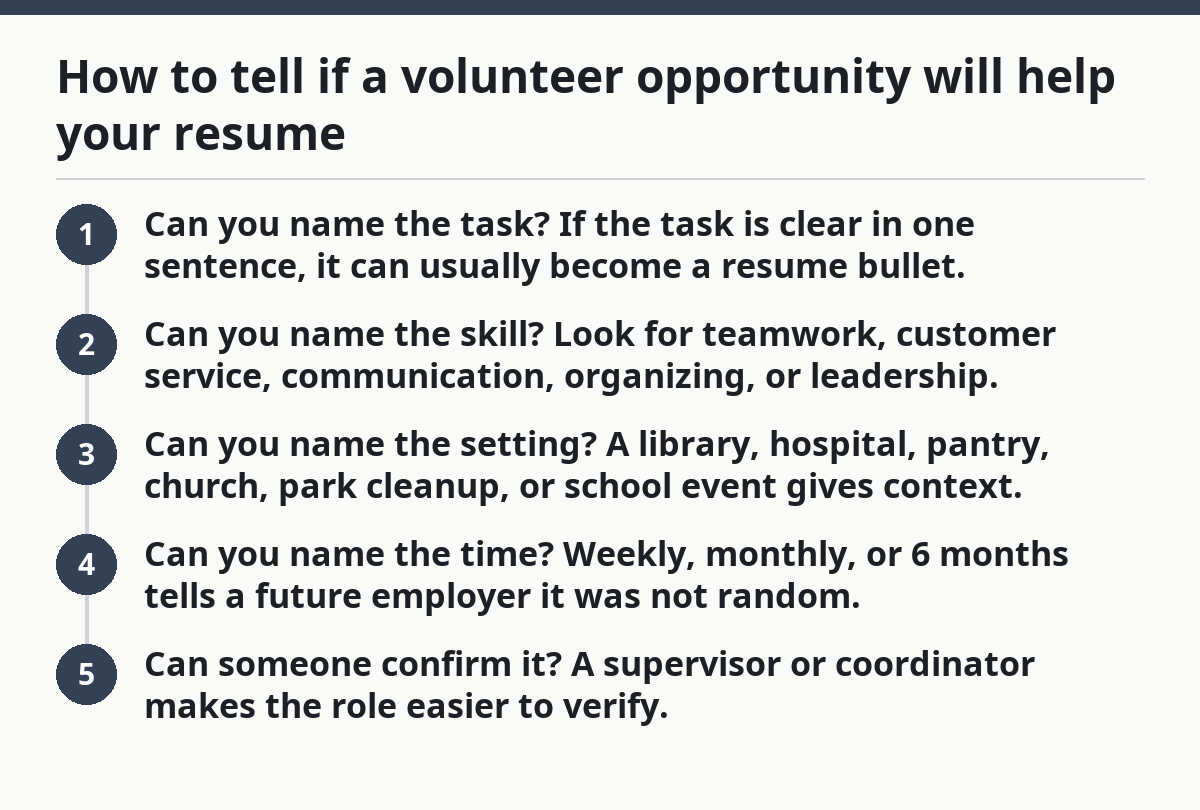
How to tell if a volunteer opportunity will help your resume
Picture this: you’re comparing a shelter shift, a school club role, and a one-day event, and you want to know which one will matter later. The answer is to look for resume-ready details, not the name of the organization.
A volunteer role helps your resume if you can turn it into a line that sounds like work, not just service. That means the role has a task, a result, and a time frame. “Helped at animal rescue” is weak. “Walked dogs, cleaned kennels, and greeted visitors during Saturday shifts” is stronger because it shows action.
Use this quick check before you commit:
- Can you name the task? If the task is clear in one sentence, it can usually become a resume bullet.
- Can you name the skill? Look for teamwork, customer service, communication, organizing, or leadership.
- Can you name the setting? A library, hospital, pantry, church, park cleanup, or school event gives context.
- Can you name the time? Weekly, monthly, or 6 months tells a future employer it was not random.
- Can someone confirm it? A supervisor or coordinator makes the role easier to verify.
A role with a schedule of 1 shift a month can still help if the duties are solid. A role with 10 hours in one weekend can help less if it gives you no real responsibility. Time alone is not the point. What you did with the time is.
If you are trying to build a first resume, ask the volunteer site one blunt question: “What would I actually do, and who would oversee me?” If they cannot answer cleanly, the role may be better for community service than for job value.
For resume wording, the CareerOneStop resume guide can help you turn experience into clear bullet points, and the U.S. Bureau of Labor Statistics Occupational Outlook Handbook shows how many jobs rely on specific skills and duties.
Which volunteer jobs give you skills a future employer cares about?
Picture this: you want a role that teaches more than folding flyers. The answer is to pick volunteer work that builds job skills you can name in 6 months or less.
The strongest roles for future jobs usually involve people, tools, or responsibility. That does not mean boring work is useless. It means the role should leave behind a skill you can point to later.
Good signs:
- You answer phones or greet people.
- You sort supplies, money, files, or food.
- You help run an event with a schedule.
- You train another volunteer.
- You solve small problems without asking every time.
Weaker signs:
- You mostly wait for instructions.
- You do the same tiny task with no variation.
- No one explains the bigger purpose of the work.
- You never interact with staff, customers, or the public.
A volunteer role at a hospital gift shop can build customer service and cash-handling habits. A library shelving job can build organization and attention to detail. A youth sports helper can show patience, communication, and leadership. A park cleanup can still help if you coordinate tools, safety steps, or a team of 5 or more people.
The truth is, the skill does not have to sound glamorous. Reliability is a skill. Being calm with customers is a skill. Following a checklist is a skill. Future employers hire those things every day.
What to ask before you sign up
- “Will I work with a supervisor?”
- “Will I get training on the first day?”
- “Can I help with more than one task?”
- “Will I be around people or just equipment?”
- “Is there any chance to lead part of the work?”
If the answer to all five is no, the role may still be kind, but it is weaker for future jobs.
How to check whether a volunteer role can lead to a reference
Picture this: you’ve done the work, but you still need someone who can say you showed up and did it well. The answer is to look for a named adult supervisor who actually sees you work.
A good reference usually comes from someone who watched you for at least a few shifts, not someone who only saw your name on a sign-up sheet. For teen volunteers, that person might be a coordinator, staff member, coach, librarian, or team lead.
Ask yourself three things:
- Will a real adult know my name?
- Will that adult see my work more than once?
- Will that adult remember something specific about how I helped?
If the role has a big team and a rotating set of supervisors, the reference may be weak. If the role is so casual that no one tracks who did what, the role is also weak. You want a place where your effort is visible.
A strong reference usually comes from a volunteer role that lasts at least a few weeks. That gives the supervisor time to see whether you arrive on time, follow directions, and handle pressure. One afternoon rarely does that.
Here’s a simple test: if you left tomorrow, could one adult there honestly describe your work? If the answer is yes, you’re in better shape. If the answer is no, the role may still be good for service hours, but it is less useful for job hunting.
A reference does not have to be dramatic. It only has to be real.
How leadership experience changes the value of volunteer work
Picture this: you’re not just helping—you’re trusted to run part of the shift, answer questions, or show someone else what to do. The answer is that leadership turns ordinary volunteer work into stronger job evidence.
Leadership does not mean being in charge of everyone. It means handling responsibility other people do not have. That could be opening a room, checking supplies, teaching a new volunteer, or solving a problem before a staff member has to step in.
This matters because future employers like to see initiative. A teen who only receives directions looks less ready than a teen who can give directions, too. Even small leadership can help:
- Leading a sign-in table for 2 hours
- Training a new volunteer on one task
- Keeping track of supplies during an event
- Coordinating 3 or 4 other volunteers on a short project
Do not chase a title just for the word “leader.” A fake leadership role with no real duty is easy to spot. Real leadership leaves a trail of work.
The best volunteer roles for leadership often have:
- Repeated events over several weeks
- A staff member willing to hand over a task
- A clear system, like checklists or shifts
- A chance to speak to strangers or solve problems
This is where college or job applications often get stronger. “Volunteered at event” sounds thin. “Trained new volunteers and managed check-in during weekly food drives” sounds like someone who can handle work.
On the flip side, if you hate leading or get overwhelmed fast, don’t force it. A solid support role can still help your future more than a stressful leadership role you quit after 2 shifts.
What volunteer work looks good on college or job applications?
Picture this: you’re filling out an application and wondering whether the activity will look impressive or just take up space. The answer is that consistent, specific volunteer work usually beats flashy but shallow service.
Colleges and employers both like evidence of commitment. A role that lasted through a full school term, a semester, or even a year tells a better story than a one-time photo opportunity. They also like details. “Volunteer” is vague. “Tutored younger students in reading once a week” is useful.
The strongest application entries usually show at least one of these:
- Long-term commitment, like 4 to 6 months or more
- Real responsibility, like organizing, training, or leading
- A direct link to the field you want
- Service to people outside your friend group or school bubble
If you want a health-related career, volunteering in a clinic, hospital, or care setting may be more relevant than a general event. If you want business or event planning, fundraising, registration, or inventory work can matter more. If you want teaching, tutoring or mentoring can be a smart fit.
Do not force a connection that is not there. A role does not need to match your future job exactly to help you. It only needs to show useful traits. A teen interested in engineering can still benefit from volunteering in a warehouse-like setting that requires sorting, counting, or problem-solving.
The honest limitation: volunteer work alone will not carry an application if the rest is thin. It works best as one piece of a larger picture that includes school performance, activities, and maybe paid work later.
For the bigger picture, the hub on Teen Jobs and Earnings — The Complete Guide can help connect volunteering to paid work and income goals.
Common mistakes that make volunteer work less useful for jobs
Picture this: you spent time helping, but the experience does not help your future because you picked the wrong role or never saved the proof. The answer is to avoid the mistakes that turn useful service into forgettable hours.
The biggest mistake is choosing a role only because it is easy to get. Easy can be fine, but if the job has no skill, no contact person, and no repeat work, it will not help much later. Another mistake is treating the experience like it will speak for itself. Consider asking a counselor, teacher, or career advisor how to present it on an application or resume. It won’t automatically do that for you, and guidance from an adult who knows job applications can help.
Watch out for these traps:
- Too vague: “helped out” does not tell a future employer anything.
- Too short: one shift may help a cause, but it may not build a reference.
- Too hidden: if no one saw your work, no one can vouch for it.
- Too random: if you did ten unrelated tasks once each, it is hard to explain.
- Too passive: if you only watched, the skill value stays low.
What to do instead:
- Keep a simple note with the date, place, duties, and supervisor name.
- Stay long enough to learn the routine.
- Ask for specific tasks you can describe later.
- Look for one skill to practice on purpose.
- Save any email or letter that confirms your hours.
A role with just 1 or 2 clear duties can still be good if you did them repeatedly. A role with 12 duties and no pattern may look busy but won’t read well on paper. Clarity wins.
How to decide if a volunteer opportunity is worth it
Picture this: you have a signup deadline tonight, and you need a yes-or-no answer fast. The answer is to judge the role by future use, not present mood.
Use this final check before you commit:
- Can I explain the work in 10 seconds?
- Will I learn something I can name on a resume?
- Will a real adult see me work more than once?
- Could this role lead to a reference or a recommendation?
- Would this still sound useful if I described it to a future employer?
If you answer yes to at least 3 of those, the role is probably worth doing. If you can’t answer yes to any of them, it may still be good for the community, but it is not a strong move for future jobs.
The strongest volunteer opportunities for teens usually do 3 things at once: they build skills, they give you a contact person, and they let you handle real work. That is the combination that makes a role matter later.
Does volunteering count as work experience?
Sometimes, yes. Volunteer work can count as work experience when it involves real duties, a schedule, and a supervisor who can confirm what you did. A future employer may not treat it exactly like paid work, but the skills and examples can still count on an application or resume.
For more on how employers evaluate experience, the U.S. Department of Labor’s career resources and the CareerOneStop resume guide can help you explain volunteer work clearly.
Drafted with AI; not yet reviewed by a person.