Last updated: November 19, 2026
Key Takeaways
- A teen no-experience resume should fit on one page and still look job-ready.
- Turn activities into proof by showing the skill each one demonstrates.
- The section does not need pay; it needs clear signs of responsibility.
- List skills that can be observed, not just traits that sound impressive.
A teen no-experience resume still works if it turns classes, clubs, sports, volunteering, and skills into proof that a student can show up, learn fast, and do the job. In other words, how to write a resume for a teen with no experience starts with school life, not work history. The goal is simple: show responsibility, communication, teamwork, and follow-through with real examples from the last 2 to 4 years.
What a teen resume with no experience should do
A teen resume with no experience should make a school and activity record look job-ready on one page. The goal is not to pretend a student has a long work history. The goal is to show responsibility, communication, teamwork, and follow-through using real examples from the last 2 to 4 years.
A simple resume format helps here because it keeps the page easy to scan. Use 4 basic parts: contact information, a short summary, education and activities, and skills. If there is volunteer work, put that in its own section. If a teacher, coach, or club adviser can speak for the student, add a references line or a separate references section only if the employer asks for it.
What this format should do when it works:
- make the student’s name and contact details obvious at the top
- show school status right away
- give the reader 3 to 5 strong examples of responsibility
- keep the whole page clean and readable in 30 seconds
This page is for a teen who has classes, clubs, sports, volunteer work, or family responsibilities, but not formal paid experience. It is not the right approach for someone trying to build a portfolio-heavy creative resume or a trade resume that needs certificates, licenses, or a long list of tools. Those cases need a different structure.
A teen resume also should not be crowded with filler. One page is enough in most cases. Two pages usually make the page feel thin, not stronger.
How do I turn school activities into resume proof?
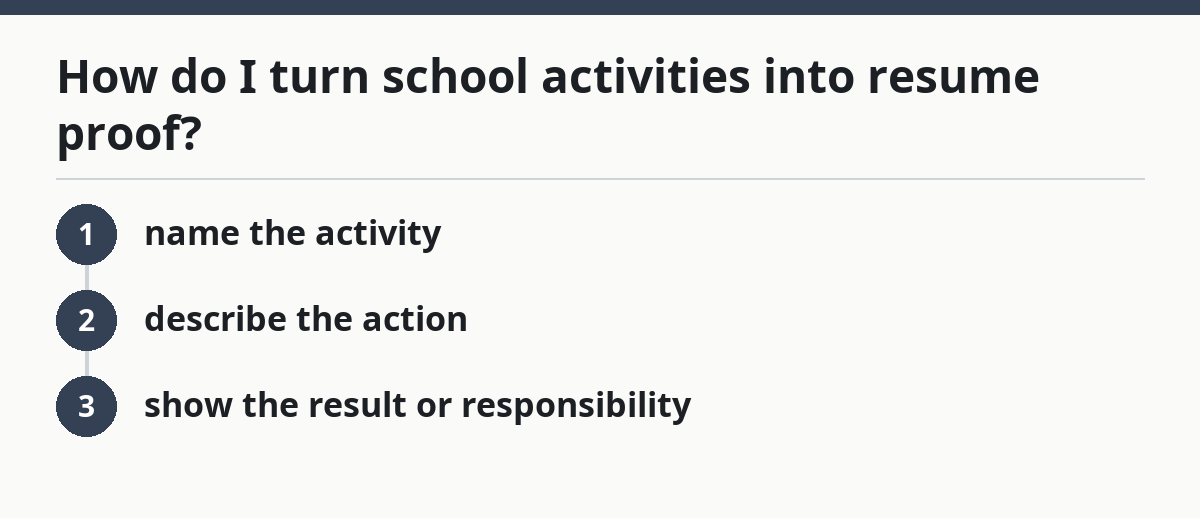
Turn school activities into resume proof by writing each activity as evidence of a skill, not as a title alone. “Member of debate club” is weaker than “Prepared weekly arguments, spoke in front of 20 peers, and met 3 deadlines for research notes.” The second version shows what the teen did.
Use this rule for every activity:
- name the activity
- describe the action
- show the result or responsibility
For example:
- Student council: helped plan 4 school events and collected sign-up sheets
- Soccer: attended practice 3 times a week and worked with teammates under a coach’s schedule
- Marching band: followed a fixed rehearsal calendar and performed in public
- Drama club: memorized lines, rehearsed on time, and supported a production with a 2-hour call time
- Honor society: kept grades up while balancing meetings and volunteer projects
A school club works best on a resume when it shows reliability. Sports work when they show discipline. Arts activities work when they show practice, memory, performance, or teamwork. Even a part in the yearbook staff can show deadlines, editing, or layout work.
A common mistake is listing 6 activities without explaining any of them. That costs the reader clarity. If every line only names the club, the resume feels empty. Pick the 2 to 4 activities that best fit the job and give each one a line of proof.
This is also where dates help. If an activity ran for 1 school year or 2 semesters, say so. Dates show commitment. A vague list of clubs looks smaller than a dated list of steady participation.
How to write the experience section when there is no job history
Write the experience section as a “related experience” section and use volunteer work, school projects, babysitting, lawn care, yard work, pet sitting, or family responsibilities if they are real and relevant. The section does not need a paycheck to count; it needs evidence of responsibility.
Use this order in the section:
- role or activity title
- organization, family, or setting
- dates, if known
- 2 bullet points that describe actions
A useful bullet point has a verb, a task, and a concrete detail. For example:
- Set up chairs and tables for 5 weekly youth group meetings
- Helped sort donations and organized boxes by size and label
- Watched younger siblings after school for 2 hours at a time
- Fed pets, cleaned cages, and followed a set schedule during school breaks
- Mowed lawns and raked leaves for neighbors on Saturdays
Volunteer work belongs here when it shows the same traits an employer wants. A student who handed out snacks at a community run or helped at a food drive has already shown punctuality, basic customer service, and the ability to follow instructions. That is usable experience.
The honest trade-off is that not every chore belongs on a resume. If the task is too small, too frequent, or too private to explain clearly, it may not help. “Helped at home” is weak. “Managed the family calendar and watched a younger sibling every Tuesday from 3 to 5 p.m.” is specific enough to matter.
A teen should not invent job titles to make the page sound better. Calling a weekend babysitter a “childcare coordinator” looks forced. Plain language wins.
If the student has no volunteer work, that is still workable. The resume can lean harder on school activities, class projects, and skills. The point is to choose the best proof available, not to fill every section with thin content.
What skills should a teen list?
A teen should list skills that can be seen, not personality traits that sound nice but prove nothing. “Hardworking” and “nice” do not help much. “Microsoft Word,” “cash handling,” “customer service,” and “public speaking” are easier for an employer to understand.
A strong skills section usually includes 6 to 10 items. Keep them grouped if possible:
- Computer skills: Google Docs, Microsoft Word, spreadsheets
- Communication: phone etiquette, speaking to adults, writing clear messages
- Workplace skills: punctuality, teamwork, following instructions, organization
- Job-specific skills: cash register basics, stocking, cleaning, file sorting, babysitting
Only include a skill if it can be backed up somewhere on the page. If the student says they know spreadsheets, a school project or club budget helps prove it. If they list public speaking, debate club or presentations can support it.
A skills section also needs restraint. Too many vague items make the resume look copied from a template. A cleaner list of 8 specific skills is better than 15 broad ones.
One good way to build the section is to ask: “What could I do on day 1?” If the answer is “answer phones,” “arrive on time,” “use Google Docs,” or “work with a team,” those belong. If the answer is “lead a department,” it does not.
For teens applying to an entry-level job, skills should be simple and practical. Employers know a first resume will not be packed with advanced software or years of experience. What matters is that the student can follow directions, learn quickly, and stay organized.
What should a references section look like?
A references section should be short, real, and ready, or left off until asked for. A teen does not need a long list of references on the first draft unless the employer specifically requests them. When they do want references, 2 or 3 people are enough.
Good reference choices are adults who have seen the student show responsibility:
- teacher
- coach
- club adviser
- volunteer supervisor
- school counselor
- pastor, mentor, or youth leader
Do not use family members as references unless the employer clearly allows it. A parent can explain character, but employers usually want someone who has seen the teen in school, volunteer, or activity settings.
A simple references line can say:
References available upon request
If the student adds full references, include:
- name
- job title or relationship
- phone number or email
- permission from the adult first
That last part matters. No one should be surprised by a resume reference. Ask first, then list the person exactly as they want to be listed. If they prefer email over phone, use email.
This section is often where a teen resume gets sloppy. A common mistake is listing a reference without permission or without current contact information. That can cost credibility fast. Another mistake is using 5 references when the employer asked for 2. More is not better here.
Keep the references section neat and separate from the rest of the resume. If the student is short on space, leave it off and bring a separate reference sheet only when needed.
A simple resume format that fits on 1 page
A simple resume format should fit on 1 page, use clear headings, and leave enough white space that the eye can move easily. A crowded teen resume looks harder to read than a short one with clean margins.
Use this order:
- Name and contact information
- Short summary
- Education
- Activities or related experience
- Skills
- References, if needed
The summary should be 2 to 3 lines. It can say the student is a high school teen with strong attendance, communication skills, and experience from clubs, sports, and volunteer work. It should sound direct, not dramatic.
Education should include the school name, city, expected graduation year, and maybe GPA only if it is strong and the student wants to share it. If there are honors classes, awards, or a 4.0-scale GPA that is worth showing, that can go here. If not, leave it out. A resume is not stronger because every possible detail is crammed into it.
For format, use a plain font like Arial, Calibri, or Times New Roman in 10.5 to 12 point size. Keep margins around 1 inch if the document allows it. Use black text on white paper. Fancy graphics, colored boxes, and multiple columns can make a teen resume harder to scan, especially if someone prints it.
This is the place to be honest about fit. A plain resume is better than an overdesigned one for most first jobs. The exception is a creative field where a portfolio matters, but that is a different document and a different job search.
The whole page should answer one question quickly: “Can this student show up, learn, and do basic work?” If the format helps that answer appear in 10 seconds, it is doing its job.
Common mistakes that make a teen resume weaker
The most common mistakes are padding, vagueness, and trying to sound older than the student is. Those choices make a resume feel less trustworthy, not more impressive.
Here are the mistakes that cause the most damage:
- writing “hard worker” without proof
- listing every club without explaining any of them
- using fake job titles for chores or babysitting
- making the resume longer than 1 page
- leaving off contact information
- forgetting dates for school activities or volunteer work
- using a school email that will expire in 2 months without a backup
Each mistake has a cost. Vague wording makes the resume easy to ignore. Fake titles make it look padded. A 2-page resume can bury the few strong details that matter. Missing contact information can end the process before it starts.
The fix is simple: cut the weak lines and replace them with action. Write what the teen did, how often, and in what setting. If a line cannot answer those questions, it probably does not belong.
A teen resume also should not try to impress by sounding overly formal. “Demonstrated exemplary synergy” is not better than “worked with a team to set up events.” Clear language wins with real hiring managers.
If the student is building a larger plan for earning money as a teen, this resume can sit alongside the hub on how to make money as a teen, but this page should stay focused on the resume itself.
Teen resume checklist before sending it
A teen resume is ready when every line has a purpose and the page still fits on 1 sheet. Before sending it, read it from top to bottom and check for 5 things: clear contact details, a short summary, school and activity proof, a useful skills list, and no spelling errors.
Use this final check:
- name and contact info at the top
- one-page layout
- school, clubs, sports, and volunteer work included where relevant
- 2 to 4 bullets that show real action
- skills listed plainly
- references ready if requested
- no fake experience
- no empty phrases
It helps to print the resume once, even if it will be sent online. Paper exposes spacing problems that a screen can hide. A line that looks fine in a document can wrap badly on paper or disappear in a narrow margin.
A teen resume with no experience is not a disadvantage if it is built the right way. The page should show reliability, not pretend to be a career summary. That is the whole point: turn school life into evidence the reader can trust.
What should a teen resume include?
A teen resume should include contact information, a short summary, education, school activities, volunteer work or related experience, skills, and references if asked. The strongest version is usually 1 page and uses specific examples instead of vague claims. Classes, clubs, sports, and volunteer work can all count when they show responsibility.
How long should a teen resume be?
A teen resume should usually be 1 page. That length is enough for contact information, school details, activities, skills, and any volunteer work without making the page feel crowded. A second page often weakens the resume unless the student has unusually deep experience, which is rare for a first resume.
Can a teen have a resume with no work experience?
Yes, a teen can absolutely have a resume with no work experience. School activities, sports, clubs, volunteer work, babysitting, and other responsibilities can replace job history when they are written clearly. The resume should show what the student has done and what skills those experiences prove.
Drafted with AI; not yet reviewed by a person.