Last updated: November 20, 2026
Key Takeaways
- A good teen job fits school, pays on a sensible schedule, and builds habits for adult work.
- A teen can earn pocket money or a part-time paycheck, depending on hours, age rules, and the work type.
- Teen jobs with short training, clear tasks, and close supervision are often easier to start with.
- A first paycheck should be split among spending, saving, and future goals, even when the amounts are small.
Teen jobs can bring in real money, but the bigger win is learning how to show up, follow through, and handle a schedule. A teen job is one that fits school, transportation, and the kind of responsibility a teen can handle now. The Complete Guide below sorts out what pays, what builds skills, and what to watch for before the first shift.
What a teen job should actually do
A good teen job does three things at once: it fits around school, it pays on a schedule that makes sense, and it teaches habits that carry into adult work. A bad one eats sleep, creates constant conflict, or asks too much from someone who is still learning the basics of a workplace.
Because of that, if you’re trying to pick a first job, but you also have homework, practice, and a parent who needs the car at 5 p.m., the right choice is usually part-time, local, and predictable—not the highest hourly pay on paper. Here’s the catch: a job that looks impressive can be a poor fit if the commute is long or the shifts are late.
- School-night shifts work best when the schedule stays steady.
- A short commute matters more than a flashy title.
- The job should teach punctuality, basic communication, and simple money habits.
- If the employer can’t explain the schedule clearly, that’s a warning sign.
The truth is, work readiness starts before the job offer. A teen who can arrive on time, answer a phone call, and ask a clear question is already ahead of a lot of first-time applicants. That does not require a long resume. It requires practice.
How much can a teen earn from a first job?
A teen can earn anything from a little pocket money to a steady part-time paycheck, but the real number depends on hours, age rules, and the type of work. In the U.S., federal youth labor rules limit some jobs and hours for minors, especially under 16, and state rules can be stricter. See the U.S. Department of Labor’s youth employment page and your state labor department for the exact limits.
Because of that, if you’ve got a shift after school, a weekend shift, and maybe a summer schedule too, the question isn’t just “what does it pay?” It’s “how many hours can I actually work without wrecking school or sports?” A 10-hour week at a modest wage can be better than a higher-pay job that forces missed classes.
What changes the money most:
- Hours per week: More hours mean more income, but also more stress.
- Wage rate: Some jobs pay by the hour; others tip.
- Season: Summer and holiday seasons often mean more openings.
- Transportation: If a job costs gas, rides, or transit, the take-home amount drops.
For federal youth employment rules, start with the U.S. Department of Labor here:
https://www.dol.gov/agencies/whd/youthrules
For work permit and hour rules in your state, use your state labor agency. The exact rule can change by age, job type, and school calendar.
What jobs are best for teens right now?
The best teen jobs are usually the ones with short training, clear tasks, and close supervision. That usually means retail, food service, grocery stores, camps, parks, tutoring, yard work, babysitting, pet care, and some office help. They are not glamorous. They are useful.
For example, if you’re comparing a fast-food job, a store job, and a neighborhood babysitting gig, the one that matches your age, your schedule, and your comfort with customers is often the better first choice. A teen who hates phone calls may do better stocking shelves than handling front counter duty.
Here’s the catch: not every job that looks “easy” is actually easy for a first-timer. A babysitting job can sound simple until a toddler melts down. A retail job can seem calm until the holiday rush. The question is not whether a job is hard in general. It’s whether the hard parts match the teen’s skills right now.
- Retail: Good for learning customer service, folding, sorting, and cash handling.
- Food service: Good for speed, teamwork, and following steps under pressure.
- Babysitting and pet care: Good for responsible teens who stay calm and follow instructions.
- Tutoring or homework help: Good for strong students who can explain ideas clearly.
- Yard work and errands: Good for teens who like physical tasks and flexible hours.
These jobs often build references fast. A supervisor who sees steady work for a season can become the person who says, “Yes, this teen shows up and finishes the job.”
Which teen jobs build real work readiness?
The jobs that build the most work readiness are the ones that force a teen to do the boring parts well: arrive on time, handle correction, and repeat tasks without complaint. That means retail, food service, camp staff, and office support tend to teach more than one-off gigs.
For instance, if you want a job that looks good on paper and helps later when you apply for internships, summer work, or a first adult job, the real skill isn’t “having a job.” It’s learning how to take direction, fix mistakes, and keep a steady pace for 3 to 6 hours at a time. That is what employers notice.
A teen job can teach:
- Time management: Getting dressed, leaving on time, and not missing shifts.
- Communication: Asking for help, repeating instructions, and speaking clearly.
- Money habits: Reading a pay stub, saving part of a paycheck, and tracking spending.
- Work stamina: Staying focused even when the task is repetitive.
- Team behavior: Sharing space, taking turns, and not starting drama.
The truth is, a lot of first jobs are less about the work itself and more about the habits around it. A teen who learns to text early about a conflict, not ten minutes after a shift starts, is learning professional behavior. That lesson pays off later.
What should a teen know before applying?
A teen should know the basic facts before applying: what kind of work is legal at their age, what shifts are realistic, how to introduce themselves, and how to answer a few common interview questions. That preparation matters more than a fancy resume.
Since the application usually asks for availability, school hours, and previous work, if you can answer those without guessing, you already look more prepared than most first-time applicants. A teen does not need a long job history to seem dependable. They need clean basics.
Before applying, get these ready:
- A simple schedule: school days, weekends, and any sports or clubs.
- A short work goal: earning spending money, saving for a car, or building experience.
- One or two references: a teacher, coach, counselor, or adult who knows the teen well.
- A basic outfit for interviews: clean, neat, and appropriate for the job.
- A response to “Why do you want this job?” Keep it plain and honest.
Here’s the catch: a teen who cannot explain when they’re free is not ready for every job. A manager needs reliability more than enthusiasm. If the schedule is fuzzy, the employer will assume the teen will be too.
For job-hunting and resume basics, the U.S. Department of Labor’s CareerOneStop site is a solid starting point:
https://www.careeronestop.org/
How should parents and teens think about the first paycheck?
A first paycheck should be split into spending, saving, and future goals, even if the amounts are small. The habit matters more than the size of the check. A teen who learns to set aside money from the start is building a better money life than one who spends every dollar the day it lands.
When you’re looking at a paycheck for the first time and trying to decide whether to spend it all on food, clothes, and games, that temptation is normal. The better move is to decide in advance what part gets spent, what part gets saved, and what part stays untouched for school or future needs.
A simple split can look like this:
- Spending money: for small daily purchases.
- Saving: for larger goals, emergencies, or school costs.
- Giving or family help: if that matters in the household.
- Taxes: if the paycheck is not already net of withholding, the teen should learn that gross pay is not take-home pay.
This is one of the few times when a small paycheck can teach a big lesson. A teen who sees money as a tool, not just quick cash, is much harder to fool later by impulse buys or shady offers.
What can go wrong with a teen job?
Teen jobs go wrong when adults treat a first job like a full-time adult job. Late-night shifts, unsafe tasks, unclear pay, and too many hours can turn a decent opportunity into a bad one fast. A teen should never have to guess about pay, breaks, or who is supervising them.
Since you may be promised “easy money,” but the schedule changes every week, the manager texts at odd hours, and the job asks for more than was discussed, that is not normal first-job behavior. A solid employer explains the work clearly, keeps to the rules, and respects school.
Watch for these red flags:
- The employer will not explain pay in writing.
- Shifts get changed last minute with no warning.
- The teen is asked to do work that seems unsafe or illegal for their age.
- The job depends on vague promises instead of a clear schedule.
- The place feels chaotic before the teen even starts.
The truth is, some jobs are bad for teens even if they pay well. If the job cuts into sleep or school, the cost is too high. A better job with steadier hours usually wins in the long run.
For wage and hour questions, the U.S. Department of Labor is the right starting point:
https://www.dol.gov/agencies/whd
What makes a teen job worth keeping?
A teen job is worth keeping if it still works after the novelty wears off. That means the schedule stays manageable, the manager gives clear direction, and the teen comes home able to do homework and sleep. If the job causes constant stress, it is not worth the paycheck.
After the first week feels exciting, the second week shows the truth. A good job still feels manageable when the teen is tired, busy, or dealing with a tough school day. A bad job starts to swallow everything else. That difference matters more than a few extra dollars an hour.
A teen job is usually worth keeping when:
- It does not damage grades or attendance.
- The commute is reasonable.
- The tasks are clear and repeatable.
- The supervisor corrects mistakes without humiliation.
- The teen is learning something useful for later jobs.
On the flip side, a job should be reconsidered if the teen is always exhausted, the manager is hostile, or the schedule keeps changing around school. A paycheck is not worth giving up sleep, safety, or a shot at graduating with decent grades.
The honest comparison: money job vs skill-building job
A high-pay teen job is not always the best teen job. A lower-pay job with strong structure can be the better choice for a first-time worker because it teaches habits that matter later. The goal is not just income. It is readiness.
For example, one job may pay more but be messy, while another pays less and teaches the teen how to work like an adult. The second one often wins for a first job. Here’s why: the first job should teach how to work, not just how to collect money.
| Criteria | Higher-pay, less structured job | Lower-pay, more structured job | Winner for the teen who needs basics |
|---|---|---|---|
| Schedule stability | Often uneven | Usually clearer | Structured job |
| Skill building | Can be limited | Often stronger | Structured job |
| Money now | Better upfront | Less upfront | Higher-pay job |
| Stress level | Can be high | Often lower | Structured job |
| Supervisor support | May be thin | Usually better | Structured job |
| Resume value | Depends on the role | Often steady and explainable | Structured job |
| Transportation burden | May be farther away | Often local | Structured job |
| School compatibility | Can be harder | Usually easier | Structured job |
| First-job confidence | Can be shaky | Usually better | Structured job |
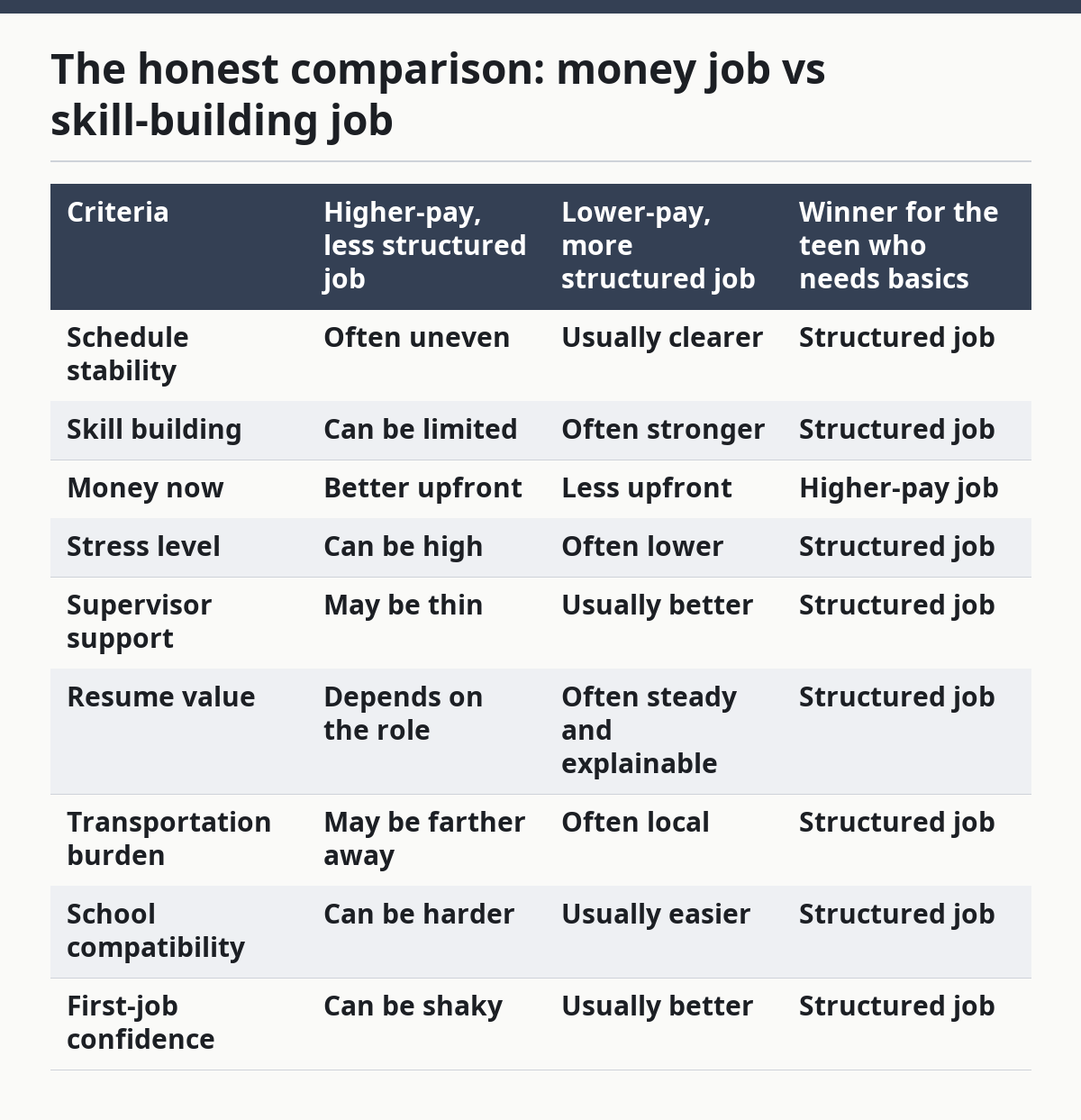
This is where a lot of families get it wrong. They chase hourly pay and ignore the shape of the work. A teen who can keep a simple job for six months often gains more than a teen who chases the biggest check and burns out.
When should a teen wait before taking a job?
A teen should wait if school is already a struggle, if sleep is too short, or if the household schedule cannot support a regular shift. A job is not the right move when it will make the rest of life fall apart.
Once the teen wants money, but the calendar is already packed with classes, sports, tutoring, family duties, and a long commute, a job may still be possible, but not yet. The first rule is not “work as soon as you can.” It is “work when you can do it well.”
A teen may need to wait if:
- Grades are dropping.
- Transportation is unreliable.
- The teen cannot get enough sleep on school nights.
- The family cannot cover uniforms, lunch, or commute costs yet.
- The teen is already overwhelmed by stress.
Here’s the catch: waiting is not failure. Sometimes the smarter move is to build readiness first with chores, volunteer work, or a short seasonal job later. That can lead to a much better first work experience than rushing into a bad fit.
What should a teen do this week to get ready?
A teen should spend this week getting practical: make a one-page resume, list available hours, choose two references, and practice one short interview answer. That is enough to start.
Because school, classes, chores, and maybe sports or club work already fill the week, the job search gets easier when you turn that into a simple plan. A teen who prepares for 30 minutes a day can be ready in a week.
A simple first-week plan:
- Write down school hours, practice times, and free windows.
- List three job types that fit the schedule.
- Ask two adults for references.
- Make a simple resume with school, skills, and activities.
- Practice saying: “I’m reliable, I learn fast, and I can work these hours.”
- Apply to a small number of local jobs first.
The truth is, first jobs are won by people who look prepared, not by people who know the most. Clean forms, clear availability, and a calm attitude beat hype every time.
Frequently asked questions
How old do you have to be to get a job?
The answer depends on federal and state law, plus the type of work. In the U.S., younger teens can do some jobs with limits, while other work is off-limits until older ages. The safest step is to check the U.S. Department of Labor’s youth employment rules and your state labor department before applying.
What is the best first job for a teen?
The best first job is usually the one with short training, clear tasks, and a steady schedule. Retail, food service, grocery work, babysitting, and basic office help are common starting points because they teach punctuality and communication. The right fit depends on school hours, transportation, and how much supervision the teen needs.
Should a teen work during the school year or only in summer?
A teen can work during the school year if the hours stay light and grades stay steady. Summer gives more room for longer shifts, but a school-year job can still be a good idea if it is local and predictable. The school-year job should fit around homework, sleep, and extracurriculars.
How can a teen tell if a job is a bad fit?
A job is a bad fit if it wrecks sleep, hurts grades, or keeps changing the schedule without warning. If the employer is vague about pay, tasks, or supervision, that’s another warning sign. A first job should be challenging enough to teach responsibility, not so chaotic that it becomes a daily fight.
What matters more than hourly pay for a teen job?
Reliability matters more than hourly pay for many first jobs. A steady schedule, a safe workplace, and a manager who explains things clearly usually do more for long-term success than a slightly higher wage. A teen who learns good habits at a decent job is building a stronger next step.
Drafted with AI; not yet reviewed by a person.