Last updated: November 20, 2026
Quick Answer: Teens can often find summer jobs that fit a short schedule by targeting places that need 2- to 5-hour shifts and asking about hours before applying.
Summer jobs for teens with a short schedule are easiest to find when you target employers that already use short shifts, fixed time blocks, or weekend-only help. How Teens Can Find Summer Jobs That Fit a Short Schedule starts with employers that say schedule flexibility upfront.
The steps below show how to spot those jobs, when to apply, and which openings usually fit a school break calendar better than a full-time role.
Key Takeaways
- Look for 2- to 5-hour shifts, set days, or weekend-only work.
- Ask about hours before applying so there are no surprises later.
- Start with local employers that already need seasonal or weekend help.
- A short schedule search works best when it stays focused, quick, and honest.
What kind of summer job fits a short schedule?
A good fit is a summer job that can be done in 2- to 5-hour shifts, on a few set days, or on weekends only. That usually means the employer can work around camp, travel, family plans, sports, or driver’s ed without building the whole schedule around one teen.
Picture this: you’re looking for work, but your week already has three mornings booked and two afternoons that you can’t move. You do not need a “perfect” job. You need a job that fits the hours you actually have.
Some employers are more likely than others to offer short blocks of coverage. Think about:
- ice cream shops and cafés with rush periods
- retail stores with short closing shifts
- local pools or recreation centers
- grocery stores with weekend help needs
- lawn care, pet care, and neighborhood services
- summer camps or activity programs that need junior help
Here’s the catch: a job can sound flexible and still be a bad fit if the manager expects you to “stay if it gets busy.” That can turn a 4-hour shift into a 7-hour day fast. Ask about the real schedule, not the hopeful version.
A short schedule also changes the kind of job you should avoid. Skip roles that depend on a full-day block, like inventory projects, long catering events, or jobs that only make sense with 20+ hours a week. Those openings can be fine for older teens with open calendars, but they usually clash with a packed school-break schedule.
How do you tell if an employer will really work with limited hours?
A good employer will say what hours they need before you fill out the application. If the posting says “part-time,” “weekends,” “after-school,” “seasonal,” or “flexible availability,” that’s a clue—but not a promise.
Picture this: you open a listing that sounds perfect, but the words are vague. You do not want to waste a day on an application for a job that needs 30 hours a week. You want to spot the mismatch in 2 minutes, not after an interview.
Start with the posting itself:
- Look for shift length, not just total hours.
- Check whether the job says mornings, nights, or weekends.
- See if the role is labeled seasonal, temporary, or summer only.
- Notice whether the employer asks for open availability.
Then read the details for clues. A place that says “must be available during peak hours” may still be workable if peak hours are short. A place that says “must work every Saturday and Sunday” is a different story.
If the posting is unclear, ask one direct question before you apply: “I’m available on Tuesdays, Thursdays, and Saturday mornings. Is that enough for this role?” That question saves time. It also tells you quickly whether the employer is hiring for a short schedule or wants full availability hidden behind a friendly job ad.
Because of that, you can also look at the business itself. Stores that get busy in short waves—like snack bars, pools, movie theaters, and ice cream shops—often need extra hands for 2- to 4-hour shifts. That pattern matters more than the word “teen-friendly.”
Where should teens look first during summer break?
Teens should start with local employers that already run on seasonal traffic, school schedules, or weekend crowds. Those businesses are more likely to need extra help for a short stretch instead of a long, year-round commitment.
Picture this: you’re trying to land a summer job before July is half over, and you only have a few openings in your week. The smartest move is to look where the rush is predictable and the training is quick.
Good places to check first:
- neighborhood restaurants and cafés
- ice cream shops and shaved-ice stands
- parks, pools, and recreation centers
- grocery stores
- local farms or stands with summer traffic
- day camps and youth programs
- pet care, babysitting, and yard work through local families
Don’t ignore small businesses. A local shop may only need someone for 8 to 12 hours a week, which can be a better fit than a big chain that wants a fixed rotation. Small employers often care more about reliability and timing than a long résumé.
The truth is, leads are often physical, not flashy. Walk into the place during a slow hour, ask for the manager, and say you’re looking for summer work with limited availability. Bring a paper application if they use one. That old-school move still works in a lot of places.
Use job boards too, but filter them hard. Search terms like “seasonal,” “weekend,” “part-time,” and “summer help.” If a listing says “full availability required” or “open schedule only,” move on. You are not trying to force a bad fit.
A simple summer job search plan that fits a short schedule
A short schedule works best when the search is narrow, fast, and honest. Use a list of 10 places or fewer, and apply where the hours already look close to your actual calendar.
Picture this: you have one afternoon, a phone, and a short list of places near home. You do not need a giant search plan. You need a clean one that gets answers fast.
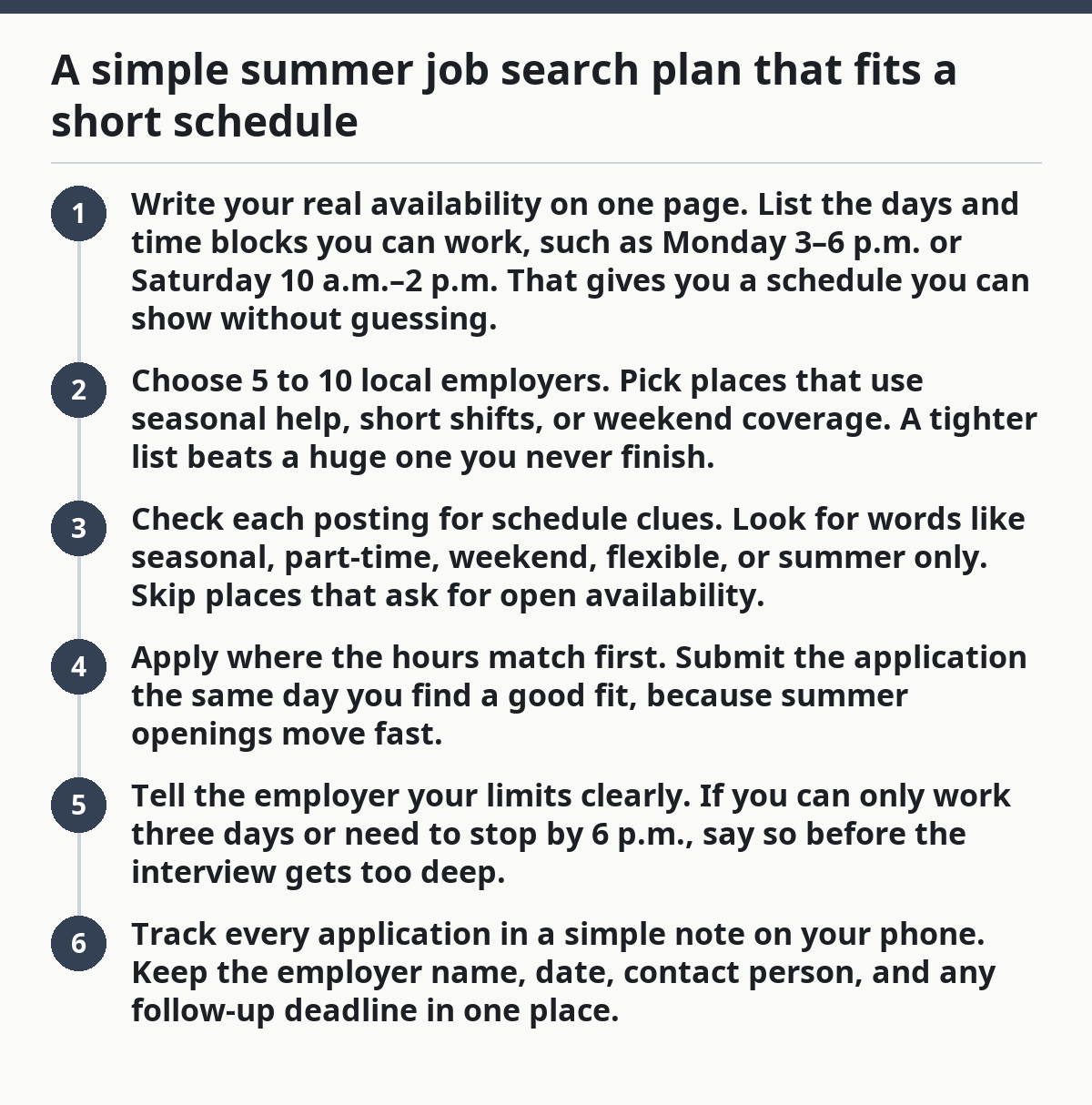
Follow these steps:
- Write your real availability on one page. List the days and time blocks you can work, such as Monday 3–6 p.m. or Saturday 10 a.m.–2 p.m. That gives you a schedule you can show without guessing.
- Choose 5 to 10 local employers. Pick places that use seasonal help, short shifts, or weekend coverage. A tighter list beats a huge one you never finish.
- Check each posting for schedule clues. Look for words like seasonal, part-time, weekend, flexible, or summer only. Skip places that ask for open availability.
- Apply where the hours match first. Submit the application the same day you find a good fit, because summer openings move fast.
- Tell the employer your limits clearly. If you can only work three days or need to stop by 6 p.m., say so before the interview gets too deep.
- Track every application in a simple note on your phone. Keep the employer name, date, contact person, and any follow-up deadline in one place.
A simple tracker can help you avoid double-applying or losing track of who already called back; if you are unsure about what to share, check with a parent, counselor, or another trusted adult, and use the job application details from the employer or its posted instructions. It also helps if one employer asks, “Where else have you applied?” You will have an answer ready.
If you’re applying online, use the same availability wording every time. If you give one employer “afternoons only” and another “pretty flexible,” the mismatch can cost you the job later. Short schedule jobs depend on trust. Say what you can actually do.
What should teens say in an application or interview?
Teens should say their availability early, plainly, and without apologizing for it. That one habit can save time and get you matched with the right employer faster than trying to sound fully open when you’re not.
Picture this: the manager asks when you can work, and you only have a few clean blocks each week. This is not the moment to waffle. It is the moment to be specific.
Use simple language:
- “I’m available Tuesday and Thursday afternoons.”
- “I can work Saturday mornings and one weekday shift.”
- “I’m free through August 10, then my schedule changes.”
- “I’m looking for summer work that stays under 15 hours a week.”
That last line matters. It sets a limit without making you sound difficult. It also helps the employer decide quickly whether you fit the role.
Bring a printed copy of your schedule if you can. A phone calendar is fine, but paper is easy to hand over in a busy store or office. If your schedule changes every week, say that too. Some employers can handle it. Others can’t.
Do not oversell your availability to “get in the door.” If you say you can work every weekday and then backtrack later, the job can turn sour before you start. A short schedule is not a weakness. It is just a constraint. The right employer can work with it; the wrong one will not.
Common mistakes that make a short schedule harder to fill
The biggest mistake is applying to jobs that clearly need more hours than you can give. That wastes time and often leads to a fast rejection, especially when the posting asks for 20 to 40 hours or open availability.
Picture this: you keep sending applications, but the calls never come. That usually means the job is wrong for your schedule, not that your application is bad.
Watch for these traps:
- Ignoring shift length. A “part-time” job can still mean long shifts. Ask how many hours per shift, not just per week.
- Waiting too long to apply. Summer employers fill early. If you wait until July, many of the better short-shift jobs may already be taken.
- Hiding your limits. If you can’t work past 5 p.m., say it. Surprises hurt your chances later.
- Chasing only big brands. A local café or pool may be easier to fit than a chain with rigid rules.
- Skipping follow-up. A quick call or message after a few days can move an application along.
These mistakes are easy to fix. Use the posting as a filter, not a wish list. If the schedule does not match on paper, it usually will not match in real life.
A short schedule also means you should pick quality over quantity. Three strong applications to places that fit your hours beat fifteen random ones that do not.
Where this search fits in the bigger teen jobs picture
This search works best as one part of a larger plan for teen jobs, income, and work readiness. A summer job that fits a short schedule can teach punctuality, customer service, and basic workplace habits without taking over the whole break.
Picture this: you want money for the summer, but you also want time for family, trips, or sleep. That balance is normal. A short schedule can be the right first step into work, not a compromise.
If you want the bigger map, the hub on teen jobs and earnings gives the broader picture of how teen work fits into summer plans, pay, and job readiness. This page stays focused on one job: finding a summer job that fits a limited schedule.
The limit is real, though. A short schedule is not the best fit for every teen. If you need lots of hours to save for a big goal, or if you want a job with steady daily shifts, a narrow availability window can slow the search. That does not mean the plan is bad. It just means the filter is working.
For most teens, the goal is simple: find one employer that can use the hours you already have. That is enough to turn a summer break into real work experience without turning the whole season into a job.
What kinds of summer jobs fit a teen schedule?
Summer jobs that fit a teen schedule are usually roles with short shifts, seasonal demand, or weekend-only coverage. Good examples include pools, cafés, ice cream shops, parks, grocery stores, pet care, and neighborhood services. The best fit is one that asks for the hours you can actually give, not the hours a full-time worker can give.
When should teens apply for summer jobs?
Teens should apply as early as possible, ideally before the busiest summer weeks begin. Many employers start filling seasonal spots before school lets out or soon after. If you wait until late summer, the short-shift jobs may already be gone or cut down to tiny gaps in coverage.
How do you choose a job with limited hours?
Choose the job that matches your real calendar first, then the pay or title second. Read the schedule language, ask about shift length, and be honest about the days you can work. If the employer needs open availability or long blocks, it is probably the wrong fit for a short schedule.
Drafted with AI; not yet reviewed by a person.