Last updated: November 20, 2026
Quick Answer: Start by splitting each paycheck into 3 buckets — spending, saving, and buffer — and aim to do it within 1 day of getting paid. Teens with uneven pay need a budget that works by paycheck, not by month. The fix is a paycheck-based budget that splits every payment into spending, saving, and a buffer before the money disappears. The steps below show how to build an irregular teen income budget that fits real cash flow.
Key Takeaways
- Plan around each paycheck, not a calendar month.
- Set a minimum saving target first, then assign the rest.
- Use spending categories with a buffer so one small paycheck does not wreck the whole plan.
- A budget worksheet makes uneven income easier to track.
- If your pay changes a lot, percent-based budgeting is usually easier than fixed dollar targets.
This is information, not financial advice. Money rules differ by country and change often, so a qualified adviser should be consulted for your own situation.
Who this works for, and what you need first
This works for a teen who gets paid at odd times or in uneven amounts and already knows their basic bills, school costs, and spending habits. You need your last 3 to 6 paychecks, a list of regular expenses, and a place to keep savings separate from spending — even a basic savings account will do.
Picture this: you get paid this week, then nothing for 2 weeks, then a bigger check after that. A monthly budget falls apart fast in that setup, but a paycheck plan can still work if you know your minimum spending needs and your cash flow pattern. That is the whole point of How Teens Can Make a Budget for Irregular Paychecks.
Here’s what this article covers:
- how to sort each paycheck before you spend it
- how to choose spending categories that match teen life
- how to set a minimum saving target without guessing
- when a buffer category keeps you from going broke between paydays
If you are looking for a basic teen budget from scratch, that belongs on the hub for Teen Budgeting and Goal Planning. This page is for the uneven-pay version.
How do you budget when your paychecks change in How Teens Can Make a Budget for Irregular Paychecks?
You budget by assigning every paycheck a job the day it arrives, using percentages first and dollar amounts second. That keeps the plan stable even when one check is small and the next one is larger.
Picture this: you open a paycheck on a Friday and do not know if it will cover next week’s plans. You need a system that works in 15 minutes, not a spreadsheet marathon. Percent-based budgeting is the easiest starting point because it scales up and down with your income.
- Write down the last 3 to 6 paychecks. List the date, amount, and whether the money was tips, shifts, chores, babysitting, or a mix. Verify that you can see a pattern in the sizes or timing. If the amounts swing wildly and you cannot tell why, your next budget should use a larger buffer.
- Add up your must-pay items for one pay cycle. Include food you buy yourself, school costs, transport, phone payments if you cover them, and any savings goal you already promised yourself. Verify the list is only essentials for the next 1 to 2 weeks or until the next paycheck. If the list includes every want, the budget will fail on day one.
- Choose a minimum saving target. Pick a floor you can hit on every paycheck, even a small one. A simple rule is to save a set percentage first, then adjust later if needed. Verify the target is small enough that you can still cover essentials after saving. If you cannot, the target is too high for your current cash flow.
- Split the paycheck into 3 buckets. Put money into spending, saving, and buffer. The buffer category is money held back to smooth out weak paychecks and surprise costs. Verify each dollar has a label before you spend anything. If you have no buffer, the next short paycheck will force you to borrow from your next check.
- Pay essentials first. Move the money for food, transport, and other fixed needs into the category you will use for them. Verify the remaining balance still covers at least one small treat, or zero if the paycheck is tiny; if you are unsure, consult a qualified financial professional. If essentials are not covered, cut wants before cutting savings below your minimum.
- Set a hard limit for wants. Decide how much can go to games, snacks, streaming, clothes, or hanging out. Keep the limit tied to this paycheck, not what you hope to earn later. Verify you can name the number without checking your balance again. If you cannot, the category is too loose.
- Keep the buffer untouched unless income drops. Use the buffer only when a paycheck is smaller than expected or a real essential comes up. Verify you still have enough in the next paycheck to refill it. If you spend it on extras, the budget stops protecting you.
- Update the plan after every paycheck. Compare what you planned with what actually happened, then adjust the next split. Verify the plan gets easier after 2 or 3 paychecks because you now know your real spending categories. If it keeps feeling random, your categories are too broad.
The best part, if you like simple systems, is that you do not need a perfect spreadsheet. A simple budget worksheet, a notes app, or a paper page can do the job if you keep the categories the same every time.
What should go in a teen budget worksheet for irregular paychecks?
A teen budget worksheet should show income, spending categories, savings, and buffer money on one page. That layout makes the cash flow problem visible without turning the budget into homework.
Picture this: your paycheck hits, and you need to decide what happens to it before lunch. A worksheet gives you the same answer every time, which matters when the amount changes from check to check. The goal is clarity, not beauty.
Use these lines on the worksheet:
- paycheck amount
- date paid
- minimum saving target
- essential spending
- wants
- buffer category
- money left over
A simple worksheet can be done on paper, in a phone notes app, or in a basic spreadsheet. What matters is that each paycheck gets the same labels. A worksheet with 12 different custom lines usually causes more confusion than help.
Here’s the catch: a worksheet only works if you update it on payday and again after you spend. If you wait until the weekend, the money may already be gone.
How much should you save from each paycheck?
You should save a small, repeatable share from each paycheck before you spend on extras. That turns saving into a habit instead of a leftover.
Picture this: one week you earn very little, and the next week you earn much more. A fixed-dollar savings target can break on the small week, but a percent-based target usually flexes better. That is why many teens do better with percentages first.
A practical way to set the target:
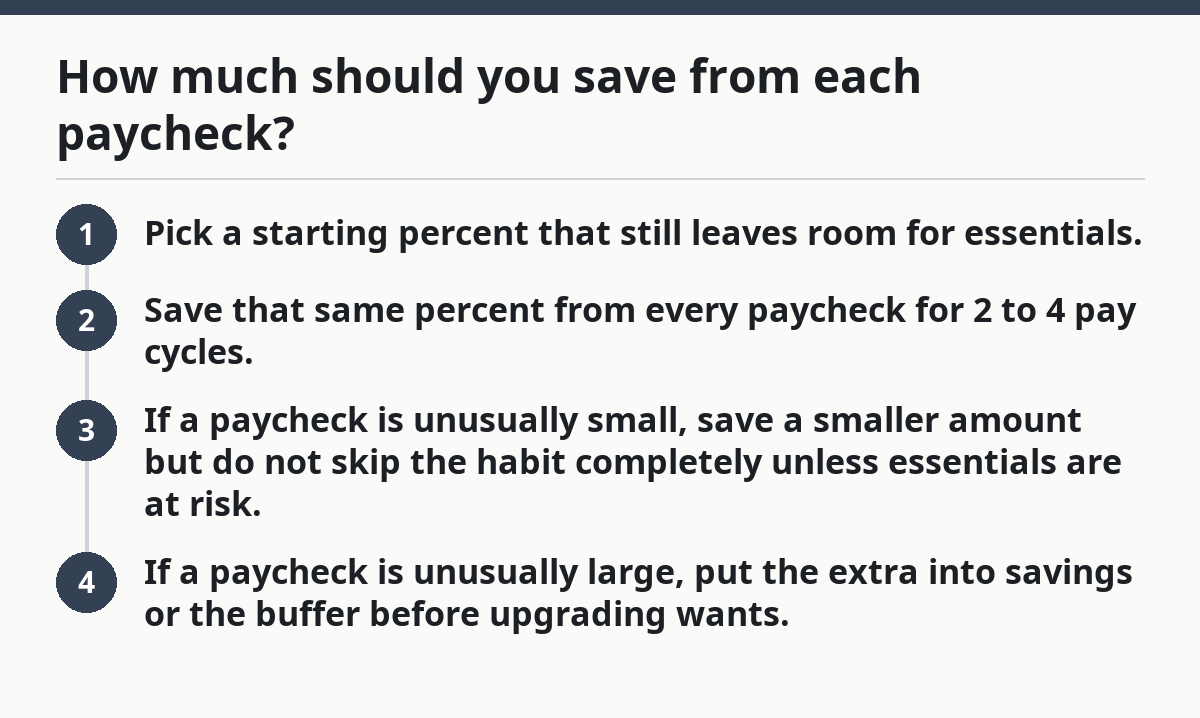
- Pick a starting percent that still leaves room for essentials.
- Save that same percent from every paycheck for 2 to 4 pay cycles.
- If a paycheck is unusually small, save a smaller amount but do not skip the habit completely unless essentials are at risk.
- If a paycheck is unusually large, put the extra into savings or the buffer before upgrading wants.
If you already know a goal, like a concert, a school trip, or a phone replacement, keep that goal inside the savings bucket. That keeps your spending categories from fighting each other.
The truth is, no single percent works for every teen. If you have to choose between saving and covering lunch, food comes first. If your pay is erratic, consistency matters more than a big number.
What if one paycheck is much smaller than the last?
A smaller paycheck should trigger a budget reset, not panic spending. The right move is to protect essentials, reduce wants to near zero, and pull only from the buffer if the shortfall is real.
Picture this: last payday felt strong, so you spent like the next one would be the same. Then the new check lands and it is much smaller. That is the exact moment the buffer category earns its keep.
Use this order:
- cover essentials first
- keep the minimum saving target if possible
- cut all nonessential spending
- use the buffer only after the first three are set
- delay any new purchase until the next paycheck arrives
If the smaller paycheck is part of a pattern, lower your spending category amounts for the next 1 to 2 cycles. Do not pretend the old level is still normal. A budget that ignores cash flow can often feel broken.
When should a teen stop using a standard paycheck plan?
A standard paycheck plan stops working when your income is too unpredictable for the same split to hold up. That does not mean the idea is bad — it means the setup needs a different shape.
Picture this: one month you get 4 paychecks, next month you get 1, then you miss a week because shifts change. A neat monthly budget will keep slipping out of date. That is when you switch to paycheck planning plus a bigger buffer.
Income is too irregular to predict: If you cannot guess the next check within a rough range, monthly targets will miss often — use a per-paycheck plan and keep more money in the buffer.
Your essentials exceed most paychecks: If one paycheck cannot cover food, transport, and other must-pays, the plan is too tight — cut wants to zero and look for another income source or family support.
You keep dipping into next payday’s money: That means your categories are too loose — shrink wants and raise the buffer until the pattern stops.
You do not know what you spend on: If you cannot name your top 3 spending categories, the budget has no data — track every payment for 2 weeks before changing the split.
Your savings goal is crowding out basics: If saving leaves you short on essentials, the target is too ambitious right now — lower it until your cash flow stabilizes.
You have debt or required payments you cannot miss: If there are late fees or obligations tied to money timing, the budget alone may not be enough — get help from a qualified adviser who can look at your full situation.
A teen budget for irregular paychecks is a control tool, not a stress test. If it keeps causing skipped meals, missed rides, or repeated overdrafts, the method needs to change.
Common mistakes teens make with irregular income
Teens usually do not fail because they are bad with money. They fail because they use a budget built for a steady paycheck and then act surprised when uneven income breaks it.
Picture this: you plan your whole month off one large paycheck, then two smaller ones show up and the plan falls apart. That is a category problem, not a character problem. The fix is usually simpler than people think.
-
Using one monthly number for unstable pay. The consequence is overspending early in the month. The better move is to budget each paycheck separately.
-
Saving only from “extra” money. The consequence is that saving happens once, then disappears for weeks. The better move is to set a minimum saving target on every check.
-
Skipping the buffer category. The consequence is that one small paycheck causes a chain reaction. The better move is to hold back some cash for weak weeks.
-
Mixing wants with essentials. The consequence is that you cannot tell what the paycheck actually needs to cover. The better move is to separate spending categories before you buy anything.
-
Changing the plan every time you feel like it. The consequence is that the budget never becomes a habit. The better move is to keep the same worksheet format for at least 2 to 4 pay cycles.
-
Ignoring where cash goes between paydays. The consequence is that small purchases quietly eat the paycheck. The better move is to write down spending the same day it happens.
The best budgets for teens with irregular pay are boring on purpose because they repeat the same choices until the numbers stop surprising you.
What a good result looks like after 1 month
A good result is not a perfect month. It is a month where you know where the money went, one paycheck does not wreck the rest, and your savings balance grows a little even if the income jumps around.
Picture this: you get paid, split the money in 10 minutes, and do not have to guess whether your bus fare is safe. That is a working budget. It should make decisions easier, not harder.
A healthy first month often looks like this:
- the same categories used every payday
- at least one paycheck saved partly instead of spent fully
- the buffer still there after a small surprise
- fewer “where did my money go?” moments
- one clear change for next month, such as raising the buffer or lowering wants
If the result is messy but visible, that still counts as progress. The point of an irregular teen income budget is to make uneven pay predictable enough to live with.
How much should a teen save from each irregular paycheck?
A teen should save a small, repeatable share from each irregular paycheck and keep it consistent before worrying about a perfect number. The right amount depends on food, transport, school costs, and how uneven the pay is from week to week. If saving the same share makes you short on essentials, lower the target and protect basics first.
What if one paycheck is much smaller than the last?
A much smaller paycheck means the budget needs a reset for that cycle. Cover essentials first, trim wants to near zero, and use the buffer only if the shortfall is real. If small paychecks keep happening, lower your spending categories for the next few paydays instead of hoping the old number returns.
Should a teen budget before or after getting paid?
A teen should budget before spending and as soon as the paycheck arrives. You can plan in advance using past paychecks, but the actual split should happen on payday so the money gets assigned before it leaks away. If you wait until the end of the week, the easiest spending is usually already gone.
Drafted with AI; not yet reviewed by a person.