Last updated: November 20, 2026
Key Takeaways
- Teen budgets help track where money comes in and where it quietly goes.
- Start with income, fixed costs, spending, and one goal you want to fund.
- A good teen money goal is specific, visible, and realistic enough to keep pursuing.
- Cash is easy to see, apps are convenient, and spreadsheets give the most control.
Teen budgeting and goal planning is about one thing: giving your money a job before it disappears. This guide to Teen Budgeting and Goal Planning — The Complete Guide shows how to build a simple plan, pick a savings goal, and avoid the traps that make teen budgets fall apart.
I write about personal finance for families and young adults, and this article is information rather than financial advice; a qualified adviser should be consulted for your own situation.
What teen budgeting actually solves
Teen budgeting solves the gap between money coming in and money quietly vanishing. If you get allowance, gift money, a part-time paycheck, or cash from odd jobs, a budget shows where it goes before it gets spent on snacks, rides, apps, or impulse buys.
Picture this: you have $20 in cash, a few dollars in a digital wallet, and a goal you keep talking about buying. Without a plan, each small spend feels harmless. With a plan, the money starts to look like parts of a bigger choice.
A teen budget does not need to be complicated.
- It can be a notebook.
- It can be a notes app.
- It can be a simple spreadsheet.
- It can be an envelope system with cash.
The method matters less than the habit. The budget has to match the way you actually get paid. If your money comes in once a month, a weekly plan may feel too loose. If your money comes in from babysitting or lawn work, a monthly-only plan may hide the real pattern.
A generic article often skips the hard part: teen income is uneven. Some weeks are fat, some are empty. The budget has to survive both.
How do you start a teen budget?
You start a teen budget by listing income, fixed spending, short-term wants, and one goal you care about enough to keep funding. That’s the whole job.
Picture this: you’re staring at money in two places, maybe cash in your wallet and a balance on a card, and you want a plan that won’t collapse by Friday night. Start by making the money visible, then assign every dollar a job.
Use this simple order:
-
List every source of money.
- Allowance
- Birthday or holiday money
- Pay from a job
- Money from chores or side jobs
-
List recurring spending.
- Lunch
- Bus fare
- Phone costs if you pay part of them
- Streaming or app subscriptions
- Gifts you expect to buy
-
Pick one savings goal.
- New shoes
- A game
- A concert ticket
- Emergency cash for school or transport
- A larger goal like a laptop or trip
-
Set a rule for each dollar.
- Spend now
- Save for later
- Don’t spend without checking the plan first
A teen budget works best when it has three buckets: spending, saving, and holding back for later. That simple split keeps every purchase from feeling like a yes-or-no emergency.
The truth is, most teens do not need a fancy app to begin. They need a repeatable habit and a clear target. If the money changes from week to week, track it for a month first. That gives you a real pattern instead of a guess.
A simple budget structure that actually holds up
A budget structure holds up when it stays small enough to use after school, on a bus, or between classes. One page is enough for most teens.
Use a layout like this:
| Category | Amount In |
|---|---|
| Income | cash, transfers, pay |
| Fixed costs | phone, lunch, transport |
| Goal savings | moved to goal fund |
| Fun money | snacks, games, extras |
| Buffer | unexpected costs |
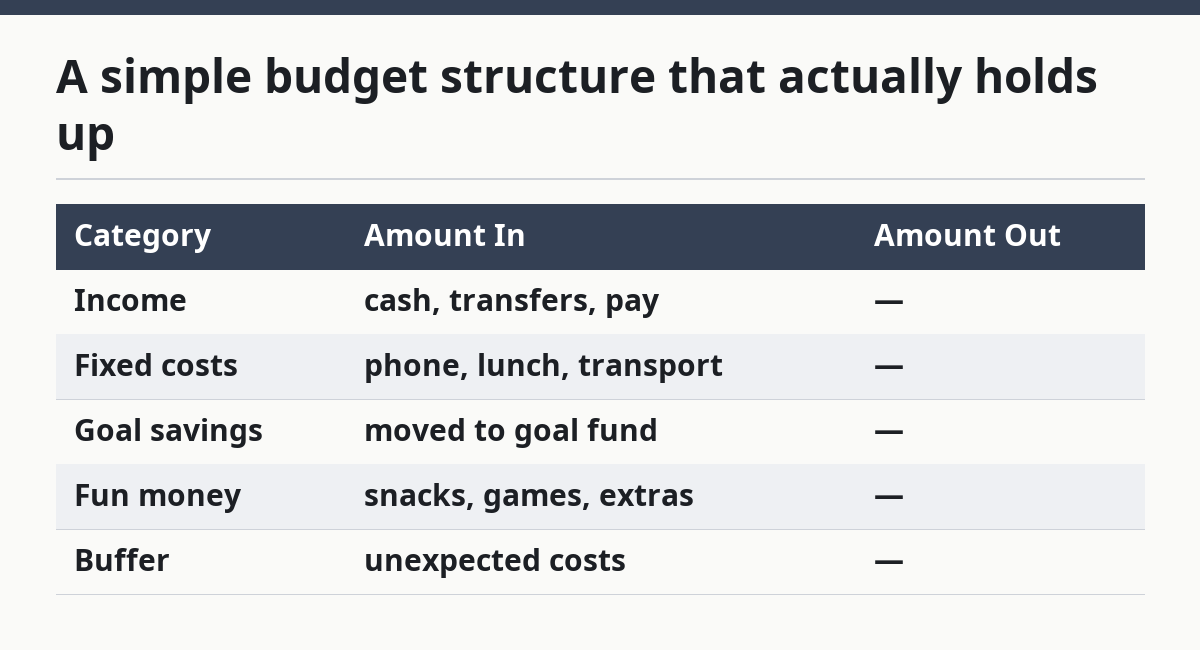
The buffer is the part many beginners miss. It handles the stuff that ruins a plan: a lost lunch money day, a last-minute school fee, or a ride you didn’t expect to pay for. Even a small buffer can stop a budget from cracking.
What is the best money goal for a teen?
A practical money goal for a teen is one that is specific, visible, and close enough to reach without quitting halfway. Vague goals like “save more” usually fail because they never tell the money where to go.
Picture this: you want something badly enough to remember it, but not so far away that it feels fake. That’s the sweet spot. A good goal gives you a reason to skip one small purchase today.
A strong teen goal has four parts:
- A price or target
- A deadline
- A reason
- A place to keep the money
The reason matters more than people think. “Because I want it” is fine for a start, but “because I’ll use it every day” or “because I’m paying part of it myself” creates better follow-through. A goal tied to daily life sticks better than a random wish list item.
Short-term goals work well for beginners. That might mean something you can fund in a few weeks or a few months. Longer goals are fine too, but they need checkpoints. If the goal is too far away, break it into smaller targets so progress stays visible.
A goal should be boring in the right way
A goal should be boring in the right way because the math has to be easy enough to repeat. If you need a calculator every time you save, you’ll stop doing it.
Try this:
- Pick one goal for the next 30 to 90 days.
- Name the goal clearly.
- Put the money in one place.
- Check progress on the same day each week.
- Adjust if your income changes.
A plain goal beats a fancy one. A new phone case, a game, a jacket, a class trip, or a pair of headphones can all work if the target is specific. If you want a bigger item, make the plan chunked: save part now, pause spending for a stretch, then review again.
Teen budgeting and goal planning: cash, apps, or spreadsheet?
Cash wins for visibility, apps win for convenience, and spreadsheets win for control. The right choice depends on how much you spend in person, how often you get money, and whether you can check a phone without getting distracted.
Picture this: one friend keeps cash in envelopes, another checks a balance on a phone, and a third uses a spreadsheet at home. All three can work. The real question is which one you’ll still use after the novelty wears off.
Here’s the honest split:
- Cash
- Best when spending is mostly in person.
- Best when you need to feel money leave your hands.
-
Weak when you carry too much and lose track.
-
Budgeting app
- Best when money arrives digitally.
- Best when you want alerts and balance checks.
-
Weak when notifications become noise.
-
Spreadsheet
- Best when you like numbers and want a record.
- Best when you need to track savings goals and spending over time.
- Weak when you hate opening a laptop for small updates.
If the point is habit, the simplest tool usually wins. If the point is accuracy, a spreadsheet usually wins. If the point is stopping impulse spending, cash often wins because it creates friction.
The biggest mistake is picking a tool because it looks mature. A clean-looking app that you never open is worse than a messy notebook you use every Friday.
The honest pros and cons of each method
Each method changes the budget in a different way. That’s why generic advice fails.
| Method | Strength | Weakness | Best for |
|---|---|---|---|
| Cash envelope | Spending is visible | Easy to misplace or spend too quickly | Teens who shop in person |
| App | Fast checks and reminders | Easy to ignore alerts | Teens with digital payments |
| Spreadsheet | Clear record and planning | Needs more setup | Teens with regular income |
| Notebook | Simple and cheap | Harder to search later | Teens who like paper |
The best method is the one that matches your day, not the one that sounds smartest. A bus rider with lunch money needs a different system from a teen who gets paid by transfer.
How much should a teen save?
A teen should save enough to make real progress on a goal without starving the budget for normal life. The exact split depends on income, family rules, and required expenses, which vary by country and can change over time.
Picture this: you get money on a schedule, but your wants show up at random. If you save too little, the goal never moves. If you save too much, you give up after one weekend.
A practical rule is to split money into three lanes:
- Spend
- Save
- Hold back
The save lane funds the goal. The hold-back lane covers surprises. The spend lane keeps life from feeling locked down. If you have a job, the money may also need to cover transport, snacks, school items, or clothes, which means the save lane has to be realistic.
That realism matters. A budget that steals every fun dollar usually breaks. A budget that allows small spending is more likely to survive exam weeks, bad moods, and last-minute invites.
If you want a better goal plan, use one of these checks:
- Can I still cover school costs?
- Can I still go out once in a while?
- Can I still add to the goal every time money comes in?
- Can I keep doing this for a month?
If the answer is no to the first three, the goal is too aggressive. A goal that dies in week two is not discipline. It’s overreach.
What mistakes ruin teen budgets?
The biggest mistakes are not tracking small purchases, using savings for random wants, and setting goals that don’t fit actual income. Those three problems break more teen budgets than big emergencies do.
Picture this: you spend a few dollars here, a few dollars there, and nothing feels serious. Then the goal fund is empty and the month still has days left. That’s how budgets fail.
Common mistakes:
- Not writing anything down
- Small spends vanish from memory fast.
-
The budget becomes a guess.
-
Treating savings like free money
- You keep borrowing from the goal.
-
The goal becomes a decoration.
-
Using one pile for everything
- School costs, fun money, and goal money blur together.
- You can’t tell what is safe to spend.
-
If that keeps happening, consider asking a parent, school counselor, or qualified financial professional for help.
-
Ignoring irregular income
- A birthday month looks rich.
-
A quiet month looks like failure, even when the plan is fine.
-
Picking too many goals
- One goal can be tracked.
- Four goals turn into noise.
A generic guide often says “just cut spending.” That advice is too blunt. Teens often don’t control all spending categories. Some costs are fixed, some are family-based, and some depend on school or transport. The better move is to protect the goal from the small leaks first. For more budgeting basics, the CFPB’s budgeting tools are a useful starting point: https://www.consumerfinance.gov/consumer-tools/budgeting/.
What to do when the budget breaks
A budget breaks less often when you give it a repair rule. The repair rule should be simple enough to use on a bad day.
Use this:
- Pause spending for 24 hours.
- Check the last seven days.
- Find the one category that slipped.
- Cut that category first.
- Restart with the next money that comes in.
This method works because it avoids the shame spiral. You are not “bad with money.” You are missing one control point. Fix the control point.
How do you stay motivated long enough to hit a goal?
You stay motivated by making progress visible, making the goal specific, and making the next step small enough to finish even on a lazy day. Motivation is not the engine; structure is.
Picture this: you open a jar, a note, or an app and can see the goal getting closer. That visual cue matters. It tells your brain the effort is doing something real.
Try these tactics:
- Put the goal where you can see it.
- Break the goal into milestones.
- Check it on the same day each week.
- Use one sentence to explain why it matters.
- Celebrate progress that is real, not fake.
Celebration does not mean spending the savings. It can mean noting the halfway mark, crossing off a checkpoint, or telling someone who supports the plan. The point is to keep the goal from feeling like endless work.
A lot of people think motivation comes from wanting the item more. Usually it comes from seeing proof that the plan is working. That’s the cleaner truth.
If you are saving for a bigger item, milestones help more than raw willpower. A goal that takes months needs signs of life. Without them, the plan feels dead even when it’s fine.
When should a teen change the plan?
A teen should change the plan when income shifts, school costs change, or the goal no longer matches the season of life. A budget is supposed to move when real life moves.
Picture this: a sports season starts, transport costs go up, or you pick up more shifts. The old numbers stop fitting. That is not failure. That is a cue to update the plan.
Change the plan if:
- Your income changes for more than a couple of pay cycles.
- A fixed cost appears, like a phone bill or school fee.
- Your goal deadline is too close or too far.
- You keep missing the same category.
- The budget is taking too long to use.
You do not need to rebuild the whole system. Often one line changes and the rest stays the same. That’s the power of a simple budget. It can bend without breaking.
Teen budgeting and goal planning: the verdict
Choose a simple cash or notebook system if you spend mostly in person and need a plan you can use in under 5 minutes. Choose a spreadsheet or app if your money moves digitally and you want a clearer record. Neither if you have no regular income and no control over any part of your spending yet.
A straightforward plan is the one you can repeat every week without drama. If your money is irregular, start with one goal, one spending rule, and one check-in day. If your spending is already tied to a card or transfer, digital tracking may fit better because it matches the way the money already moves.
The truth is, teen budgeting works when it stays small. One goal. One system. One habit.
Sources and further reading
For a plain-language starting point on budgeting, the U.S. Consumer Financial Protection Bureau has a useful budgeting page with simple categories and planning ideas: https://www.consumerfinance.gov/consumer-tools/budgeting/.
For broader money skills and goal-setting guidance, the National Endowment for Financial Education publishes consumer education material on budgeting and saving: https://www.nefe.org/.
For teen money habits and practical saving ideas, the Jump$tart Coalition offers financial education resources: https://www.jumpstart.org/.
Rules and tools differ by country, so if you’re managing part-time earnings, savings, or family contributions, a local adviser or school financial counselor can help you match this plan to your situation.
FAQ
How much money should I put toward savings?
Put enough toward savings to move the goal forward without making the rest of your budget collapse. If every dollar goes to savings, you usually quit. If savings only gets leftovers, the goal stalls.
Should I use cash or an app?
Use the one you will actually check. Cash helps when spending happens face to face, while an app helps when money moves digitally and you need a quick balance check.
What if I get money only once in a while?
Use a longer time frame and split each deposit right away. One rare payment can still work well if you assign part of it to spending, part to saving, and part to a small buffer.
What if I keep breaking my budget?
Find the category that keeps leaking money and fix that first. Most broken budgets fail because of one repeated habit, not because the whole plan is wrong.
Can a teen budget work with a small allowance?
Yes, a small budget can work if the goal is small too. The size of the money matters less than the habit of assigning it before it disappears.
Drafted with AI; not yet reviewed by a person.