Last updated: November 19, 2026
Quick Answer: A teen can usually spot a pay stub mistake by checking hours worked, gross pay, deductions, net pay, direct deposit, overtime pay, and year-to-date totals against the time sheet and pay schedule.
How Teens Can Read a Pay Stub and Spot Mistakes starts with the gross pay line, then works through the rest of the stub.
The steps below show what each line means and which mismatches are worth asking about.
What a pay stub tells you at a glance
A pay stub tells you what you earned, what came out, and what finally landed in your bank account. If the numbers do not line up, the problem is usually in hours, rate, or deductions.
How Teens Can Read a Pay Stub and Spot Mistakes begins with a simple check: compare the stub with the hours you actually worked. Picture this: you open your first paycheck record on your phone after a 4-hour shift on Friday and a 6-hour shift on Saturday. You want to know if the pay is right without guessing or scrolling forever.
Start with these labels:
- Gross pay: money earned before anything is taken out
- Net pay: money left after deductions
- Hours worked: the time you were paid for
- Deductions: amounts removed from the check
- Direct deposit: where the money was sent
- Year-to-date totals: the running total for the year
Here’s the catch: a stub can look “normal” and still be wrong. A missing 2 hours, a wrong pay rate, or a duplicate deduction can hide in plain sight.
If the numbers feel confusing, one practical move is to find the gross pay line and work outward from there:
- Find the gross pay line.
- Find the hours and rate line.
- Check deductions one by one.
- Compare the net pay with the deposit in your bank.
- Save the stub.
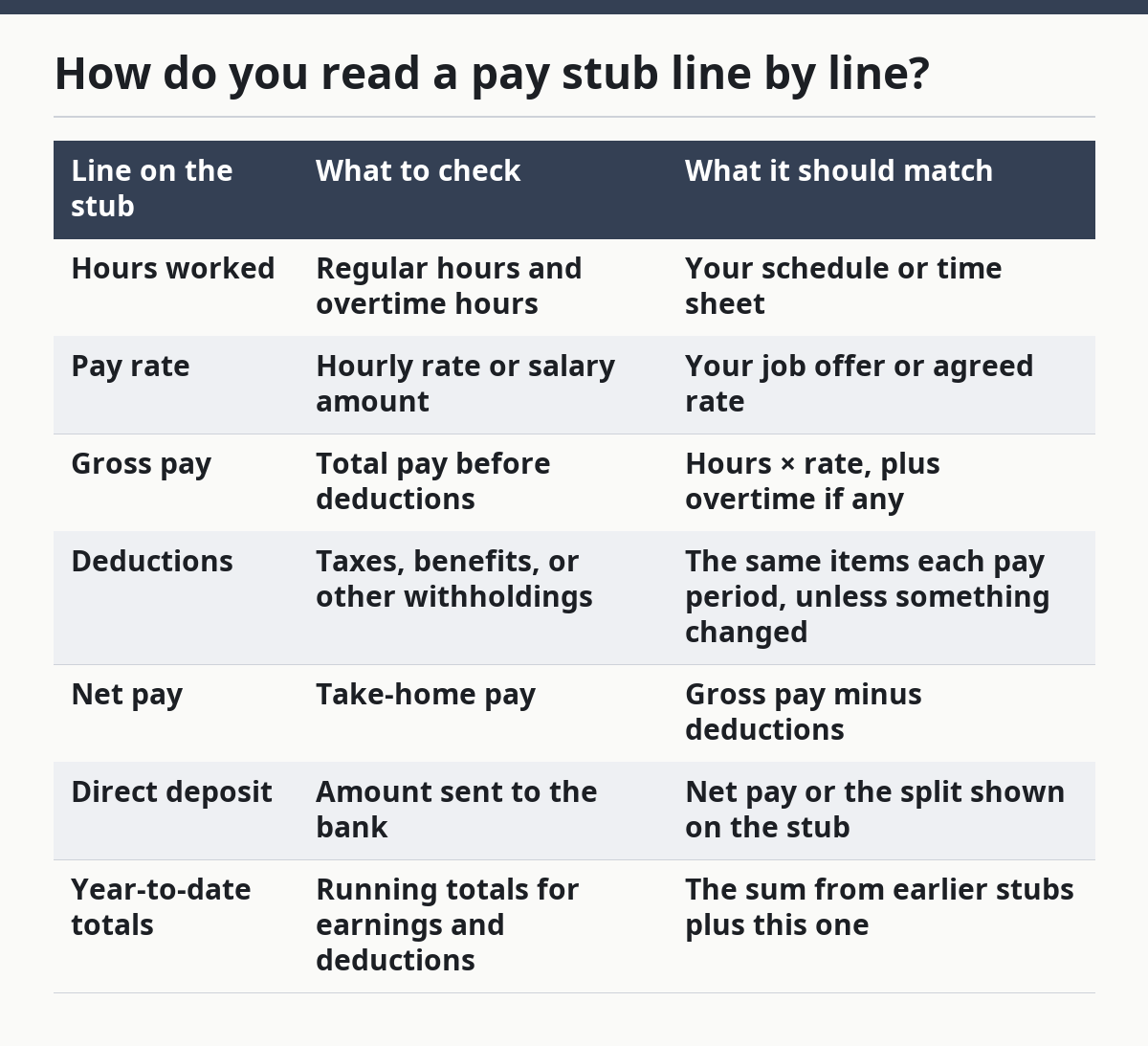
How do you read a pay stub line by line?
You read a pay stub by matching each line to a question: what did I earn, what was taken out, and what should have been deposited? A careful 3-part scan of earnings, deductions, deposit can make that easier.
Picture this: you’re standing in a break room at the end of a 7-hour shift, and your manager hands you a pay stub with a dozen lines. You do not need to understand every code to spot a mistake. You just need the right order.
Use this order as a guide:
| Line on the stub | What to check | What it should match |
|---|---|---|
| Hours worked | Regular hours and overtime hours | Your schedule or time sheet |
| Pay rate | Hourly rate or salary amount | Your job offer or agreed rate |
| Gross pay | Total pay before deductions | Hours × rate, plus overtime if any |
| Deductions | Taxes, benefits, or other withholdings | The same items each pay period, unless something changed |
| Net pay | Take-home pay | Gross pay minus deductions |
| Direct deposit | Amount sent to the bank | Net pay or the split shown on the stub |
| Year-to-date totals | Running totals for earnings and deductions | The sum from earlier stubs plus this one |
You do not have to solve the whole stub at once. One line at a time is enough.
A common mistake is jumping straight to net pay and skipping the rest. That can hide a wrong hourly rate or a missed overtime hour. Another mistake is trusting the deposit alone. A bank deposit can be split into more than one account, so the stub is the cleaner record.
How can you check hours worked and overtime pay?
You check hours worked and overtime pay by comparing the stub to your time sheet or schedule, then making sure the math fits the pay period. If the stub says 38 regular hours and you worked 40, that is a mismatch worth asking about.
Picture this: you worked a Saturday shift, stayed 30 minutes late, and covered one extra break. Small time changes can matter. Even a 1-hour difference can change gross pay, overtime, and tax withholding.
Follow this short procedure:
- Find the pay period dates on the stub.
- Count every shift you worked during those dates.
- Check the regular hours line.
- Check the overtime line, if your job pays overtime.
- Compare the total hours on the stub with your own count.
- If the numbers differ, bring your schedule or time sheet to the payroll contact.
Look closely at these details:
- Start and end times on the schedule
- Meal breaks that were unpaid
- Overtime hours if you worked past the cutoff your job uses
- Holiday or special hours if they appear on the stub
The truth is, errors often come from timekeeping, not from the paycheck itself. A punch-in at 3:01 instead of 3:00, a missed punch-out, or a shift swap can change the totals.
What if the stub shows overtime and you expected none? Ask how your job counts overtime. Some employers split regular and overtime hours by pay rule, not by the day you worked. Do not guess from memory alone.
What deductions should a teen check?
A teen should check deductions for anything that looks unfamiliar, repeated, or larger than usual. Deductions are the part of the stub where small mistakes can hide because they get taken out before net pay is shown.
Picture this: the gross pay looks fine, but the take-home amount is lower than expected by about the cost of a pizza and drink. That gap is often caused by deductions, not by lost hours.
Watch for these common deduction types:
- Taxes required by law
- Benefit costs, if you signed up for them
- Retirement contributions, if your job offers them
- Wage garnishments, if they apply
- Any other line your employer lists as a withholding
Now, you might be wondering which deductions are normal for a first job. Normal deductions are the ones listed clearly and repeated in a steady pattern. A surprise deduction on one stub and not the others deserves a question.
Use this check:
- Same name on the deduction line each pay period
- Same amount unless your hours changed or you enrolled in something
- Same reason listed on the stub or payroll portal
- No duplicate line for the same item
Some deductions are expected. The issue is not knowing which ones you agreed to. If a deduction was not explained when you started the job, ask for a plain-language breakdown.
Here’s the catch: the stub should make sense even if you do not know tax rules. If a line name is unclear, ask payroll or your supervisor to explain it in plain English. Keep the question simple: “What is this deduction for, and why did it change?”
Is your net pay wrong if the direct deposit looks different?
Your net pay may still be right even if the direct deposit looks different, because some employers split pay across more than one account or hold back a separate payment. The number to compare first is net pay, then the bank deposit.
Picture this: the stub says one number, but your bank app shows a different deposit amount. That can feel like an error, especially on a first paycheck. It is worth checking.
Use this quick comparison:
- Net pay on the stub: what you should receive after deductions
- Deposit amount in the bank: what actually arrived
- Split deposit note: whether money went to 2 accounts
- Payment timing: whether the deposit landed a day early or late
If the deposit is short, check these first:
- Did the money go to more than one account?
- Was part of the pay put on a pay card or separate account?
- Did the bank post the deposit in pieces?
- Does the stub show a correction from a prior period?
A bank deposit can be delayed, but a short payment on the stub itself is a different issue. The stub should still show the right net pay if the payroll math is correct.
The next step is to compare the net pay line with the direct deposit amount and then check the pay date. If those three do not line up, ask payroll before the next shift starts stacking up.
What year-to-date totals can catch that one paycheck misses
Year-to-date totals can catch mistakes that one pay period hides, like a missed deduction, a duplicated amount, or an earnings total that is off over several checks. These totals show the running count from the start of the year to the current stub.
Picture this: each paycheck looks close enough, but the totals keep drifting. A year-to-date line can expose a slow error that a single stub would not make obvious.
Check these lines:
- Year-to-date gross pay
- Year-to-date deductions
- Year-to-date net pay
- Any year-to-date amount tied to overtime or special pay
Why this matters: if you worked the same 10-hour schedule for 3 weeks, the totals should grow in a pattern that makes sense. A sudden jump or a missing chunk can signal a payroll mistake.
Use year-to-date totals as a second check, not the first one. They are useful when you want to see whether the current stub fits the earlier ones. If your current check is off by a little, the year-to-date line can show whether that error is new or has been happening all month.
You can also use this line to spot a correction. If the employer fixed a prior error, the year-to-date totals should reflect that change. If they do not, ask what was adjusted and which pay period changed.
For a broader look at earning your first paycheck and making sense of job money, the hub on teen income and first-job choices can help. For related guidance, see how to understand hourly pay, deductions to watch for, and what year-to-date totals mean.
How teens should ask about a pay stub mistake
Teens should ask about a pay stub mistake by naming the exact line, the exact pay period, and the exact number that looks wrong. A clear question gets a faster answer than “my pay seems off.”
Picture this: you have 2 pay stubs in hand, and one line does not match your schedule. You do not need a speech. You need a short, specific message.
Use this script:
- “My stub for the March 1 to March 15 pay period shows 34 hours, but I worked 36. Can you check the time record?”
- “This stub lists a deduction I do not recognize. What is it for?”
- “My net pay and direct deposit do not match. Can you explain the difference?”
Bring these items with you:
- The pay stub
- Your schedule or time sheet
- Any note about your hours or shift swap
- The date you noticed the problem
A common mistake is waiting too long. Payroll people can usually fix a simple error faster when the pay period is still fresh. Another mistake is asking in a vague way that forces someone else to do the detective work.
The strongest outcome is a written answer or a corrected stub. If the first explanation does not fit the numbers, ask for the math again. Numbers should add up without hand waving.
Key Takeaways
- A pay stub is easiest to read when you check hours, gross pay, deductions, net pay, and direct deposit in that order.
- The fastest mistake check is simple math: the hours on the stub should match the hours you worked.
- Overtime, surprise deductions, and a deposit that does not match the net pay are the biggest red flags.
- Year-to-date totals help catch errors that hide across several pay periods.
- If something looks off, ask about the exact line and the exact pay period.
What should a teen pay stub include?
A teen pay stub should include earnings, deductions, net pay, and the pay period dates. It should also show enough detail to explain how the total was built, such as hours worked, pay rate, and direct deposit information if that is how the paycheck was sent. If those basics are missing, the stub is hard to verify.
How do you know if a pay stub is wrong?
A pay stub is probably wrong if the hours do not match your schedule, the gross pay does not fit the rate, or the net pay does not match the deposit pattern. One odd line can happen, but two or more mismatches are a stronger sign that something needs a question.
What does year-to-date mean on a pay stub?
Year-to-date means the total from the start of the calendar year up to that paycheck. It tracks running amounts for pay and deductions, so you can see the whole year’s total in one line. That makes it easier to catch a problem that has repeated over several pay periods.
Who should a teen ask about a pay stub error?
A teen should ask the employer’s payroll contact, manager, or HR person listed for pay questions. Start with the person who can see the time record and paycheck system, since they can check hours, deductions, and direct deposit details. If the answer does not match the numbers, ask for a written correction.
Drafted with AI; not yet reviewed by a person.