Last updated: November 19, 2026
Teen money 101: how money works for teens starts with four choices: earn it, save some, spend with a plan, and give a little if you want to. If you are unsure how to apply those choices to your situation, check with a parent, guardian, or financial professional. Personal finance for teens is not about becoming an adult overnight; it is about learning how money moves before mistakes get expensive.
What personal finance for teens actually means
Teen money 101: how money works for teens means knowing where money comes from, where it goes, and how to keep it from disappearing in a day. That sounds simple, but it covers the basics that drive almost every money decision: income, spending, saving, budgeting, bank accounts, debit cards, and credit.
A teen does not need a full adult salary to learn this. A $20 allowance, a weekend job, birthday cash, or gift-card balance all work as practice money. The point is to learn the system, not to wait for a “real” paycheck.
Think of money as a tool with a few jobs:
- Income is money coming in.
- Spending is money going out now.
- Saving is money held for later.
- Giving is money set aside for someone or something else.
- Credit is borrowed money that must be paid back.
That last one matters early. Credit is not “free money.” It is a promise to repay, usually with fees or interest if the balance is not paid on time. A teen who understands that rule early has fewer surprises later.
This is also where the word budget belongs. A budget is just a plan for money before it gets spent. It can be written on paper, kept in notes on a phone, or tracked in a basic spreadsheet. It does not have to be fancy to work.
A helpful warning: this page is not about finding side hustles, opening a specific bank account, or picking an investment. Those are separate questions. This page is about the map that makes every later decision easier.
How does money work for teens?
Teen money 101: how money works for teens is the same basic system adults use, but in smaller amounts and with more limits on how it can be used. A teen usually receives money from a job, family, gifts, or a small business task, then decides whether to spend it now or hold it for later.
The core system looks like this:
- Money comes in as cash, direct deposit, or a card balance.
- Some of it gets spent right away on food, rides, games, clothes, or subscriptions.
- Some of it gets saved in a safe place for a bigger purchase.
- Some of it may be shared or given.
- If credit enters the picture, the borrowed amount has to be repaid on a schedule.
That is the whole machine. The details change, but the structure does not.
The biggest difference for teens is access. A 16-year-old may have a debit card but no credit card. A 14-year-old may have cash only. A 17-year-old may be earning through a part-time job and getting paid every 2 weeks. The tools differ, but the same question stays in place: “What should this dollar do next?”
Because of that, two things make teen money easier to manage:
- Visible balances. A debit card or bank app makes it easier to see what is left.
- Clear limits. A fixed amount for spending keeps one purchase from swallowing the whole month.
In contrast, two things make it harder:
- Small amounts feel easier to ignore. A few $5 purchases can disappear fast.
- Subscriptions hide. A $10 charge each month does not feel like much until it repeats all year.
A plain-English rule helps: if money is already promised to something, it is not really spendable. That is why people separate “money I have” from “money I can safely use.”
The 4 money decisions every teen needs to make
Every teen money choice fits into one of four buckets: earn, save, spend, or give. The trick is not to make one bucket eat the others.
If a teen gets $40, the whole amount looks flexible at first. After splitting it into four decisions, it becomes easier to manage. A rough example might be:
- $20 to spend
- $12 to save
- $6 to give or share
- $2 left as a buffer
That exact split is not magic. It just shows the point: a plan beats guessing.
1. Earn
Money usually starts with work or transfer. For teens, that may mean a part-time shift, a parent paying for chores, babysitting, tutoring, or birthday money. The source matters less than the habit of tracking it.
2. Save
Saving means moving money out of immediate reach so it is still there later. A teen saving for a $120 pair of headphones does not need to save all at once. Saving $10 at a time gets the job done, and the goal becomes visible.
3. Spend
Spending is where most teen money disappears. Instead of spending first and thinking later, it helps to decide in advance what money is for. A $15 lunch, a $25 game skin, or a $60 sweatshirt may all be valid choices, but not if they wreck the rest of the week.
4. Give
Giving is optional, but useful. A teen might donate to a cause, buy a small gift, or help with a family expense. Even $5 can build the habit of planning beyond the self.
The common mistake is treating all money as “available.” If that happens, it can cost teens two ways: it creates regret after impulse buys, and it leaves no money for the next thing. If you are unsure how to handle that, a parent, guardian, or financial professional can help. The fix is simple: assign each dollar before it is spent.
A teen budget that actually works in real life
A teen budget works when it matches the money coming in over a 1-week or 2-week period, not when it looks neat on paper. The best budget is the one a teen can keep using after the first exciting day.
Here is a simple 5-step method.
- List every source of money for the next 2 weeks. Include cash, allowance, direct deposit, and any planned gift money so the total is real, not guessed.
- Write the next 5 to 10 things money must cover. Put in lunch, rides, phone use, a friend’s birthday, savings, and anything with a fixed due date.
- Set a spending cap for each category. A category can be as small as $5 if that is the amount that disappears fastest.
- Move savings out of the spend pile immediately. Even a $10 transfer or a separate envelope makes the money harder to spend by accident.
- Check the balance before every purchase over $10. That one habit catches the mistake of “I thought I had enough.”
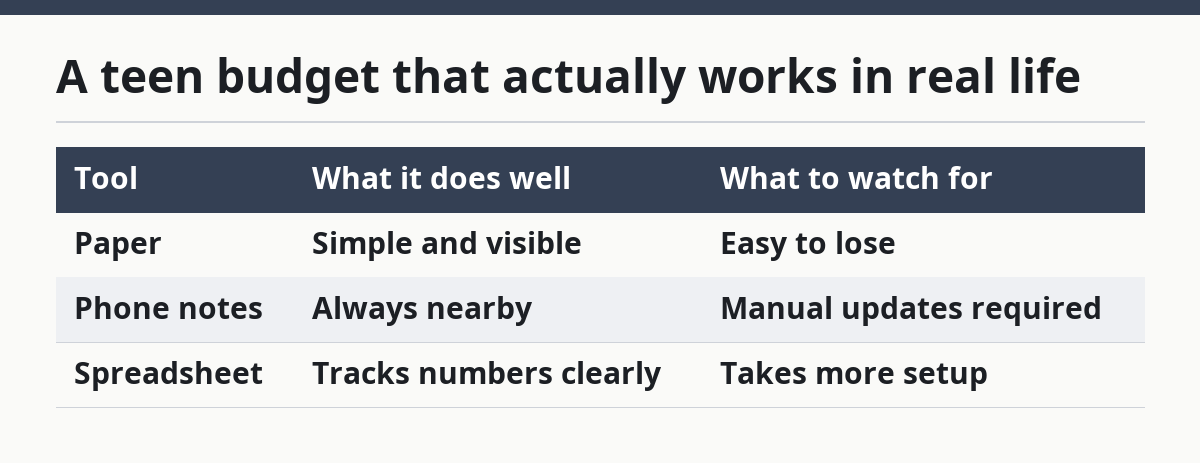
This kind of budget does not need an app. Paper works. Notes on a phone work. A spreadsheet works if the teen likes numbers. The method matters more than the tool.
For a quick comparison, here is how common budget tools stack up:
| Tool | What it does well | What to watch for |
|---|---|---|
| Paper | Simple and visible | Easy to lose |
| Phone notes | Always nearby | Manual updates required |
| Spreadsheet | Tracks numbers clearly | Takes more setup |
A common failure is making the budget too strict. If every dollar is locked up, the teen will stop using the budget after a week. A better approach is to leave a small amount free for random spending. That prevents the “all or nothing” problem.
Another failure is ignoring irregular costs. Haircuts, school trips, team dues, and gifts do not appear every day, but they still hit the wallet. A budget that ignores them is not a budget; it is a wish.
If a teen has a bank account, the monthly statement can help here. If the bank charges fees, those fees need to be part of the plan too, because they reduce the amount actually available. The Consumer Financial Protection Bureau has plain-language budgeting resources, and the Federal Deposit Insurance Corporation explains how deposit accounts work.
What teens should know about bank accounts and debit cards
A bank account and a debit card make teen money easier to track, but they also make spending faster, which is the trade-off. A debit card spends money that is already in the account, so it is not borrowed money like credit.
Here is the basic setup:
- A checking account is for spending and everyday payments.
- A savings account is for money not meant to be spent right away.
- A debit card usually pulls from checking, not from a loan.
The practical upside is clear: no pocketful of cash, easier tracking, and less risk of losing bills. The downside is also clear: tapping a card or clicking pay can make spending feel painless. That is exactly why a teen still needs a budget even with a card.
Therefore, two rules help:
- Check the balance before buying. A card can be declined if the account is short.
- Know the fee basics. Some accounts charge for certain actions, such as using an out-of-network ATM or missing account conditions.
A teen should also learn what a bank statement is. It is the record of money that came in and went out over a period, often a month. That statement is the paper trail of real spending, not the memory of spending.
This is one place where a parent or guardian may need to help, depending on age and local rules. Account options for minors vary by bank and by country, so this is not the place to guess. If a specific account is needed, check the bank’s own terms before opening anything. The FDIC and CFPB both have consumer information that can help explain account basics.
Credit basics every teen needs before 18
Credit is borrowed money, and the main job is paying it back on time. That is the simplest useful definition, and it should stay simple until the teen is ready for the details.
A credit card, unlike a debit card, lets someone spend money first and repay later. If the full balance is not paid by the due date, interest may be charged on what is left. That is why credit can be helpful and dangerous in the same month.
The practical lessons are these:
- A credit limit is not spending money the person owns.
- A missed payment can create stress and extra cost.
- Small balances can grow if they are ignored.
- Using credit well takes restraint, not confidence.
For teens, the safest first lesson is conceptual: understand what credit is before using it. That means learning terms like balance, due date, minimum payment, and interest. Those terms show up on statements and in app screens, and they matter more than the plastic card itself.
A teen does not need to rush into credit. In fact, rushing is the wrong move. If a person cannot explain how a $50 charge becomes a bill, or why a payment date matters, that person is not ready to treat credit casually.
This is also where a limitation matters. Credit is not the right tool for every teen, and it is especially wrong for anyone who wants to borrow just to keep spending when cash is already tight. Borrowing to cover a habit usually makes the habit more expensive.
For a deeper explanation of how credit works, the Consumer Financial Protection Bureau has plain-language material on credit and credit cards, and the Federal Deposit Insurance Corporation has consumer basics on bank accounts and debit cards.
The mistakes that cost teens the most money
The biggest teen money mistakes are small, repeatable, and easy to ignore until they add up. They usually cost less than a crisis today and more than expected over a month.
The first mistake is spending first and thinking later. A $12 lunch, a $9 app purchase, and a $7 drink can feel harmless separately. Together, they can wipe out the week’s flexible money. The fix is to pause before nonessential purchases and check what is already promised.
The second mistake is saving only what is left over. What is left over is often nothing. Saving works better when a set amount goes to savings first, even if it is just $5 or $10.
The third mistake is not tracking subscriptions. A monthly charge of $4.99 or $9.99 is easy to forget. The cost is not the single payment; the cost is the repeat. The fix is to review every recurring charge once a month.
The fourth mistake is treating every payment method the same. Cash is spent immediately. A debit card makes spending fast. Credit can create a bill later. If a teen uses all three, they need to know which one is in hand before swiping or tapping.
The fifth mistake is confusing “can buy” with “should buy.” A balance can be positive and still not be wise to spend. That difference matters when the next school fee, birthday, or ride home is coming soon.
A good rule: if money has a job, do not steal it for a quick want. That is the habit that keeps teen money working instead of evaporating.
What a teen should remember first
A teen should remember that money is a set of choices, not a mystery. Earn it, give it, save some, spend the rest on purpose, and treat credit as borrowed money with strings attached. That is the foundation.
The most useful habit is not earning more, though earning helps. It is noticing where each dollar goes before it disappears. A teen who can do that with $20 can do it later with $200.
A second useful habit is keeping money systems simple. One account for spending, one place for saving, and one clear plan beat a pile of random decisions. The cleaner the system, the fewer surprises.
This guide is not for anyone looking for fast ways to make money, stock-pick, or outsmart fees with tricks. It is for a teen who wants the basics to make sense before the bigger choices start. For more general help, the Consumer Financial Protection Bureau and the FDIC both offer consumer education pages.
Key takeaways
- Teen money starts with four moves: earn, save, spend, and give.
- A budget is just a plan for money before it leaves your hands.
- Debit uses money you already have; credit uses money you must pay back.
- Small charges and subscriptions can drain a balance faster than they seem.
- The smartest first habit is checking what money is already spoken for.
What is personal finance for teens?
Personal finance for teens is the basic skill of managing money you earn, receive, or save. It covers spending, saving, budgeting, bank accounts, debit cards, and credit in simple terms. The goal is not perfection. It is learning how money works before bigger bills and bigger mistakes arrive.
How should a teen handle money?
A teen should handle money by giving every dollar a job before spending it. That usually means setting aside some for saving, deciding a limit for spending, and keeping track of what is left.
Drafted with AI; not yet reviewed by a person.