Last updated: November 19, 2026
Quick Answer: For most families, teen money safety and fraud protection works best with a teen bank account or prepaid card that has alerts, no overdraft, and a clear lock-and-dispute plan. Teen money safety and fraud protection means two things: keeping a teenager’s cash, cards, and payment apps from getting stolen, and keeping the teen from becoming the easiest target in the room. The fix is not a lecture about “be careful.” It is a setup: fewer attack surfaces, tighter permissions, fast alerts, and a clear response plan for scams, chargebacks, and identity theft.
Key takeaways
- Start with the lowest-risk setup: a teen checking account or prepaid card with alerts, a hard spend limit, and no overdraft.
- The biggest losses usually come from social engineering, not “hacking,” so the defense has to include the teen’s phone, texts, and DMs.
- Freeze credit before there is a problem if the teen has a Social Security number and does not need new credit right now.
- Use payment app controls, turn on transaction notifications, and keep recovery codes somewhere offline.
- If money disappears, speed matters: lock the card, change passwords, check linked devices, and dispute unauthorized charges immediately.
The real question: how do I stop a teen from losing money?
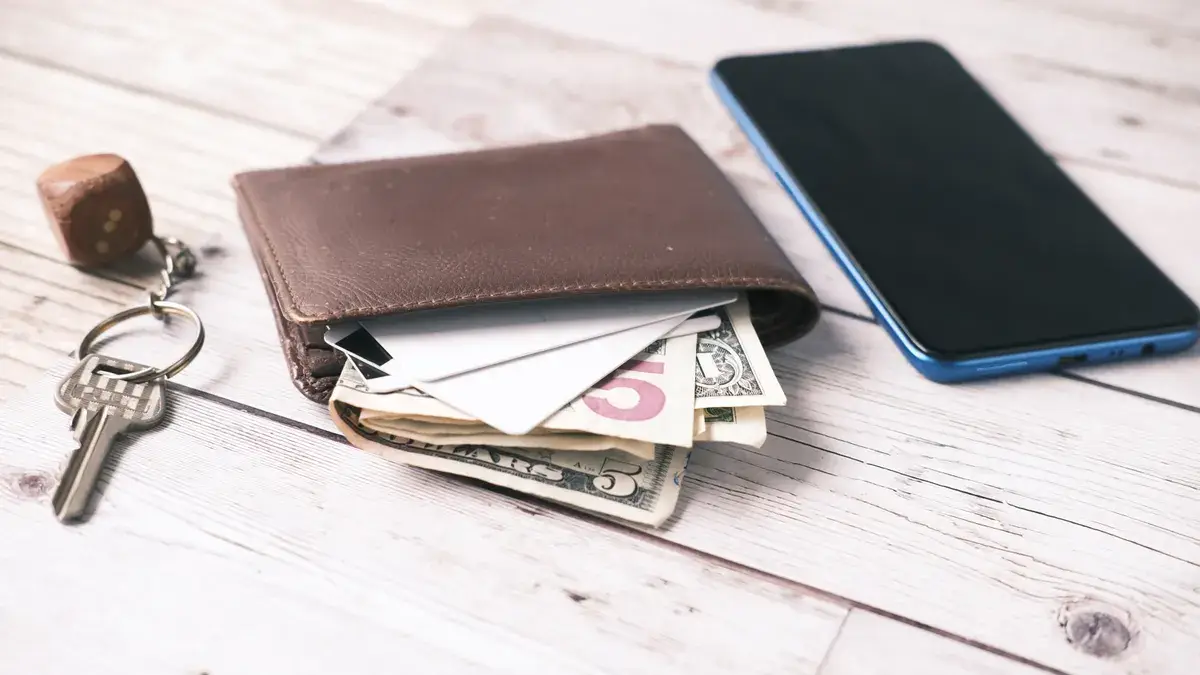
The answer is to build a system that makes mistakes expensive for scammers and cheap for the family. A teen should not have unlimited payment access, a card with overdraft, or a password that can be reset from an email inbox the teen shares with school clubs and streaming services. A safer setup usually includes one debit card or prepaid card, transaction alerts, biometric phone open, and a parent or guardian who can see activity the same day it happens.
This is not about treating a teenager like a child forever. It is about matching access to judgment, and families should consult a financial professional or trusted bank representative if they are unsure how much access is appropriate. A 15-year-old who buys lunch, splits rides, and pays for a class trip needs different protection than an 18-year-old who is applying for a first apartment. The right question is not “Should a teen have money access?” It is “How much damage can one bad tap cause?”
That answer changes the design. Avoid shared passwords whenever possible. Avoid card numbers saved in browsers on school laptops. Avoid cash apps with no PIN or Face ID. Avoid overdraft protection on a teen debit card unless a parent wants the account to function more like a credit line. For many families, a teen banking product with real-time alerts and the ability to freeze the card in-app is the cleanest setup because it reduces the time between a problem and a fix.
The weak spot in most families is not the bank account. It is the phone. Scammers know that a teen who clicks a fake “package delivery,” “friend needs help,” or “account locked” message may hand over a one-time code before the adult notices. The money defense has to include the device, the inbox, and the DMs. If those are loose, the banking controls only do half the job.
What teens get wrong about scams
The first mistake is assuming fraud looks dramatic. It usually does not. It looks like a text from a “carrier,” a DM from a hacked friend, or a checkout screen that asks for a debit card, a verification code, and a “confirm” tap in one breath. Teens are especially vulnerable to pressure scams because many of them move money while distracted, on mobile screens, and in public.
The second mistake is trusting familiarity. A message from a known contact can still be a scam if that contact’s account is compromised. A payment request that looks routine can be a social-engineering trick if the sender says “send it back right away.” A resale listing can be bait even when the seller profile has a photo and a name. Fraudsters count on teens to skip the step that matters most: pausing long enough to verify through a second channel.
A useful defense is a tiny rule set a teen can remember in under 10 seconds:
- Never send a code you did not request.
- Never pay a new person from a message thread without confirming by voice or in person.
- Never move money to “protect it.”
- Never pay a deposit or “verification fee” to open a prize, job, apartment, or delivery.
- Never open a banking link from a text if the app or bookmarked site can be opened directly.
That last point matters because phishers often copy real branding well enough to fool a tired thumb. The Federal Trade Commission’s scam guidance at https://consumer.ftc.gov/scams helps here, and so does the Consumer Financial Protection Bureau’s general fraud and scam material at https://www.consumerfinance.gov/consumer-tools/scams-and-fraud/. Both are worth reading before a problem starts, not after.
The hard truth is that a teen who knows how to spot one scam may still fall for another. That is why the protection has to be layered. One layer is teaching the pattern. Another is setting up the money tools so a single mistake does not drain the balance. A third is making recovery fast enough that the loss is small and visible.
What kind of money setup is safest for a teen?
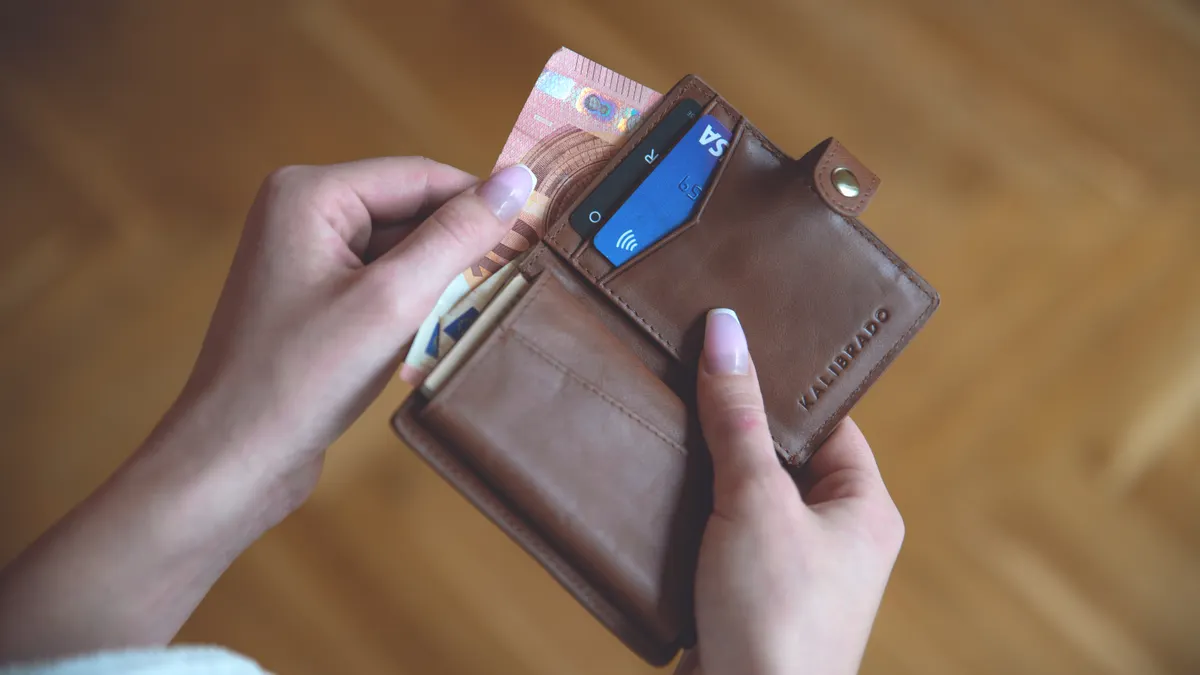
A teen debit card or prepaid card with alerts usually wins for everyday spending, while a linked checking account with overdraft disabled wins for teens who need a real bank relationship. The most appropriate choice depends on whether the main goal is spending control or banking history.
A prepaid card is the stricter option. It can be a good fit for a younger teen because the spending ceiling is usually limited to what has already been loaded. That makes the downside easy to understand. If the card is compromised, the thief generally cannot spend beyond the balance. The drawback is practical: some merchants, car-rental desks, subscription services, and online platforms handle prepaid cards poorly or not at all. That can become frustrating fast if the teen needs to buy something recurring or reserve something that expects a debit card with a bank account behind it.
A teen checking account is more flexible. It can support direct deposit from a part-time job, school refund payments, and normal card use. Many banks also offer app-based controls: card lock, real-time alerts, merchant category controls, and spending limits. Those features are useful because they let a parent notice a $2 test charge before a larger theft follows. The downside is that checking accounts can drift into risky territory if overdraft is allowed or if the teen has a card tied to a full bank balance with weak alerts.
For a teen who is just starting, the safer default is usually a card with low exposure and tight controls, not a full-featured open-ended setup. That is especially true for teens who buy a lot through games, social apps, or resale marketplaces. Those environments create more chances to click the wrong thing.
The consumer side of this choice is not glamorous, but it is useful. Many banks and card issuers publish fee schedules and card protections on their own sites; the exact controls vary by product. The important part is to check for four features before opening anything: no overdraft, instant transaction alerts, card freeze in the app, and two-factor authentication on account access. If one of those is missing, the setup is weaker than it should be.
Teen bank account or prepaid card: which one actually fits?
The teen bank account wins for older teens who need flexibility, while the prepaid card wins for younger teens or anyone who needs a hard spending ceiling. The right answer depends on how much freedom the teen needs and how much loss the family can tolerate.
| Criteria | Teen bank account | Prepaid card | Winner for [condition] |
|---|---|---|---|
| Overdraft risk | Can be zero if overdraft is disabled, but defaults vary by institution | Usually limited to loaded funds | Prepaid card for strict loss control |
| Direct deposit from a job | Usually works well | Sometimes supported, sometimes clunky | Teen bank account for working teens |
| Merchant acceptance | Broad, because it functions like a normal debit card | Can fail with subscriptions, hotels, and some app stores | Teen bank account for general use |
| Fraud exposure | Higher if the balance is larger and alerts are weak | Lower because the card often caps losses at the loaded amount | Prepaid card for first-time cardholders |
| Parental visibility | Often strong in teen-focused products | Varies by issuer and app design | Teen bank account if alerts are a priority |
| Financial skill building | Better for learning budgeting, deposits, and account statements | Better for learning simple spend-and-track habits | Teen bank account for older teens |
| Recovery after theft | Depends on issuer rules and how fast the loss is reported | Depends on the prepaid program, which can be more limited | Teen bank account if the program has stronger dispute handling |
| Fees and fine print | Can include maintenance, ATM, or out-of-network fees | Can include load fees, usage fees, or inactivity fees | Tie; read the fee schedule closely |
| Best fit age range | Older teens who need broader access | Younger teens or cautious first users | Depends on maturity and spending habits |
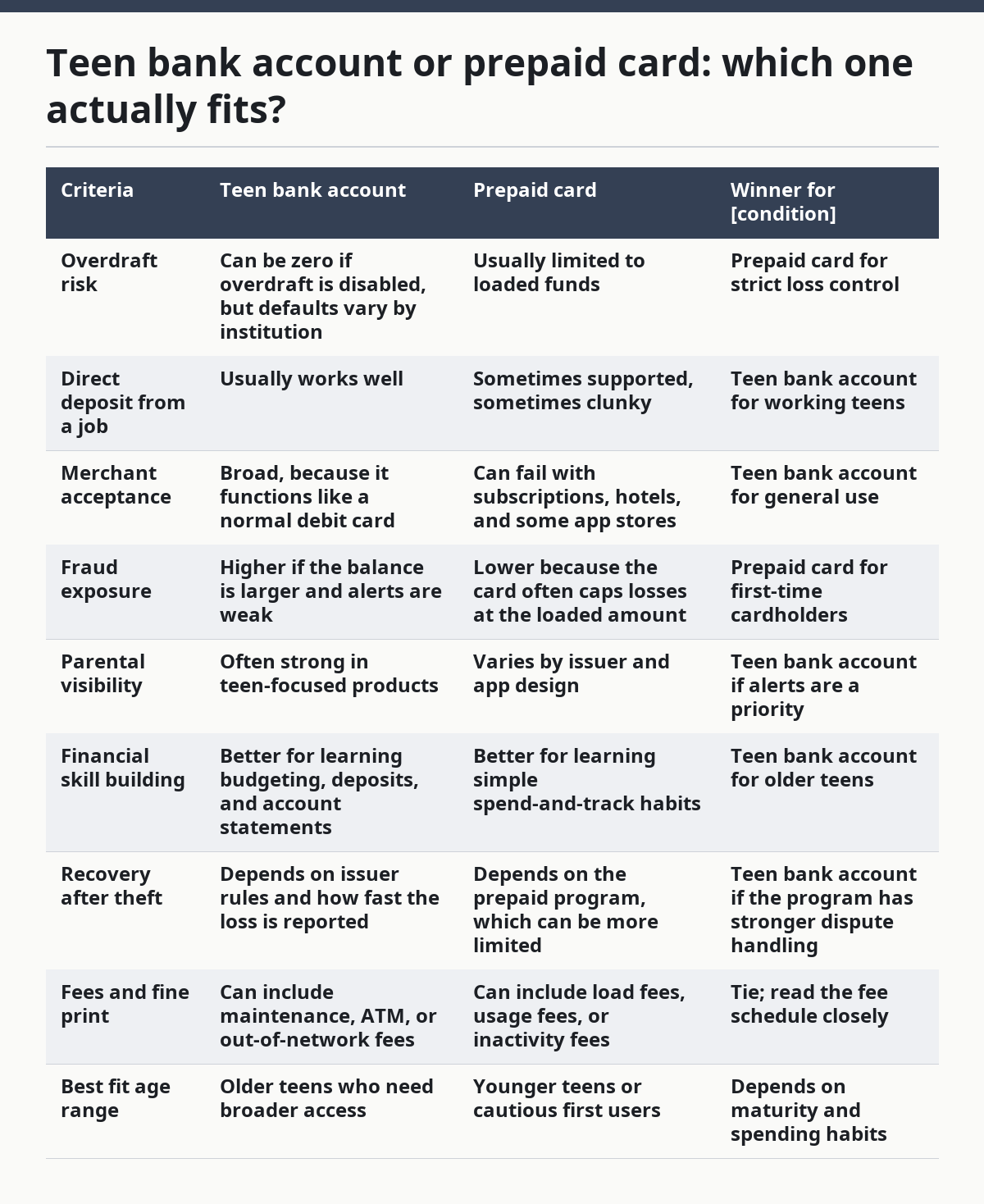
The bank account wins for any teen who gets paid, travels independently, or needs regular debit-style access. The prepaid card wins when the family wants a clean ceiling and can live with weaker flexibility. Neither is automatically safer if the app has no alerts, the teen reuses passwords, or the parent never checks activity. A card with a low balance and weak controls is still a soft target.
The hidden issue is that some prepaid products look simpler than they are. That simplicity can hide fees. Check for activation fees, reloading fees, ATM fees, and inactivity fees before choosing one. Read the fee schedule, not the marketing page. If a card’s real use case is “weekly allowance and occasional online purchase,” it may be enough. If the use case includes work paychecks, subscriptions, and travel, it is usually the wrong tool.
How to lock down a teen’s phone, email, and payment apps
The phone is the vault, so the vault needs a lock. A teen’s financial safety improves most when the device itself is hardened with a strong passcode, Face ID or fingerprint open, and no automatic login to money apps. If the phone falls into the wrong hands, the phone should not become the payment system.
Start with the basics. Use a six-digit passcode at minimum; longer is better if the teen will remember it. Turn on biometric open. Disable message previews on the lock screen if verification codes show up there. Make sure the recovery email attached to any banking or payment app is one the teen does not casually share with gaming platforms, school clubs, or public Wi-Fi sign-ins. That recovery inbox should also use a unique password and 2-factor authentication.
Then move to the payment apps themselves. Cash apps, peer-to-peer payment tools, and wallet apps should have a PIN, Face ID, or fingerprint requirement every time money leaves the account. If the app allows it, turn on transaction notifications for every send, request, and card purchase. That can surface a problem in seconds rather than days.
This matters because many scam losses are not “bank hacks.” They are account takeovers created by stolen codes, reused passwords, or a teen approving a login request without reading the prompt. The FBI’s Internet Crime Complaint Center at https://www.ic3.gov/ is a good place to understand how often fraud starts with online access problems rather than with the bank itself. If a teen uses a payment app, the app is part of the security perimeter, not an accessory.
There is a trade-off here. More security can mean more friction. A teen who has to open three screens to send lunch money may complain. That complaint is the cost of making mistakes harder. If the family wants convenience above all else, the security posture will be weaker. That is a conscious choice, not a neutral one.
What should parents freeze, monitor, and store offline?
Credit freezes are the strongest protective move for teens who do not need new credit right now. They do not stop every kind of fraud, but they make it harder for someone to open new credit lines in the teen’s name. In the United States, the major consumer reporting agencies allow freezes; the process is free. The Consumer Financial Protection Bureau and Federal Trade Commission both explain the basics, and the three national bureaus maintain their own freeze procedures.
For a teen with a Social Security number and no near-term need for a loan or credit card, a freeze is usually the right default. The downside is administrative friction: the freeze must be lifted temporarily if the teen later needs a credit check for some applications. That is manageable, but only if the parent knows where the login credentials and PINs are stored. Store those offline, not in a notes app tied to the same device that handles banking.
Monitoring is the second layer. A parent should see card swipes, online purchases, and cash withdrawals in near real time if the teen is younger or if there has already been a fraud incident. For older teens, the goal shifts from control to visibility. That can mean alerts only above a set threshold, or weekly review rather than minute-by-minute checking. Exact settings depend on the child’s age and the family’s trust level. A 14-year-old and an 18-year-old should not have identical rules.
The third layer is documentation. Keep a simple paper or offline note with the bank’s fraud number, the card issuer’s number, the app support contact, and the steps to disable the card. If something goes wrong, nobody wants to search through email while a scammer is still spending. Also keep a copy of the teen’s Social Security number, state ID details, and account-opening records in a secure place, because identity-theft paperwork is much easier when the details are ready; if you are unsure how to store those records safely, consult a financial professional or the issuing institution’s fraud team and rely on their official guidance.
The honest drawback of this approach is that it asks adults to stay organized. That is the price of protection. If the family will not maintain the records, the system collapses the first time it is needed.
What to do in the first 15 minutes after fraud
The answer is to stop the bleeding first, then document everything. If a teen’s card, payment app, or bank login has been misused, act in this order: freeze the card or lock the app, change the password, sign out of other devices, and call the issuer’s fraud line. Do not wait to “see if more transactions come through.”
The reason speed matters is simple: many digital fraud cases grow in minutes. A stolen login can be used to move money, change recovery settings, or add a new device before the owner notices. If the teen uses a payment app, review authorized devices and revoke any that are unknown. If the teen’s email may be compromised, change that password too, because email often controls password resets.
After the account is secured, gather evidence. Save screenshots of transactions, usernames, phone numbers, and messages. Write down the time the fraud began, the amount taken, and what the teen clicked or shared. This is not busywork; it is the backbone of a dispute. The FTC’s identity theft recovery resource at https://www.identitytheft.gov/ is a useful place to organize the aftermath, and it can help frame the next steps if the problem includes identity misuse rather than only card theft.
Do not ignore small losses. A $7 test charge can be the first sign of a larger breach. A strange $1 payment request can be a probe. A teenage victim often feels embarrassed and hides the problem, which gives the scammer more time. Make it normal to report a mistake fast. That is a family process issue, not just a financial one.
The main limitation here is that dispute outcomes vary by issuer, product type, and speed of reporting. A bank card with strong fraud protections is usually easier to unwind than a prepaid product with tighter limitations. That is one reason the choice of product matters before anything goes wrong.
When the safer choice is not a financial app at all
Sometimes the right answer is no app, no card, and no linked debit access yet. That is true when the teen repeatedly loses phones, shares passwords, or cannot explain a payment request clearly enough to spot a scam. It is also true when the teen is being targeted by a specific person online, such as an ex-friend, a fake buyer, or someone asking for “temporary” help with rent, rides, or crypto.
A cash-only or cash-plus-parent-managed setup can be the better short-term move in those cases. It removes the most common digital fraud paths while the teen learns the habits that keep a real account safe. That might sound old-fashioned, but the point is not to maximize convenience. It is to reduce harm.
This choice also makes sense if the teen does not yet need online payments at all. A younger teen who only needs lunch money, a sports fee, or an occasional school trip does not need a fully exposed payment ecosystem. A low-balance card, or even a controlled cash allowance, may be enough. The whole point of protection is to match the tool to the task.
The trade-off is obvious: too little access can slow down legitimate spending and prevent the teen from practicing real-world money skills. That is why the “no app” choice should be temporary, not permanent, for most families. It works best as a bridge, not a destination.
The honest verdict: which setup to choose
Choose a teen bank account if the teen needs direct deposit, regular debit access, and a real banking relationship with alerts and card controls. Choose a prepaid card if the teen is younger, the family wants a hard spending cap, and the loss exposure must stay small. Neither if the teen refuses basic security habits, the parent will not monitor activity, or the setup depends on reused passwords and shared recovery email.
That is the clean call. For most families with a teen who is ready for normal spending but not ready for open-ended risk, a teen bank account with overdraft off, alerts on, and a card freeze button is the strongest balance of safety and usefulness. For a younger or more impulsive teen, the prepaid card is safer because the damage radius is smaller. If the money tool cannot be monitored, controlled, and recovered quickly, it is the wrong tool.
Exception scenarios that change the recommendation
The overall verdict flips in three common cases.
First, if the teen is under heavy scam pressure from DMs, gaming chats, or resale marketplaces, a prepaid card or even cash-only setup is safer for a while. The goal there is not flexibility; it is cutting off fast losses while habits improve.
Second, if the teen has a stable paycheck and needs to build normal banking behavior, a teen checking account is the better choice even though it carries more complexity. Direct deposit and regular statement review are part of the lesson.
Third, if the teen has already been hit by identity theft, the priority is not a new card. It is a credit freeze, password cleanup, and a locked-down recovery process. Opening another payment app before those basics are fixed only creates more surfaces for the same problem.
Fourth, if the family cannot commit to alert review and fraud response, the safest card in the world will not help much. In that case, the setup should be simpler and more controlled until someone can actually supervise it.
The small habits that prevent big losses
The answer is repetition, not heroics. A teen who checks notifications daily, never shares codes, and verifies payment requests through a second channel is far less likely to lose money than one who treats fraud as an abstract adult problem. A 30-second habit does more than a one-time lecture.
Use a monthly money checkup with four questions: Did any transaction look unfamiliar? Did any new device sign in? Did any app ask for a code? Does the teen still know how to freeze the card? That review takes less time than fixing one compromised account.
A family that makes money safety ordinary gives the teen something better than paranoia: practiced judgment. That is the real protection.
Drafted with AI; not yet reviewed by a person.