Last updated: November 19, 2026
Quick Answer: A teen job scam screening check usually comes down to 3 big warning signs: pressure, vague details, and any request to pay or share personal information before you can verify the employer. For How Teens Can Tell If a Work Opportunity Is a Scam, the safest next step is to pause and confirm the employer through an official website or phone number, and if you are unsure, consult a parent, guardian, school counselor, or another trusted adult. The FTC and the Better Business Bureau both warn about these patterns in job scams. FTC job scam guidance and BBB scam alerts.
A teen job scam screening check starts with one rule: if the job pushes you to pay, rush, or share personal details before you can verify the employer, treat it as suspicious. Real jobs can be messy; scam offers are usually pushy, vague, and built to move fast.
Key takeaways
- Scam offers often sound exciting but skip basic facts like a real company name, location, supervisor, or clear duties.
- A request for money up front is a major warning sign, especially if the message says you need to buy training, equipment, or access.
- Fake check scams often ask you to deposit a check and send part of the money back before the bank catches the fraud.
- Safe communication stays on an official company email, phone number, or website; random text threads and chat apps are easier to fake.
- Teens should slow the process down, verify the employer, and keep a parent, guardian, or school counselor in the loop if anything feels off.
What a teen job scam screening check looks for first
A teen job scam screening check looks for pressure, vagueness, and money requests before anything else. Those three signals catch many fake offers because scammers want a fast yes, not a careful one.
Start with the job listing itself. A real posting usually says what the work is, where it happens, what age rules apply, and who the employer is. A scammy posting may promise “easy cash,” “no experience needed,” or “start today” but leave out the company name. It may also use a generic title like “customer support assistant” while giving almost no details about the actual tasks.
Then look at the tone. Scam ads often promise unusually high pay for very simple work. They may say you can earn hundreds of dollars for a few hours of packing boxes, posting on social media, or “mystery shopping.” That does not prove fraud by itself, but it should make you stop and check the basics.
Meanwhile, urgency is another clue. If the message says there are only 24 hours to accept, or that you must reply by the end of the day, that is a pressure tactic. Real employers can have deadlines, but they still let you read the details. A legitimate hiring process rarely needs a teen to decide in 10 minutes.
Finally, notice what is missing. No address, no company website, no named manager, and no way to confirm the role are all red flags. A job offer that cannot be tied to a real business is not ready to trust.
For broader money guidance, the hub on teen money jobs and earnings can sit beside this page without repeating the fraud checks here.
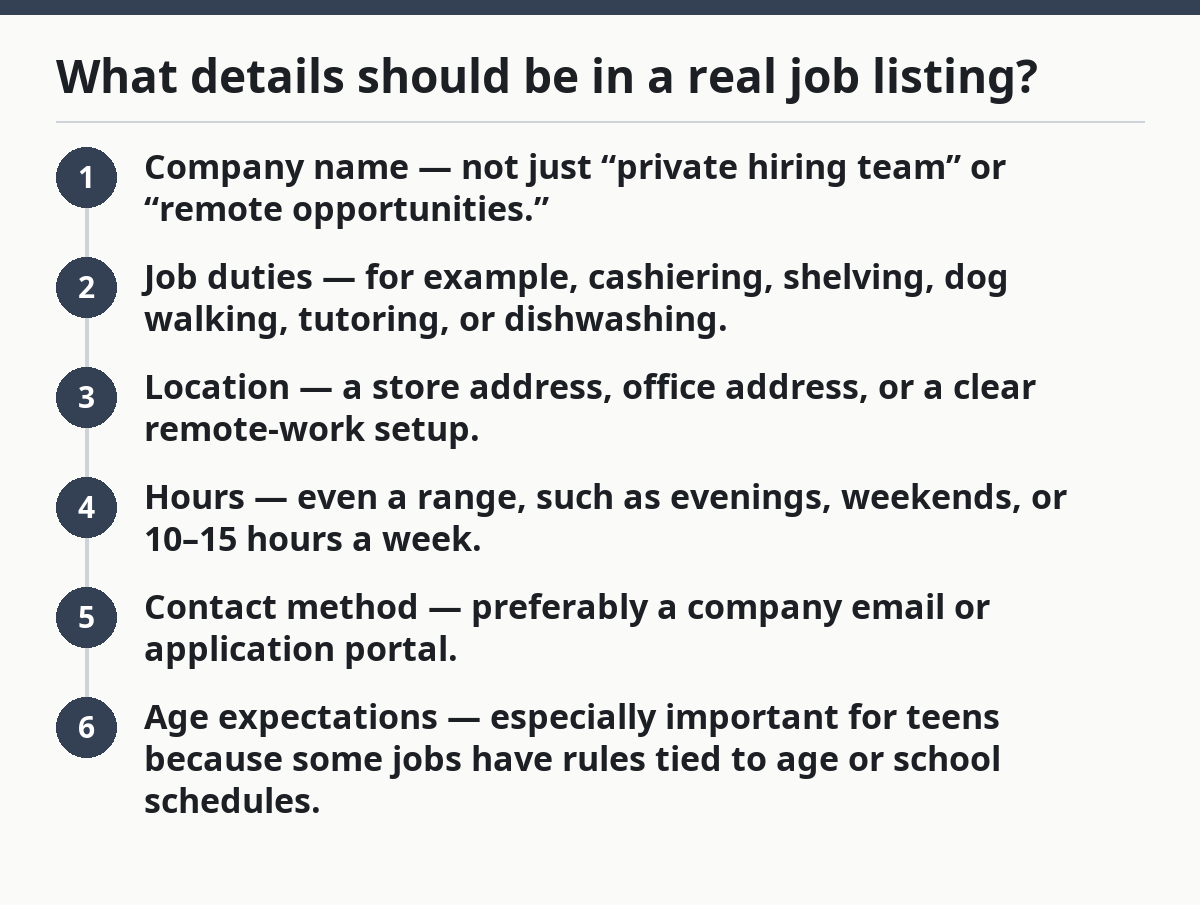
What details should be in a real job listing?
A real job listing should name the employer, explain the work, and give a way to verify the company within about 5 minutes. Those are the basics that separate a real opening from a bait-and-switch ad.
A trustworthy listing usually includes these pieces:
- Company name — not just “private hiring team” or “remote opportunities.”
- Job duties — for example, cashiering, shelving, dog walking, tutoring, or dishwashing.
- Location — a store address, office address, or a clear remote-work setup.
- Hours — even a range, such as evenings, weekends, or 10–15 hours a week.
- Contact method — preferably a company email or application portal.
- Age expectations — especially important for teens because some jobs have rules tied to age or school schedules.
A fake posting often skips at least two of those items. It may use a free email address, like a generic webmail account, instead of a company domain. It may say the job is “near you” but never name the town. It may talk a lot about pay and almost nothing about the actual work.
Read the posting like a checklist, not like an advertisement. If the employer expects you to fill out a form, the form should not ask for sensitive information before the role is even explained. A request for a Social Security number, bank details, or a photo ID on the first contact is too early for most jobs. If a teen is not sure what a field means, the safer move is to pause and ask a parent, guardian, school counselor, or another trusted adult to look at it first.
One more clue: real listings do not need dramatic language to sound worth it. “Flexible schedule” is normal. “Make $500 a day from home with no interview” is not.
What does a scam email or text message look like?
A scam email or text message usually arrives out of nowhere, sounds generic, and pushes you to reply fast. It may look polished, but the details often do not line up with how real hiring works.
The sender name is a good place to start. If the email address does not match the company domain, that matters. A message from a personal address can still be real in rare cases, but a legitimate employer normally uses a business account for recruiting. A text from an unknown number is even easier to fake.
Read the greeting. Scam messages often say “Dear applicant” or “Hello candidate” instead of your name. That is not proof on its own, but it is a sign the sender may be mass-messaging many people.
Then inspect the body of the message. A real employer usually refers to the specific job title, the place you applied, or the next step in the process. Scam messages often skip that and jump straight to excitement: “Congratulations, you are selected!” before any interview. If you never applied, or if the message does not mention where you applied, treat it as suspect and verify it with a trusted adult or the employer’s official contact details.
Watch for links and attachments you did not expect. A text message that asks you to click a shortened link, open a strange file, or fill out a form on a site you do not recognize is not something to rush into. Safe hiring usually keeps the process on the employer’s website or a known application platform.
Tone matters too. A message that says “reply in the next 15 minutes” or “keep this confidential” is doing the opposite of what safe hiring should do. A real employer should be fine with you asking a parent to review the message, or with you taking a few hours to think.
If the contact asks you to move the conversation to a private chat app right away, slow down. That can be a way to avoid records and make the conversation harder to trace later.
How do you check if the employer is real?
You check if the employer is real by matching the name, website, contact info, and location across at least 3 independent sources before you reply with personal details. That takes a few minutes, and it can save you from a fake offer.
Use this simple process:
- Find the company name in the listing or message. If there is no clear name, stop there and do not guess.
- Search the company name on its official website and look for the same job title. A real opening should connect to the same work, not a completely different role.
- Check the domain of the email address. A business email should usually match the company name, not a random free email account.
- Look up the company’s main phone number or location from its official website, then contact that number directly. Ask whether the hiring contact and the job posting are real.
- Search the job title plus the company name on a known job board or local listing site. If the post appears nowhere else, that does not prove fraud, but it is a reason to slow down.
- Compare the pay, duties, and schedule. If the message says one thing and the website says another, trust the mismatch.
That process works because scammers rely on speed and isolation. A real employer can survive a 3-minute verification call. A fake one often falls apart when you ask for a supervisor’s name, the business address, or a callback number.
Since teens also need to check whether the role makes sense for age and location, a summer job in a town 200 miles away with no interview and no local presence is harder to trust than a nearby store or known business. That does not make remote work fake, but it does mean the proof needs to be stronger.
Two reputable sources on job scam patterns are the FTC’s fraud guidance and the Better Business Bureau’s scam alerts. Those pages are useful because they focus on the exact tricks scammers use, not just on general online safety.
Why fake check scams trap teens
Fake check scams trap teens by making the victim believe the money is already real. The trap works because the check may appear to clear at first, but the deposit later gets reversed.
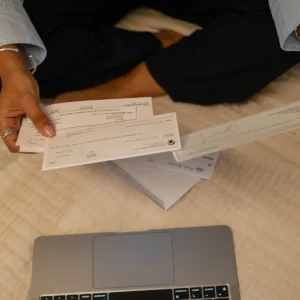
Here is the usual setup. A scammer says you have been hired for a simple task such as buying supplies, paying a vendor, or “setting up your work account.” They mail or email a check, often for more than the amount needed. Then they ask you to deposit it and send part of the money back through a payment app, wire transfer, gift card, or cash pickup.
The danger is the timing. Banks may make some funds available before the check is fully verified. That can fool a teen into thinking the payment is safe to spend. When the bank later discovers the check is fake, the account holder is left responsible for the loss. The money already sent to the scammer is usually gone.
This scam often comes with a believable story. The employer may say the overpayment was a mistake, that the accountant is out sick, or that you need to buy materials right away. The fake job may look more official because it involves a check, but that is exactly why it works.
A real employer does not need you to handle company money before you have even started the job. It also does not ask you to forward part of a payment to a third party as part of “training” or “setup.” If the first assignment includes a check, a quick refund, or buying supplies with your own money, stop.
Teens should treat any unexpected check as a reason to pause, not as proof of legitimacy. If that happens, the safest move is often to avoid depositing it, avoid spending any of it, and show the message to a trusted adult right away.
Why upfront fees are a major red flag
Upfront fees are a major red flag because real employers usually pay you, not the other way around. If a job says you must pay to get hired, the offer deserves extra skepticism.
Common fee claims include:
- paying for training
- buying a starter kit
- covering shipping for materials
- opening a “work account”
- paying for background check processing through a random link
- buying a uniform from a specific seller before your first shift
Some of these costs can exist in legitimate settings, but the details matter. For example, a real employer may provide a uniform later or deduct certain items through a formal process, depending on local rules. A scammer uses the same words to create urgency and get money immediately.
If the employer wants payment before any contract, before any in-person interview, and before any official paperwork, that is a strong warning sign. A legitimate company can explain what the fee is for, where it goes, and whether it is optional. A scam usually cannot answer those questions clearly.
Also watch for payment methods that are hard to reverse. Gift cards, wire transfers, crypto, and peer-to-peer transfers are common scam tools because they move quickly and are difficult to undo. A real hiring process should not ask a teen to use those methods just to start working.
This is one place where being careful is better than being polite. It can be okay to ask, “Why do I need to pay this, and can you verify it on the company website?” If the answer is vague, defensive, or rushed, the safest answer is no.
Safe communication before an interview or background check
Safe communication before an interview or background check stays on the employer’s official channels and gives you time to verify what is being asked. That matters because interviews and checks are exactly where scammers try to sound legitimate.
Before an interview, keep the conversation on the company email, website, or known phone number. If someone asks you to switch to a personal chat account, a text-only thread, or a new app, pause. A real recruiter can still use those tools, but they should not refuse basic verification. Ask for the full name of the interviewer, the company address, and the main switchboard or office number.
If a background check comes up, be careful with the form and the timing. A legitimate employer may use a standard screening process, but a teen should not enter sensitive data on a link sent from an unverified source. The request should line up with the company’s own hiring process, not with a random form or payment page.
Use the interview itself as a test. A real interview usually includes specific questions about your schedule, availability, skills, and the job duties. Scam interviews may be unrealistically short, oddly scripted, or skipped entirely. If someone offers the job after a 5-minute chat and never asks about your experience, that is not a good sign.
There is also a practical safety rule for teens: do not meet alone in a private place for an interview unless a parent, guardian, or trusted adult knows exactly where you are going. A public location such as a store, office, or library is safer than an apartment or an empty building. If the location feels off, leave.
A teen does not need to decide instantly. Taking 1 day to verify a job is normal. Getting pushed to respond in 1 hour is not.
What to do the moment something feels off
The moment something feels off, stop sending information and verify the offer through a separate channel. That is the fastest way to keep a small mistake from becoming a lost paycheck, fake check problem, or identity mess.
Use this order:
- Do not send money, ID images, or bank details yet. The result should be a pause, not a permanent commit.
- Save the message, email, or listing screenshot. This gives you a record if the person disappears later.
- Check the company using a different contact method. Call the business number from its official site, not the number in the message.
- Ask a parent, guardian, or school counselor to look at it with you. A second set of eyes often spots the clue you missed.
Drafted with AI; not yet reviewed by a person.