Last updated: November 19, 2026
Quick Answer: A teen debit card for everyday spending should have spending limits, merchant restrictions, instant alerts, a card freeze, and clear cash withdrawal access. In practice, that usually means a card a teen can use for lunch, rides, and small purchases without creating constant family friction.
Key Takeaways
- The right card for everyday teen spending uses limits, merchant blocks, alerts, freeze controls, and clear cash rules.
- A teen debit card for everyday spending should keep purchases simple, visible, and tightly managed.
- A spending limit should match the teen’s real routine, not an ideal one.
- Parents should be able to set limits on a teen debit card; that is one of the first features to check.
A teen debit card for everyday spending should be easy to control, quick to alert, and hard to misuse. A teen debit card for everyday spending works best when it gives a teen room to spend on lunch, rides, and small purchases without turning every transaction into a family problem.
The short answer: look for control first, rewards second
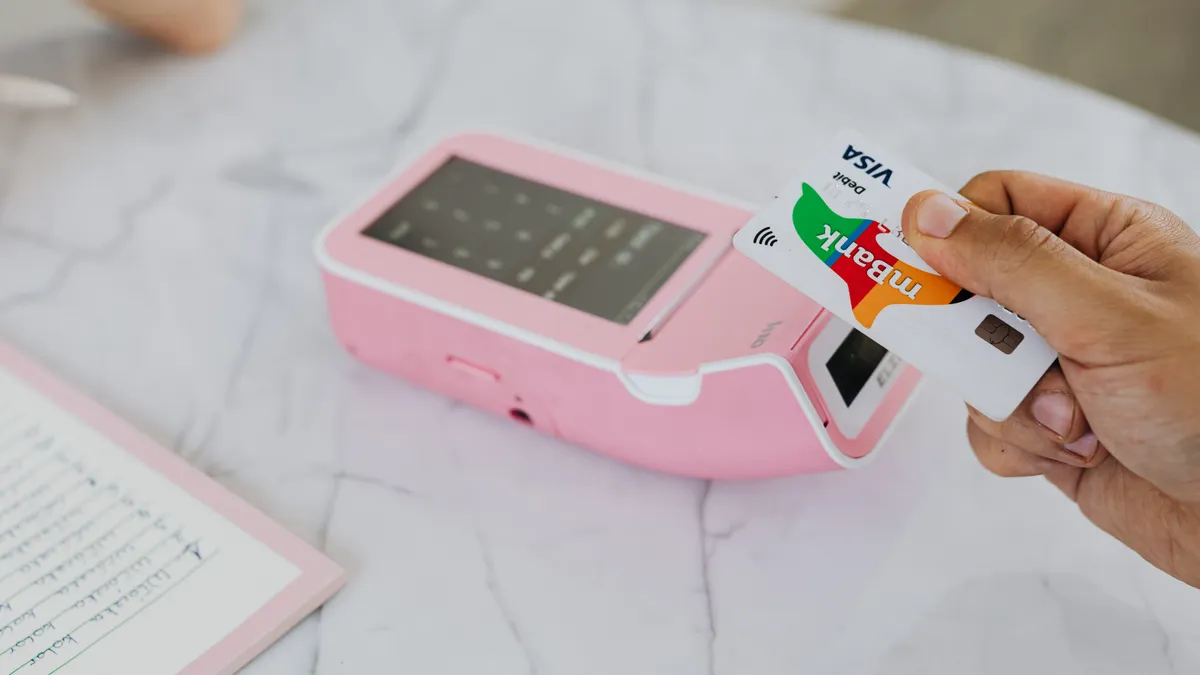
The right debit card for everyday spending is one with spending limits, merchant restrictions, instant alerts, a card freeze, and clear cash withdrawal access. Those features matter more than a shiny app or a rewards promise, because everyday teen spending is mostly about staying safe with a $5 coffee, a $12 movie ticket, or a $20 ride home.
A generic marketing page will often push “smart money tools” and leave out the part that actually keeps a teen out of trouble: control settings that work the same day the card is issued. A parent or guardian should be able to set a cap, block certain merchant types, and turn the card off in seconds if it goes missing. A teen should be able to check a balance before tapping at a store or ATM, then see the result appear as an instant alert. For context on consumer debit-card protections and error resolution, see the Consumer Financial Protection Bureau’s guidance on electronic fund transfers and debit cards: https://www.consumerfinance.gov/rules-policy/regulations/1005/
That is the standard I would use. If a card cannot do those basics, it is not a strong everyday-spending card for a teenager, no matter how polished the app looks. This is the part many comparison pages miss: convenience matters, but control is what makes the card usable week after week.
For families comparing teen money tools more broadly, the teen banking and spending accounts hub can help you compare the card with the rest of the account setup.
What should teens look for in a debit card for everyday spending?
A teen should look for a debit card for everyday spending that keeps spending simple, visible, and limited. That means the card should show every purchase right away, let a parent set boundaries, and make it easy to stop the card if it is lost or borrowed.
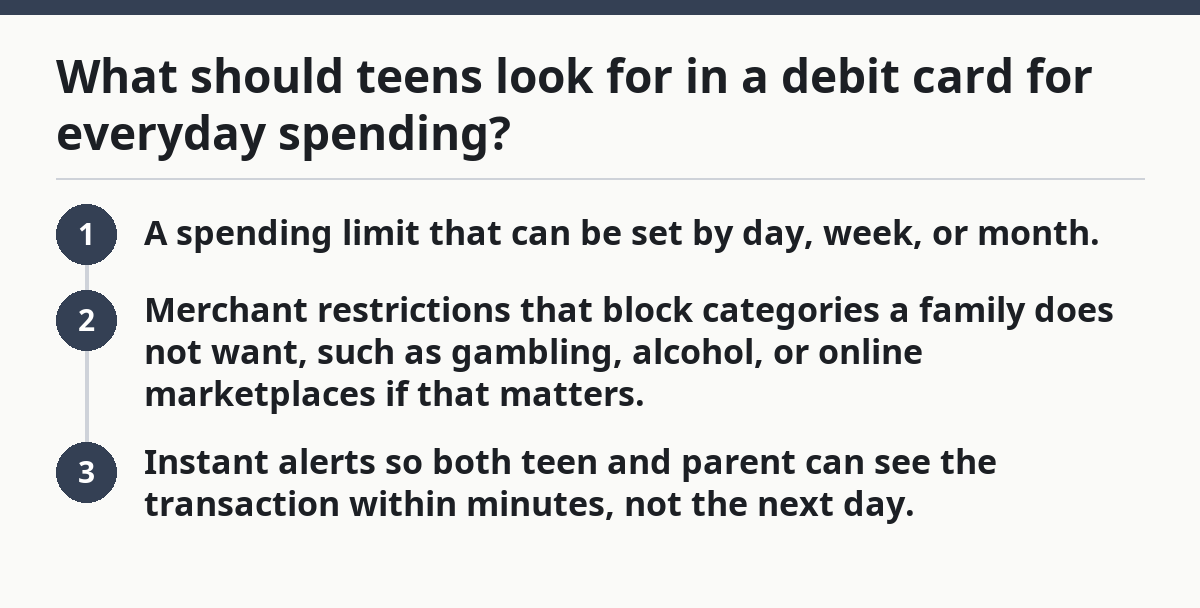
Think of the daily use case. A teen buys lunch on Monday, pays for a bus ride on Wednesday, and withdraws cash once on Friday. Those are small transactions, but they happen in different places, with different risks. A card built for that pattern needs three things:
- A spending limit that can be set by day, week, or month.
- Merchant restrictions that block categories a family does not want, such as gambling, alcohol, or online marketplaces if that matters.
- Instant alerts so both teen and parent can see the transaction within minutes, not the next day.
The ATM piece matters too. If the card allows cash withdrawal, the limit should be low enough to reduce damage if the card is stolen. A $40 or $60 daily cash limit is often more practical than a high limit, because many teen purchases do not require large cash amounts. The exact number depends on the family’s routine, but the principle is the same: cap the loss before it becomes a problem.
Look closely at who controls the settings. Some cards give the teen too much independence too early. Others make every tiny change require a parent’s approval, which turns the card into a nuisance. The sweet spot is fast control with enough flexibility for normal spending. A card that supports that balance is one a teen can actually use every day.
If you are comparing options, a simple checklist can help: limits, alerts, freezes, merchant blocks, and ATM rules. That is the core of what teens should look for in a debit card for everyday spending.
Spending limits that match real teen behavior
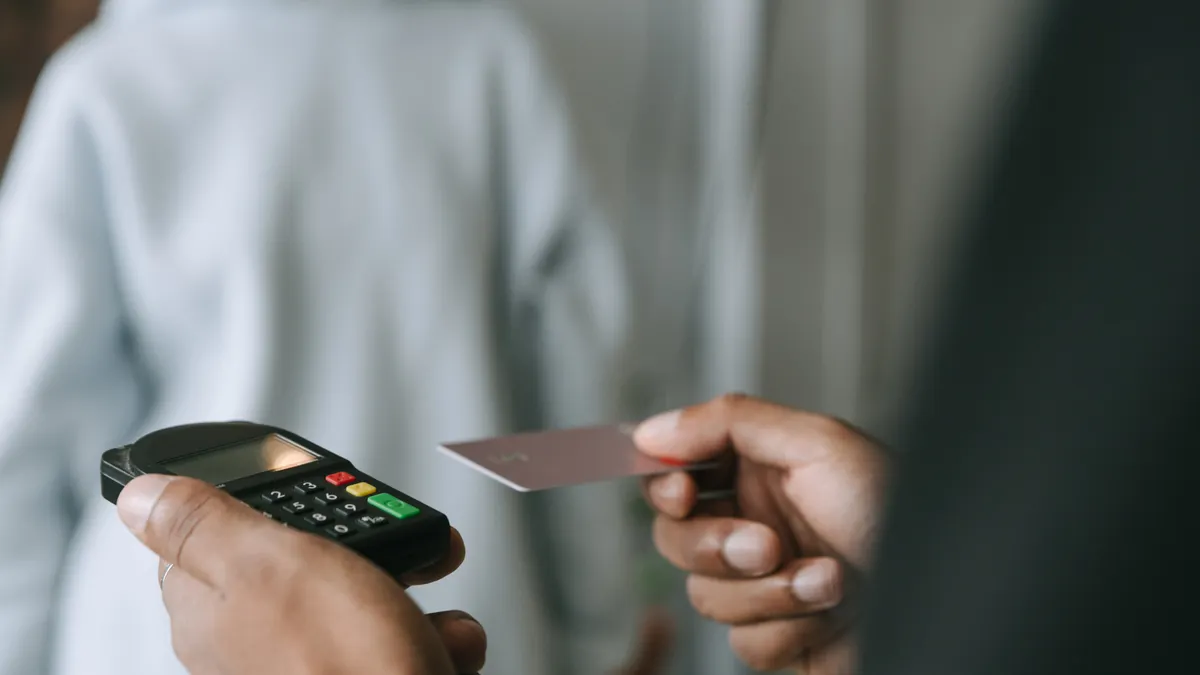
A good spending limit should fit the teen’s actual routine, not an imagined one. If the card is meant for school days, rides, snacks, and occasional extras, the limit should be low enough to prevent impulse spending but high enough that the card still works at the register.
The smartest way to set a limit is to tie it to a time period. Daily limits work well for teens who spend irregularly. Weekly limits work better for teens who get one allowance-style deposit each week. Monthly limits can be useful for older teens who handle a bigger budget and only need a guardrail, not a hard stop every 24 hours.
Here is the practical approach I would use:
- List the teen’s regular spending for 2 weeks, including lunch, transit, school supplies, and small digital purchases.
- Pick a limit that covers the normal total with a buffer, not the most expensive day.
- Set the card so a purchase above that cap declines automatically.
- Review the limit after 30 days and adjust it if the teen is constantly hitting the ceiling or never using the full amount.
- Keep the limit separate from savings money so one overspend does not drain everything.
A weak card feature here is “parent can turn on controls” without any detail about what those controls are. That sounds useful and often is not. I want to know whether the cap applies per purchase, per day, or per merchant. I also want to know whether ATM withdrawals count toward the same limit or a separate one.
This is not the place for a card that encourages broad spending power. If a teen is not ready for any cap at all, that is a sign to start with a more basic setup. The point of a teen debit card is not unlimited access; it is practice with boundaries.
Can parents set limits on a teen debit card?
Yes, parents should be able to set limits on a teen debit card, and that is one of the first features to check. A useful card lets a parent control dollar limits, block certain merchant types, and choose when the teen can spend cash or online.
The parent controls should be specific, not vague. I would look for controls such as:
- A purchase limit by day, week, or month
- ATM withdrawal limits
- Merchant category restrictions
- The ability to freeze and unfreeze the card
- Alerts for every transaction above a set amount, such as $1 or $10
- Separate controls for in-store, online, and mobile-wallet use
That last point matters. A card can be safe in a store and risky online, where card numbers can be entered into websites or saved for recurring charges. If the teen does not need online spending, block it. If the teen does need it, keep the ceiling tight and pair it with instant alerts.
The drawback is obvious: too many controls can become annoying. If a parent changes the rules every few days, the teen stops trusting the system and the card becomes a source of arguments. A better setup is stable rules with one review point each month. The card should teach judgment, not trigger a new negotiation for every purchase.
A strong teen debit card also separates permissions by purpose. The teen should be able to buy lunch without asking, while a larger cash withdrawal or a new online merchant may trigger a parent approval step. That is the kind of design that matches real family use, not a fantasy of perfect spending habits.
For a broader comparison of account types, the teen banking and spending accounts guide can help parents match controls to the right setup.
Instant alerts and card freeze: the safety net every teen needs
Instant alerts and a card freeze are the two features that matter most when a card goes missing or gets misused. Alerts tell you what happened; freeze stops the next charge.
Alerts should arrive for purchases, ATM withdrawals, cash-back transactions, and failed attempts if the app supports it. The alert should show the amount, merchant name, and time. If the app hides those details, the alert is not doing much work. For secure-by-design guidance on alerts and account monitoring, the Federal Trade Commission’s advice on spotting and reporting identity theft is useful background: https://consumer.ftc.gov/articles/what-know-about-identity-theft
The card freeze should be one tap away in the app, with no long support call required. That matters because the first few minutes after a card disappears are when damage can grow. If a teen leaves the card at a friend’s house or drops it at a game, freezing it immediately is better than waiting until morning. A freeze is also useful when the card is still physically present but the teen suspects a wrong merchant charge.
A simple process helps:
- Turn on every transaction alert the app allows.
- Set a low alert threshold for anything unusual, such as $1 or $5.
- Freeze the card when it is not in use, if the app supports that habit.
- Unfreeze it only when the teen is ready to spend again.
- Review alerts together at least once a week so the teen learns what normal spending looks like.
One common mistake is assuming a card is “safe” because the number is in an app. That is not enough. If the app does not give instant alerts and easy freeze controls, the card can still be abused before anyone notices. The whole point is speed.
For families comparing banking tools more broadly, this is one reason the teen banking and spending accounts hub exists: the card is only one piece of the system, and the controls around it matter just as much.
ATM access should be limited, not ignored
ATM access should be available only when the teen truly needs cash, and it should come with a low limit. Many teens can manage everyday spending almost entirely by card, but some still need cash for vending machines, school events, tips, or places that do not accept card payments.
The risk with ATM access is not just theft. It is also overspending in one short burst. A card that allows a $200 withdrawal can disappear fast, especially if the teen is not watching the balance closely. I would rather see a card with ATM access capped tightly than one with no cash controls at all.
A useful setup has three parts:
- A daily ATM withdrawal cap
- A monthly withdrawal cap if the app supports one
- Alerts for every cash withdrawal
If the teen rarely uses cash, the cap can be quite low. If the teen needs cash often, it should still be low enough that a single lost card cannot drain a large sum. The exact amount is a family decision, but the principle is straightforward: cash is harder to trace than card purchases, so the cap should be tighter.
This is also where parents can create a habit that sticks. Before leaving home, the teen checks whether cash is actually needed for the day. If not, the card stays in the wallet and the risk stays lower. That small routine matters more than most people think.
A card with no clear ATM rules can work for adults who manage their own risk. It is a poorer fit for teens, especially younger ones. Everyday spending cards for teens should make cash access possible, not casual.
How to judge whether a teen debit card is too restrictive or too loose
A teen debit card is too restrictive if it blocks normal purchases, needs constant parent intervention, or makes the teen afraid to use it. It is too loose if the teen can spend freely, withdraw cash without clear limits, or add new merchants without oversight.
The simplest test is to imagine a normal school week. Can the teen buy lunch, pay for transport, and handle a small online purchase without asking three times? Can a parent stop the card quickly if needed? If the answer to both is yes, the setup is probably in the right zone.
A card is too restrictive when:
- Small purchases keep failing for no clear reason.
- The app is hard to handle on a phone.
- Every transaction needs a manual approval.
- The teen cannot see the balance before spending.
A card is too loose when:
- Limits are off by default and hard to change.
- There are no merchant blocks.
- Alerts are optional and buried in settings.
- ATM withdrawals are wide open.
The trade-off is real. More control usually means less freedom, and less friction usually means more risk. For a teen, I would choose the side that protects the money first, then relax the settings after a few months of solid use.
One thing a generic article often leaves out is age fit. A 13-year-old and a 17-year-old do not need the same setup. The younger teen usually needs tighter caps and more parent visibility. The older teen may need more room to manage a regular budget and practice with online purchases. The card should fit the teen’s stage, not just the family’s preference for convenience.
The bottom line for everyday teen spending
The best teen debit card for everyday spending is the one with clear limits, fast alerts, strong freeze controls, and cash rules that are hard to abuse. If those pieces are in place, the card can handle lunch money, transit, and small purchases without creating constant worry.
I would pass on any card that looks polished but gives vague control, slow alerts, or weak ATM settings. For teens, the card is not just a payment tool. It is a training tool. That is why the basics matter more than bonuses, points, or flashy app features.
What features should a teen debit card have?
A teen debit card should have spending limits, instant alerts, merchant restrictions, a card freeze, and clear ATM controls. Those features help a teen spend on everyday needs without opening the door to oversized purchases or delayed fraud detection. The card should also be easy for a parent to manage from a phone in a few taps.
Can parents set limits on a teen debit card?
Yes, parents should be able to set limits on a teen debit card. The card should let a parent choose daily or weekly caps, control ATM withdrawals, and block certain merchant categories. A good setup makes it easy to adjust the rules without turning every small purchase into a manual approval.
How do debit card alerts help teens?
Debit card alerts help teens by showing spending in real time. They make it easier to catch mistakes, notice fraud fast, and learn how small purchases add up over a week. Alerts also help parents confirm that the card is being used the way the family intended, which keeps the system predictable.
Drafted with AI; not yet reviewed by a person.