Last updated: November 20, 2026
Key Takeaways
- Your availability for work is the exact time block you can reliably show up and stay on the job.
- Start with one short sentence, then add the details that matter.
- Name your fixed school hours first, then fit sports practice and weekend shifts around them.
- Match the form, then keep your wording consistent with what you’d say out loud.
If you’re a teen filling out a job application or talking to a manager, How Teens Can Answer What Is Your Availability for Work comes down to the hours and days you can reliably work. Quick answer: give a clear, honest time window, usually in one sentence, and include any hard limits from school or activities. The best answer is honest, specific, and simple enough for the employer to schedule around. The steps below show how to do that without overpromising or sounding unsure.
What “availability for work” means for teens

Your availability for work is the exact time block you can show up and stay on the job. That usually means weekdays, weekends, summer weeks, and any limits from school, sports practice, or family duties.
Picture this: you’re staring at a blank line on an application and trying to guess what sounds “good.” The real goal is not to sound perfect. It is to give a work schedule the employer can actually use, with school calendar conflicts and shift hours spelled out.
A teen’s availability often includes:
- Days of the week you can work
- Start and end times on school days
- Weekend shifts you can take
- Summer availability
- Any dates you cannot work at all
Here’s the catch: availability is not a promise to be “always free.” It is a truthful map of your time. If you write “open anytime” and then can only work after 4 p.m., the mismatch will show up fast.
A clear answer also helps you avoid one of the biggest first-job mistakes: getting hired for hours you can’t keep. For a wider view of teen job basics, the hub on Teen Jobs, Income, and Work Readiness — The Complete Guide can help with the bigger picture. For more on scheduling and work expectations, see Teen jobs that fit school schedules and How to talk to a manager about hours.
How do I answer “What is your availability for work”?
Answer it in one short sentence first, then add the details that matter. Start with the broad shape of your week, such as “I’m available after 3:30 p.m. on weekdays and anytime on Saturday,” then name the limits that come from school or sports practice.
Picture this: an employer asks for your hours, and you only say “pretty flexible.” That sounds polite, but it gives no usable information. The better answer includes days, times, and limits so the manager can place you on a real schedule.
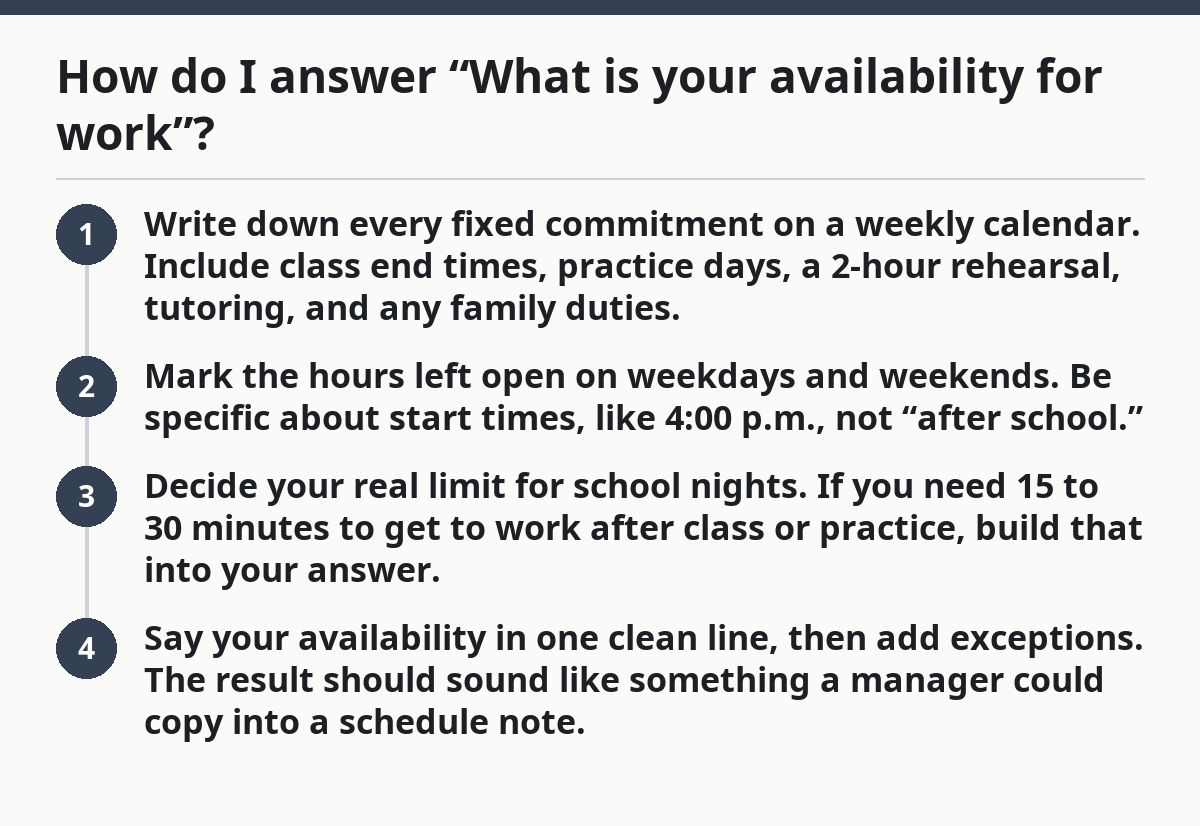
Use this 4-step method:
- Write down every fixed commitment on a weekly calendar. Include class end times, practice days, a 2-hour rehearsal, tutoring, and any family duties.
- Mark the hours left open on weekdays and weekends. Be specific about start times, like 4:00 p.m., not “after school.”
- Decide your real limit for school nights. If you need 15 to 30 minutes to get to work after class or practice, build that into your answer.
- Say your availability in one clean line, then add exceptions. The result should sound like something a manager could copy into a schedule note.
The answer should sound plain. For example: “I’m available Monday through Friday after 4 p.m., all day Saturday, and Sunday until 6 p.m. I can’t work during track practice on Tuesdays and Thursdays.”
Avoid vague language like:
- “I’m open a lot”
- “I can probably make it work”
- “Whenever you need me”
- “My schedule is kind of random”
Those phrases make you sound uncertain, and they force the employer to guess. A better answer saves time on both sides and shows that you understand your own work schedule.
What should I say if I have school, sports practice, and weekend shifts?

You should name your fixed school hours first, then fit sports practice and weekend shifts around them. That order matters because the employer needs to know which hours are locked and which hours move.
Picture this: your week has a 7-hour school day, a 90-minute practice, and a Saturday shift you can handle. If you list all three clearly, the employer can decide whether your free blocks match the job. If you hide one of them, the schedule breaks later.
A strong answer usually covers three pieces:
- School days: when you can start after class
- Sports practice: which days and how long you’re unavailable
- Weekend shifts: whether you can work mornings, afternoons, or both
A simple format works well:
“I’m available after 3:45 p.m. on school days except Tuesdays, when I have practice until 6:00 p.m. I’m free all day Saturday and can work Sunday mornings.”
That answer works because it gives a real time window, not a guess. It also tells the employer where the hard limits are.
If practice runs until 7:00 p.m. twice a week, say that early. Hiding it may get you a schedule you can’t keep.
One honest note helps here: if your school calendar changes during exam week, say so. A sentence like “My hours may shrink during finals week in December” is better than pretending your schedule never changes. That keeps the first conversation clean.
What is the best way to answer on a job application?
The best approach on a job application is to match the form, then keep your wording consistent with what you’d say out loud. If the form asks for days and times, give days and times. If it uses check boxes, check only the boxes that are true.
Picture this: a paper form asks for “available hours,” and you’re tempted to mark every box so you look eager. That backfires fast. The employer wants a schedule they can trust, not a polished fantasy.
Use the form’s space in a practical way:
- If there is a blank line, write a sentence with your main availability.
- If there is a table, fill in each day with a time range.
- If there is a comment box, add one short note about school or practice.
A useful example looks like this:
- Monday: after 4:00 p.m.
- Tuesday: after 6:30 p.m.
- Wednesday: after 4:00 p.m.
- Thursday: after 6:30 p.m.
- Friday: after 4:00 p.m.
- Saturday: open
- Sunday: until 6:00 p.m.
That format is easy to scan in under 20 seconds. It also keeps your answer honest and easy to schedule around.
Some applications ask for “open availability,” but a teen usually does not have that. If you only have 12 usable hours a week because of school, write those 12 hours clearly instead of pretending you can cover a full retail week. An employer may still hire you for the right role.
Honest time limits are better than sounding flexible
Honest time limits are better because they prevent bad matches before they start. If you can only work 10 hours a week, say 10 hours, not “as much as needed.”
Picture this: a manager hears “I’m flexible” and builds a schedule with 18 hours. Then your math class, bus ride, and 2-hour practice make that impossible. The result is stress for you and a problem for the store.
Two common mistakes cost teens the most:
- Saying yes to hours you can’t keep
- Leaving out a regular conflict because you think it will hurt your chances
The first mistake leads to missed shifts and awkward talks. The second creates the same problem later, only with more frustration. The fix is simple: state the limit now.
A few good phrases:
- “I can work up to 12 hours a week.”
- “I’m available after 3:30 p.m. on weekdays.”
- “I can work every Saturday, but not Sundays.”
- “I’m open more during summer break.”
That last one matters. Summer availability can be much wider than the school-year schedule, and employers often want to know that up front. For a broader look at teen work options, see summer jobs for teens and how many hours teens can work.
A teen does not need to apologize for limits. A short, direct answer is enough. “I’m in school until 3:15 p.m., so I can only take evening shifts on weekdays” is clear and professional. It also tells the employer exactly what kind of shift hours can work.
What if my schedule changes every week?
If your schedule changes every week, you should give your baseline availability and say how far ahead you’ll know changes. That gives the employer a starting point without pretending your week is fixed when it is not.
Picture this: one week you have a game on Wednesday, the next week you have tutoring, and the week after that you’re free. A manager can work with that if you say the pattern clearly. A vague “it depends” is harder to use.
Use this structure:
- Give your normal weekly pattern.
- Name the part that changes.
- Say when you usually know the new schedule.
- State how you’ll share updates.
Example:
“My usual availability is Monday, Wednesday, and Friday after 4:00 p.m. My Tuesday schedule changes because of club meetings, but I know that by the Friday before. I can send updates as soon as I get them.”
That answer does two jobs at once. It shows a real work schedule, and it shows that you can communicate changes before they become no-shows.
The best part is that this is still honest even if your week is messy. An employer does not need a perfect calendar. It needs enough lead time to fill the shift.
If your schedule changes so often that you cannot predict any 7-day pattern, say that plainly. In that case, a job with fixed shift hours may not be a good fit right now.
Examples of good teen availability answers
A good teen availability answer is short, specific, and tied to real weekly limits. The examples below work because they name days, times, and a real reason for the limit without oversharing.
Picture this: you need a line you can adapt for an application, an interview, or an email. These examples give you a clean starting point and show how to sound steady instead of unsure.
Try one of these:
- “I’m available after 3:30 p.m. Monday through Friday, all day Saturday, and Sunday until 5:00 p.m.”
- “I can work evenings on school days and have open availability during summer break.”
- “I’m free Thursday through Sunday, but I can’t work Tuesday because of practice.”
- “My school schedule limits me to about 12 hours a week during the semester.”
Each one works because it is plain and measurable. The employer can picture your availability without decoding it. For more examples, check teen job interview questions and answers and best first jobs for teens.
A weak answer sounds like this:
- “I’m pretty free most days.”
- “I can do whatever.”
- “I don’t know yet.”
- “Depends on the week.”
Those answers may feel easy to say, but they create doubt. If you want the job, clarity helps more than sounding casual. The right answer lets the employer see where you fit before the interview even starts.
For a teen, the goal is not to sound like an adult with no limits. The goal is to sound like a person who knows their own week. That is what hiring managers remember.
What does availability mean on a job application?
Availability means the days and times you can work. It tells the employer when you are free for shift hours, not whether you want the job or how hard you will work.
How do I answer if my schedule changes every week?
Give your normal pattern and say when you learn the changes. If you can usually confirm a week in advance, say that clearly so the employer knows how to plan around you.
Should I be honest about limited availability?
Yes, you should be honest about limited availability. A clear limit now is better than missed shifts later, and most employers would rather hire someone reliable for fewer hours than someone vague for more.
Sources
- U.S. Department of Labor, YouthRules! https://www.youthrules.gov/
- U.S. Department of Labor, Fair Labor Standards Act and youth employment rules: https://www.dol.gov/agencies/whd/youthrules
Drafted with AI; not yet reviewed by a person.