Last updated: November 20, 2026
Key Takeaways
- A strong work reference shows an adult can describe your behavior in a real setting.
- The best fit is the adult who has seen the job-related side of you.
- A character reference can work for a teen job if the application allows it and the adult has real observation.
- Teens can check a reference by asking direct questions before listing any names.
A teen’s work reference is a good choice if the person has seen you show up, follow directions, and handle people well. For How Teens Can Tell If a Work Reference Is a Good Choice, the quick answer is that 1 good reference is usually enough to start, and that person should give a real example, not just say you’re “nice.” This guide shows how to check that before you list anyone.
What a good work reference actually proves

A good work reference proves that an adult can speak to how you act in a real setting, not just that they know your name. That usually means they’ve watched you for at least a season, a semester, or a job shift pattern and can describe your habits clearly.
Because of that, the most useful reference is often someone who has seen you under real expectations, not just around friends. You can also use resources on first-job preparation from U.S. Department of Labor and CareerOneStop to think through what employers look for.
Picture this: you’re filling out a job application and the form asks for a reference contact. You don’t want to guess and hand over a name that sounds fine but can’t say much. You want someone who can back up your reliability with details.
A strong reference usually knows one of three things:
- how you handle tasks
- how you treat other people
- how you respond when something goes wrong
If you’re unsure what counts as appropriate, it can help to consult a professional or review the application instructions before you list anyone. A weak one knows you only in passing. That person may like you, but they can’t say much that helps an employer.
Here’s the catch: a reference does not have to be famous, impressive, or related to your future job. A teacher from one class can be better than a family friend who barely knows your school habits.
To check the fit, ask:
- Have they seen me work, not just socialize?
- Could they describe me without guessing?
- Would they sound believable to a hiring manager?
If the answer to any of those is no, keep looking.
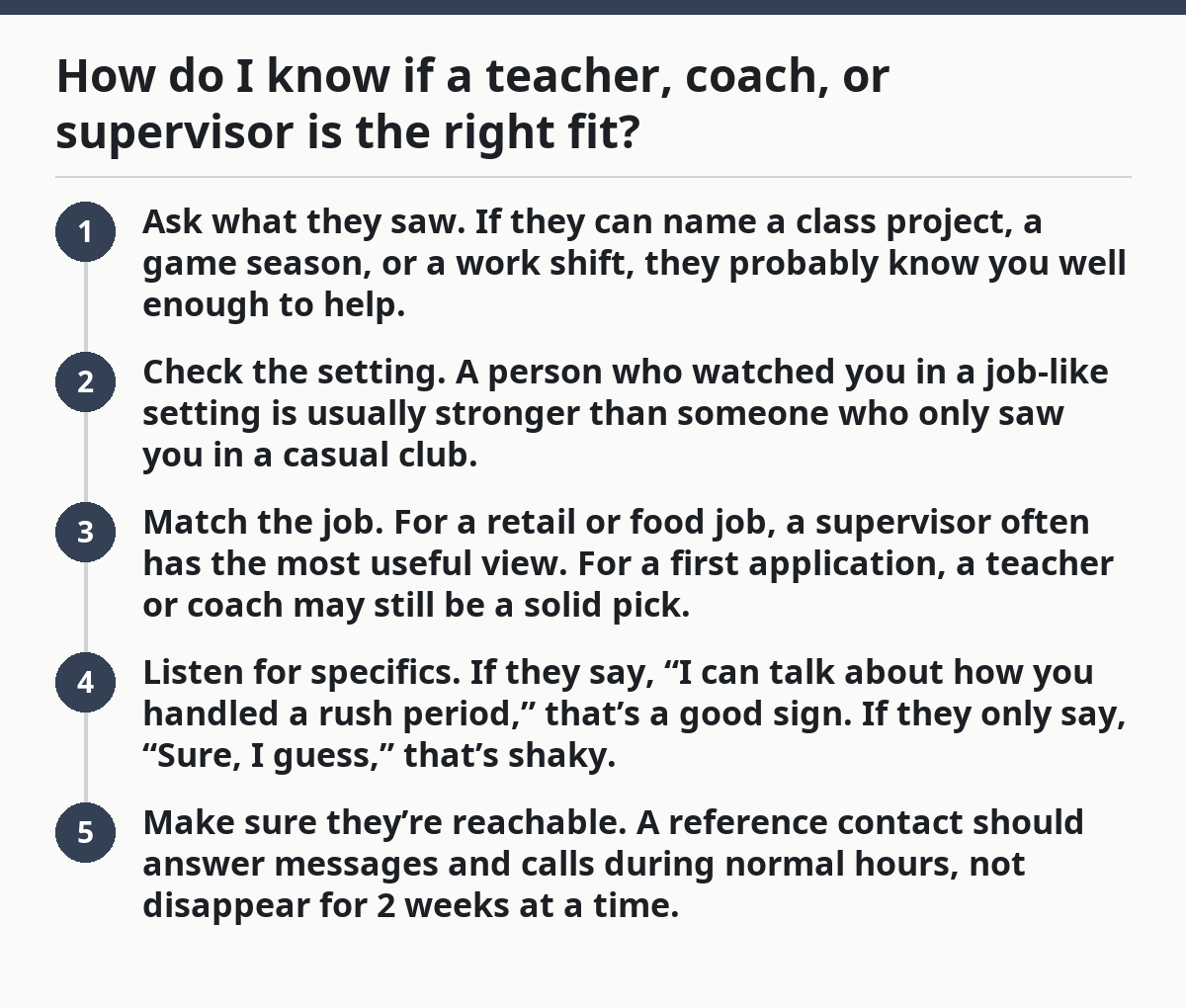
How do I know if a teacher, coach, or supervisor is the right fit?
The right fit is the adult who has seen the side of you that matters for the job you want. A teacher is strong for school-based traits, a coach is strong for effort and teamwork, and a supervisor is strongest for real work habits.
Picture this: you want a grocery store job, and you’re deciding between a math teacher and a team coach. The teacher may talk about deadlines and focus. The coach may talk about punctuality and handling pressure. One is not automatically better than the other. The better one is the one who can give the clearest, most honest examples.
Use this order when you compare possible references:
- Ask what they saw. If they can name a class project, a game season, or a work shift, they probably know you well enough to help.
- Check the setting. A person who watched you in a job-like setting is usually stronger than someone who only saw you in a casual club.
- Match the job. For a retail or food job, a supervisor often has the most useful view. For a first application, a teacher or coach may still be a solid pick.
- Listen for specifics. If they say, “I can talk about how you handled a rush period,” that’s a good sign. If they only say, “Sure, I guess,” that’s shaky.
- Make sure they’re reachable. A reference contact should answer messages and calls during normal hours, not disappear for 2 weeks at a time.
Rather than choosing the most flattering person, choose the one who can describe you clearly and honestly. You do not need the “perfect” adult. You need one who can describe you honestly and clearly.
Can a character reference work for a teen job?

A character reference can work for a teen job, but only if the job application allows it and the person can speak from real observation. A character reference is weaker than a work reference for most jobs, because it usually covers your behavior, not your job skills.
Picture this: you don’t have a paid job yet, so you’re wondering if a neighbor, youth group leader, or family friend can help. They can, but only if they’ve seen you over time and can talk about something useful, like responsibility or respect.
A character reference is more convincing when:
- the person has known you for many months or years
- they’ve seen you handle commitments on time
- they are not a close relative
- they can give one or two concrete examples
It is a poor choice when the person only knows you from greetings, family dinners, or quick chats. A hiring manager will hear that instantly.
The trade-off is simple:
- Teacher, coach, or supervisor = stronger for job fit
- Character reference = useful backup when you lack work history
If you need to use a character reference, make it someone with a calm, professional voice. Someone who can say, “I’ve seen this teen show up every week for 6 months and follow through,” sounds far better than someone who says, “They’re great.”
What makes a character reference weak?
- They are a parent or sibling
- They only know you socially
- They cannot say how they know you
- They would sound surprised if a hiring manager called
What makes one usable?
- They have real contact with you
- They can describe your habits
- They are comfortable being a reference contact
- They know the kind of job you’re applying for
A character reference is fine as a backup. It is not the first choice unless the application says it is.
How can teens check if a reference is reliable before listing them?
A teen can check a reference’s reliability by asking direct questions before names ever go on the application. Reliability matters just as much as friendliness, because a reference who doesn’t answer calls can sink a good application.
Picture this: you’ve picked a coach who likes you, but you’re not sure if they’ll pick up the phone during the school year. That’s the problem to solve before you submit the form. A good choice is warm, reachable, and ready.
Use this quick check:
- Can they respond within a day or two?
- Do they have a voicemail or email they actually use?
- Do they know your full name, your role, and the job type?
- Are they okay being contacted by an employer?
If you want a clean way to judge them, ask yourself whether they would be comfortable giving a reference after a 30-second call from a hiring manager. If that sounds awkward, they may not be ready.
A simple process helps:
- Choose your top 2 or 3 names. Keep at least one backup.
- Ask permission first. Never assume “yes.”
- Name the job type. Retail, camp, tutoring, food service, office help—each one asks for different strengths.
- Ask what they can honestly say. The right person will be clear about what they’ve seen.
- Check contact details. Confirm phone number, email, and best time to reach them.
- Give them context. A short note about the job helps them remember the right examples.
The better your reference understands the role, the easier it is for them to help. They are not the most flattering ones. They are the ones who are both credible and available.
Which mistakes make a reference choice look bad?
A bad reference choice looks bad when it creates doubt, confusion, or silence. The most common mistakes are easy to avoid, and each one can hurt your chances more than you think.
Picture this: you list a person who likes you, but they barely remember your last semester or your work shift. That can lead to vague answers. Vague answers make you sound unprepared. A hiring manager notices.
- Listing someone without asking. That can lead to a surprised “I’m not sure they remember me.”
- Choosing a close relative. That often looks less credible than a teacher or supervisor.
- Picking someone too casual. If they only know you from one event, they can’t say much.
- Using an inactive contact. A missed call or old email can end the follow-up.
- Choosing someone who might oversell you. Too much praise with no details sounds fake.
A mistake costs you either trust or time, and sometimes both. If a reference cannot speak clearly, an employer may move on without telling you why.
The better move is to choose someone who can answer three things:
- How long they’ve known you
- What they’ve seen you do
- Why you’d be a good fit for the job
If they can’t answer those in plain language, they’re not a good fit for the list.
A quick warning sign
If the person says, “I’ll just say whatever helps,” that is not a strength. Employers want honesty, not a script.
A better replacement
If one adult is shaky, swap in a teacher, coach, or supervisor who knows your habits well enough to speak plainly.
How to choose the best reference for the job you want
How to choose the best reference for the job you want starts with the job’s daily work. A teen applying for a summer camp job needs different proof than a teen applying to a coffee shop or a bookstore.
Picture this: you’re applying for a first part-time job and you’ve got three names. One is a coach, one is a teacher, and one is a former supervisor from a volunteer shift. The best one depends on what the employer will care about most.
Use this match-up:
- Retail or food service: supervisor, then teacher
- School-based or tutoring roles: teacher
- Team-based jobs with schedules and pressure: coach
- First job with no work history: teacher or coach, with a character reference only if needed
A strong reference should match at least one of these job signals:
- punctuality
- listening
- handling stress
- working with a team
- following directions
If the employer wants someone who can confirm you handled a 4-hour shift, don’t lead with a person who only saw you in a classroom. That doesn’t mean the teacher is useless. It just means the fit is weaker.
A good rule: pick the person who can describe the trait the employer will care about most, not the person who likes you most.
What should teens say before listing a reference contact?
A teen should ask for permission, share the job type, and make sure the person is comfortable being contacted. That one conversation prevents awkward surprises and makes the reference stronger.
Picture this: you’ve picked the right adult, but you still haven’t talked to them. Don’t skip that step. A reference who knows the job and agrees to help is far more useful than one who hears about it later from a recruiter.
Here is a simple script you can use:
“Hi, I’m applying for a job at [type of place], and I wanted to ask if I could list you as a reference. I think you could speak to [schoolwork, teamwork, punctuality, responsibility]. Would that be okay?”
Then add:
- the job title or place
- the best phone number or email
- any deadline if you know it
- one short reminder of how they know you
If they say yes, keep the note short and clear. A reference contact does not need a long speech. They need enough information to remember you and answer well.
If they hesitate, take that seriously. They may be telling you, politely, that they are not the best choice. That’s useful information.
A clean reference list usually has:
- 2 or 3 names
- a title or relationship, like teacher or coach
- current contact details
- a quick note on what they can speak about
The better you prepare them, the better they can help you. That’s the whole point.
How a teen builds a strong reference list without guessing
A teen builds a strong reference list by choosing people who know real behavior, can be reached quickly, and match the job. That means checking relevance first, not just choosing the nicest adult in the room.
Picture this: you’re almost ready to apply, and you want one last filter before you type names into the form. Use this list as the final check:
- Did they see me work or perform?
- Can they give a real example?
- Will they answer a call or email?
- Are they okay being listed?
- Do they fit the job I want?
If the answer is yes to all five, that’s a good choice.
If you still feel unsure, compare your top picks side by side:
- teacher for effort, deadlines, and school habits
- coach for teamwork, discipline, and pressure
- supervisor for actual work habits
- character reference only when you lack work history or the application allows it
The best reference is not the loudest cheerleader. It’s the adult who can tell the truth well.
For more help with first-job basics, the Teen Jobs, Income, and Work Readiness — The Complete Guide is the right next stop.
Who can be a reference for a teen?
A teacher, coach, supervisor, club leader, or another adult who has seen you act responsibly can be a reference for a teen. The key is real observation, not just familiarity. A person who can describe your habits clearly is better than someone who only knows you casually.
Should I ask before listing someone as a reference?
Yes, you should always ask before listing someone as a reference. That lets them say yes, check their contact details, and prepare for a call or email. It also avoids awkward surprises if they are busy, unreachable, or not comfortable speaking for you.
Can a teacher be a job reference?
Yes, a teacher can be a job reference, especially for a first job or school-year application. A teacher is strongest when they can talk about your effort, attendance, focus, or teamwork. If you have a supervisor who knows your work habits better, that person may be the stronger choice.
Drafted with AI; not yet reviewed by a person.