Last updated: November 19, 2026
Key Takeaways
- Teens should understand that money is limited, cash flow matters, fees are real, and payment methods have trade-offs.
- For many teens, a youth checking account linked to savings is a strong starter setup, not a one-size-fits-all rule.
- A simple teen budget can use spend, save, and give or grow buckets, with spending capped and savings automated.
- Teens often stumble by spending before checking balances, overlooking fees, stacking small subscriptions, losing track of cash, and treating savings like spare change.
Teen money basics start with one simple rule: a teen needs a system before they need a salary. The best first money setup is a way to earn, save, spend, and track without turning every purchase into a fight. This guide to Teen money basics — The Complete Guide is for the parent, guardian, or teen who wants a practical plan, not a pep talk.
I write about personal finance and consumer guidance, with a focus on the small choices that shape long-term money habits: bank accounts, cards, budgeting tools, fees, and the guardrails that keep a young person from learning every lesson the expensive way.
What a teen actually needs to know first

A teen needs to know four things first: money is limited, cash flow matters, fees are real, and every payment method has trade-offs. That is the entire foundation.
A lot of “teen money” advice starts with investing, side hustles, or credit scores. That is backwards for most beginners. A 15-year-old with a part-time job, allowance, or birthday money usually needs a plain system that answers these questions: Where does the money go? How much can I spend this week? What happens if I lose the card? What happens if I overdraft?
The useful order is:
- Earn — allowance, gifts, chores, babysitting, part-time work, or small freelance jobs where legal.
- Save — money for future goals stays in a separate bucket or account.
- Spend — day-to-day purchases live in a checking account, debit card, prepaid card, or cash.
- Track — every dollar needs a place on paper, in an app, or in a spreadsheet.
That order matters because teens learn faster when the money is visible. A teen with only one pool of money often treats a bank balance like a guess. A teen with separate buckets can usually see the effect of a $12 lunch, a $30 game, or a $75 pair of shoes immediately.
A common mistake is giving a teen money access without any limit structure. That can work for a mature 17-year-old with steady income and a clear budget. It is a bad fit for a younger teen who still spends impulsively or forgets recurring charges. The goal is not to block every mistake; it is to make the mistake small enough to learn from. The Consumer Financial Protection Bureau has practical guidance on using bank accounts safely: https://www.consumerfinance.gov/consumer-tools/bank-accounts/
Is a debit card or a prepaid card better for a teenager?
A debit card is better for many teens who have a bank account and can handle a little responsibility; a prepaid card is better when you want a hard spending cap and do not want overdrafts or a linked bank balance exposed.
That is the real split. Debit cards connect to a checking account, so the teen spends money that already exists in the account. Prepaid cards are loaded in advance, so spending stops when the card balance is gone. Both can be useful, but they solve different problems.
Debit card: who should use it
A debit card wins for a teen who needs to learn real-world banking. It teaches the habits that matter later: checking balances, avoiding overdrafts, recognizing pending transactions, and understanding how digital payments work. If the teen has a youth checking account, direct deposit from a part-time job, or regular allowance deposits, debit usually fits better.
The strength of debit is access. Most teens already need a card for school lunches, rides, online orders, or digital subscriptions. Debit also makes it easier to move from “parent-managed money” to independent money later. Some youth accounts even let a parent monitor transfers or alerts.
The drawback is obvious: if the account allows overdrafts or the teen misjudges a balance, the consequences can be real fees or a negative balance. Not every bank treats teen accounts the same way. Some youth accounts remove overdraft fees; some do not. The account agreement matters more than the card type. For debit card and account basics, the FDIC explains how cards and bank accounts work: https://www.fdic.gov/consumers/consumer/news/cnfall19/bank_cards.html
Debit is a poor fit for a teen who treats every available dollar as spendable. If the same account is used for spending and saving, the savings will get raided. Debit also does not protect against overspending the way a strict cash limit can.
Prepaid card: who should use it
A prepaid card wins when the main goal is control, not banking practice. It is useful for younger teens, for families that want a fixed monthly allowance system, or for parents who do not want a linked checking account. Since the card only holds what has been loaded, the spending limit is built in.
That makes prepaid cards simple. They also reduce the risk of accidental overdrafts. For a teen who tends to forget how much has already been spent, that matters. The FTC has consumer guidance on prepaid cards and fees: https://consumer.ftc.gov/articles/general-purpose-prepaid-cards
The weakness is that prepaid cards do not teach full banking. They can become a dead-end tool if the teen uses them for years without learning how a checking account works. Some prepaid products also carry activation fees, reload fees, or monthly fees. Those charges vary by product, so the fine print matters. A card that seems convenient can be a poor deal if it charges to reload cash or check a balance.
Prepaid is not the right choice for a teen who already has regular income and should be learning deposit habits. It is also a bad fit if the teen needs cash deposits, wants to build banking history, or will soon need direct deposit for a job.
Which teen bank account setup makes the most sense?

A youth checking account with a linked savings account is often a strong setup for teens because it teaches everyday banking without forcing a full adult account too early.
That setup usually has three useful features: a debit card, mobile access, and parental oversight or alerts. The checking side handles spending. The savings side separates money for a goal, like a laptop, sports gear, prom, or a first car fund. Many banks market these as teen accounts, student accounts, or youth checking accounts, and the exact age rules vary by institution.
A good youth account should do four things:
- show balances clearly in the app,
- make transfers simple,
- keep fees low or nonexistent,
- avoid surprise overdrafts.
The best version of this setup gives a teen freedom with training wheels. A parent can still see what is happening, but the teen gets practice making decisions. That matters because money habits are built through repetition, not lectures. The CFPB also offers clear guidance on account features and consumer protections: https://www.consumerfinance.gov/consumer-tools/bank-accounts/
A generic article would stop at “open a bank account.” That is too vague. The important question is which account features protect the teen without turning the account into a surveillance system. If every transaction triggers a conflict, the system will fail. If there is no oversight at all, the teen may treat the account like play money.
The weak spots are worth saying plainly. Some youth accounts limit what a teen can do online. Some cannot receive every type of transfer. Some banks require a parent or guardian to be joint owner on the account, which may not suit every family. Some checking accounts that look teen-friendly still charge maintenance fees if a minimum balance is not met. That can wipe out the benefit.
The practical move is to choose an account with:
- no monthly fee if possible,
- a debit card,
- strong mobile alerts,
- no overdraft fees or clear overdraft protection limits,
- easy transfers between checking and savings.
For basic account safety and consumer rights, the Consumer Financial Protection Bureau is a solid reference point: https://www.consumerfinance.gov/consumer-tools/bank-accounts/
For debit card payment and dispute basics, the FDIC explains how accounts and cards work: https://www.fdic.gov/consumers/consumer/news/cnfall19/bank_cards.html
If the teen is very young, a prepaid card may still be the better first step. If the teen is 16 or 17 and has a part-time job, a youth checking account is usually the smarter long-term choice.
How should a teen budget without hating the process?
A teen should use a three-bucket budget: spend, save, and give or grow, with spending capped first and savings automated second.
This is the simplest budget that still works. It does not require a complicated spreadsheet. It does require a rule. For example, if a teen gets $100, the money might be split into $50 spend, $30 save, and $20 for future goals or charity. The exact percentages do not matter nearly as much as the habit of assigning every dollar a job.
A budget for teens should answer two questions:
- How much can I spend this week without running out?
- What money should never be touched unless the goal changes?
The spend bucket handles food, transport, entertainment, apps, and small impulse buys. The save bucket is for medium-term goals, like headphones, school event tickets, a phone replacement, or a spring break trip. The third bucket can be for long-term goals or for giving. Some families prefer “save and share”; others prefer “save and invest.” The wording matters less than the discipline.
A teen budget fails when it is too abstract. “Save more” is not a budget. “Put $15 from every paycheck into savings and do not touch it for one month” is a budget.
A teen who earns irregular income needs a percentage-based budget more than a fixed one. If babysitting money comes in bursts, fixed monthly categories can break down fast. In that case, the teen can use a simple rule: each time money arrives, move a set percentage into savings immediately. That avoids the common trap of spending first and saving if there is anything left, which often means nothing gets saved.
The biggest weakness of budgeting at this age is that surprises happen. A school trip, a birthday gift, or a last-minute fee can wreck a rigid plan. That is not a reason to abandon budgeting. It is a reason to keep a small “miscellaneous” buffer. A teen who never leaves room for the unexpected will learn the hard way. For broader budgeting guidance, the CFPB’s budgeting tools are a useful starting point: https://www.consumerfinance.gov/consumer-tools/budgeting/
What money mistakes do teens make most often?
Teens most often make five money mistakes: spending before checking balance, ignoring fees, subscribing to too many small charges, losing track of cash, and treating savings like spare change.
The first mistake is the most common and the most expensive. A debit card tap feels painless. A few taps later, the balance is gone. If a teen does not check before spending, the account can become a surprise. That is especially true when pending transactions have not yet cleared.
The second mistake is ignoring fees because they seem small. A $2.50 fee does not look dramatic until it happens repeatedly. This matters with prepaid cards, out-of-network ATMs, and some checking accounts. Teens usually notice the fee only after the money is missing.
The third mistake is subscription drift. A $5 or $10 app, streaming add-on, game pass, or in-app purchase can quietly eat a budget. This is where teens often need a hard rule: every recurring charge gets written down on the same day it starts. If the charge cannot be named, it should not exist.
The fourth mistake is mixing cash and card spending with no record. A teen who spends cash at school and card money online can easily double-count the same “available” money in their head. A simple note in a phone or a weekly check-in solves more than most people expect.
The fifth mistake is raiding savings for routine wants. Savings should be for a specific purpose, not an emotional rescue fund for every urge. If the savings bucket is too easy to tap, it will be tapped.
This is where a parent or guardian can help without taking over. A weekly 10-minute check-in works better than a monthly lecture. Look at what came in, what went out, what got saved, and what recurring charges appeared. That rhythm teaches more than punishment after the fact, and it helps teens avoid the spending patterns the CFPB warns about in everyday account management: https://www.consumerfinance.gov/consumer-tools/budgeting/
A teen money system is not supposed to eliminate mistakes. It is supposed to turn a $15 mistake into a lesson instead of a debt spiral.
Can a teenager build credit yet?
A teenager can start learning credit concepts, but a real credit card is usually too much too soon unless there is a strong repayment system and adult oversight.
Credit is one of the most misunderstood topics in teen money. A lot of people jump straight to “build credit early.” That advice can be correct for a 17-year-old who is close to adulthood and has steady income. It is wrong for a younger teen who does not yet understand due dates, minimum payments, or how interest snowballs.
The safer first step is education, not a card. A teen should understand:
- what a credit limit is,
- why paying the full balance matters,
- what a due date does,
- why missing one payment can cause trouble,
- how borrowing differs from spending cash.
If a family decides to add credit later, the teen needs a clear rule: only charge what can be paid in full when the bill arrives. A teen who carries a balance just to “build history” may be paying interest for no good reason. That is an expensive lesson.
For most families, a debit card or a secured, tightly controlled setup makes more sense first. A secured card can be a bridge for an older teen, but it still should not be treated like free money. The wrong setup here can create the exact habits the teen should avoid.
The Federal Trade Commission has straightforward consumer guidance on credit and how it works: https://consumer.ftc.gov/credit-loans-and-debt
That’s the kind of source worth checking before opening any product tied to borrowing.
The weak point in teen-credit advice is that it often treats “early” as automatically better. Early is not always better. Readiness matters more than age alone.
What should parents actually do, and what should they avoid?
Parents should set guardrails, not control every decision, because the point is to build judgment before the teen is on their own.
The best parent role is coach, not accountant. That means choosing the account type, setting the spending rules, deciding how much oversight is appropriate, and letting the teen practice inside those limits.
A practical parent framework looks like this:
- decide the monthly or weekly funding amount,
- define what counts as spendable money,
- keep savings separate,
- require a check-in routine,
- explain one mistake at a time, not ten at once.
The parent should avoid three common errors. First, don’t make the system so strict that the teen never learns to make choices. Second, don’t make it so loose that the teen can hide spending for months. Third, don’t use money as the only discipline tool. If every financial mistake becomes a moral failure, the teen will stop being honest.
A good system is transparent. If the teen can see the rules and the consequences in advance, the money lesson lands faster. If the teen has to guess what the parent expects, the system becomes a conflict generator.
This section also has a limit: if a family is dealing with very low income, inconsistent housing, or any situation where money stress is already severe, the right answer may be less about optimization and more about stability. In that case, a simple cash system or a very low-risk account may be the better choice.
The strongest teen money systems are not fancy. They are boring, repeatable, and hard to break. That is exactly why they work.
The honest side-by-side
The better choice depends on whether the teen needs banking practice or hard spending limits. Debit wins for learning real banking. Prepaid wins for strict control.
| Criteria | Debit card | Prepaid card | Winner for [condition] |
|---|---|---|---|
| Teaches checking balances | Yes, because it connects to a bank account | Somewhat, but only card balance management | Debit, for teens learning banking |
| Spending cap | Depends on account balance and overdraft rules | Hard cap equal to loaded funds | Prepaid, for strict limits |
| Overdraft risk | Can exist unless the account blocks it | Usually none | Prepaid, for families avoiding overdrafts |
| Banking experience | Closer to adult banking | Limited banking practice | Debit, for older teens with jobs |
| Fees | May be low or zero, depending on the account | May include loading or monthly fees | Debit, if the account is fee-light |
| Oversight by parent | Often easy through alerts or linked access | Usually easy if the card is parent-managed | Either, depending on setup |
| Use for direct deposit | Usually better suited | Less ideal for regular job income | Debit, for teen workers |
| Risk of losing access to savings | Higher if spending and saving share one account | Lower if only spending money is loaded | Prepaid, for impulse-prone spenders |
| Long-term usefulness | High | Moderate | Debit, for transition to adulthood |
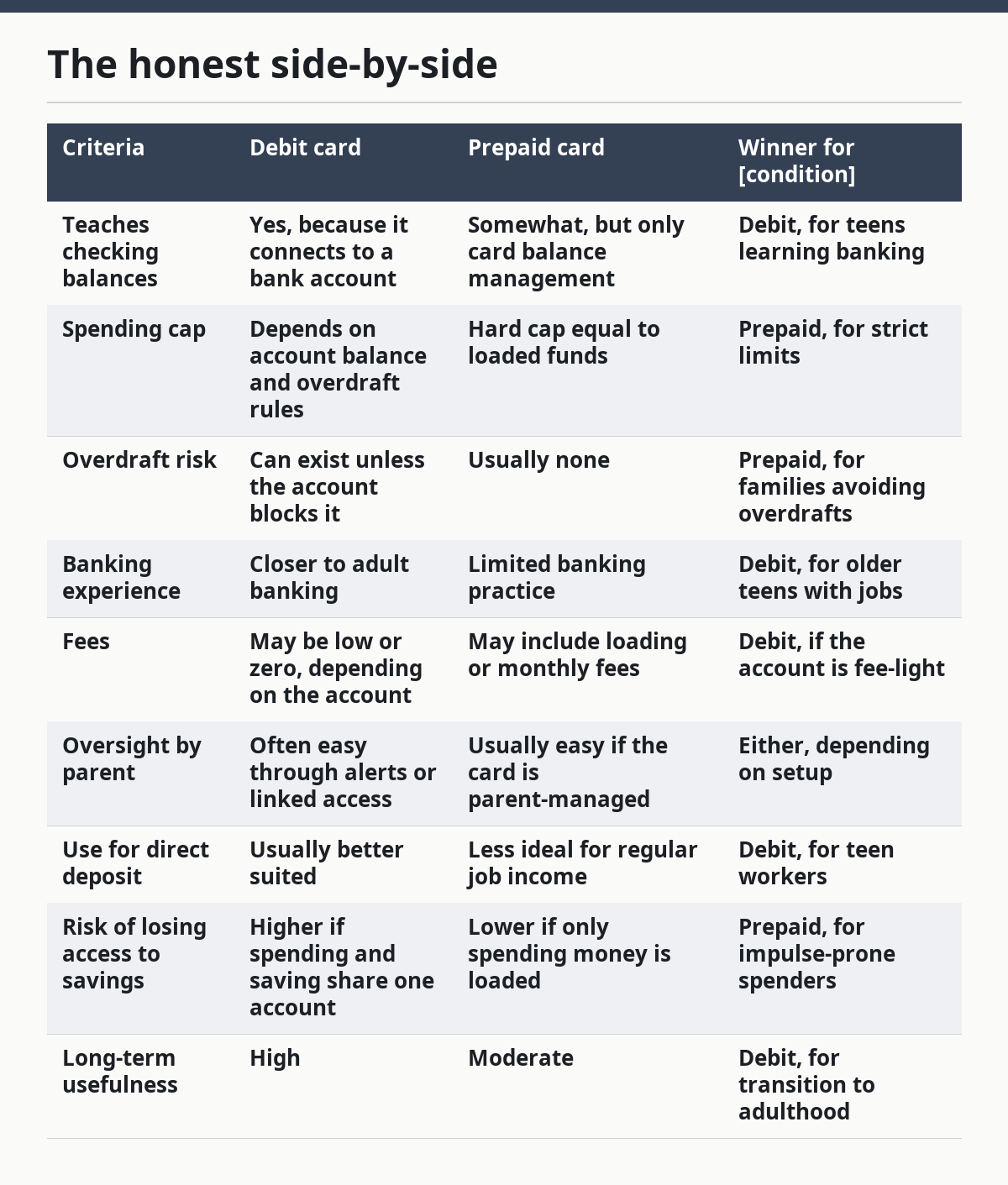
Debit is the better general-purpose tool. Prepaid is the better guardrail. That distinction matters more than branding, apps, or marketing language. A card with a sleek interface can still be the wrong tool if it does not match the teen’s habits.
The most common mistake is choosing prepaid simply because it feels safer. Safer is not always better. If the teen is 16 or 17 and ready to learn account management, a prepaid card may delay the skills they need next. If the teen is younger or reckless with money, debit may be too loose unless the account is tightly controlled.
What is the final call?
Choose a debit-based youth account if the teen is old enough to learn real banking, gets regular income, and can handle a balance without treating it like an invitation to spend. Choose a prepaid card if the teen needs a strict spending ceiling, has no need for deposits, or would otherwise overdraft a bank account. Neither if the setup has hidden fees, no parental guardrails, or a teen who is not ready to manage even small sums.
That is the plain answer. The right first system is the one the teen will actually use every week, not the one that sounds smartest in theory.
For most families, the best path is simple: start with a clear spending rule, separate savings from spending, and move to a youth checking account once the teen can check a balance before buying. Keep the system boring. Boring is what makes it work.
What should a teen do this week?
A teen should pick one account, one savings goal, and one weekly money check-in this week.
That is enough to start. The goal is not to master finance in a weekend. The goal is to build a routine that can survive a school week, a birthday, and a random expense without collapsing.
A useful first checklist:
- write down every source of money,
- choose where spending money lives,
- open or review a savings bucket,
- list any recurring charges,
- set one alert for low balance or new spending.
If the teen already has money but no system, start there before worrying about investing or credit. If the teen has no income yet, start with allowance, gift money, or chore-based transfers and practice the same habits anyway.
The best money lesson for teens is not “never make mistakes.” It is “know where the money is going before it disappears.”
Drafted with AI; not yet reviewed by a person.