Last updated: November 19, 2026
Quick Answer: A good teen car savings goal is the full first-year cost you expect to pay for the car, insurance, registration, maintenance, and an initial repair cushion — often around $5,000 or more for a modest used car. For How to Save for a Teen Car Without Confusing It With Everyday Savings, the key is to keep the car money in its own bucket from day one.
A car savings goal works best when it has its own number, its own place, and its own timeline. If a teen wants a car, the money for that car should not blur into lunch money, concert money, or the cash meant for a phone replacement next month.
Start with the full teen car budget, not the sticker price
The car savings goal should include the car itself, the first insurance bill, maintenance, registration, and a cushion for repairs. That wider view keeps the goal honest, because a $6,000 used car can turn into a much bigger out-of-pocket cost once title fees, tires, and insurance are added.
A teen car budget usually has five parts:
- Car purchase price: the asking price or private-party price for a used car.
- Car down payment: money paid upfront if a parent or teen is financing part of the car.
- Insurance costs: the first payment, deposit, or several months of premium, depending on the policy setup.
- Maintenance costs: oil changes, brake work, tires, batteries, and other wear items.
- Starter repair fund: money kept back for the first surprise, such as an alternator or a dead battery.
Many guides miss this point and treat the car like a one-time purchase; in practice, a teen and parent should check real ownership costs before setting the goal, because the sale price is only part of the bill. The Consumer Financial Protection Bureau notes that buying a car involves more than the price tag, including taxes, fees, and ongoing costs, and state agencies such as the Federal Trade Commission also advise comparing the full cost of ownership before buying.
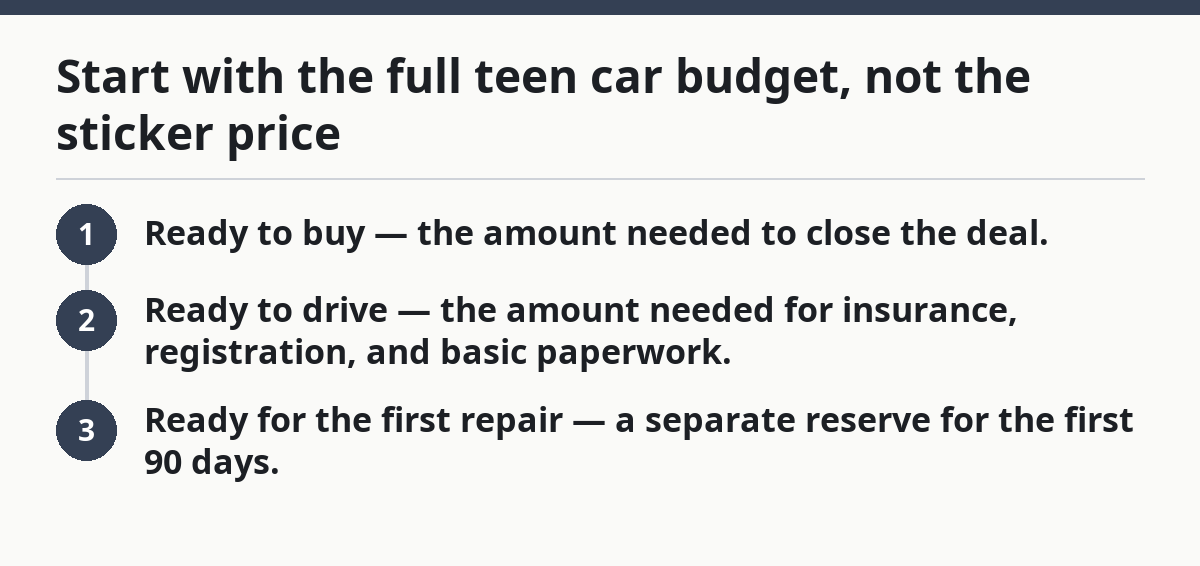
A practical way to do that is to break the target into three buckets:
- Ready to buy — the amount needed to close the deal.
- Ready to drive — the amount needed for insurance, registration, and basic paperwork.
- Ready for the first repair — a separate reserve for the first 90 days.
That third bucket matters. Used cars, especially older ones, often need something small soon after purchase. A belt, tire, or sensor can wipe out a tiny savings plan. A teen who understands that upfront is less likely to raid other savings or put the repair on a high-interest card later.
For a structured next step after this page, the hub on teen saving and goal planning can help with the broader habit side. This page stays on the car goal itself.
How much should a teen save for a car?
A teen should save enough to cover the car price plus the costs that come before and just after driving it home. That means the target is usually higher than the number on the windshield, even before insurance is factored in.
The right target depends on the route:
- Cash purchase: save the full purchase price, then add money for tax, title, registration, and immediate upkeep if those apply in the buyer’s state.
- Partial financing: save for a car down payment, first insurance costs, and a maintenance cushion.
- Private-party used car: add extra room for a pre-purchase inspection and repairs that appear after the sale.
A simple rule works better than a vague wish: set the goal around the real first-year cost of ownership, then strip it down to the months available. If the teen has 12 months, divide the total by 12. If the teen has 18 months, divide by 18. That gives a monthly target that can be tracked without guessing.
For example, if the goal includes:
- $4,000 for the car
- $500 for insurance setup
- $300 for maintenance and repairs
- $200 for registration and paperwork
the savings goal is not $4,000. It is closer to $5,000 before any extra cushion. If the teen can save $250 a month, that timeline points to about 20 months. If the teen can save $400 a month, the timeline drops to about 13 months.
The judgment call here is clear: this method is right for teens buying their first car, especially a used one. It is not the right framework for a teen who is only trying to save spending money or who has a parent covering nearly every ownership cost. In those cases, the goal is smaller and simpler.
Build the car savings goal into its own bucket
The car savings goal should live in a separate bucket so the money is not confused with everyday savings. That separation is the difference between “I’m saving for a car” and “I keep borrowing from myself.”
The exact bucket can be a labeled subaccount, a separate envelope, or another clearly marked place. The name matters more than the format. The label should say something like Car Goal, First Car, or Teen Car Fund so the purpose is obvious every time money goes in.
Here is a straightforward process:
- Write the goal in dollars. Put one number on paper, such as $5,200, not “a car someday.” A hard number turns the goal into a target instead of a mood.
- Split the goal into categories. Set aside separate amounts for the car, insurance, maintenance, and a repair cushion. Even four lines on paper works.
- Choose a monthly deposit. Use a fixed number like $100, $150, or $250 each month. A fixed amount is easier to maintain than “whatever is left.”
- Pick a date for each deposit. Matching it to payday, allowance day, or a monthly transfer date keeps the goal moving for 6 to 18 months without constant rethinking.
- Track the balance once a month. Update the total and the remaining gap. The point is to see progress, not to check it every day.
- Protect the bucket from casual spending. If the money can be spent on pizza, gaming credits, or a jacket, the car goal will keep shrinking. Separate purpose prevents that drift.
The biggest mistake here is mixing the car goal with general savings and calling the pile “money saved.” That feels organized, but it creates confusion the moment the teen wants to spend on something else. A car goal needs a lane of its own.
A second mistake is making the monthly deposit too aggressive. A plan that demands $400 a month from a teen who can reliably save $120 will collapse. A smaller number that actually gets saved for 12 months beats a perfect number that lasts two weeks.
What car costs should teens plan for besides the price?
Teens should plan for insurance, maintenance, and the first repairs because those costs arrive fast and can be larger than expected. A used car is rarely just a purchase; it is a system that needs money to stay legal and usable.
The most common extra costs are:
- Insurance: often the biggest recurring cost after the payment itself. The price depends on the driver, the car, and the coverage, so it should be checked before the purchase, not after.
- Maintenance: oil changes, tire rotation, air filters, brake pads, and fluid checks. A teen car with 100,000 miles usually needs more attention than a newer one.
- Repairs: a used car can need a battery, belts, sensors, or tires early on.
- Registration and title work: paperwork costs can show up right away.
- Fuel: a car that uses more gas than expected can strain a tight monthly budget.
- Parking and local costs: some places charge for parking, permits, or inspection steps.
A teen saving for a used car should think in terms of a starter ownership fund, not just a purchase fund. That fund can cover the first 3 months of ownership, which is when hidden needs tend to show up. A small reserve matters because early repairs can arrive before the savings plan has had time to settle.
The honest trade-off is this: a cheaper car can be more expensive to keep on the road if insurance or repairs are high. A slightly newer car with lower mileage may cost more up front but be easier to live with for the first year. Rather than assuming newer is always better, compare the likely ownership costs and the insurance quote before choosing.
If a teen and parent are comparing two cars, the better choice is often the one with lower expected maintenance and a cleaner history, even if it costs a few hundred dollars more.
How to choose a used car budget that leaves room to breathe
A used car budget should leave at least a few hundred dollars unassigned so the teen is not spending every saved dollar on the car alone. That buffer is what keeps the plan from falling apart after the purchase.
The used car budget should answer three questions before shopping starts:
- What is the maximum purchase price?
- How much is reserved for insurance and paperwork?
- What amount stays untouched for repairs?
A teen shopping for a used car should avoid setting the budget at the absolute ceiling. If the target is $5,000, shopping at $5,000 leaves no room for taxes, title, or the tire that appears a week later. A better ceiling is slightly lower, with room above it for ownership costs.
This is also where the car type matters. A sporty coupe, luxury badge, or older SUV can carry higher insurance and maintenance than expected. A plain sedan or compact hatchback often fits a teen budget better because it is usually easier to insure and cheaper to keep running. That is not a universal rule, but it is a practical one.
A smart budget uses a simple split:
- About most of the money for the car itself
- A meaningful portion for insurance
- A smaller but real portion for maintenance and repairs
That split stops a common trap: a teen spends every dollar on the vehicle and then has to ask for help with the first oil change or emergency tire replacement.
The teens who do this well are not the ones chasing the newest model. They are the ones choosing a car they can afford to own for a full year, not just buy on the day of the sale.
Keep the savings timeline realistic and visible
The savings timeline should be short enough to stay motivating and long enough to be credible. For many teens, that means a 6-month, 12-month, or 18-month plan, depending on how much can be saved each month.
The simplest way to build the timeline is to divide the target by the monthly deposit. If the car goal is $4,800 and the teen saves $200 each month, the timeline is 24 months. If the teen can save $400 each month, the timeline is 12 months. That math is blunt, but it keeps wishful thinking out of the plan.
A visible timeline should include:
- the total goal
- the monthly amount
- the target finish month
- the current balance
A paper chart on a wall, a note on a phone, or a spreadsheet with one line per month all work. The method matters less than the habit of checking it at least once a month. The goal should not live in memory only.
One useful trick is to divide the timeline into milestones. For a $5,000 goal, mark:
- $1,000 saved
- $2,500 saved
- $4,000 saved
- full goal reached
Milestones keep the plan from feeling endless. They also make it easier to pause and adjust if insurance quotes or repair estimates come in higher than expected.
The limit of this approach is obvious: it cannot fix an income problem. If a teen’s monthly savings capacity is too low for the target car, the answer is not to pretend the timeline is shorter. The answer is to lower the target, add time, or choose a less expensive car.
Common mistakes that make teen car saving harder
The biggest mistake is saving only for the car price and ignoring the rest. That mistake costs extra time, extra stress, and sometimes a car that sits unused because insurance or repairs were never funded. The fix is to budget for the full first year of ownership before shopping.
A second mistake is combining car money with regular savings. That costs clarity. The teen cannot tell whether the car goal is on track if the same pot also covers school supplies, clothes, or weekend spending. The fix is a separate bucket with a clear label and a monthly check-in.
A third mistake is setting a goal based on what sounds affordable instead of what is actually affordable. A $300 monthly target is useless if the teen can only consistently save $125. The result is churn, discouragement, and missed months. The fix is a deposit amount that can survive ordinary life for at least 6 months.
A fourth mistake is skipping insurance research until the car is already chosen. That can turn a “good deal” into a bad fit. The fix is to check the likely insurance range before finalizing the vehicle, especially for a teen driver.
A fifth mistake is forgetting the first 90 days after purchase. New tires, fluid service, or a battery can show up quickly on a used car. The fix is to keep a repair cushion separate from the purchase money.
The right plan is not flashy. It is clear, repeatable, and a little conservative. That is what keeps the car goal from colliding with everyday spending.
Key Takeaways
- A teen car goal should cover the vehicle, insurance, maintenance, and a repair cushion.
- The purchase price alone is not the real target.
- A separate bucket keeps car money from getting mixed up with everyday savings.
- A used car budget needs room for registration, first repairs, and the first months of ownership.
- A realistic monthly deposit and timeline matter more than an ambitious goal that collapses in month two.
- The safest budget is usually the one that still works after the first surprise bill.
How much should a teen save for a car?
A teen should save enough to cover the car plus the costs needed to put it on the road. That usually means more than the sticker price. Insurance, registration, maintenance, and a small repair cushion should be part of the target so the car does not become unaffordable the moment it is bought.
What car costs should teens plan for besides the price?
Teens should plan for insurance, maintenance, registration, and early repairs besides the price. A used car can also need tires, a battery, or routine service soon after purchase. If the budget only covers the vehicle itself, the teen may still need more money before the car is truly ready to drive.
Drafted with AI; not yet reviewed by a person.