Last updated: November 20, 2026
Quick Answer: Teens can prepare for a job interview in 10 to 15 minutes by reviewing common questions, choosing a simple outfit, and checking their schedule before they leave home. Teen job interview prep means knowing what to wear, what to say, and how to answer common questions without freezing. This article on How Teens Can Prepare for a Job Interview With Common Questions covers what to say, how to act, and how to handle questions when you don’t have job experience yet.
What to do before the interview starts
Picture this: you’re 10 minutes away from the interview, your shirt is clean, and you still feel shaky because you don’t know what the employer will ask. The fix is to prepare the basics before you leave home — clothes, directions, and your answers to a few common questions.
That small prep makes the first 5 minutes much easier.
Start with the details that matter on a real application day:
- Write down the interview time, address, and the name of the person you’re meeting.
- Plan to arrive 10 to 15 minutes early.
- Put your phone on silent before you walk in.
- Bring a pen and a small notepad, plus a copy of your application if you have one.
- Think through your work availability so you can answer clearly.
A teen interview is usually not a trap. It’s a basic test of whether you can show up, speak clearly, and follow directions. The truth is, many employers expect a first-time applicant to be nervous. They care more about your attitude than perfect answers.
One thing to settle now is your schedule. If you have school, sports, band, or family duties, know exactly which days and hours you can work. “I can work after 4 p.m. on weekdays and anytime on Saturday” sounds ready. “I’m pretty flexible” sounds vague.
Key Takeaways
- Get there early enough to settle your nerves.
- Bring a pen, paper, and a quiet phone.
- Know your schedule before you walk in.
- Ready answers beat perfect answers.
What questions are asked in a teen job interview?
A teen job interview usually asks about your schedule, your strengths, your teamwork, and why you want the job. The questions are often simple, but the employer is listening for honest, specific answers.
That is why practice matters.
Here are the common questions to expect:
- Tell me about yourself.
- Why do you want to work here?
- What days and hours can you work?
- What are your strengths?
- How would friends or teachers describe you?
- Tell me about a time you solved a problem.
- What would you do if a customer was upset?
- Do you have any questions for me?
These are not trick questions. They are a way to see if you can speak with confidence and stay calm. A good answer is short, direct, and related to the job.
For example, if they ask, “Why do you want to work here?” don’t say, “I need money.” That may be true, but it doesn’t help your case. Say something like: “I like this place because it’s busy, and I want to learn how to work with customers and a team.” That answer shows interest and effort.
If they ask about a mistake, don’t panic. The employer is not looking for a flawless teen. They want someone who can learn, fix a problem, and keep going. A school project, club role, or family task can work as an example if you’ve never had a paid job.
How do you answer if you have no experience?
You answer by using school, sports, chores, clubs, or volunteer work as proof that you can show up and do the job. No paid job is not the same as no useful experience.
That’s the part many teens miss.
Use this simple method when you build an answer:
- Say the skill first. Name the trait the employer asked about, like responsibility, teamwork, or time management.
- Give one real example. Use a school project, team practice, babysitting, yard work, or helping a relative.
- End with the result. Show what happened because of what you did.
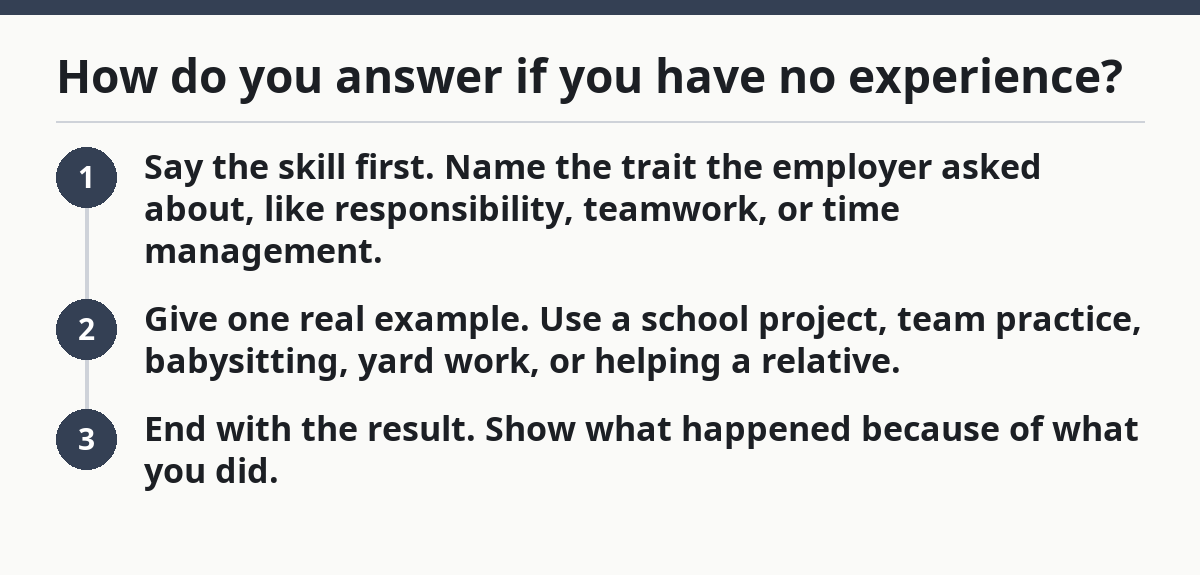
For example, if the question is, “Are you a responsible person?” you might say: “Yes. I turn in schoolwork on time, and I keep track of my sports schedule so I don’t miss practice.” That’s short, specific, and believable.
If they ask for a time you worked with others, you can talk about a group assignment or team sport. If they ask about problem-solving, you can describe what you did when a class project fell behind or when you had to change plans at home. The employer wants a pattern, not a dramatic story.
Here’s the catch: don’t make things up. If you’ve never handled money in a job, don’t pretend you have. Use the truth and make it useful. A teen who says, “I haven’t had a job yet, but I’ve helped with chores, school projects, and babysitting” sounds more trustworthy than someone who sounds rehearsed and fake.
How to prepare answers that sound natural
Picture this: you know the questions, but your mind goes blank the second the employer looks at you. The fix is to practice out loud for 10 to 15 minutes before the interview, not to memorize a speech.
Natural beats robotic.
Use short answer frames:
- For strengths: “I’m good at ___ because ___.”
- For availability: “I can work ___ and ___.”
- For interest in the job: “I want this job because ___.”
- For no experience: “I haven’t had a paid job yet, but I have ___.”
That keeps your answers focused. It also keeps you from rambling when you get nervous.
A good teen answer usually has 2 or 3 sentences. More than that, and you may drift off the point. Less than that, and you may sound unprepared. The middle ground is where you want to be.
Try this practice drill:
- Read the question out loud.
- Pause for one breath.
- Answer in 2 sentences.
- Say it again without looking at notes.
- Fix any part that sounds too stiff.
The goal is not to sound older than you are. The goal is to sound like a teen who thought ahead. Employers notice that. So do parents, teachers, and interviewers who meet a lot of first-time applicants.
On the flip side, avoid memorized lines that sound copied from the internet. If every answer sounds the same, the interviewer hears a script, not a person. Use your own words, even if they’re simple.
What should a teen wear to an interview?
A teen should wear clean, simple clothes that look neat and respectful, even if the job is casual. You do not need a suit for most first jobs, but you do need to look like you tried.
That means no wrinkled shirts and no clothes with holes or large graphics.
A safe interview outfit usually includes:
- A plain shirt or blouse
- Clean pants, khakis, or a modest skirt
- Closed-toe shoes if possible
- Hair that is neat and out of your face
- Very little jewelry and no strong scent
The goal is not fashion. It’s first impressions. An employer sees your appearance before you say a word, and they notice whether you look prepared. A clean, tidy outfit sends that message fast.
There are a few mistakes that cost teens points right away:
- Wearing clothes that are too casual for the setting
- Showing up with messy hair or dirty shoes
- Wearing strong perfume or cologne
- Choosing something uncomfortable that makes you fidget
If you’re not sure what counts as too casual, choose the neater option. A simple shirt and dark pants are safer than anything loud or trendy. A job in a restaurant, store, or office may all call for slightly different dress, but clean and neat works almost everywhere.
You do not need expensive clothes. You need clothes that fit, are clean, and do not distract from your answers.
How can a teen practice without sounding awkward?
A teen can practice best by saying answers out loud, timing them, and doing one mock interview with a parent, older sibling, or teacher. Writing answers in a notebook helps, but speaking them is what makes them usable in the room.
That is the real test.
Use a mirror or your phone camera if you want to check your posture. You should notice if you stare at the floor, talk too fast, or cross your arms. Fixing one habit is better than trying to fix everything at once.
A strong practice session can look like this:
- Sit for 15 minutes with 6 common questions.
- Answer each one in under 30 seconds.
- Practice a handshake if that’s normal for the setting.
- Make eye contact with the person asking the question.
- End with one question of your own.
One smart question to ask is, “What does a typical shift look like?” Another is, “What do you look for in a good employee here?” Those questions show interest and help you understand the job.
The second or third time you hear the same question, your brain stops treating it like a surprise. If anxiety feels overwhelming, you may want to consult a parent, school counselor, or other professional for extra support before the interview. You won’t feel perfect. You’ll feel ready enough, and that matters more.
If you want a wider path into work and money habits, the hub guide on Teen Jobs and Earnings — The Complete Guide is the next stop after interview prep. This page stays focused on getting through the interview itself. For related tips, see the guide on teen jobs and how to make money as a teen.
What teens often get wrong in interviews
Picture this: you walk into the interview, but you don’t answer the question being asked. You talk too long, shrug at your schedule, or act like the job should chase you. That kind of mismatch can sink a good candidate fast.
Small mistakes carry real cost.
The most common misses are easy to fix:
- No clear availability. Cost: the employer can’t schedule you. Fix: bring exact days and hours.
- One-word answers. Cost: you seem uninterested. Fix: add one example to each answer.
- Talking badly about school, teachers, or past jobs. Cost: you sound hard to work with. Fix: keep it neutral.
- Bad body language. Cost: you look closed off or distracted. Fix: sit up, look at the interviewer, and keep your hands still.
- Not asking any questions. Cost: you seem passive. Fix: prepare 1 or 2 questions before you arrive.
Another trap is pretending confidence without preparation. That usually falls apart the moment the interviewer asks something simple, like what hours you can work. Honest readiness beats fake polish every time.
A teen who says, “I’m still learning, but I’m ready to work hard and show up on time,” gives the employer something usable. That is better than trying to sound like a veteran.
What to do right after the interview
A teen should leave the interview politely, thank the interviewer, and then follow up only if the employer said to do so. The final impression still matters, even after the last question.
That last minute can stick.
Before you go, say thank you and ask what happens next. If they give you a timeline, write it down. If they say they’ll call, make sure your voicemail and phone number are ready and easy to reach.
Right after the interview, check these details:
- Did you say your name clearly?
- Did you mention your availability?
- Did you ask at least one question?
- Did you thank the interviewer before leaving?
If you forgot one small thing, don’t panic. One missed line does not ruin everything. What matters is whether you stayed polite, honest, and alert.
If the employer asks you to fill out more paperwork or send more information, handle it quickly. A fast response helps a teen stand out because many applicants drag their feet. Follow-through is part of interview prep too.
What questions are asked in a teen job interview?
Teen job interviews usually ask about availability, strengths, interest in the job, and how you handle simple problems. The employer wants to know if you can show up on time, speak clearly, and learn fast.
That is the core of it.
Common questions include “Tell me about yourself,” “Why do you want to work here?” and “What hours can you work?” A teen can answer well by using short examples from school, chores, sports, or clubs. If you have no paid experience, honesty and a calm tone matter more than a perfect résumé.
What should a teen wear to an interview?
A teen should wear clean, neat clothes that look respectful and not too casual. A plain shirt, clean pants, and tidy shoes are usually enough for a first interview.
The point is to look prepared, not flashy.
Avoid wrinkled clothes, big graphics, messy hair, and strong scent. If you’re unsure, dress one step neater than the job itself seems to require. That is usually the safest choice.
How do you answer if you have no experience?
You answer by using school, sports, chores, clubs, or volunteering as examples of responsibility and teamwork. No paid job does not mean no skills.
It means you need to show those skills another way.
Pick one real example, name the skill, and end with what happened. A simple answer like “I haven’t had a paid job yet, but I’ve helped with babysitting and school projects, and I’m good at following directions” works better than trying to fake experience you don’t have.
Drafted with AI; not yet reviewed by a person.