Last updated: November 20, 2026
Key Takeaways
- A sinking fund is a separate savings plan for a planned buy, not spare cash with no purpose.
- Set one goal, keep the money separate, and save on a schedule you can sustain.
- Put money toward purchases with a clear cost and a clear date.
- Choose a deposit amount that fits the deadline and still covers normal spending.
A teen who wants to pay for a laptop, prom, a class ring, or a trip needs a plan that sits between daily spending and emergency savings. How Teens Can Set Up a Sinking Fund for Big Purchases gives that plan a clear home. The steps below show how to pick a goal amount, split savings into money buckets, and track progress without mixing it up with everyday cash.
What a sinking fund is for, and what it is not
A sinking fund is a separate savings plan for a known purchase, not a pile of “extra money” with no job. If you already know you want the item in a few months, this is the cleanest place to put the cash.
Picture this: you’ve got a part-time paycheck, a birthday check, and a few cash gifts in hand, but you also want to stop raiding the same balance for snacks, apps, and a bigger purchase. A sinking fund gives each dollar a label. That label matters.
Money rules, bank features, and tax treatment vary by country and can change, so a qualified adviser can help with your own situation if the amount gets complicated; the Consumer Financial Protection Bureau and IRS have more general guidance, but not country-specific advice. Consumer Financial Protection Bureau, IRS
A sinking fund works best when you already know three things:
- what you’re saving for,
- about how much it costs,
- and roughly when you want to buy it.
It is not the same as emergency savings. That money stays untouched for surprise problems, while a sinking fund is for a planned goal with a known price range. On the flip side, if the purchase is vague or far away, this method can get messy fast. Then the goal needs more planning before you start.
How do you set up a sinking fund as a teen?
You set it up by naming one goal, parking the money somewhere separate, and adding to it on a schedule you can keep. A savings account or a budget app can help, but the real power is in the split between “spend now” money and “save for later” money.
Picture this: you’re scrolling past a new pair of shoes, a concert ticket, or a school event fee, and you want a system that tells you what part of your paycheck is already spoken for. That system starts with one goal amount and one home for the cash. Simple and separate works.
- Choose one big purchase first. Pick a single item, such as a laptop, phone upgrade, band trip, sports gear, or formalwear. Write the goal amount next to it, even if it is only a rough estimate. Verify that the purchase is specific enough to price. If the goal is “savings for stuff,” the fund is too vague.
- Find the price range before you save. Check the store site, a school form, or a reliable local price source and write down the current range. Use the higher end if the price moves by size, fees, or add-ons. Verify that the amount includes taxes, shipping, service fees, or required extras. If those costs are still missing, the target is too low.
- Pick the time window. Decide when you want the money ready, such as before summer, before graduation, or before a birthday. A 3-month plan needs a faster weekly deposit than a 12-month plan. Verify that your deadline is realistic for your income. If the target date is only a few weeks away and the amount is large, the plan may need to shrink.
- Open one place for the fund. Use a savings account if you can, or set up a clearly named bucket in a budget app if that is what you have. Label it with the goal, like “New Laptop” or “School Trip,” so it does not blur into daily cash. Verify that the money is separated from spending money. If you keep dipping into it without noticing, the setup is too loose.
- Set a deposit rule. Decide the exact amount or percentage to move from each paycheck, cash gift, or side-job payment. For example, you might move a fixed amount every payday or every time you get paid for babysitting. Verify that the rule is small enough to repeat. If you can’t stick to the amount for 2 paychecks in a row, it is too high.
- Break the goal into buckets. If the goal is bigger, split it into smaller sub-savings buckets such as item price, taxes, and accessories. This helps you see what part is done and what part is still missing. Verify that each bucket has a purpose. If all the money sits in one lump and you lose track, the bucket labels are doing nothing.
- Track progress after each deposit. Update the balance in a budget app, notebook, or spreadsheet every time money goes in. A simple checkmark beside each paycheck works. Verify that the new balance matches the deposit you made. If the numbers don’t match, stop and find the mistake before you keep saving.
- Review the plan once a month. Check whether the price changed, the deadline moved, or your income changed. Adjust the deposit amount if needed. Verify that the plan still fits your real schedule. If the monthly review keeps showing gaps, the goal may need a longer timeline or a smaller target.
The good part is that you do not need a fancy setup. A notebook, a free budget app, or a basic savings account can do the job if the money is clearly separated and the goal is written down.
What should a teen put in a sinking fund?
A teen should put in planned purchases that have a clear cost and a clear date. That usually means things like school gear, event tickets, a phone replacement, a gaming console, a bike, holiday gifts, or summer trip costs.
Picture this: you know you want something that costs more than a casual purchase, but it isn’t an emergency and it won’t last forever. That is the sweet spot for a sinking fund. Known cost, known purpose.
Good fits usually share these traits:
- the item is wanted, not guessed at,
- the price can be checked in advance,
- and the purchase date is at least a few weeks away.
A sinking fund is a poor fit for random spending. It also gets clumsy when the goal is too broad, like “fun stuff” or “future needs.” Those goals may need a different budget structure, because the fund only works when the target is specific.
If you are unsure, ask a blunt question: “Could I explain this purchase in one sentence and name a price?” If not, the goal is still too fuzzy.
How much should go into it from each paycheck?
A teen should put in an amount that fits the deadline and still leaves room for normal spending. The right number is the one you can repeat from each paycheck without wrecking the rest of your budget.
Picture this: you’ve got a part-time job, or money from chores and gifts, and you want the fund to grow without emptying your wallet every week. Start with the deadline, then work backward. Time drives the amount.
Here’s a simple way to think about it:
- A shorter timeline needs larger deposits.
- A longer timeline lets smaller deposits work.
- Irregular income means deposits may need to change from one paycheck to the next.
A budget app helps here because you can set a goal amount and watch the gap close over time. If your income is uneven, base the plan on the money you already have, then add more when the next paycheck lands. Do not assume every month will be the same.
The clean test is this: after you move money into the sinking fund, can you still handle your normal spending, school costs, transit, and other set expenses? If not, the deposit is too aggressive and needs to come down.
How do you keep sinking funds from mixing together?
You keep them apart by using separate categories, clear names, and one rule for each bucket. A teen can use one savings account for multiple sinking funds if the balance is tracked carefully, but it is easier to follow when each goal has its own label.
Picture this: you’re saving for a phone case, a school trip, and a concert at the same time. Without labels, the money turns into one confusing pile. Labels prevent mix-ups.
A few ways to separate the money:
- name each goal inside a budget app,
- use separate categories in a spreadsheet,
- or keep one savings account with memo notes for each purpose.
If the account has no way to show categories, use a notebook or app beside it. The point is not the tool. The point is that you can tell which dollars belong to which goal in under 30 seconds.
This also helps with goal tracking. If one bucket is growing and another is stalled, you’ll see it quickly. That makes it easier to cut a deposit, pause a goal, or add a small side-job payment where it matters most.
What should a teen do when the plan stops working?
A teen should change the plan, not pretend it still fits. If the goal is slipping, the deadline moved, or the balance keeps getting raided, the setup needs a reset.
Picture this: you start strong for 2 paydays, then a school fee, ride cost, or impulse buy knocks the fund off track. That does not mean the idea failed. It means the plan needs a tweak. Fix the system, not the goal.
Stop and adjust when any of these happens:
- The target price jumps: The goal amount is no longer right — raise the target or reduce the purchase.
- The deadline gets closer: The same deposit no longer works — increase the transfer or extend the timeline.
- You keep borrowing from it: The categories are too loose — separate the sinking fund from spending money more clearly.
- Your income drops: The deposit rule is too high — lower it before the plan starts causing missed expenses.
- The purchase loses importance: The goal no longer matters — pause it and move the money back to a higher-priority bucket.
A sinking fund is not the right tool if the purchase is urgent, the cost is unknown, or the money keeps getting used for unrelated spending. In those cases, the first step is to shrink the target, delay the buy, or rethink the budget structure.
The mistakes teens make with sinking funds
Teens usually do not fail because they hate saving. They fail because the fund is too vague, too crowded, or too easy to raid. A few small fixes prevent most of the trouble.
Picture this: you have the idea right, but the setup is sloppy, so the money vanishes into lunch, apps, or “just this once” spending. That is not a character problem. It is a system problem. Systems beat willpower.
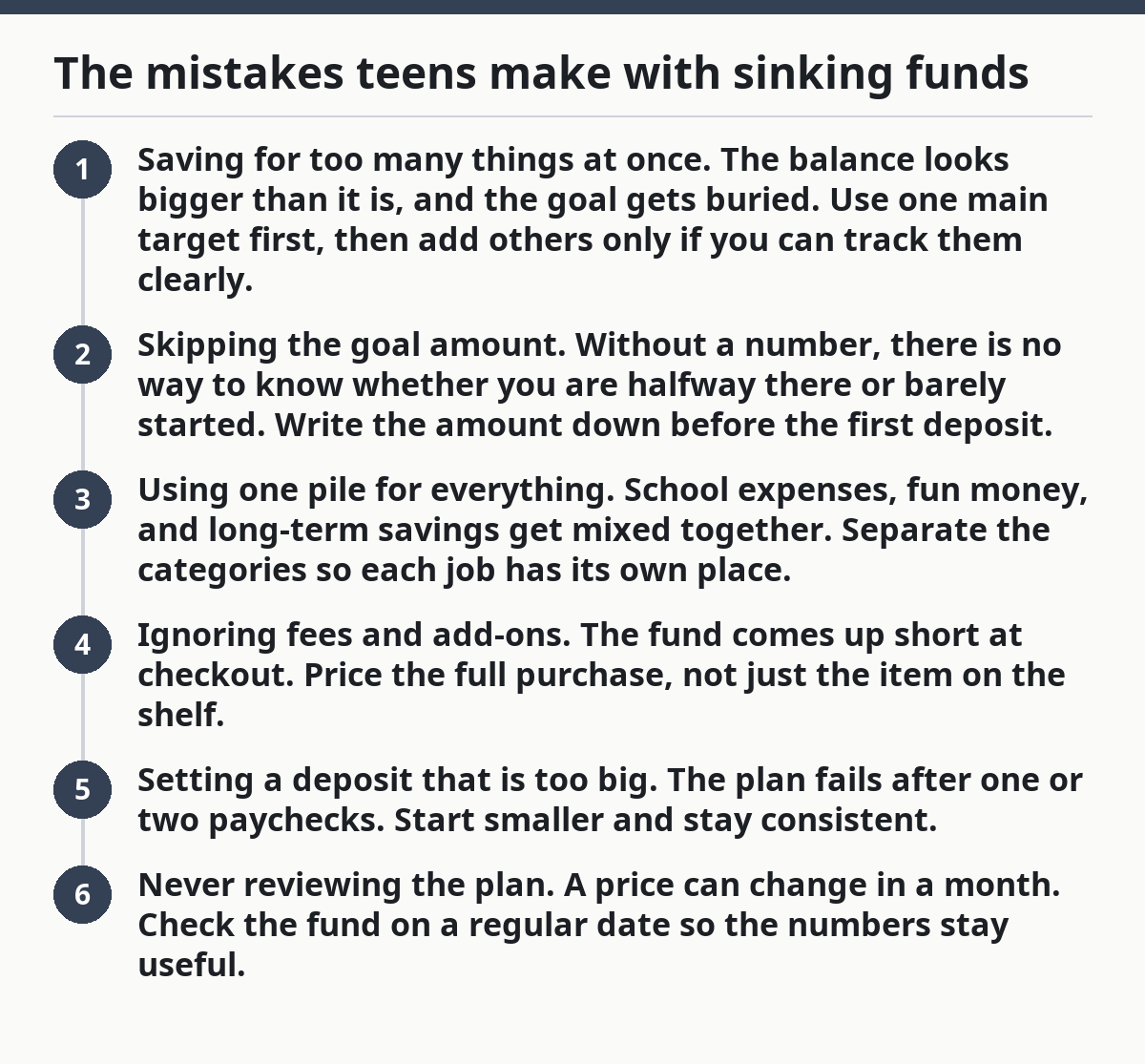
Here are the common mistakes:
- Saving for too many things at once. The balance looks bigger than it is, and the goal gets buried. Use one main target first, then add others only if you can track them clearly.
- Skipping the goal amount. Without a number, there is no way to know whether you are halfway there or barely started. Write the amount down before the first deposit.
- Using one pile for everything. School expenses, fun money, and long-term savings get mixed together. Separate the categories so each job has its own place.
- Ignoring fees and add-ons. The fund comes up short at checkout. Price the full purchase, not just the item on the shelf.
- Setting a deposit that is too big. The plan fails after one or two paychecks. Start smaller and stay consistent.
- Never reviewing the plan. A price can change in a month. Check the fund on a regular date so the numbers stay useful.
The correct alternative is usually boring: one goal, one amount, one schedule, one place to track it. Boring works.
When should a teen use a different approach?
A teen should use a different approach when the goal is not a planned purchase with a clear price and timeline. A sinking fund is for target spending, not for everything money-related.
Picture this: you want a simple rule for every dollar, but not every dollar belongs in the same bucket. Some money is for current spending, some is for a planned buy, and some belongs elsewhere in your budget. One tool does not fit all jobs.
Use a different approach if:
- the item is not time-based and you do not know when you’ll buy it,
- the price changes too often to estimate,
- the purchase is a short-notice need,
- or the money is already needed for regular expenses this month.
If your goal is broad, like “I want to be better with money,” a sinking fund is too narrow. If your goal is a known purchase before a known date, it is a strong fit. That is the line.
For broader teen budgeting help, the hub on Teen Budgeting and Goal Planning is the better next stop. This page stays focused on one job: setting up the fund for a planned buy.
What kinds of teen goals belong in a sinking fund?
A sinking fund works best for planned purchases with a clear price and date. Think school supplies, event tickets, gifts, a bike, a phone upgrade, or a trip payment. If the goal is vague or not tied to a known buy, it usually belongs in a different bucket.
How is a sinking fund different from emergency savings?
A sinking fund is for something you already expect to buy. Emergency savings are for surprise costs that you did not plan for, like an unexpected bill or repair. The two jobs are different, so the money should be treated differently. If the setup gets complicated, ask a qualified professional to help sort the money correctly, since rules can vary by country and provider. The Consumer Financial Protection Bureau and IRS offer general consumer guidance, but not personal advice. Consumer Financial Protection Bureau, IRS
Can a teen use one savings account for multiple sinking funds?
Yes, if the teen can keep the goals separated with clear labels. A budget app, spreadsheet, or notes system can track each bucket inside one savings account. If the categories keep getting mixed up, separate tracking becomes more useful than one shared pile.
Drafted with AI; not yet reviewed by a person.