Last updated: November 20, 2026
Quick answer: most teens can adjust a budget after a surprise expense by pausing new spending, shifting money from flexible categories, and rebuilding the next-paycheck plan in one sitting. This article on How Teens Can Adjust a Budget After a Surprise Expense explains the reset step by step.
A surprise expense can throw off a teen budget fast. The fix is to pause the plan, move money from lower-priority categories, and protect the next paycheck before you spend again. The steps below show what to change right away and what to leave alone in an adjusted teen budget.
Who this applies to, and what you need first
This applies if you already have a spending plan, a few budget categories, and at least one source of money coming in, like allowance, a paycheck, or gift money. For your own situation, a qualified adviser or trusted adult can help if the numbers are unclear.
You do not need a perfect budget to start. You need a list of your categories, the amount you thought each one would get, the size of the unexpected expense, and the date of your next paycheck or money deposit.
The truth is, a surprise expense only becomes a budget crisis when you guess instead of reset. If you know the numbers, you can make a clean repair in one sitting.
Use this page as the practical middle step between the teen budgeting hub and the next paycheck. It fits under the broader Teen Budgeting and Goal Planning system, but it focuses only on the reset after the break.
How do you adjust a teen budget after a surprise expense?
You adjust it by covering the new cost first, then trimming categories that can wait, then setting a smaller plan until your next paycheck arrives. That keeps the budget realistic instead of pretending nothing happened.
For example, you may have meant to spend $15 on snacks, but a broken phone charger or school fee takes part of that money. You still need a plan for the rest of the week, not a lecture about what should have happened.
Here’s the catch: a good reset is not just “spend less.” It is a short, ordered repair. Follow these steps in order.
- Write down the surprise expense exactly. Put the amount, the date, and the category on paper or in your notes app. Verify that the number matches the receipt, message, or bank app. If the amount is fuzzy, your budget will stay fuzzy too.
- Check your cash on hand and account balance. Look at the money you can use right now, not what you hope to get later. Verify your usable balance after any pending payments. If the balance is already near zero, do not promise money to other categories.
- Freeze new spending for 24 hours. Stop nonessential purchases for one day so the budget stops leaking. Verify that you can still cover basics like lunch, transit, or school supplies for that day. If you cannot, you need to move to the most urgent category cuts immediately.
- Protect fixed needs first. Keep money for must-pay items such as transportation, lunch, phone service, or a required school fee. Verify that these basics are covered through the next paycheck. If they are not, the plan is broken and needs deeper cuts.
- Cut from flexible categories. With guidance from a trusted adult or qualified adviser if needed, reduce spending in categories that can wait, such as entertainment, extras, or nonessential treats. Verify that the cut covers the surprise expense without emptying every category. If one category drops to zero and still does not cover the loss, cut another small category instead of draining savings first.
- Use savings only if the gap is still open. Move the smallest amount needed from savings after category cuts. Verify that the transfer closes the gap and still leaves at least a little money for another short problem. If savings gets wiped out for a small cost, the budget was too tight before the surprise hit.
- Rebuild the spending plan for the time left. Divide what is left by the number of days until the next paycheck or deposit. Verify that the daily amount is realistic for your routine. If the daily number is so low that you cannot cover basics, the budget needs a second pass.
- Record the reset in one place. Write the old category amount, the new amount, and what changed. Verify that your total now matches your actual money. If the math does not balance, stop and fix it before the next purchase.
The point of this reset is simple: your budget has to match reality today, not last week. If it does, the rest of the month gets easier.
What should change right away, and what should stay the same?
The surprise expense should change the flexible parts of the budget, not every part of your life. Keep the categories that protect school, transport, and basic routines steady if you can.
For instance, if you have a set amount for a week and one bill or repair takes a bite out of it, you need to decide which categories can shrink for 7 to 14 days and which ones cannot.
A useful rule is to treat your budget like a row of buckets, if that comparison helps you think through priorities. Some buckets are easy to pour from. Others keep the week running.
- Change now: entertainment, impulse buys, extra snacks, app purchases, and any category that already had room to shrink.
- Keep mostly intact: school supplies you need this week, transit money, lunch money, phone service, and required payments.
- Review later: savings goals, gift spending, and longer-term wants that do not have a deadline this week.
If you cut a need instead of a want, the surprise expense can create a second problem. That is how one repair turns into missed lunch money or a late fee.
A small cut can still help if it is honest and specific.
Which categories should teens cut first?
Teens should cut the categories that buy comfort, not access. Entertainment, eating out, games, cosmetics, and extra spending are usually the first places to look.
Because the budget is short by a modest amount, you need room without wrecking the whole week. You do not start by raiding everything. You start with the loosest money first.
A practical order looks like this, and it is worth checking with a trusted adult or qualified adviser if you are unsure:
- Stop nonessential treats for the rest of the week.
- Shrink flexible categories by a small amount, not all at once.
- Move money from the category with the least deadline pressure.
- Use savings only after the easy cuts are done.
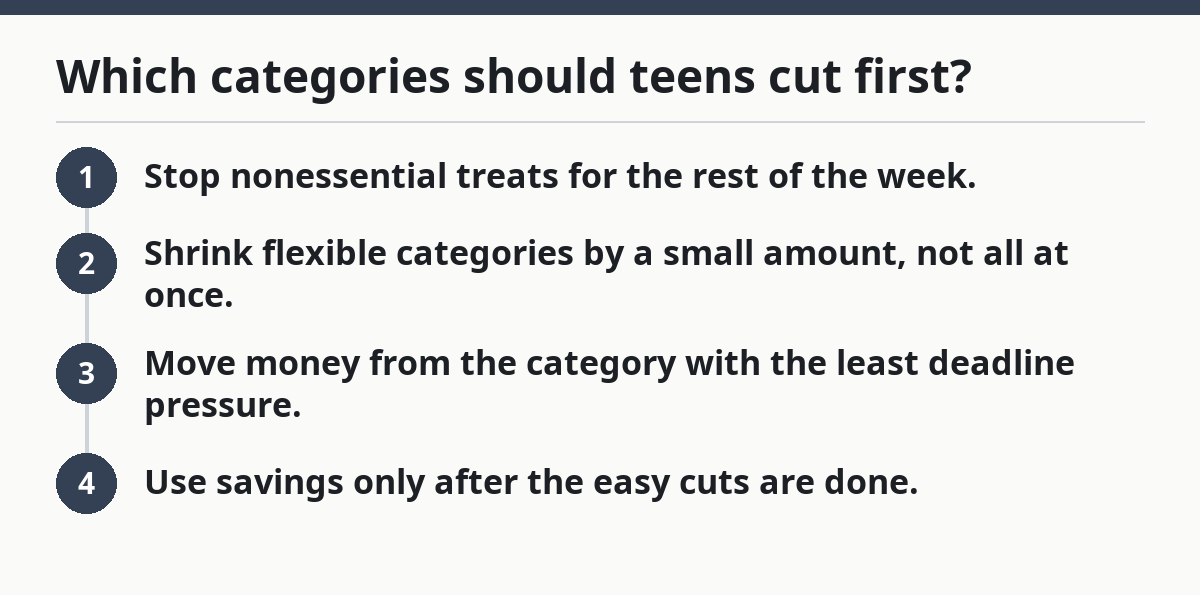
This works because a category with no deadline can absorb a short-term cut more easily than money set aside for a school cost or transportation. If you cut the wrong category first, the budget may “look fixed” but fail in real life.
On the flip side, if you make every category equal, you miss the whole point of a spending plan. Money with a date attached needs more protection than money for a want.
Should a teen use savings to cover a surprise expense?
A teen can use savings to cover a surprise expense if the expense is real, the category cuts are not enough, and the savings move is small enough to leave a cushion. Savings is not the first tool, but it is a valid backup.
As a result, if you have savings set aside for goals and an unexpected cost lands before the next paycheck, the question is not “Can I touch savings?” It is “How much do I need to move, and what gets hurt if I move it?”
Use savings in this order:
- First, ask whether the expense is temporary or one-time.
- Second, ask whether a category cut will cover it.
- Third, move only the amount needed to close the gap.
- Fourth, if possible, leave your long-term goal intact.
If you pull from savings for every small surprise, your plan stops acting like a plan. Then the next surprise has nowhere to go.
A good sign is that your savings move is small, your basic categories stay funded, and your next paycheck still has a job to do. A bad sign is that you emptied savings and still cannot cover the week.
What does next paycheck planning look like after the reset?
Next paycheck planning means giving every dollar a job before it lands. You set the next paycheck aside on paper first, then spend from the paper plan instead of guessing.
Since the surprise expense is handled, your money may still be tight until payday. You need the next paycheck to do more than just disappear into random spending.
Do this in one pass:
- Put required costs at the top, such as transportation, lunch, phone, and any due school costs.
- Set a small amount for flexible spending.
- Refill the category you cut from only if there is money left.
- Leave a little room for the next surprise, if possible.
If you expect a paycheck on Friday, build the plan for Friday through the next payday, not for the whole month all over again. Short time blocks are easier to control and easier to check.
The truth is, many teen budgets fail because they are built for an ideal month, not a real one. A reset only works if the next paycheck gets a fresh assignment.
Common mistakes that make the budget break again
Teens usually break the repair by acting too fast, cutting the wrong thing, or pretending the surprise never happened. Those mistakes cost money and make the next reset harder.
Therefore, if you fix the budget once and then spend as if the problem disappeared, the numbers stop matching fast.
- Skipping the math. If you do not total the expense and the remaining money, you guess wrong. Use exact numbers from the receipt or app.
- Cutting from fixed needs first. That can create a second problem, like missing transit money or a school payment. Cut flexible categories first.
- Using every spare dollar. That leaves no cushion for another small surprise. Keep some money unassigned if you can.
- Starting over from scratch. That wastes time and hides the real problem. Adjust the current budget instead.
- Ignoring the next paycheck. If you do not plan the days until payday, you may overspend on day 2 and panic on day 10. Build to the next deposit, not to a vague month.
A good adjustment is boring. It balances, it covers the week, and it gives the next paycheck a clear job.
When should you stop and get help from someone who manages money?
You should stop the DIY reset when the surprise cost is bigger than your ability to cover it without missing a required payment. That is the point where a parent, guardian, or other qualified money helper needs to look at the full picture.
Because one expense is no longer the only issue, the budget may be so tight that you are choosing between basics, or you are already behind on a required payment.
The expense would wipe out money for required basics: This means the budget can no longer cover transportation, lunch, or a required school cost — get help with the whole plan before spending again.
The budget has no flexible category left: This means every category is already at the minimum — the reset needs a larger redesign, not another cut.
You do not know where the money went: This means the plan was not tracked closely enough — pause and review the last few transactions before making changes.
The surprise expense will repeat soon: This means the cost is not a one-time shock, such as a recurring fee or regular school cost — build for that pattern instead of treating it as an accident.
You are borrowing from future money: This means you are spending a paycheck before it arrives — stop and rebuild around the money you actually have.
If the problem is one small mistake, a reset works. If the problem is a broken system, you need a bigger conversation than category cuts.
How can a teen avoid repeating the same budget problem?
A teen avoids the same problem by building a small buffer into the plan, tracking the category that broke, and checking the budget once a week for 10 minutes. Repetition, not perfection, is what keeps the fix alive.
Since the same kind of surprise can hit again in a month, you need to know whether the budget broke in the same place.
Use this simple review:
- Mark the category that failed.
- Note whether it failed because the amount was too small or the timing was wrong.
- Add a small line for surprise costs in the next plan if your money allows it.
- Check spending before the week is over, not after it is gone.
If you treat every surprise as a one-off, you miss the pattern. A pattern is where the real fix lives.
You do not need a huge budget to do this. You need a habit of checking the numbers before the money disappears.
Key takeaways
- A surprise expense is handled best by pausing new spending and resetting the plan in order.
- Cut flexible categories first; protect the costs that keep school and daily life moving.
- Use savings only after the easy cuts still leave you short.
- Rebuild the plan around the next paycheck, not the old budget.
- If the expense threatens basic needs or leaves no room to cut, the budget needs a bigger review.
FAQ
What categories should a teen cut first?
Start with the money that has no deadline attached. Entertainment, snacks, apps, and impulse spending usually move first because they can wait 1 to 2 weeks without breaking school or transportation needs. If one cut is not enough, trim another flexible category instead of touching required expenses first.
Should a teen use savings to cover a surprise expense?
Yes, sometimes, but only after checking whether category cuts cover the cost first. Savings works best as a backup for a real one-time expense. If you drain savings every time something small happens, the budget has no cushion left for the next surprise.
How can a teen avoid repeating the same budget problem?
Track where the budget broke and fix that spot in the next plan. A 10-minute weekly check helps catch weak categories before they fail again. If the same kind of expense keeps showing up, treat it as a regular cost in the spending plan instead of a surprise.
Drafted with AI; not yet reviewed by a person.