Last updated: November 19, 2026
Quick Answer: In How Teens Can Negotiate a Starting Hourly Rate at a First Job, the best time to ask is after the offer and before you accept, and a clear ask can take under 2 minutes. Teens can ask for a higher starting hourly rate before they accept a first job, and the best move is to keep it polite, brief, and tied to what you bring. The sections below show what to say, what to ask for besides wage, and when to stop. For wage-floor rules and youth work guidance, the U.S. Department of Labor and YouthRules! are useful references.
Key Takeaways
- Ask after the offer and before saying yes, with one short sentence about your skills, schedule, or experience.
- A polite request, one reason, and room for “yes” or “no” usually keeps the conversation open.
- Check your local minimum wage first, because it sets the legal floor for pay in your area.
- You can often ask about availability, shifts, training, or a review date even if the hourly rate stays fixed.
What a teen should say first
You should ask for the starting hourly rate after the offer is made and before you say yes, using one clear sentence about your experience, schedule, or skills. That keeps the conversation focused on the job offer, not on pressure or guessing.
Picture this: you’ve finished the interview, the manager likes you, and the offer is on the table. You do not need a long speech. You need a short, calm ask that sounds like a real person asking about pay. That is the whole job.
Use this kind of line:
- “I’m excited about the job. Is there any room to start at a higher hourly rate?”
- “I can work the school-night shifts and weekend mornings. Could the starting rate be adjusted?”
- “I have babysitting, sports, or club experience that helps here. Is a higher starting rate possible?”
The key is to ask before accepting and to keep your tone friendly. A teen who sounds demanding can shut the door fast. A teen who sounds prepared can sometimes get a better number, or at least a better package.
What this section settles: the ask, the timing, and the tone. Not a debate. Just a clean question.
How do teens ask for more pay politely?
Teens ask for more pay politely by making a simple request, giving one reason, and leaving room for the manager to say yes or no. That is the cleanest way to handle a first job conversation.
Picture this: you’re standing near the counter, or the manager calls you after the interview. You want to say something that is short enough to remember and respectful enough to keep the offer alive. The best version usually sounds steady, not pushy.
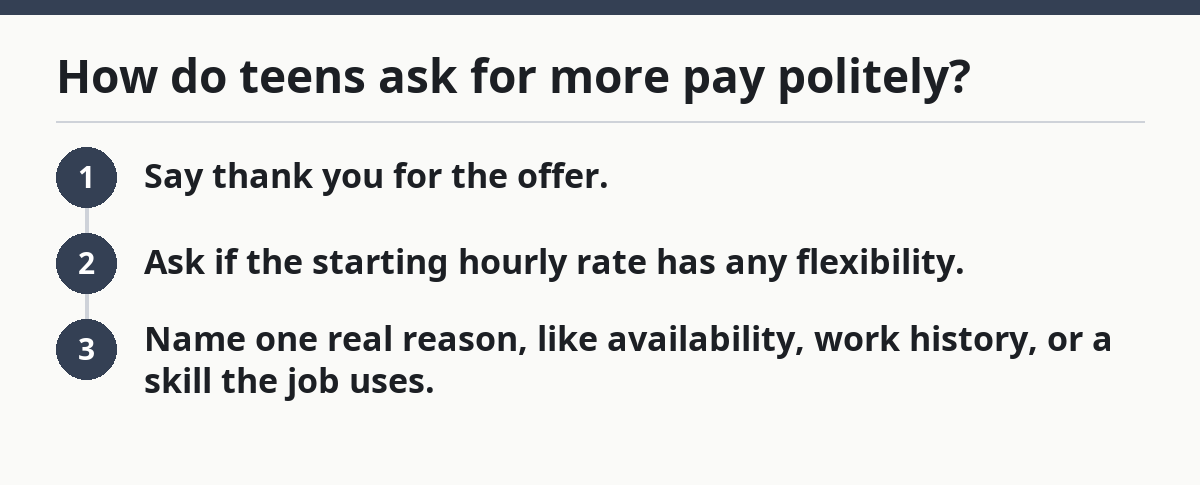
Use a 3-step script:
- Say thank you for the offer.
- Ask if the starting hourly rate has any flexibility.
- Name one real reason, like availability, work history, or a skill the job uses.
Here’s a simple example:
- “Thank you for the offer. I’m really interested in the job. Is there any flexibility on the starting hourly rate?”
If the manager says the rate is fixed, do not argue in circles. Ask one follow-up instead:
- “Is there any room to discuss the schedule, training hours, or another part of the offer?”
That keeps the conversation alive without making it awkward. The truth is, many entry-level jobs have a set pay range. Still, a polite ask is not rude. It is normal. The mistake is acting like negotiation means a fight.
Two things to avoid:
- “I need more money or I’m gone.” That sounds like a threat.
- “Can you pay me what the older workers make?” That invites comparison you may not want.
A better move is to ask about the offer, not the person next to you. Different people can have different duties, shifts, or experience levels.
What to know about minimum wage before you ask
You should know the minimum wage first, because that number sets the floor and tells you what cannot be offered legally in your area. If the starting hourly rate is already at that floor, your room to negotiate may be small.
Picture this: you are looking at a job that pays near the state minimum wage, and you are not sure whether asking for more makes sense. This is where a teen can get tripped up. A manager can only move so far if the pay is tied to a posted wage band or local rules.
Use this order:
- Check the posted wage, if the ad lists one.
- Look up the local minimum wage for your city or state.
- Decide whether you are asking for a higher rate or for a different part of the offer.
- If the rate is fixed, shift to other terms, like hours, training, or shift choice.
If the pay is below the legal minimum, that is not a negotiation issue. It is a red flag. If the pay meets the floor, then the question becomes whether the employer has any flexibility at all.
Many teens stop at wage and miss the rest of the package. That is a mistake. A job that starts at the minimum wage but gives you steadier hours, better shifts, or a faster review date can be better than a slightly higher rate with poor scheduling.
Use this check before you ask:
- Is the wage posted?
- Is it at or above minimum wage?
- Are you being hired for cashier work, stocking, food prep, or something with more responsibility?
- Does the offer include training time, uniforms, or a set schedule?
The result should be simple: you know whether the number is fixed, flexible, or not legal. That saves you from making a pointless ask.
What can be negotiated besides the hourly rate?
You can often negotiate availability, shift timing, training details, and sometimes a review date, even when the hourly rate will not move. That matters because the wage is only one part of a first job.
Picture this: the manager says the rate is set at $X, but the job still needs to fit around school, practice, or a bus schedule. That is where a teen has real leverage without overreaching. A first job is not just pay per hour; it is also when those hours happen and how workable the job is.
Possible points to raise:
- Start date
- Weekend versus weekday shifts
- Opening or closing shifts
- Training length
- Number of hours you can realistically work
- A pay review after a set period, if the employer uses one
Do not turn this into a wish list. Pick one or two items that matter most. If you ask for five changes at once, the manager may stop listening.
A useful line is:
- “If the hourly rate can’t change, could we talk about my schedule or a review after I learn the role?”
That keeps the conversation practical. It also signals that you are serious about the work, not just the money.
Trade-off: asking for a better schedule can be smarter than pushing too hard on pay. The downside is obvious: you may still start at the posted rate. The upside is that you can accept the job without wrecking school or sleep.
How experience level changes the conversation
Your experience level changes the conversation because employers pay for risk as much as for skill, and a teen with proof of reliability can make a better case. That does not mean you need a long work history.
Picture this: you do not have a paid job yet, but you have helped with childcare, coached younger kids, handled a cash box at a fundraiser, or shown up for repeated school shifts. That is not the same as retail experience, but it is still evidence that you can follow directions and show up on time.
Use examples that match the job:
- Food service: handling cleanup, speed, and order
- Retail: customer contact and simple transactions
- Childcare: patience and attention
- Team sports or clubs: attendance and responsibility
You do not need to brag. You just need to connect the dots. Say what you did, how often you did it, and why it matters for the job. A manager hears that as lower risk.
If you have no paid experience, do not fake it. Say you are new and then point to what you do have: strong availability, fast learning, or a clean school schedule that lets you cover more shifts. That is honest and useful.
A simple way to frame it:
- “I’m new to paid work, but I’ve handled responsibility in school and activities, and I’m available on Friday nights and Saturdays.”
That can support a higher starting hourly rate, or at least help you avoid sounding like a blank slate.
What to avoid when negotiating your first job offer
You should avoid sounding entitled, comparing yourself to other workers, or pushing for a higher rate without a reason. Those moves can cost you the offer, and a first job does not give you much room for drama.
Picture this: you want to ask for more, but you are worried about saying the wrong thing. The biggest mistakes are small, and they show up fast in a short conversation.
Common mistakes:
- Asking before the offer is made
- Saying “everyone else gets paid more”
- Using a hard ultimatum on the first ask
- Talking too much
- Acting like the posted rate is an insult
What it costs:
- The manager may think you are hard to work with
- You may lose the chance to discuss other parts of the offer
- You may turn a possible yes into a no
What to do instead:
- Wait until you have the offer
- Keep the request short
- Tie your ask to one fact: availability, skill, or experience
- Stay open to a lower rate if another part of the job works for you
The truth is, many teens think negotiation means “ask bigger.” It does not. It means “ask smarter.” A polite question and one solid reason are enough.
Who this is not for: if you are already upset about the pay before the job starts, this may not be the right match. A calmer offer with a fair schedule may fit better than a higher number that comes with tension.
A simple step-by-step script for the conversation
You can handle the whole conversation in under 2 minutes if you keep it tight and planned. That is enough time to ask, listen, and respond without turning it into a speech.
Picture this: you’ve got the offer in hand and your heart is moving fast. A script helps because it gives you a lane. You do not need clever lines. You need a clean order.
- Thank the manager for the offer.
- Ask about flexibility on the starting hourly rate.
- Name one reason you’re a strong fit: experience, reliability, or availability.
- Listen carefully to the response.
- Accept, pause, or ask about another part of the offer if the rate is fixed.
A useful full script sounds like this:
- “Thank you for the offer. I’m excited about the job. Is there any flexibility on the starting hourly rate based on my availability and experience?”
If the answer is yes, ask what number they had in mind. If the answer is no, do not keep pushing the same point. Ask whether there is flexibility on shifts, start date, or a future review.
That is the whole pattern. Short ask. Clear reason. Calm response.
If you want a reference point for wage floors and youth work rules, the U.S. Department of Labor and the YouthRules! program are useful places to check before you talk pay. State labor agencies matter too, since local minimum wage rules can differ.
Should a teen accept the first number?
A teen should not accept the first number blindly, but they also should not reject a fair offer just to prove a point. The right move is to compare the offer with the job’s duties, your schedule, and the local minimum wage.
Picture this: the manager gives you a number, and you have a few seconds to decide whether to push back. This is where judgment matters more than pride. A tiny wage bump means little if the commute is long, the schedule is a mess, or the hours are too few to matter.
Ask yourself:
- Does the rate clear the legal floor?
- Does the shift fit school and family time?
- Are the hours enough to make the job worth taking?
- Is there any chance of a raise review after training?
If the answer to most of those is yes, the offer may be good enough. If not, a polite ask is still worth trying. Negotiation is not about winning every time. It is about not leaving money or flexibility on the table for no reason.
For a bigger picture on first-job money choices, see the hub on teen income and first-job choices.
Can teens ask for more pay before accepting a job?
Yes, teens can ask for more pay before accepting a job. The cleanest time is after the offer is made and before you say yes, because that is when the employer knows you are serious and you know the job is real. Keep the ask polite, short, and tied to your experience, availability, or skills.
What is a reasonable way to ask for a higher starting rate?
A reasonable way is to thank the manager, ask whether the starting hourly rate has any flexibility, and give one clear reason for the request. A simple sentence works better than a speech. If the answer is no, ask about another part of the offer instead of repeating the same request.
Does experience matter when negotiating pay for a teen job?
Yes, experience matters, but it does not have to be paid work. Babysitting, team sports, club leadership, tutoring, and regular volunteer work can all show reliability and responsibility. The point is to connect what you’ve already done to the job you want.
Can a first job offer be negotiated?
Yes, a first job offer can often be negotiated, but not every part of it will move. The hourly rate may be fixed, while the schedule, start date, or a future review may have some room. If the employer says the pay is firm, you can still ask about other parts of the offer without sounding difficult.
Drafted with AI; not yet reviewed by a person.