Last updated: November 19, 2026
A teen comparing a W-2 job and a 1099 job should start with one question: am I an employee or an independent contractor? That one label changes who controls the work, how taxes are handled, and whether the teen gets employee benefits or has to manage self-employment taxes. For the IRS rules behind that distinction, see its worker-classification guidance and self-employment tax page: https://www.irs.gov/businesses/small-businesses-self-employed/independent-contractor-defined and https://www.irs.gov/businesses/small-businesses-self-employed/self-employed-individuals-tax-center.
I write about teen work, payroll, and tax classification, and the keyword here is simple: a W-2 role is usually better for a first job, while a 1099 role only makes sense when the teen truly runs work like a contractor.
Key takeaways
- A W-2 job means the business treats the teen as an employee, with taxes often withheld from pay; if the classification is unclear, check the IRS worker-classification guidance or a tax professional.
- A 1099 job usually means the teen is an independent contractor, paid for a job or project and responsible for more tax bookkeeping.
- Control matters as much as pay: if the company sets the schedule, tools, and process, that points toward employee status under IRS guidance.
- A 1099-NEC form usually signals contractor pay; a W-2 usually signals employee pay.
- For most teens, the safer first-job default is W-2 because the rules are clearer and the tax burden is less confusing.
- A contractor job can still be legitimate, but it should come with real independence, not just extra tax hassle.
- When in doubt, the IRS worker-classification rules and a tax professional can help sort out the label before pay starts.
What is the real difference between a W-2 job and a 1099 job?
A W-2 job is an employee job; a 1099 job is usually independent contractor work. That is the whole comparison in one sentence, and it matters because the IRS looks at control, not just the form at tax time.
In a W-2 role, the employer usually decides the shift, trains the teen, supplies the tools, and withholds payroll taxes from wages. The teen is on the company payroll and gets a W-2 after year-end. In a 1099 role, the business usually pays for a result or service, not for hours worked under employee-style supervision, and the teen generally receives a 1099-NEC if the pay reaches the reporting threshold.
The biggest beginner mistake is assuming “1099” just means a flexible part-time job. It can, but only if the work relationship really fits contractor rules. If the business tells the teen exactly when to show up, how to do the work, and what equipment to use, the teen may be functioning like an employee even if someone tries to pay them on a 1099.
For a teen, the cleanest shortcut is this: if the job looks like a typical hourly role with a manager, a schedule, and workplace rules, it is probably W-2. If the teen is hired to complete a project with room to choose methods and timing, it is more likely 1099. The IRS has worker-classification guidance on its site, and that guidance is the right place to check before accepting the role.
How do taxes change between W-2 and 1099 work?
A W-2 job usually puts less tax responsibility on the teen during the year, while a 1099 job pushes more of that responsibility onto the worker. That difference is one of the biggest reasons a first-time earner should pay attention.
With W-2 pay, the employer generally handles payroll withholding. That can include federal income tax and the employee share of Social Security and Medicare taxes, depending on the worker’s situation. The teen still has to file a tax return if their income requires it, but the paycheck itself is usually simpler.
With 1099 pay, the business usually does not withhold income tax for the contractor. The teen may need to set money aside for taxes on their own, and self-employment tax can come into play because contractors generally pay both the worker and employer portions of Social Security and Medicare. That does not mean every teen with 1099 income will owe a lot, but it does mean the cash in hand is not the whole story.
This is where many teens get surprised. A 1099 check can look bigger on paper because there is no automatic withholding, but the teen may later face tax bills, estimated tax responsibilities, and more recordkeeping. A W-2 paycheck often feels smaller in the moment, yet the tax mechanics are easier to follow.
The IRS explains self-employment tax and worker classification on its own pages, and a parent, guardian, or tax professional can help if the teen is unsure how much to save. For a first job, that extra help matters more than a slightly higher gross pay rate.
W-2 job: when it usually wins for teens
A W-2 job wins for most teens because it is the cleaner employee setup. It is usually the better fit for someone who wants predictable instructions, a set shift, and less tax risk.
This option is strongest when the teen wants a classic first job: retail, food service, camp staff, grocery work, lifeguarding, or another role where the employer sets the schedule and provides the training. The manager controls the work process, the business supplies the tools, and the teen gets a clear chain of command. That structure is not just convenient; it is a strong clue that the job is truly employment rather than contracting.
The practical upside is simple. A W-2 job usually means fewer surprises at tax time and fewer business-like chores during the year. The teen is not chasing invoices, tracking business expenses as a self-employed worker, or figuring out whether estimated taxes are due. The pay may feel more straightforward, and the job is easier to compare with other first-job offers.
There are trade-offs. A W-2 teen worker usually has less freedom to set hours, choose methods, or negotiate how the work gets done. The employer can direct the teen’s time, and that can feel rigid. W-2 roles also may not offer much beyond wages, especially for teens who are part-time or seasonal workers.
That said, the W-2 structure is usually the safer recommendation when the teen is new to work, new to taxes, or new to handling money without a lot of supervision. It is not glamorous. It is simply less likely to cause classification mistakes or tax confusion.
1099 job: when it actually makes sense
A 1099 job wins when the teen is genuinely working as an independent contractor and wants more control over how the work gets done. It is not the better choice just because the pay stub looks different.
This setup can fit a teen who already knows how to deliver a service on their own terms: tutoring, editing, design work, photography, yard services, or another project-based task where the teen decides the workflow and the business wants a finished result. The key point is independence. The client should not be treating the teen like a regular employee with a fixed shift, close supervision, and company-only rules; if the arrangement is close enough to employment, a tax professional can help confirm whether 1099 treatment is appropriate.
The upside is flexibility. A contractor can sometimes choose clients, set a service area, negotiate the scope, and decide how to complete the job. That can be valuable for a teen with school, sports, or family obligations that make a rigid schedule difficult.
The drawback is bigger than many teens expect. A 1099 worker has to think like a small business. That means saving for taxes, keeping records, tracking income, and understanding that the amount paid is not the same as take-home pay after tax obligations. The job may also provide no benefits, no paid time off, and no fallback if the work dries up.
Here is the honest limit: a 1099 role is a poor choice if the teen just wants a simple first paycheck and the company is using contractor language to avoid payroll rules. If the work looks and feels like employment, the 1099 label may be the wrong fit even if the business prefers it.
The honest side-by-side
A teen can compare these jobs best by looking at control, taxes, and day-to-day reality instead of just the pay rate. The winner changes depending on what the teen needs most.
| Criteria | W-2 job | 1099 job | Winner for this condition |
|---|---|---|---|
| Who controls schedule | Employer usually sets shifts and start times | Worker often has more control over timing | 1099 if flexibility matters most |
| Who provides tools | Employer usually supplies equipment and training | Worker often supplies tools or materials | W-2 for a first job |
| Tax withholding | Taxes are often withheld from wages | No usual withholding; worker must plan ahead | W-2 for simplicity |
| Self-employment tax risk | Usually not the worker’s burden in the same way | Can apply to contractor income | W-2 for lower tax hassle |
| Employee benefits | May include some workplace protections or benefits | Usually none | W-2 if benefits matter |
| Paperwork at year-end | W-2 form is usually straightforward | 1099-NEC requires more tracking | W-2 for beginner workers |
| Work style | More supervision and process | More independence and business judgment | 1099 for experienced self-starters |
| Risk of misclassification | Lower when the role is a normal employee job | Higher if the business still directs the work like an employee job | W-2 if the role looks like a normal job |
| Best fit for first-time earners | Usually easier to understand | Can be confusing without tax guidance | W-2 |
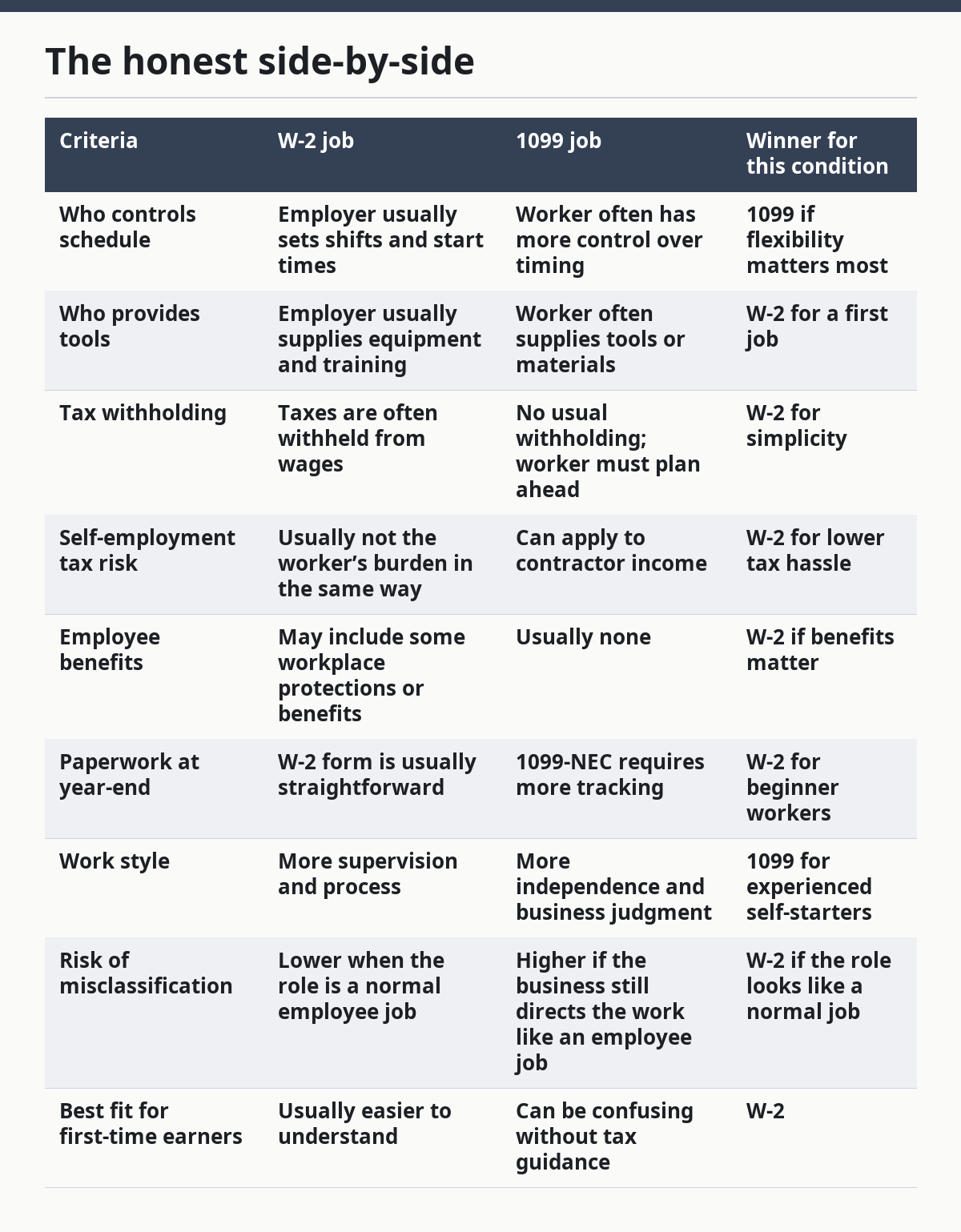
That table points to the same conclusion: a W-2 job is the better default, and a 1099 job only wins when the teen truly wants contractor-style independence and understands the tax trade-offs.
When does the label itself look wrong?
The label looks wrong when the company says “1099” but still acts like an employer. That mismatch is the biggest red flag in this whole comparison.
A teen should be cautious if the business sets the exact schedule, requires permission for time off, supplies the main tools, trains the worker step by step, and supervises the work closely. Those facts often point toward employee status, even if the pay arrangement is being called contractor work. The IRS classification rules focus on the real relationship, not the label on a payment form.
Another warning sign is a job that sounds like a normal hourly position but comes with a 1099-NEC instead of payroll treatment. That can create tax trouble and make the teen responsible for obligations that usually belong in a W-2 setup. If the job is in a shop, office, or service role where the worker follows a manager’s instructions like any other staff member, the classification deserves a second look.
This is also where a teen should slow down if the pay is unusually attractive but the setup is vague. A contractor role can be legitimate, but a confusing offer should not be accepted just because the number sounds better. A teen, parent, or guardian can ask one direct question: “Am I being hired as an employee or as an independent contractor?” If the answer is fuzzy, the job is not ready to sign.
For legal and tax questions, the IRS guidance matters, and a tax professional can help if the situation is close. That is especially true when the teen is under 18 and the work arrangement is unusual.
The verdict: which one should a teen choose?
Choose a W-2 job if the teen wants a first job that is easier to understand, easier to file taxes for, and more likely to come with normal employee supervision. Choose a 1099 job if the teen truly wants contractor independence, can handle tax planning, and is actually being paid as a separate service provider. Neither if the business is calling the teen a contractor only to avoid payroll rules or the work is unclear enough to need legal or tax review.
That is the clean recommendation. For most teens, W-2 is the better first choice because it matches a typical beginner job and keeps tax surprises lower. 1099 only wins when the work relationship really fits contractor rules and the teen is ready to treat the job like a small business.
What should a teen ask before saying yes?
A teen should ask four direct questions before accepting the offer: “Will I be an employee or an independent contractor?” “Will I get a W-2 or a 1099-NEC?” “Who sets my schedule and who provides the tools?” “Will taxes be withheld, or do I need to save for them myself?”
Those questions reveal the real structure of the job faster than the title on the posting. They also give the teen a chance to spot a mismatch before the first shift or first invoice. For a first job, that check is worth the extra minute.
FAQ
What is the difference between W-2 and 1099 for teens?
A W-2 job treats the teen as an employee, while a 1099 job usually treats the teen as an independent contractor. The difference affects schedule control, tax withholding, and who is responsible for self-employment tax. For a teen, the W-2 setup is usually simpler and easier to manage.
Which type of job is better for a teen first job?
A W-2 job is usually the better first-job choice because it is easier to understand, easier to tax-file, and less likely to create classification confusion.
Drafted with AI; not yet reviewed by a person.