Last updated: November 19, 2026
Quick answer: How to start a teen business in the simplest way is to choose one low-cost offer, test whether someone will pay, and aim for a first sale within a week if you can. A teen business can start small, cost very little, and still make real revenue if the first idea solves a simple problem for people nearby. The shortest path is: pick one service or product, check that someone will pay for it, set a basic price, find your first customer, and track every dollar from the start.
Key takeaways
- Start with a problem you can solve in your own neighborhood, school circle, or online community.
- Choose one offer first. A teen business grows faster when the first version is simple enough to explain in one sentence.
- Validate demand before you buy supplies, so money does not disappear into inventory nobody wants.
- Charge enough to cover materials, time, and a little profit, even if the first price feels awkward.
- Keep simple records from day one: sales, costs, and what is left after expenses.
- Ask a parent or guardian to help with payment accounts, permissions, and anything that has age limits.
- The wrong move for many beginners is trying to look “real” before making the first sale.
What a teen business is, and what it is not

A teen business is a small venture a minor can run with light startup costs, simple operations, and a clear first customer. It is not a full-scale company with employees, loans, and a complicated legal setup.
For many teens, the best first businesses are the ones that use skills or tools already available: pet sitting, lawn care, tutoring in a subject you know, handmade items, phone photo cleanup, house organizing, or local social media help for a family friend’s small business. The first teen business is often easiest to run when it is easy to explain, easy to deliver, and easy to repeat.
This matters because a lot of beginner advice skips the real constraint: a teen usually has limited time, limited cash, and limited room for mistakes. A business that needs $300 of stock, a website, and a month of setup is often a poor first project. A business that can start with a notebook, a phone, and one willing customer is more realistic.
The question to ask first is not “What sounds cool?” It is “What can I sell this week?” If you cannot answer that in one sentence, the idea needs trimming.
Here is a simple rule: the product or service should fit on a single page of notes. If it needs a logo package, a shipping system, and a pricing spreadsheet before the first sale, it is too big for round one.
How do I choose a teen business idea?
Choose the idea that matches a skill you already have, a problem people already complain about, and a way to start with less than 3 moving parts. That is a fast filter for a first teen business.
-
List 5 things you can do now. Write down skills, chores, hobbies, or school subjects you handle well in 10 minutes or less, such as walking dogs, editing notes, baking, fixing clutter, or designing simple flyers. When this works, you will have a short list with no “maybe someday” ideas on it.
-
Match each skill to a local need. Ask who would pay for it: neighbors, parents, classmates, teachers, or local small businesses. A skill only becomes a business when there is a buyer, not just applause. You should be able to name at least one type of customer for each idea.
-
Cut anything that needs expensive tools. If an idea needs a machine, special permit, or lots of inventory, move it to the bottom. A good first teen business usually starts with under a few basic supplies, not a garage full of stock.
-
Pick the one you can explain in 10 seconds. “I water plants for people who travel” is better than “I’m building a lifestyle brand.” If the sentence is clear, a customer can understand it fast.
-
Check whether the work can be done after school or on weekends. If the business needs daily attention and you only have 2 hours on Saturdays, it will fight your schedule. The right idea fits around classes, sports, and family obligations.
-
Choose the version that can make the first sale fastest. Speed matters because the first sale tells you more than planning does. If one idea can get a customer this week and another needs a month, start with the faster one.
A generic article often says “follow your passion.” That sounds nice, but passion does not pay for supplies. Better to start with demand and learn the fun part later.
How to test if people will actually pay

Test demand by asking for one small commitment before you spend money on materials, signs, or packaging. A real teen business does not need a fancy launch; it needs proof that someone will hand over money.
Before you spend anything, talk to 10 people in your target group and ask a simple question such as, “Would you pay for this if I did it next week?” Keep the offer specific. “Would you pay $15 for a weekly dog walk after school?” gets a better answer than “Would you be interested?” Interest is cheap. Payment is the test.
Then make a tiny pilot offer. For example, post a message to a family group chat, school club, or neighborhood group and offer only 3 slots. Limited availability helps you see whether the idea has pull without taking on too much work. If nobody responds, revise the offer, not the dream.
You can also test with a sample or mockup. If you want to sell baked goods, make one batch and ask for preorders before you make 10 more. If you want to sell a service, do one discounted trial for a neighbor and ask whether they would book again. The goal is not perfection; the goal is a yes, a maybe with a reason, or a no you can learn from.
Watch for three signs the idea is weak: people say it is “cute” but do not buy, they ask for a version that costs more than you can handle, or they keep asking for a completely different service. Those are useful signals. They mean the market wants a change.
This step saves money. It is much better to learn that a $40 supply order is a bad idea before you place it than after.
What supplies, tools, and permissions do I need first?
You need the smallest set of supplies that lets you deliver the first sale cleanly, plus a parent or guardian involved wherever age limits, accounts, or safety rules apply. That is the practical starting line for a teen business.
For most beginner businesses, the supply list should have only 3 categories:
- Delivery tools: phone, notebook, calendar, or a simple payment app your parent approves.
- Job tools: whatever the work truly needs, such as gloves, scissors, leash, broom, mixer, printer, or cleaning cloths.
- Presentation tools: a basic flyer, message template, business name, or simple price list.
Do not buy everything at once. Buy only what you need for the first 1 to 3 jobs. If you sell brownies, do not buy custom labels before you know whether people will reorder. If you offer yard help, you do not need matching shirts or a website on day one. A plain text message and a clear price are enough.
A parent or guardian matters here for practical reasons, not just legal ones. They may need to help with bank accounts, payment apps, transport, or signing forms. If you are unsure what applies, check your local rules and talk with a parent or guardian before money starts moving. That support can also keep the business from becoming a school-night mess. Set one 15-minute check-in each week so the business does not drift into family conflict.
One honest trade-off: keeping startup costs low can make the business look less polished at first. That is fine. Customers usually care more about whether the work gets done on time than whether the logo looks expensive.
If the business involves food, childcare, transport, or anything potentially risky, check the local rules before you take payment. A teen business should stay simple enough that it can grow without creating a safety or compliance headache.
How do I price it without guessing?
Price it by adding materials, a fair amount for your time, and a little profit, then compare that total with what a customer will realistically pay. That is the simplest way to avoid undercharging.
Use a basic formula:
price = supplies + time + profit
If you make $8 worth of cookies, spend 1 hour baking, and want the work to be worth something, the price needs to cover more than ingredient cost alone. The same logic applies to mowing lawns, tutoring, dog walking, or organizing a closet. A business that only covers supplies is not really a business.
Use one of three pricing styles:
- Flat rate: good for repeatable tasks like cleaning a room or washing a car.
- Hourly rate: useful when the time varies a lot, such as tutoring or organizing.
- Package price: useful when you want to bundle 2 or 3 visits together.
| Pricing style | Best for | Example use |
|---|---|---|
| Flat rate | Repeatable jobs | Washing a car |
| Hourly rate | Jobs with variable time | Tutoring |
| Package price | Multi-visit work | 3 lawn visits |
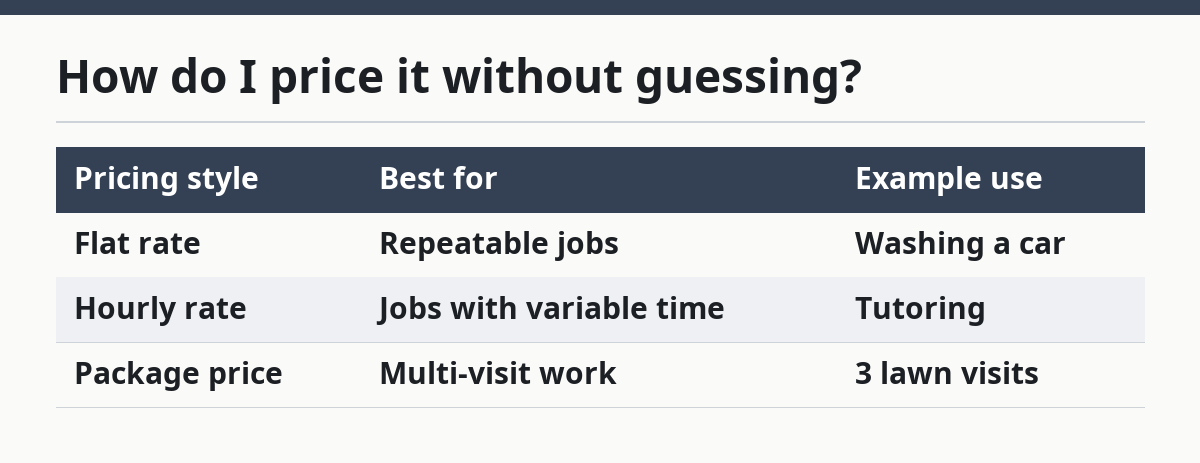
The mistake beginners make is pricing too low because they think “cheap” will bring customers. Low prices can attract people, but they also create resentment when the work takes longer than expected. They can also make a teen business feel less serious. If the job takes 90 minutes, your price should reflect 90 minutes, not the hope that the customer will be impressed by a bargain.
Write the price down before you pitch the offer. That keeps you from freezing when someone says yes. You do not need a complicated spreadsheet. A notebook with 3 columns—price, cost, profit—is enough for the first month.
If you are unsure, start with a test price and ask the first few customers what felt fair. Then adjust slowly. Sharp jumps make customers confused. Small changes are easier to explain.
For pricing context, the U.S. Small Business Administration and the FTC both have plain-language guidance on pricing, recordkeeping, and clear consumer communication.
How to get the first customers without feeling awkward
Get the first customers by asking people who already know you, using one clear message, and making it easy to say yes. Most teen businesses fail at the asking stage, not the doing stage.
Begin with the closest circle: parents, relatives, neighbors, teachers who are allowed to hire students, family friends, and classmates where appropriate. A first customer is usually someone who trusts you already. That is a feature, not a shortcut.
Use a short message with 4 parts:
- What you do
- Who it helps
- The price or starting price
- How to book
Example: “I’m offering Saturday lawn cleanup for neighbors nearby. It starts at $20 depending on the yard. Text me if you want a spot.”
That kind of message works better than a long speech. It gives the reader a job, a price, and a next step. When it works, you will get a reply that asks a real question, like “Can you come this weekend?” or “Do you also rake leaves?”
Use 3 channels first: direct text, a parent-approved social post, and a printed note if your neighborhood still uses them. Do not scatter your energy across 8 apps. One good message sent to 20 people is better than a vague post nobody sees.
A smart move is to offer a first-job discount or a simple starter package. The point is not to stay cheap forever. The point is to make the first yes easier. Once you have 1 or 2 happy customers, ask them for a referral. A referral from a real person beats any ad.
The biggest mistake here is waiting until the business looks perfect before asking. Perfect delays cash. Clear wording brings the first sale.
For more help on first offers, see the related guides on teen side hustles, how to make money as a teen, and small business pricing.
How do I keep a teen business organized after the first sale?
Keep a teen business organized by tracking every sale, every cost, and every payment method in one place from day one. That prevents confusion once money starts moving.
Use a notebook, a notes app, or a simple spreadsheet with these 5 lines:
- Date
- Customer
- Service or product
- Money received
- Money spent
At the end of each week, total your revenue and subtract costs. What is left is your rough profit. You do not need a full accounting system for a small teen business, but you do need a habit. If you skip records for 3 weeks, you will forget what you earned and what you owe.
Keep receipts for supplies, even if they are small. A $6 item can disappear from memory quickly, and small costs add up. If you buy ingredients, paper, tape, fuel, or replacement parts, write them down the same day.
Also set one boundary for your time. A teen business can eat homework time fast if you never cap it. Choose a weekly limit, such as 5 hours, and stick to it until you know the work fits your life.
This is where a lot of beginner advice gets too rosy. A business is not just making money; it is handling messages, showing up on time, and not losing track of what you spent. If that sounds annoying, it is. But it is also what makes the business real.
For broader teen earning ideas, the hub on how to make money as a teen can help you compare options without mixing every question into one page. The SBA also has plain guidance on recordkeeping, and the FTC explains why clear records matter when money changes hands.
Can a teenager start a business?
Yes, a teenager can start a business if the idea is simple, safe, and supported by a parent or guardian where needed. The easiest teen business starts with a service or small product, not a complicated company structure. If the work needs special licenses, travel, or adult accounts, check the rules first.
What business can a teen start from home?
A teen can start a business from home with low-cost services or products that do not need a storefront. Examples include tutoring, digital organization, handmade items, pet care planning, or content cleanup for family businesses. The best home-based choice is one that fits a 1-room setup, a phone, and a few basic supplies.
How do teens get first customers?
Teens get first customers by asking people who already trust them and making the offer easy to understand in one sentence. A text to family, a post in a neighborhood group, or a flyer with a clear starting price can work well. The first sale usually comes from clarity, not from a big audience.
What should a teen charge first?
A teen should charge enough to cover supplies, time, and a little profit. For a first price, start with the basic formula used earlier in the article and check whether the amount feels fair to the customer after the first few jobs.
Do teens need a business license?
Sometimes they do, depending on the work, location, and age rules. Food, childcare, transport, and other regulated services can have extra requirements, so check local rules and ask a parent or guardian before taking payment.
Drafted with AI; not yet reviewed by a person.