Last updated: November 19, 2026
Quick Answer: Most teens can open a teen bank account in 20 to 30 minutes if they bring the right ID, a Social Security number or taxpayer ID, and a parent or guardian when the bank requires one. Opening a teen bank account usually means choosing a teen checking or savings account, confirming the age rules, and completing the application with the required adult signer.
Opening a teen bank account is usually a short process: pick a bank or credit union, gather ID, bring a parent or guardian if the account requires one, and sign the account papers or finish the online application. The part that trips most teens up is not the form itself; it is the account type, the joint-account rules, and the exact ID the bank wants to see. For families comparing options, the main question is how to open a bank account as a teen without missing a document or choosing the wrong account structure.
Key takeaways
- A teen bank account usually means a checking or savings account designed for minors, often with a parent or guardian on the account.
- The first thing to check is whether the bank or credit union lets a teen open alone or needs a co-owner to approve.
- A government ID, Social Security number or taxpayer ID, and proof of address are common requests, but each institution sets its own list.
- Debit card access is often tied to the account setup, not something added later by default.
- Fees matter. Monthly maintenance fees, overdraft fees, and ATM fees can erase the value of a basic account.
What a teen bank account actually is

A teen bank account is a checking or savings account opened for someone under 18, usually with adult oversight. In many places, a minor cannot hold a standard solo account the same way an adult can, so the bank or credit union uses a joint account, custodial account, or teen-specific account structure instead.
That structure is the whole difference between “I can open this today” and “I need a parent or guardian.” Some institutions let a teen be the primary user while the adult is a joint owner. Others make the adult the owner and the teen an authorized user. The name on the card and the control over withdrawals can change depending on that setup.
This matters because the account model affects daily life. A joint account can let the adult see transactions, move money, and sometimes freeze the debit card. A teen-only product, where allowed, may give the teen more independence but still comes with bank limits, such as card spending caps or fewer transfer options. Credit unions often have their own membership rules too, so the first branch you walk into may not be able to open the same account a second branch can.
The safest way to think about it is to match the account to the teen’s age and the bank’s policy. A 17-year-old who wants a checking account with a debit card will often need a different setup than a 13-year-old who only needs a place to hold savings. If the goal is to learn how money works for teens, this is one of the clearest starting points.
What do teens need to open a bank account?
Teens usually need identification, a Social Security number or taxpayer ID, and an adult co-owner or approval if the bank requires one. That is the short answer, but the exact list depends on the institution. A bank may ask for a government ID, proof of address, and a parent or guardian’s ID at the same appointment.
Start by checking the bank’s teen-account page or calling the branch before you go. Ask for the minimum documents for a minor account, not the generic “open an account” list meant for adults. Some banks accept a school ID as a supporting document but still want a government-issued ID for the adult. Others may accept a passport, state ID card, or driver’s license for both the teen and the guardian. If the teen has no government ID yet, that can delay the process even when the adult has every document ready.
Here is the paperwork that commonly comes up:
- Government ID for the teen, if available
- Government ID for the parent or guardian
- Social Security number or taxpayer ID number
- Proof of address, such as a utility bill or lease
- Birth certificate or court paperwork if guardianship needs to be shown
- Cash or a funding transfer for the opening deposit, if required
I would not assume that every bank wants the same set. One credit union may open a youth account with two IDs and a signature; another may ask for a third document if the adult’s address does not match the application. A 15-minute call can save a wasted trip.
The practical test is easy: when you have the right documents, the banker should be able to finish the account without pausing to ask for “one more thing” beyond a signature or a small initial deposit. If the branch keeps sending you back for missing paperwork, the account setup is not ready yet.
How to open a bank account as a teen

You open a bank account as a teen by choosing the right institution, bringing the required IDs, completing the application with the adult who must approve it, and setting up the debit card and online access before you leave. The account is not truly done until you know who can use it, how to fund it, and what fees apply.
-
Choose the bank or credit union that allows teen accounts. Look for a teen checking or savings account, not just a standard adult checking product with a lower age listed in fine print. If the institution offers both a bank account and a credit union membership option, compare the account rules first. The right choice is the one that accepts your age and your adult signer without extra back-and-forth.
-
Confirm whether the account needs a parent or guardian to co-sign. Ask whether the teen is a joint owner, an authorized user, or the sole account holder. This step matters because it decides who can withdraw money, close the account, and see statements. If the bank says an adult must be present, the process is not complete without that person in the room or logged in for digital approval.
-
Gather the documents the bank requested. Bring the teen’s ID if one exists, the adult’s government ID, and any proof of address or relationship the bank named. Put the papers in one folder so the branch employee can scan them in one visit. When this works, the banker will move straight to the application instead of stopping to confirm identity again.
-
Fill out the account application and sign where required. This usually happens on paper, on a tablet, or online through a branch portal. Enter the full legal name, birth date, address, and tax ID exactly as shown on the documents. A small typo can force a reprint or restart, especially if the account will be tied to a debit card or online banking profile.
-
Make the opening deposit if the account needs one. Some accounts open with no initial deposit, while others ask for a small cash amount or transfer. Ask before you arrive so you know whether to bring cash, a check, or a linked transfer account. If the deposit posts successfully, the account should show a positive balance before you leave or shortly after the transfer clears.
-
Set up the debit card, PIN, and online access. If the account includes a debit card, decide whether it should be activated immediately and who controls the PIN. Set online banking, mobile alerts, and text notifications while the branch staff can help. A working login, a confirmed card, and a visible account balance mean the setup is finished in practice, not just on paper.
Those setup steps matter because a debit card is not always included automatically. The adult’s role may also be more than “sign once and leave”; in some joint setups, the adult can monitor or change the account later. That is useful when the teen is learning, but it is a real trade-off because independence is not complete.
If the bank offers a teen account with free ATM access or no monthly fee, read the conditions. Some accounts waive fees only if a parent owns another account, if the teen keeps a minimum balance, or if the account stays within a certain age range. Those terms can decide whether the account is worth using long term. For example, a $0 monthly fee can still become expensive if the account charges out-of-network ATM fees.
Should you choose a bank or a credit union?
A bank is usually the faster choice if convenience, branch count, and app features matter more than membership rules. A credit union can be better if you qualify easily and want a more relationship-based account, but it may have stricter membership requirements before you can even apply.
This is not a case where one option wins for every teen. A large bank may have more ATMs, longer branch hours, and a smoother debit card setup. A credit union may ask for a family connection, school connection, or local membership rule before account opening. If the teen needs to deposit cash in person often, branch access matters. If the teen mostly uses mobile banking and wants a simple savings account, a credit union may be enough.
The cost side matters too. Ask about the three fees that surprise people most: monthly maintenance fees, overdraft or nonsufficient-funds fees, and out-of-network ATM fees. Some teen accounts reduce or remove one of those, but not always all three. A “free” account that still charges for ATM use outside the network can get expensive fast if the nearest machine is not affiliated with the institution.
A good rule is to compare the account brochure before you compare the logo. Look for:
- Monthly fee and how it is waived
- ATM network size
- Mobile app access
- Debit card controls
- Minimum opening deposit
- Age cutoff for the teen version of the account
If a bank account sounds easy but hides the costs in the fine print, the account is wrong for a teen who will use it often. If a credit union feels slower but offers clearer terms and a plain fee schedule, that may be the better fit. The account should be usable without needing a parent to step in on every transaction.
What changes if a parent or guardian must approve?
A parent or guardian approval means the adult is part of the account, not just a ride to the branch. In many teen accounts, that adult has legal access to the money, can review statements, and may be able to close the account or change settings.
That changes the account’s privacy and control. A teen who wants complete independence may find a joint or custodial setup frustrating. A parent who wants oversight may find that same setup useful. The important point is to ask what the adult can actually do before signing. “Approve” can mean anything from co-signing the opening documents to becoming a full joint owner with the same access as the teen.
If the teen is 16 or 17, some institutions are more flexible than they are for younger minors, but there is no universal rule. Age cutoffs vary by bank and by account type. A 17-year-old may qualify for a teen checking account at one institution and still need a guardian at another. Do not assume the number alone decides it.
The easiest way to avoid a bad surprise is to ask three direct questions before opening:
- Who owns the account?
- Who can withdraw money?
- Who can close or change it?
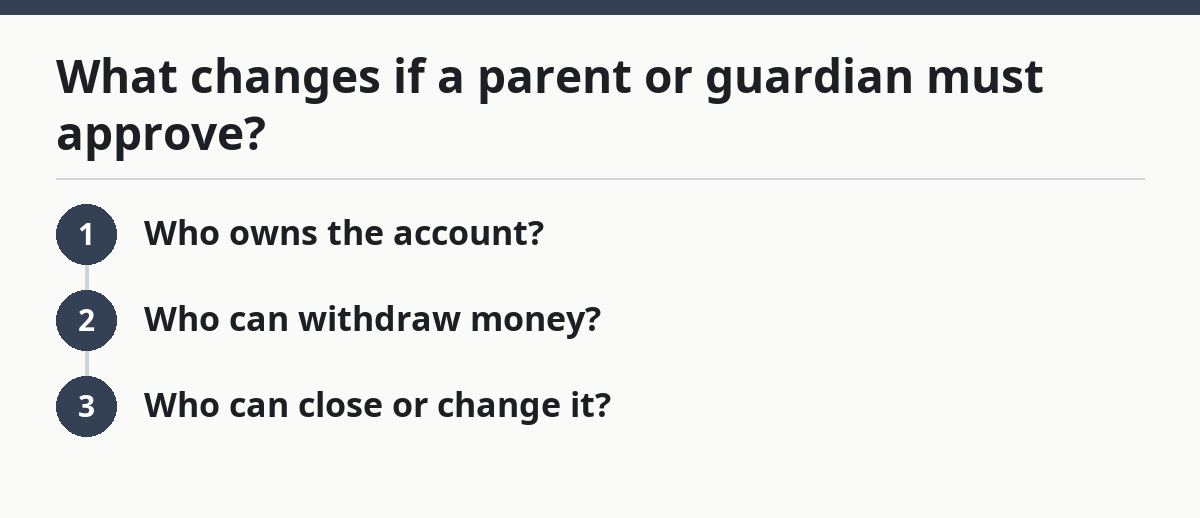
If the answers are not clear, the account is not ready to sign. That is especially true with joint accounts, where two people can sometimes act independently. A teen account should be used only when both people understand the control split.
This is also where honesty matters: a teen account is not the right choice if the adult cannot be trusted with shared access, or if the teen needs privacy that the account structure cannot provide. In those cases, wait until the teen can open the right account type under the bank’s rules, or speak with the bank directly before signing anything. For account-control questions with legal or tax implications, a financial professional can help.
What mistakes slow down teen account opening?
The most common mistakes are showing up with the wrong ID, assuming a debit card comes with every account, and skipping the fee check. Each one costs time or money, and all three are avoidable.
The first mistake is bringing only one person’s documents. If the bank needs the teen and the guardian, both should bring government ID. One missing ID can turn a 20-minute visit into a second trip. The fix is simple: call ahead and get the exact list for that branch, not the general website version.
The second mistake is confusing account access with account ownership. Some teens think that if they can use the debit card, they control the money. That is not always true. The adult may still own or co-own the account, and that adult may be able to monitor or restrict it. The fix is to ask who can do what before the first deposit goes in.
The third mistake is ignoring fees because the account is marketed as “for teens.” The account may still carry overdraft charges, ATM fees, or a monthly service fee if certain conditions are not met. The fix is to read the fee schedule, not the headline. A teen who uses cash often and visits outside ATMs can pay more than expected over a few months.
The fourth mistake is waiting until the last minute to set up the debit card and mobile banking. If the card needs activation, the PIN needs choosing, or the login needs a text message verification, that can all happen while the branch is still open. Once you leave, small setup problems become annoying delays.
If the account is needed for school, a first job, or regular allowance deposits, a clean setup matters more than rushing through the first offer. The wrong account can be closed later, but that costs time and sometimes a second round of identity checks.
FAQ
What do teens need to open a bank account?
Teens usually need identification, a tax ID number such as a Social Security number, and sometimes a parent or guardian to sign with them. The exact list depends on the bank or credit union. A government ID, proof of address, and the adult’s ID are common requests, so it helps to call before visiting.
Can a teen open a bank account alone?
Sometimes, but not always. Many banks and credit unions require a parent or guardian for minors, especially younger teens. Some institutions let older teens open certain accounts by themselves, but the age limit and account type vary. The account rules at one bank do not automatically match another bank’s rules.
What age can you open a bank account?
There is no single age that applies everywhere. Some institutions allow teen accounts before 18, while others require an adult co-owner until the teen reaches the age of majority in that state. The bank’s policy and the account type decide the answer, so the branch or account page is the final check.
Drafted with AI; not yet reviewed by a person.