Last updated: November 19, 2026
Key Takeaways
- A real offer names the employer, explains the role, and states pay timing.
- A teen can check a real employer by matching its website, contacts, and business records.
- The offer feels real when pay, schedule, and paperwork all match.
- Pressure, vague answers, or odd payment talk are signs to pause and verify.
A legit job offer gives you a real employer name, a way to verify that employer, clear pay details, and paperwork that matches what was said in the interview. If the offer is vague, rushes you, or asks for money up front, pause before saying yes. How Teens Can Know If a Job Offer Is Legit Before Saying Yes starts with checking the basics in writing, not guessing from a message.
What a legit job offer should show right away
A real job offer should name the employer, describe the job, and say how and when you get paid. That means you should be able to see the company name, the job title, the start date, the pay rate or salary, and the basic schedule before you agree.
A normal offer is not mysterious. The email, letter, or message should come from a company email address or another traceable contact point. It should also match what you were told in the interview about duties, hours, and location. If the offer says one thing and the interview said another, treat that mismatch as a warning sign and consider asking a parent, guardian, school counselor, or another trusted adult to help you review it. The FTC’s job scam guidance is a useful place to compare those details.
For teens, the biggest mistake is thinking, “They offered me a job, so it must be real.” A job offer can still be sloppy, misleading, or fake-looking. A legit employer usually expects questions. It does not get defensive when you ask for the company website, the supervisor’s name, or a written offer you can read carefully for 24 hours. The FTC and USA.gov both recommend checking details before you share personal information.
A quick way to judge the offer is to ask: Can I name the employer? Can I explain what I would do on day one? Can I tell how I will be paid? If the answer to any of those is no, the offer is not ready for a yes.
How can a teen verify a real employer?
A teen can verify a real employer by checking the company website, looking for matching contact details, and confirming the business exists in more than one place. Do this before you send personal information or accept a start date.
Use this 5-step check:
- Find the company website. Search the exact employer name plus the city. A real company usually has a site with an About page, services or products, and a contact page. If there is no site at all, that is not automatic proof of a problem, but it does mean you need extra caution.
- Match the email domain. If the company is called Northside Cafe, an offer from
hr@northsidecafe.comis easier to trust than one from a random personal email address. The name should line up with the domain. - Check the address and phone number. The offer should list a physical location or a working business number. Cross-check both on the website. If the number only appears in the job offer and nowhere else, that is a weak sign.
- Look for the hiring manager. A legit employer can usually tell you who is hiring you or who will supervise you. You should not be left with “someone from the team” and nothing else.
- Confirm the role exists. The title, duties, and shift should make sense for that business. A bakery hiring for a “remote packaging assistant” or a small shop hiring dozens of people at once may need a closer look.
A good habit is to keep screenshots of the offer, the email header, and the company contact page. If anything changes later, you will have a record. This matters more than people think, because a legitimate employer can still make a clerical mistake, and a fake one often depends on confusion. The Better Business Bureau and the FTC both advise checking outside sources, not just the message itself.
For background on checking business records and warning signs in hiring communications, the Federal Trade Commission’s consumer advice on job scams is a useful starting point, even though this page is about the offer itself, not the scam hunt.
The offer itself: pay, schedule, and paperwork that should line up
The offer is believable when the pay promise, schedule, and paperwork all tell the same story. If one part changes every time you ask, the offer is shaky.
Pay is the first place to slow down. You should know whether the job pays hourly, salary, commission, or by task. For teens, hourly pay is the easiest to understand because you can calculate exactly what a shift should produce. If someone says you will “start at $20+” but cannot explain whether that means hourly or commission-based, ask for the exact number in writing.
The schedule matters too. A real offer should say whether you work weekdays, weekends, evenings, or some mix. It should also say whether the job is part-time, seasonal, or on-call. If the schedule stays fuzzy and avoids actual hours, you may not have a clear offer yet.
Paperwork should come before the first shift, not after you already started. Expect to fill out hiring forms, identity and tax paperwork, and any required company documents before day one. In the U.S., many teens will see forms related to tax withholding and employment eligibility, and the employer should explain what each form is for. You should never be told to ignore paperwork because “we’ll sort it out later.” The Department of Labor explains that youth hiring rules and work authorization paperwork can matter, so it is worth checking the basics early.
A strong offer also explains how you will get paid. Ask whether pay comes by direct deposit, paper check, or another method. If the employer says “cash only” or changes the payment method at the last minute, be careful. Cash jobs can be real, but they make it harder to prove hours and pay if there is a dispute. A pay stub, even if digital, is a good sign because it shows hours, deductions, and pay period details.
Do not accept an offer that asks you to pay for training materials, equipment, or a “starter kit” before you begin. That is not how most normal hiring works. If the employer truly needs a uniform or tool, ask whether it is provided, reimbursed, or deducted from pay. Get that answer in writing. The FTC warns that up-front payment demands are a common scam sign.
What interview red flags tell you the offer may not be real?
An interview full of pressure, vagueness, or weird payment talk is a warning that the offer may not be reliable. The interview is where a legit employer usually gives you enough detail to make a calm decision.
Here are the red flags that matter most:
- You are hired almost immediately with no real questions. A fast hire is not always fake, but if no one asks about your availability, age, experience, or school schedule, the process may be too thin.
- The interviewer avoids names and titles. If you never learn who you are talking to, that is a bad sign.
- The interview happens only by text and moves too fast. Text can be part of a real process, but if the entire “interview” is 10 minutes of generic questions, be careful.
- The pay sounds unusually high but changes when you ask for details. A vague promise is not the same as a written offer.
- You are told to keep it secret or not tell a parent, guardian, or school counselor. Legit employers do not need secrecy.
- The interviewer pushes you to start today. A one-day deadline is meant to stop you from checking anything.
A common mistake is treating urgency as proof of opportunity. Consult a parent, guardian, school counselor, or another trusted adult if the pressure feels off. The FTC says rushed decisions are a common scam tactic, so slowing down is often the safer move.
If you are under 18, a real employer should also be willing to work with age-related limits, school hours, and any local rules about work permits or restricted tasks. If they act annoyed by those questions, the offer is weaker, not stronger.
The easiest way to compare a suspicious offer with a real one
A teen can compare a suspicious offer with a real one by checking whether the details stay stable across the email, interview, and paperwork. If the same facts keep changing, the offer is not dependable.
Use this comparison method:
| Detail | What a real offer usually does | What should make you pause |
|---|---|---|
| Employer name | Stays the same everywhere | Changes between email, interview, and paperwork |
| Pay | Listed clearly as hourly, salary, or commission | “As much as you want,” “around” a number, or no written pay |
| Contact info | Matches a website or business listing | Only a personal phone number or random email |
| Start date | Given in writing | “ASAP” with no actual date |
| Job duties | Match the interview | Sound broader or stranger after the interview |
| Pay method | Explained before day one | Sudden change to cash, gift cards, or unusual transfers |
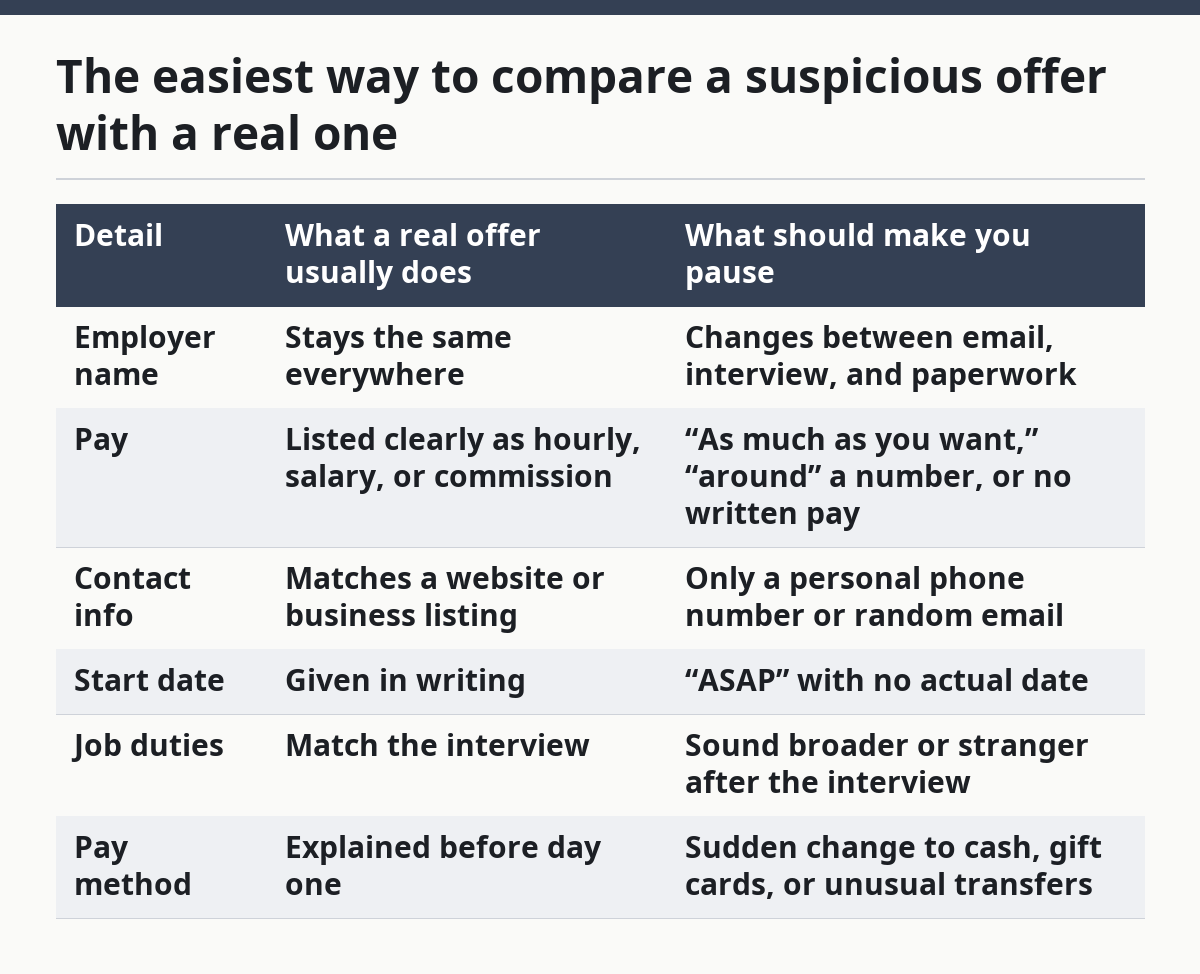
This is not about being paranoid. It is about reducing avoidable mistakes. Teens are often told to trust their gut, but the better move is to trust the details. A feeling can be wrong; a mismatch in the documents is harder to explain away.
If you have to choose one thing to verify first, verify the employer name and contact details. That is often the quickest check before you spend time on the rest, and it is one of the first things the FTC recommends checking.
This same habit also helps when you move on to other first-job decisions later. A good hub on teen income and first-job choices should sit alongside this page, because the ability to judge an offer is one piece of a bigger job-search process.
What to ask before you say yes
Before you say yes, ask for the offer in writing, ask how you will be paid, and ask who your direct supervisor will be. Those three questions often reveal whether the employer is organized or just improvising.
A practical script helps:
- “Can you send the offer details in an email?”
- “What is the exact pay rate, and is that hourly or salary?”
- “What is the official company name and website?”
- “Who will I report to on my first day?”
- “What paperwork should I complete before I start?”
- “How will I receive my first pay stub?”
The point is not to sound suspicious. The point is to make the employer put the job into concrete terms. A legitimate employer usually answers these questions without drama. If they dodge, minimize, or say you are being difficult, that tells you something useful.
This is also where teens often miss a chance to protect themselves. If you ask only one question, ask for a written offer. A text message can help, but an email or formal letter is easier to compare, save, and read carefully. It also gives you time to ask a parent, guardian, teacher, or counselor to look it over.
A real offer should still make sense after the excitement wears off. If you reread it the next day and it feels vague or rushed, trust that reaction enough to slow down.
When to walk away before the first shift
You should walk away before the first shift if the employer will not verify basic facts, keeps changing the pay story, or asks for money, passwords, or private information that has nothing to do with getting hired. That is the point where caution is smarter than hoping it works out.
Walk away if:
- the employer refuses to give a real name or business address
- the company website does not match the offer
- the “offer” has no pay rate in writing
- you are told to buy something before you start
- the paperwork looks unrelated to normal hiring
- you are pushed to start before you can read the terms
- the interview was only a few messages and ended with a job offer
The drawback of walking away is obvious: you might lose a job. The cost of staying in a bad offer is often bigger. You can lose time, personal information, and hours you never get paid for. In some cases, you can also get pulled into a mess that is hard to unwind.
If you are unsure, pause instead of saying no forever. Ask for 24 hours. A legitimate employer can usually wait that long. A shaky one often cannot.
What are red flags in a teen job offer?
Red flags are details that do not line up: a missing employer name, a vague pay promise, rushed hiring, and contact information that cannot be checked. Red flags also include being asked to pay first, start immediately without paperwork, or ignore questions about the job. One warning sign may be a mistake; several together are a reason to stop.
Should a teen pay anything to get hired?
No, a teen should not pay to get hired. A real employer does not require money for a job offer, a start date, or basic hiring approval. If a uniform, tool, or background check is mentioned, ask whether the employer provides it or handles the cost another way. Get the answer in writing before agreeing.
How can a teen verify a real employer?
A teen can verify a real employer by matching the company name, website, email address, phone number, and physical location across more than one source. The offer should point to a business that exists outside the message itself. If those details do not line up, ask for clarification before sending any personal information.
Is it normal to get hired without an interview?
It can happen, but it is not the safest default for a teen. Some jobs use short screening calls or message-based hiring, yet a complete lack of questions, verification, and paperwork is a warning sign. A real employer still gives enough details to make the offer understandable and checkable before you say yes.
Drafted with AI; not yet reviewed by a person.