Last updated: November 19, 2026
Quick answer: Teens should check every bank statement line, plus pending transactions, and compare them with receipts, app history, and recent purchases. A complete review starts with the latest full statement and the current bank app, then flags anything that does not match in about 30 days of spending.
Key Takeaways
- Review the statement first; the balance alone does not show the transaction details.
- Suspicious activity includes charges, holds, or withdrawals that do not fit normal spending.
- Tiny, repeated, or unfamiliar-merchant charges deserve the closest look.
- A strange merchant name is a reason to investigate, not proof of fraud.
A teen should check a bank statement for transactions they do not recognize, charges that are the wrong amount, merchant names that do not make sense, and activity they do not remember authorizing. In this article on What Teens Should Check on a Bank Statement for Fraud, the safest approach is to review the statement line by line and compare it with recent debit card purchases, app payments, and cash withdrawals.
Start with the bank statement, not the balance
The bank statement is the record to inspect first because the balance alone hides the details. A $12.47 charge can be harmless or fraud; the balance will not tell you which one.
Begin with the statement for the most recent full cycle, then look at the current activity in the bank app. If the statement shows 18 transactions and the app shows 4 pending ones, check all 22 items. That is where small fraud often hides. Teens who only glance at the ending balance miss the pattern and miss the charge descriptor.
A good review has a simple question behind every line: “Did I do this, approve this, or expect this?” If the answer is no, mark it. Do not assume a charge is safe because it is small. Fraudsters often start with a $1 or $5 test charge before trying a larger purchase.
Use this rule: match each line to a real event from the last 30 days. A coffee shop, a ride share, a streaming bill, a school lunch app, and a card tap at a store should all line up with something you remember. If a line has no match, that is the first red flag.
What to have open before you begin
You need 3 things: the bank statement, the bank app, and any recent receipts or order emails. A notes app or paper list helps too. Without those, the review turns into guessing, which is exactly how fraud gets missed.
How to review each transaction line by line
Check every transaction in order, from oldest to newest, and compare it with your own memory and receipts. This works better than jumping around because patterns become easier to spot.
-
Open the statement and the bank app side by side.
Look at the date, amount, and merchant descriptor for each line. When this works, each item on the statement has a matching line in the app or a clear reason it is there. -
Read the merchant name exactly as written.
A charge may show a store chain, a payment processor, or a shortened code name. When it works, you can connect the descriptor to a real purchase instead of guessing from the logo alone. -
Match the amount to what you actually spent.
Compare the exact dollar amount, including cents. A $9.99 charge is not the same as $9.49, and a tip or tax can explain a difference only if you remember making the purchase. -
Check the date and time window.
A purchase posted a day later is normal. A charge from 2 a.m. when you were asleep may still be yours if it was a subscription or delayed posting, but it deserves a second look. -
Look at pending transactions too.
Pending charges often appear before they finalize. If a pending $1.00 or $0.00 authorization shows up from a merchant you do not know, note it. Some are harmless holds; some are test charges. -
Mark anything you cannot explain in 1 sentence.
If you cannot connect the charge to a person, place, or app, flag it right away. A clean review ends with a short list of questionable items, not a vague feeling.
A useful way to think about this is simple: if a line cannot be tied to a real purchase in under 10 seconds, it deserves follow-up.
What suspicious activity looks like on a teen account
Suspicious activity is any charge, hold, or withdrawal that does not fit normal spending patterns. That includes obvious fraud and the less obvious stuff people ignore because the amount looks tiny.
Watch for these patterns:
- Unauthorized charges: purchases you did not make at all.
- Small test charges: $1, $2, or similar amounts used to see if a card still works.
- Duplicate charges: the same merchant and amount posted twice.
- Merchant names that do not match the store: a gas station showing up as a payment processor or a vending machine charge with a strange company name.
- Unexpected cash withdrawals: ATM withdrawals, cash-back amounts, or transfers you did not initiate.
- Pending transactions that never make sense: a hold from a merchant you never visited.
- Split charges: one purchase broken into 2 or 3 smaller items that do not fit what you bought.
The trick is not to look only for a big $200 problem. Fraud often starts with a small, boring line. A $3.49 charge can matter more than a $49 charge if the amount is unfamiliar and repeats a few days later.
One honest limitation: not every odd-looking charge is fraud. Some merchants batch payments, some subscription services use different billing names, and some card readers show a temporary hold before the final amount posts. That is why the next step matters before you panic.
For broader safety habits, the hub on teen money safety and fraud protection can sit beside this process, but this page stays focused on statement review.
Which charges are most likely to be fake or misused?
The charges most likely to be fake or misused are the ones that are either very small, very repetitive, or tied to a merchant name you do not recognize. That is the short version.
A few examples deserve extra attention:
- Repeated micro-charges: several small amounts in 1 week, especially under $10.
- Charges outside your routine: a restaurant in another city, a store you never visit, or a ride share late at night.
- Online merchant descriptors with no clue: names that look like abbreviations, holding companies, or payment gateways.
- Back-to-back card present charges: two swipes or taps within minutes when you only made one purchase.
- ATM and cash withdrawal activity: withdrawals you did not make, even if they are not large.
Teens sometimes assume fraud must be dramatic to count. It does not. A thief may test a debit card with a tiny purchase, then return later if the card still works. A phone or wallet loss can also trigger quick charges before anyone notices. That is why every line matters, not just the biggest one.
If a charge is pending, wait for it to post before assuming the final amount. But do not ignore it in the meantime. Write it down, because pending items can become final charges in 1 to 3 days depending on the bank and the merchant.
What to do when a merchant name looks wrong
A wrong-looking merchant name is not proof of fraud, but it is a reason to investigate the charge before you let it go. Many bank statements use billing names that do not match the storefront, especially for apps, delivery services, and subscription payments.
Start by comparing the descriptor with the exact purchase time. If you bought a $14.28 lunch through a food app, the statement may show the app company instead of the restaurant name. That is normal. If the descriptor has nothing to do with anything you used, write it down and check the date, amount, and any related pending transaction.
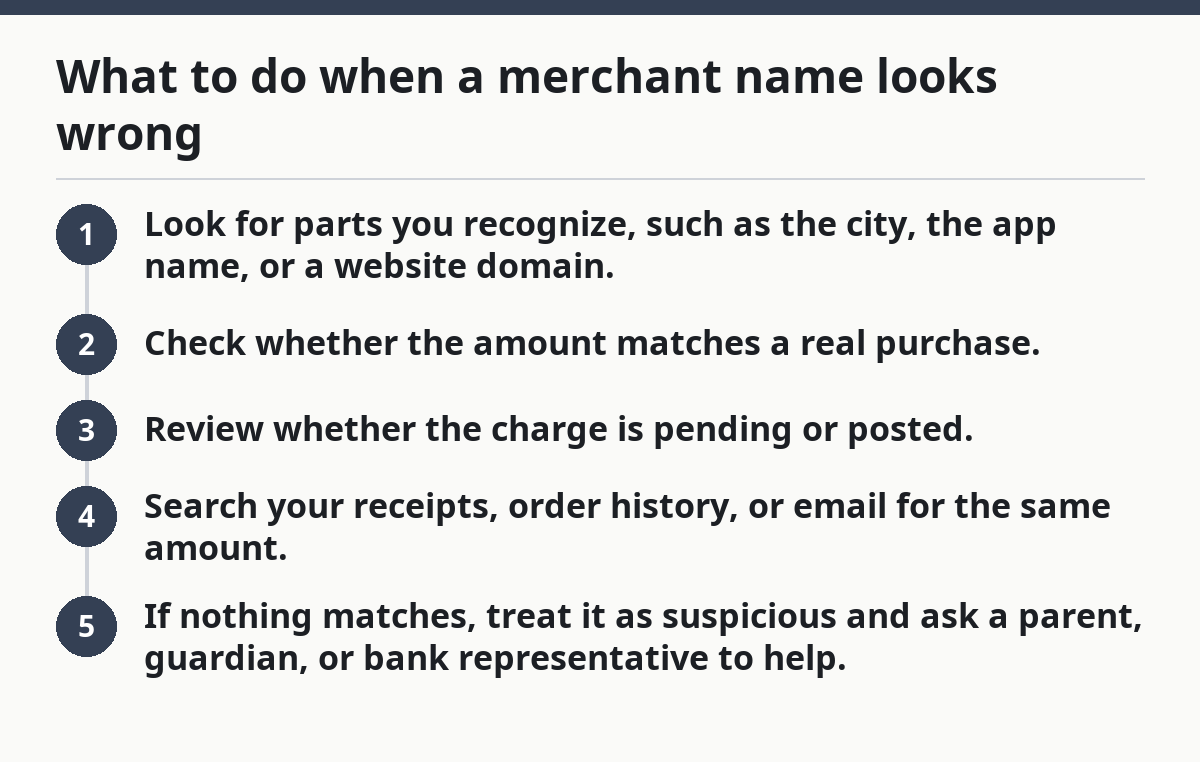
Use this short checklist for strange names:
- Look for parts you recognize, such as the city, the app name, or a website domain.
- Check whether the amount matches a real purchase.
- Review whether the charge is pending or posted.
- Search your receipts, order history, or email for the same amount.
- If nothing matches, treat it as suspicious and ask a parent, guardian, or bank representative to help.
The common mistake here is calling every unfamiliar name fraud. That wastes time and makes real fraud harder to spot. The better move is to compare 3 things at once: name, amount, and timing. If all 3 line up with a real purchase, the charge is probably fine. If only one of them lines up, keep checking.
This is also where a bank statement review beats a quick glance at app alerts. The statement often shows the final merchant descriptor more clearly than a push notification does.
Common mistakes teens make when checking for fraud
The biggest mistake is checking only the balance and skipping the transaction list. That misses the actual evidence.
Other mistakes are easy to make:
- Ignoring charges under $10: small losses add up, and small test charges often come first.
- Trusting a familiar logo instead of the descriptor: the logo can be misleading; the billing name is what matters.
- Forgetting pending items: a charge can look harmless while pending and become suspicious after posting.
- Not comparing against receipts or app history: memory alone fails fast, especially after a busy week.
- Waiting too long to review: the longer you wait, the harder it is to match a charge to a real purchase.
The cost of these mistakes is not just a single bad charge. It can turn a 2-minute problem into a mess that takes hours to sort out later. A teen who checks statements weekly is far more likely to notice a pattern after 2 or 3 odd transactions instead of after a month of silence.
The fix is boring but effective: review at a set time, such as every Sunday night, and keep it to the same 4 checks every time—date, amount, merchant name, and whether you remember authorizing it. That routine catches more fraud than a random glance after the account feels “off.”
A simple 5-minute review routine that works
A 5-minute routine is enough for a normal teen account if the spending volume is not huge. The point is consistency, not perfection.
Do this in order:
- Open the latest bank statement or monthly PDF.
- Scan every line for unfamiliar merchant names.
- Compare each amount with recent receipts and app history.
- Flag any charge you do not recognize, including $1 or $0 holds.
- Check the bank app for pending transactions that are not on the statement yet.
When this routine works, you end with one of 2 results: either every charge matches a real purchase, or you have a short list of questionable items to investigate. If you finish and still feel unsure about 1 or 2 charges, that is a sign to slow down, not to assume they are fine.
The routine is not ideal for everyone. If a teen makes lots of purchases in a week across several apps, 5 minutes may not be enough. In that case, split the review into 2 parts: in-person card use first, then app and online payments. But for a basic debit card account, this method is practical and repeatable.
A statement review is one piece of money safety, not the whole picture. It belongs inside a broader teen money safety and fraud protection plan, where account habits, device security, and quick follow-up all matter. For related guidance, see the Consumer Financial Protection Bureau’s advice on bank account security and the FTC’s fraud reporting guidance.
What should a teen do if a charge still looks wrong?
A teen should treat an unexplained charge as a problem to document, not a problem to guess about. Write down the date, amount, merchant name, and whether it is pending or posted.
Then compare it against 3 places: the bank app, recent receipts, and any order history tied to the debit card. If it still does not match, keep the note handy and follow the bank’s dispute process. A bank can usually sort out a questionable transaction faster when the details are clear.
Do not wait a week just to see if the charge “goes away.” Waiting makes it harder to remember whether you authorized it, and that memory matters. If the charge is a small test charge, a fast review can stop a larger one from being overlooked later.
If a teen is unsure whether the issue is fraud or a billing mistake, it is reasonable to ask the bank’s support team to explain the merchant descriptor or the pending status. For account-specific guidance, a parent, guardian, or bank representative may help, but the statement review itself starts with the teen’s own transaction list.
What counts as an unauthorized charge?
An unauthorized charge is a payment you did not approve and did not make yourself. It can be a card swipe, a tap, an online purchase, or a debit transaction that you do not recognize. If you cannot connect the charge to a purchase, it is worth treating as suspicious until a bank or other professional confirms what it is.
How far back should teens check statements?
Teens should check at least the most recent full statement and the current pending activity in the bank app. One month is the basic starting point because it captures most ordinary spending cycles and subscriptions. If something looks wrong, it helps to look back farther for repeated small charges or a pattern across 2 statements.
What if the charge says a different store name?
A different store name can mean the merchant uses a billing descriptor that does not match the storefront. That is common with apps, delivery services, and payment processors. Compare the amount, the date, and any receipt before calling it fraud. If none of those match, the charge still deserves follow-up.
Drafted with AI; not yet reviewed by a person.