Last updated: November 19, 2026
Quick Answer: use 3 checks before sending money — confirm the person, review the refund rules, and write a clear note. In How Teens Can Make a Safe Payment to a Person They Do Not Know Well, those 3 checks are the fastest way to reduce risk before a person-to-person payment goes out. If the person is not well known, it is usually wise to slow down for a few minutes before sending anything. A quick check now can save a teen from a payment that is hard or impossible to reverse.
Key takeaways
- Match the payment method to the risk, not just to convenience.
- Confirm the person’s name, account handle, and reason for the payment before you tap send.
- Use the note field to label the payment clearly, not to share private details.
- Treat “send it now” pressure as a warning sign, and if the request still seems unclear, consult a parent, guardian, or another trusted adult; the Federal Trade Commission says pressure and urgency are common scam signals.
- A receipt or confirmation screen is not the same as a refund policy.
What payment is safest for a teen?
The safest payment is the one that gives the teen enough time to check the recipient and the best chance of getting money back if something goes wrong. For a person you do not know well, that usually means choosing a person-to-person payment app only after you confirm the recipient and understand the app’s refund policy before you send money.
A generic cash transfer is often a poor choice for a new or shaky relationship. Once money leaves a peer-to-peer app, the transfer can act more like cash than a card payment. That means the default is often final, especially if the recipient is already a real account holder and the payment was authorized by the sender.
Think of the choice in terms of risk, not just speed. Paying a classmate you have met in person is different from paying a seller in a chat app, and both are different from sending money to a handle you found in a group post. If the person is not someone you know, it is usually better to stop and ask, “Can I verify this name and can I see the refund rules before I pay?”
The Consumer Financial Protection Bureau and the Federal Trade Commission both warn that person-to-person payments can be hard to reverse once sent. That makes the teen’s first job simple: do not treat a payment app like a returnable purchase if the transaction is really a transfer to an individual.
How do I check the recipient first?
I check the recipient by matching the person’s real name, the account name, and the reason for the payment before any money leaves the app. A safe check takes about 2 minutes and should happen before the final tap, not after.
Start with the name the person gives you. Ask for the exact spelling and compare it with the name shown in the app profile. If the app only shows a handle, ask for another proof point, such as the same name used in the message thread or the same phone number that was already shared in the chat.
Then ask what the payment is for in one plain sentence. A real request is usually specific: split lunch, concert ticket share, club fee, used textbook, or a refund to a known item. A vague reason like “just send it” is weak evidence. If the person cannot explain why the payment amount is what it is, the risk goes up.
When the request comes from social media, be stricter. Profiles can be copied, names can be close to real names, and screenshots can be reused. A teen should not rely on a profile photo alone, because a face in a profile is not proof of identity. A better check is a live message or a separate contact method already known to belong to that person.
Here is a simple order that works:
- Ask for the exact name on the payment account.
- Match that name to the message thread or another known contact point.
- Confirm the amount and what it is for in one short sentence.
- Look for signs of pressure, changes in the amount, or a new account name.
- Send only if the details line up and the request still makes sense.
If any step feels off, pause. A pause costs nothing; a mistaken transfer can cost the full amount.
Which payment method gives the most protection?
A payment method with clearer refund terms gives more protection than one that acts like cash, and the app’s refund policy matters more than the app’s logo. For a teen, the better choice is usually the method that keeps a payment trace and gives the sender a chance to challenge a problem through the provider’s process.
| Payment method | Main strength | Main drawback | Best use |
|---|---|---|---|
| Person-to-person payment app | Fast and easy to trace | Refunds may be limited once sent | Paying someone verified and known |
| Debit card tied to an app | Clear bank record | Money can leave fast if the payment is authorized | Smaller payments where record-keeping matters |
| Cash | Simple in person | No built-in record or refund path | Face-to-face, low-risk situations only |
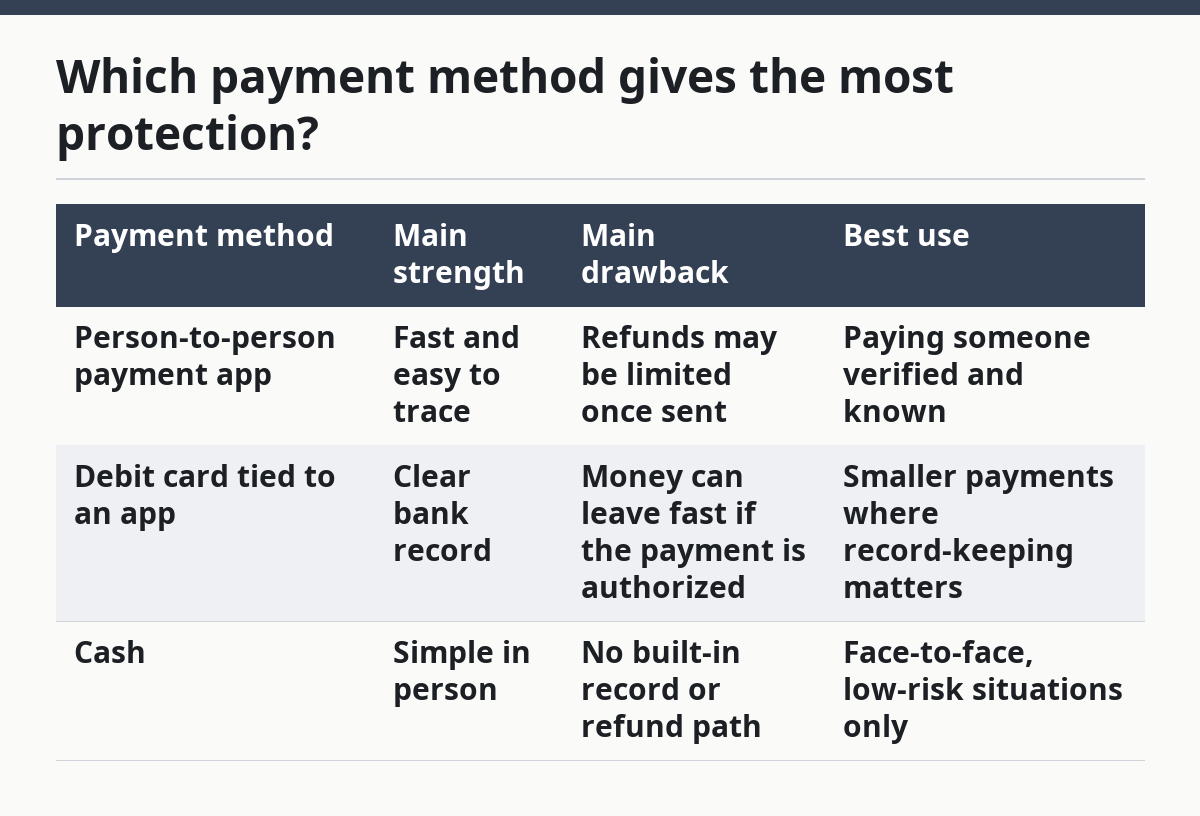
For a stranger, cash is risky because there is no transaction confirmation inside an app and no easy record to review later. A debit card or a linked bank account may give a better paper trail, but that does not mean the transfer is easy to undo. The key is still the refund policy and the payment setting, not the source of the funds alone.
Before sending, open the app and look for the terms around sent payments, cancellations, or disputes. If the app says a transfer is final after the recipient accepts it, then the teen should treat that transfer as if it may not come back. That is the right mindset for person-to-person payment, especially with someone who is not well known.
This is also where adult supervision can matter. If the payment is tied to a large amount for a teen, or the recipient is a stranger from an online listing, a parent or guardian should review the plan before the money moves. That is not about control; it is about matching the risk to the payment type.
What should go in the payment note?
The payment note should say what the money is for in plain words and should not include private details, guesses, or jokes. A clean note makes the transaction easier to identify later and can help if a support team needs to review the payment.
Keep the note short. A few words usually do the job: “math book,” “split lunch,” “club dues,” or “ticket share.” That is enough to explain the purpose without oversharing. A note that includes a school name, a phone number, or personal information can create more privacy risk than it solves.
Do not use the note to argue, threaten, or make promises that are not true. Do not write “loan,” “gift,” or “for services” unless that is exactly what it is. A misleading note can make a later refund request harder to explain and can also confuse the record of what the payment was meant to cover.
The note field is not a shield. It does not turn a risky payment into a safe one, and it does not fix a mistake in the recipient’s account. Still, it helps create a clean transaction confirmation, which matters when a teen has to look back at the transfer on a phone screen or in an email receipt.
What are the common mistakes teens make?
The most common mistakes are sending too fast, trusting a familiar-looking name, and skipping the refund check because the amount seems small. Even a small payment matters if it goes to the wrong person or if the app will not reverse it.
One mistake is paying before the identity is checked. That can cost the full amount if the transfer lands in the wrong account or if the recipient disappears. The fix is simple: hold the payment until the name, reason, and amount all match.
Another mistake is assuming a screen with a green check mark means the money can come back. A transaction confirmation only proves that the payment was sent or accepted. It does not guarantee a refund, a return, or a second chance to cancel.
A third mistake is treating a rushed request as normal. If the person says the payment must happen in 10 minutes, or says the app must be used right now, the pressure itself is useful information. Honest sellers and honest classmates usually have time to answer a question or repeat their details.
A fourth mistake is paying from the wrong source. If the teen uses a balance meant for something else, the payment can create a bigger problem than the original request. The safer move is to confirm the amount and payment method first, then send only once.
When should a teen stop and ask an adult?
A teen should stop and ask an adult when the payment is large, rushed, or tied to someone who is not easily verified. That is especially true when the request arrives through social media, a group chat, or a marketplace-style message, because those settings make identity checks weaker.
A quick adult check is also smart when the payment method is linked to a bank account or debit card and the teen is unsure about the refund policy. If the rules are unclear, the cost of a mistake can be higher than the value of the item or favor being paid for. One short conversation can prevent a bad transfer.
This is not about second-guessing every small payment. It is about matching the level of caution to the level of trust. Paying a teammate for a shared pizza is different from paying an unknown seller for a promised item. If the person cannot be verified in 2 or 3 simple checks, the safest answer is no.
For a broader set of habits around teen money safety, the hub article on Teen online money safety and scam prevention — The Complete Guide fits here.
How can a teen do the payment step by step?
A teen can do the payment safely by using a short checklist before tapping send. The point is to slow the process down enough to catch a mismatch, without making the payment harder than it needs to be.
- Open the person-to-person payment app and confirm the recipient profile shown on screen.
- Match the name in the app with the name the person gave you in chat or text.
- Read the request again and make sure the reason for the payment still makes sense.
- Check the refund policy or transfer rules in the app before entering any amount.
- Type a short note that explains the purpose in plain words.
- Review the amount one last time, then send only if the details still line up.
- Save the transaction confirmation or receipt for later reference.
Each step does one job. The name check helps with identity, the policy check helps with refund risk, and the note creates a useful record. If the app does not show enough details to do those checks, that is a sign to stop and choose another way to pay.
A teen does not need to make this complicated. The better payment is usually the one that happens after a few calm checks, not the one that happens fastest.
Should I pay a stranger with a bank app?
A teen should only pay a stranger with a bank app after checking the person’s identity, the reason for the payment, and the app’s refund rules. A bank app can move money quickly, which is useful, but quick also means mistakes can happen fast. If the request is vague or rushed, a slower method is safer.
How do I verify a person before paying them?
A teen can verify a person by matching the exact name in the app, checking the request against the chat thread, and asking for a clear reason for the payment. If the account name, message, and amount do not line up, the payment should wait. A 2-minute check is better than losing money to the wrong account.
What if the person asks me to send money fast?
A teen should treat fast pressure as a warning and pause before paying. A real request can usually wait long enough for a name check and a refund-policy check. If the person pushes hard, changes details, or says the payment must happen right away, the safer move is to stop and ask for help.
Drafted with AI; not yet reviewed by a person.