Last updated: November 20, 2026
Quick answer: a shared-expense budget works best when teens sort costs into two payers, then review the split once a week. Teens who pay for some things while parents pay for others need a shared-expense budget. The fix is to separate family-paid costs from personal money, then assign each cost to one bucket and track it the same way every week. The sections below show how to do that without mixing up allowance, school expenses, and personal savings. How Teens Can Budget When Parents Cover Some Costs and Not Others is a practical way to do that.
Who this is for, and what a shared-expense budget means
A shared-expense budget works best when you already know which costs your parent or guardian covers and which ones come from your own money. It is for teens with mixed funding: part family-paid, part personal spending money, and sometimes a little savings for school expenses, clothing, or extras.
Picture this: you get lunch money from a parent, but you pay for phone data, snacks, and a birthday gift yourself. The problem isn’t that you have “no budget.” It’s that your budget has two payers. The truth is, a teen budget gets clearer when each cost has one owner.
A shared-expense budget is not a full household budget, and it is not a spending contest. It is a simple map of who pays for what, with no guesswork. That means you can use categories like family-paid expenses, personal spending money, school expenses, personal savings, and household costs without pretending they all come from one pot.
According to the Consumer Financial Protection Bureau, a budget is most useful when you track income and expenses in a way that matches your real spending. Money rules vary by country, age, bank, and family setup, so a qualified adviser is the right person for your own situation if the choices are bigger than routine spending.
Key Takeaways
- Split money by payer, not just by category.
- Put every expense in one bucket before spending starts.
- Keep parent-paid costs visible so you don’t double count them.
- Save your own money only after the fixed teen costs are mapped.
- A shared-expense budget is about clarity, not control.
How do teens budget when parents cover some costs and not others?
Teens budget this way by naming each expense, assigning the payer, and tracking only the money they actually control. That means your budget should show what your parent pays, what you pay, and what stays in personal savings.
Picture this: you have a school trip, a haircut, a streaming subscription, and bus fare. Some of those are family-paid expenses; some are yours. The budget works when you stop treating all spending as if it comes from the same place. That is the whole trick.
- Write down every recurring cost for one month. Include school expenses, rides, snacks, phone costs, clothing, gifts, and any small household costs you pay for. Use one page or one notes app. Verify that you listed the boring stuff first; missing the repeat items usually means the budget will break.
- Mark who pays each item. Use two labels only at first: “parent/guardian” and “me.” If a cost changes from month to month, note that beside it. If you can’t tell who pays, that is the problem to solve before the month starts.
- Separate fixed costs from flexible costs. Fixed costs stay about the same, like a monthly plan or a regular school fee. Flexible costs change, like snacks or weekend spending. If you mix them, your personal spending money will look bigger than it is.
- Set aside your share as soon as money arrives. If you get allowance or income, move the amount you need for your own costs into a separate envelope, app pocket, or simple ledger line within 24 hours. Verify the set-aside amount matches the month’s mixed funding plan. If it doesn’t, the plan is too loose.
- List a spending limit for each teen-paid category. Give each category one number, even if it is small. For example, “transport,” “fun,” and “personal savings.” Without category limits, one cheap purchase can eat the whole week.
- Track every payment the day it happens. Record the date, amount, category, and payer. A plain spreadsheet works. The problem shows up when you wait a week and cannot tell whether the money was yours or your parent’s.
- Review the leftover amount before the next week starts. Check whether the balance matches your notes. If the numbers do not match, find the missing receipt or forgotten cash spending before you spend again.
- Adjust only one thing at a time. Change the category that caused the shortfall, not the whole budget. If transport stays too low for several weeks, raise transport and trim another teen-paid category. Big edits make it impossible to learn what actually changed.
The best part is that this method still works even if your parents pay the big bills and you only cover a few small ones. Small budgets still need structure. Small budgets still need a plan.
What should be in your own bucket, and what should stay in the family bucket?
Your own bucket should hold the costs you are expected to pay from allowance, income, or saved cash. The family bucket should hold expenses your parent or guardian already agrees to cover, especially shared household costs and bigger school expenses.
Picture this: your parent buys school shoes, but you pay for coffee, a club fee, and movie tickets. If you blur those together, you may think you have more money than you do. The better move is to label each item before the money leaves your hand.
Use these categories as a starting point:
- Family-paid expenses: school forms, supplies, transit cards, medical extras, or clothing if your parent handles them.
- Teen-paid essentials: phone top-ups, bus fare, lunch money not covered at school, small toiletries.
- Teen-paid wants: games, snacks, streaming, outings, gifts.
- Personal savings: money you keep for a later goal, not daily spending.
- Shared household costs: things like a family meal contribution or a chore-related purchase if that is part of your arrangement.
Here’s the catch: the same item can belong in different buckets in different homes. A phone bill may be a parent-paid cost in one family and a teen-paid cost in another. The category is less important than the agreement behind it.
A useful rule is simple: if a parent says they will pay it, do not count it as your spending money. If you pay half of something, write that split down. Shared spending without a written split often turns into confusion by the third week of the month.
What if the split changes from month to month?
If the split changes, your budget should change with it the same day, not at the end of the month. Mixed funding is normal in families, but it needs a fresh note whenever the payer changes.
Picture this: one month your parent covers school transport, and the next month you do because of a temporary change. If you keep the old plan, your numbers will lie to you. That is how teens end up spending personal money twice — once in real life and once on paper.
Use a simple update rule:
- If a parent takes over a cost for one month, mark it as family-paid for that month only.
- If you start paying a new expense, add it before the next purchase.
- If a cost is split, write the split in plain language, such as “50/50” or “parent pays first half, I pay extras.”
This is where a weekly check-in helps. Ten minutes is enough. Review what changed, what stayed the same, and which costs still belong in your budget categories. If you wait a full month, the trail gets messy.
On the flip side, a one-time event does not need to reshape the whole system. A school trip, a holiday gift, or a single repair should be recorded as a special expense, not as a permanent category unless it really repeats. That keeps your budget from getting bloated.
How do teens separate personal money from family-paid expenses?
Teens separate personal money from family-paid expenses by using different places, different labels, or both. The method matters less than the separation itself, because mixed money causes the biggest errors.
Picture this: cash in your wallet, a parent’s card, and a digital balance all get used in the same week. If you do not tag each payment, you cannot tell what is left for your own spending. That makes a small budget feel random.
Use one of these setups:
- Two-envelope method: one envelope for your money, one for family-paid items you handle on behalf of a parent.
- Two-line ledger: one line for personal money, one line for family-paid costs.
- Two app categories: one for your spending, one for shared costs.
The point is to stop family-paid money from looking like available personal cash. If you spend from a parent-paid category, note it as paid by family, not by you. If you reimburse a parent later, note that too.
A good sign is simple: you can answer, in under 30 seconds, “How much of this week’s money is actually mine?” If you can’t, the system is too mixed.
Simple example of mixed categories
| Item | Who Pays | Budget Category |
|---|---|---|
| School lunch | Parent | Family-paid expense |
| Bus fare | Teen | Teen-paid essential |
| Birthday gift | Teen | Teen-paid want |
| Exam fee | Parent | School expense |
| Phone data | Teen | Personal spending money |
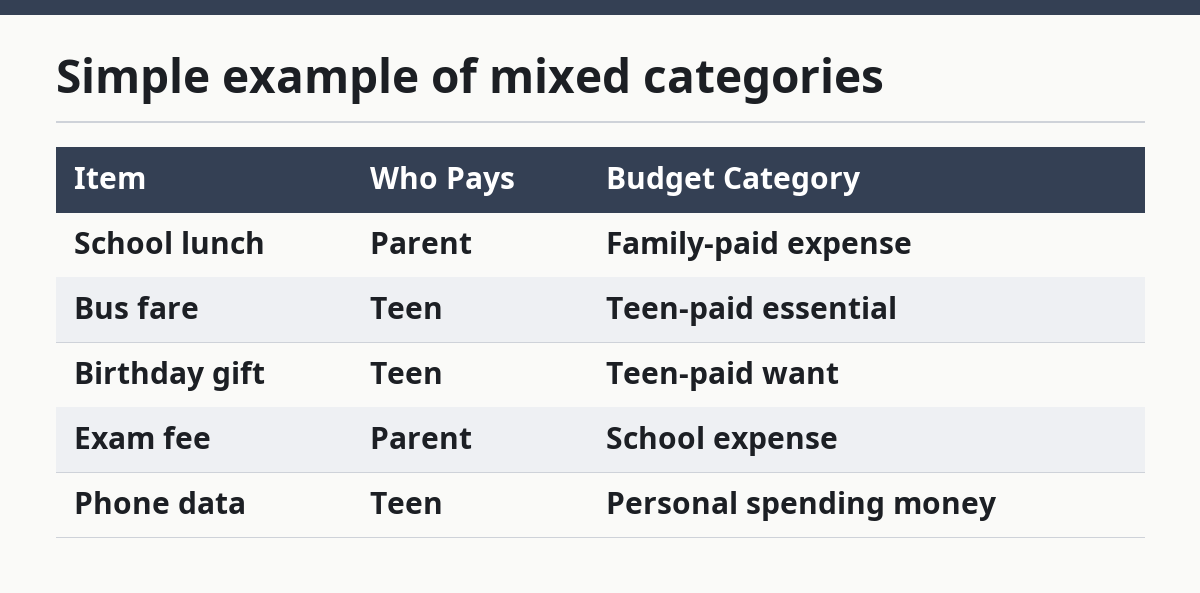
A table like this is enough to start. It does not need fancy software or a perfect math system.
The mistakes teens make with mixed budgets
The biggest mistake is treating all money as one pile. That makes family-paid expenses look available, and personal savings disappear on small purchases. The fix is to label costs before spending, not after.
Picture this: you see a balance and think you have money left, but part of that balance belongs to school expenses your parent already promised to cover. That is not extra cash. That is a bookkeeping error.
Other common mistakes:
- Forgetting small costs. Snacks, bus changes, app fees, and emergency photocopies add up fast. The consequence can be a budget that feels short even when the big items were planned. The better move is to track anything you pay once it happens, no matter how small.
- Using savings as spending money. A savings goal is not spare cash. If you dip into it for everyday purchases, the goal keeps moving away. Keep savings in a separate line and do not raid it for routine spending.
- Not agreeing on the split first. If no one says who pays, the teen often assumes wrong. That can create awkward arguments and surprise expenses. The better move is to confirm the payer before the purchase.
- Mixing gifts with personal spending. Gifts feel optional until the date arrives. Then the budget gets squeezed. Put gifts in their own category, even if the amount is small.
- Never checking the total. A category-by-category plan still fails if the total teen-paid amount is higher than your income or allowance. The fix is to compare the total with what actually comes in each week or month.
The truth is, mixed budgets are less about math and more about clarity. The clearer the labels, the fewer the surprises.
When does this approach stop working?
This approach stops working when the family agreement is too unclear, too changed, or too large for a teen-only system. At that point, the problem is not the budget sheet — it is the missing agreement.
Picture this: every week a parent changes which costs they will cover, and nobody writes it down. Your budget can’t fix a moving target. It can only reflect one.
The agreement changes every few days: the payer is not stable — write down the current split before any new spending.
You are covering a bill you can’t predict: the cost belongs in a different plan — pause new spending until the amount is clear.
Your teen-paid costs exceed your money: the plan is overfull — cut one category or wait for more income or allowance.
There is no shared rule for emergencies: surprise costs will keep breaking the budget — make a parent/guardian decision first, not during checkout.
You cannot tell whose money is whose: the system has become too mixed — separate cash, cards, or app categories right away.
This is also where a parent or guardian needs to be part of the fix, since the budget depends on who pays what. If the family side keeps shifting, a teenager alone cannot make the numbers reliable.
How the result should look after 30 days
A good shared-expense budget leaves you able to name your costs, your payer, and your leftover money without guessing. After a month, you should know which categories repeat, which ones are one-offs, and where the leaks are.
Picture this: you look back and can say, “I paid for transport and snacks, my parent covered school fees, and I still have part of my personal savings untouched.” That is a working system. It does not have to be fancy.
A solid result usually has three signs:
- Your family-paid expenses are no longer mixed into your personal spending money.
- Your teen-paid categories still make sense after a month of real spending.
- You can spot one or two weak points, like transport or gifts, and adjust them next month.
If you want a fuller money plan after this, the hub on teen budgeting and goal planning can sit next to this page and fill in the bigger picture. This page stays focused on the shared-expense part.
The best result is a budget that tells the truth.
What if parents pay for some things but not others?
Then the budget should show two separate payers and not pretend the teen is funding everything. Mixed support is normal, and the cleanest answer is to list each cost under the right person before money is spent.
Picture this: your parent covers school supplies, but you handle phone costs and weekend plans. If you record both as “my spending,” you will think you have less room than you do in some places and more in others. The balance gets distorted fast.
The fix is to group each item by payer and category. Family-paid expenses stay out of your own spending total, while teen-paid items come out of allowance, income, or saved cash. If one cost is split, write the split clearly so no one has to guess later.
Drafted with AI; not yet reviewed by a person.