Last updated: November 20, 2026
Quick Answer: in most families, the safest starting point is one parent-controlled teen banking setup with alerts, card freezes, and transfer caps. Teen banking access is usually a joint setup: a parent or guardian opens the relationship, the teen gets a card and app access, and the adult keeps control over transfers, limits, and alerts. The right setup is the one that gives the teen practice without giving away full control. The sections below show which path fits which family, what to ask for at the branch or online, and where the common mistakes hide.
Key Takeaways
- A teen setup is not one thing. It can mean a joint checking account, a youth debit card, or a parent-owned account with teen permissions.
- A practical control set is the one you can actually use every week: alerts, card freezes, transfer caps, merchant blocks, and cash limits.
- If the teen needs more freedom, start with spending controls before you hand over full transfer power.
- If there’s only one adult on the file, read the rules on replacement cards, cash withdrawals, and mobile login recovery before you open anything.
- The wrong setup is usually the one that looks easy on day one but becomes hard to supervise by month two.
Picture this: you want your teen to buy lunch, split a ride, and learn how money works, but you do not want surprise overdrafts or late-night transfers. Start with control, not freedom. The guide below settles which setup fits your household, what to turn on first, and which parts to avoid if you want fewer headaches.
What actually determines the right teen banking setup?
The right setup is the one that matches who owns the money, who can move it, and who needs a card. If the teen only needs spending access, a parent-controlled youth debit card may be enough. If the teen gets allowance, a part-time paycheck, or both, a checking setup with alerts and limits usually fits better.
Since banks use different labels for the same idea, the name matters less than the rule sheet. One bank calls it a teen checking account, another calls it a youth account, and a third treats it as a joint account with special controls. If the wording is confusing, consult the bank directly or a qualified professional before you open the account, because the age rules and permissions can differ by institution and state. The Consumer Financial Protection Bureau’s account-access guidance is a good place to start: https://www.consumerfinance.gov/consumer-tools/debit-cards/
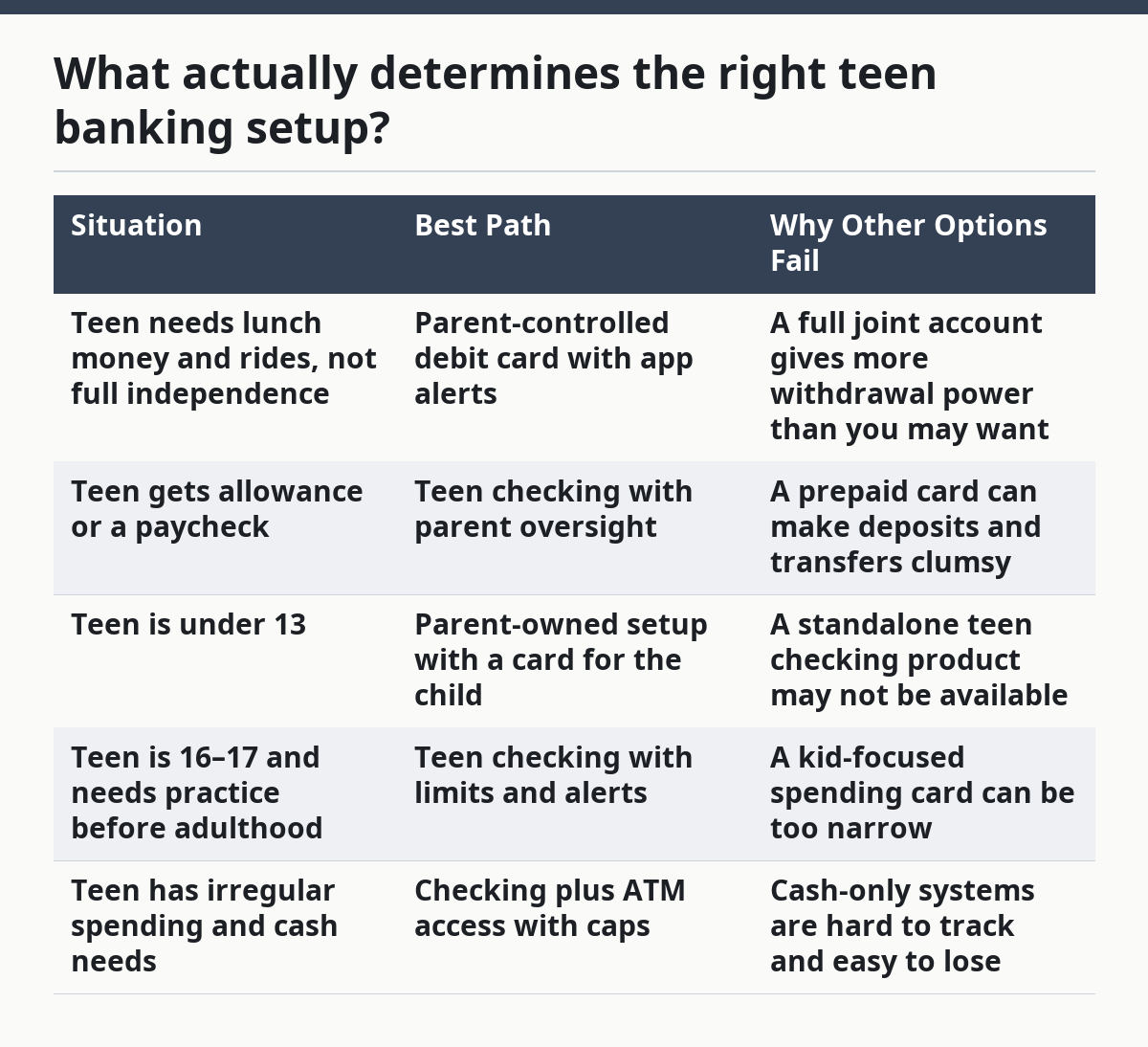
Use this table to sort the options fast:
| Situation | Best Path | Why Other Options Fail |
|---|---|---|
| Teen needs lunch money and rides, not full independence | Parent-controlled debit card with app alerts | A full joint account gives more withdrawal power than you may want |
| Teen gets allowance or a paycheck | Teen checking with parent oversight | A prepaid card can make deposits and transfers clumsy |
| Teen is under 13 | Parent-owned setup with a card for the child | A standalone teen checking product may not be available |
| Teen is 16–17 and needs practice before adulthood | Teen checking with limits and alerts | A kid-focused spending card can be too narrow |
| Teen has irregular spending and cash needs | Checking plus ATM access with caps | Cash-only systems are hard to track and easy to lose |
Before opening anything, ask four questions:
- Who is the legal owner of the money?
- Can the adult see every transaction in real time?
- Can the teen transfer money out without approval?
- What happens if the card is lost at 9 p.m. on a Saturday?
The answer usually depends on the teen’s age, the bank’s age rules, and how much supervision you want to keep. Most banks require a parent or guardian to be on the opening paperwork for minors, and many youth products have age bands such as 13, 14, or 16. Those bands are not decoration; they change what the teen can do in the app.
Quick check: if you want supervision first and independence later, you probably need a teen checking setup with controls, not a loose joint account.
How do I set up teen banking access without making a mess?
You set it up by choosing the owner structure first, then the card and app access, then the controls. If you skip that order, you end up with login trouble, unclear authority, or a card that works but a parent who cannot see the spending.
Because the setup can get messy fast, slow down when the bank asks for identity and funding details. A bad setup on day one becomes a lockout, a duplicate login, or a mess when you need to freeze the card later.
A clean setup usually looks like this:
- Pick the structure: parent-owned youth card, joint checking, or teen checking with adult oversight.
- Confirm the age rule with the bank before you collect paperwork. Some products start at 13; others begin at 15 or 16.
- Bring the required ID for both the adult and the teen. That can include a driver’s license, passport, student ID, or Social Security number, depending on the institution.
- Decide who gets the main login. If the bank allows separate logins, use them. Shared passwords are a bad idea.
- Turn on text or app alerts for every purchase, ATM withdrawal, online transfer, and low balance notice.
- Set the first spending limit lower than you think you need. A $25 or $50 daily cap is a useful starting point if the bank allows custom limits.
- Test one live transaction together, such as a $5 purchase or a small transfer, before you rely on the setup.
- Write down the steps for freezing the card, resetting the PIN, and replacing the card. Keep that note somewhere other than the teen’s phone.
The first month is about proving the rails work. Not the balance. Not the app design. The rails.
If the teen has earnings, set up direct deposit only after you know where the money lands and who can move it. Some banks split teen products from adult accounts, and some let you move funds only from the linked parent account. That matters when a paycheck hits and the teen expects instant access.
Two real sources help here: the Consumer Financial Protection Bureau has plain-language guidance on account access and debit card rights, and the FDIC explains deposit insurance for bank accounts. If a bank’s youth setup sounds vague, those are worth reading before you sign anything. FDIC deposit insurance basics are here: https://www.fdic.gov/resources/deposit-insurance/
Quick check: if you don’t know who can freeze the card, reset the login, and move money out, the setup is not finished yet.
Teen banking controls that matter most
The controls that matter most are alerts, spending caps, card freezes, and merchant blocks. If a bank offers those four tools, you can usually keep a teen setup useful without making it risky.
Picture this: your teen is in the lunch line, the card declines, and now you need to know whether the problem is a low balance, a daily cap, an ATM limit, or a blocked merchant type. That is why controls beat guesswork. The fewer surprises, the better the lesson.
Here is the control set I treat as the baseline, but you should still confirm the options with the bank or a qualified professional before relying on them:
- Purchase alerts: text or push alerts for every swipe, tap, and online charge.
- Low-balance alerts: warnings before the balance hits zero.
- Daily spending limits: a ceiling on purchases.
- ATM limits: a cap on cash withdrawals.
- Card freeze/unfreeze: immediate lock from the app.
- Merchant controls: blocks on gambling, cash-like transfers, or other categories if the bank supports them.
The trick is to set controls by use case, not by fear. A teen who buys school lunch and books needs different limits than a teen who drives, fills gas, and orders rides. A school-day cap might be enough for one, while the other needs a higher weekly limit but tighter cash withdrawal rules.
On the flip side, too many controls can make the card useless. If you set the purchase limit too low, the teen will keep getting declined for normal spending and stop trusting the setup. That can be a poor fit if the point is supervision. It is not a lesson; it is friction.
Use this quick rule:
- If the teen overspends, lower the daily cap and keep alerts on.
- If the teen forgets receipts, use instant alerts and a weekly review.
- If the teen loses things often, prioritize freeze/unfreeze and a replacement card process.
- If the teen travels for sports or school trips, make sure out-of-state or out-of-network use won’t trigger an unnecessary block.
A strong control set is simple enough to explain in one minute. If it takes a long lecture to explain the rules, the setup is too complicated.
Quick check: if your main worry is surprise spending, start with alerts and limits before you worry about fancy features.
Can a teen have a debit card without a full checking account?
Yes, a teen can often get card access without a full checking account, and that can be the better choice for younger kids or for parents who want tighter supervision. If the goal is spending practice, not banking independence, a parent-controlled debit-style setup can be enough.
Picture this: you want your child to pay at a store, but you do not want them to have transfer power, bill pay, or a checkbook. That is a valid choice. A card-only setup can reduce clutter and keep the money flow simple.
The trade-off is real. Card-only products can be easier to supervise, but they often have weaker cash deposit options, fewer banking features, and less room for a teen to learn how a checking relationship works. If the teen is nearing 16 or has a paycheck, that simplicity can become a limit.
When card-only makes sense:
- The teen is younger and mainly needs spending practice.
- The parent wants every transaction visible immediately.
- Cash deposits are rare.
- The family does not need bill pay or checks.
When it falls short:
- The teen has a job and needs direct deposit.
- The teen needs to learn balance management with real recurring expenses.
- The family wants the teen to practice monthly banking habits.
If you choose a card-only route, ask about:
- Reload methods, if the product is prepaid or wallet-based.
- ATM access and cash withdrawal caps.
- Whether the teen gets a standalone login.
- Whether the card can be frozen from a parent app.
- What happens if the card is lost during travel.
A plain prepaid or youth spending card is not a bad thing. It’s just a narrower tool. That narrowness is the point.
Quick check: if the teen does not need deposits, bill pay, or branch service, a card-only setup may be enough.
Teen checking vs. joint account: which one fits?
Teen checking is usually better when you want age-based controls and a clearer path to independence. A joint account is better when both parties need equal legal access, but that same equality can create more risk than many parents expect.
Picture this: the teen is old enough to manage a balance, but you still want visibility, limit control, and a cleaner transition to adult banking later. Teen checking usually wins here. A true joint account can be too open for that job.
The distinction matters:
- Teen checking: usually built for minors or older teens, often with a parent or guardian attached.
- Joint account: two or more owners with equal access rights unless the bank sets special controls.
- Parent-owned youth setup: the adult owns the funds and gives the teen card or app access.
The biggest problem with a joint account is that “shared” can mean shared in ways you did not mean. If both owners can withdraw, transfer, or close the relationship, the teen may have more power than the situation calls for. That is not always bad, but it is a poor fit if the point is supervision.
Use teen checking when:
- The teen is old enough to manage a real balance.
- You want alerts and controls tied to the teen’s use.
- You want a smoother transition to adult banking.
Use a joint account when:
- Both sides truly need equal access.
- The teen is old enough to understand shared ownership.
- The family is comfortable with the legal and practical consequences of shared rights.
If you are unsure, read the account agreement before you sign. Look for cash withdrawal rights, online transfer rights, overdraft rules, and who can add or remove the other owner. Those four lines matter more than the product name.
Quick check: if you want one person to supervise and the other to learn, teen checking is usually the cleaner fit.
What do banks usually let parents control?
Banks usually let parents control limits, alerts, access, and card status, though the exact mix changes by institution. If a bank cannot show you those four controls in plain language, keep looking.
Picture this: you want to stop one type of purchase, cap daily spending, and still let the teen buy gas on the way to school. That is normal. The useful bank is the one that gives you enough control without making each change a support call.
Common control points include:
- Card activation and deactivation
- PIN resets
- Cash withdrawal caps
- Purchase limits
- Transfer permissions
- Merchant category blocks
- Statement or transaction review
- Mobile login recovery
Here is the part many people miss: some banks only let the primary adult change settings, while others let both parties see activity but only one party make changes. That difference affects day-to-day life more than a shiny app design does.
If the teen has multiple adults in the home, ask how the bank handles co-parents. Some products allow multiple guardians; others do not. If one adult needs backup access, see whether a second user can receive alerts or manage the card when the primary adult is unavailable.
A useful control setup is:
- Real-time alerts to the adult.
- A teen app view that shows balance and recent spending.
- A weekly review of one statement or feed.
- A freeze button for lost-card emergencies.
- A low cash withdrawal cap, unless the teen truly needs more.
Because the day-to-day details matter, choose the bank that keeps those controls inside the app instead of burying them at the branch.
Quick check: if you need more than basic alerts, choose a bank that offers card controls inside the app, not just at the branch.
What happens when the teen turns 18?
The setup usually changes at 18, and that transition is where many families get surprised. If you wait until the birthday week to ask questions, you may lose the structure you wanted or miss a deadline to switch the relationship.
Picture this: the teen is about to become a legal adult, and the banking setup that worked at 16 may no longer work the same way. Ask about the age flip early. Some products convert automatically; others need a fresh application or a changed ownership structure.
The most important questions are simple:
- Does the teen checking product convert to adult checking?
- Does the parent remain a joint owner after 18?
- Can the teen remove the parent from the file?
- Does the bank require a new debit card or new terms?
That last point matters because some banks treat 18 as a hard reset. If the relationship converts, features may change too. Overdraft terms, card controls, direct deposit routing, and access roles can all shift at once.
If the teen is working, renting a dorm room, or handling regular expenses, this is the time to move from “supervised spending” to “real banking.” If the teen still needs oversight, keep the conversation going and make the structure match the new reality. The bank may not do that automatically.
A good 18-year plan looks like this:
- Review the current setup 30 to 60 days before the birthday.
- Ask what changes automatically.
- Ask whether the teen needs new ID to keep using the same setup.
- Move recurring payments if the account number changes.
- Revisit alerts, limits, and app access.
- Decide who should still see statements and transactions.
The worst time to learn about an age change is after a card stops working. That is a mess you can avoid with one call.
Quick check: if the teen is within a few months of 18, call the bank now and ask how the relationship changes.
Edge cases where the normal advice breaks down
The normal advice breaks down when the teen’s life is not normal banking life. If the teen travels, earns irregular income, shares custody, or has weak internet access, the right setup changes fast.
Picture this: you’re trying to fit a neat banking rule onto a messy real life. That never works for long. These edge cases are where the product choice matters most.
-
The teen gets paid in cash.
What changes: cash deposit access matters more than card controls.
What to do instead: choose a bank or credit union with branch deposit options or ATM deposit support, and confirm deposit posting times. -
The teen travels for sports or school trips.
What changes: out-of-area card use and emergency replacement matter.
What to do instead: pick a setup with strong travel notices, instant freeze/unfreeze, and a way to reach support if the card fails away from home. -
Two parents manage money from different homes.
What changes: login recovery and permission rights matter more than the card itself.
What to do instead: ask whether both adults can receive alerts, whether both can change limits, and how the bank handles disputes between owners. -
The teen has no steady smartphone access.
What changes: app-only controls become fragile.
What to do instead: prefer a bank with online and branch controls, plus text alerts that work on a basic phone. -
The teen is close to adulthood but not quite there.
What changes: the transition date matters more than the current feature list.
What to do instead: pick a product that either converts cleanly at 18 or can be moved without closing everything and starting over. -
The teen has a history of impulse spending.
What changes: behavioral limits matter more than card convenience.
What to do instead: lower daily caps, remove cash withdrawal access if possible, and keep the adult as the only person who can change limits.
The point of these edge cases is not to make the setup more complicated. It is to stop you from choosing a product that only works in a perfect week.
Quick check: if any of these situations sound familiar, ignore generic teen-banking advice and choose the setup that matches the real-life constraint.
What a good teen banking setup looks like on day 30
A good teen setup still works after 30 days, not just on the day you open it. If the card works, the alerts fire, the limits hold, and the teen understands the rules, you picked well.
Picture this: the first month is over, and you want to know if this whole thing is actually helping. Look for three signs. The teen knows the limits, the adult can see spending, and the card is not being declined for normal purchases.
A healthy setup usually shows these traits:
- The teen can explain where the money comes from.
- The adult can spot every transaction without digging.
- The limits are strict enough to prevent chaos but loose enough to avoid constant declines.
- The card freeze process is known before an emergency happens.
- There is a clear path from teen use to adult banking later.
If those pieces are missing, the setup is wrong or the controls are too weak. If the teen is constantly asking for workarounds, the limits are too tight or the rules were never clear. If the adult is always surprised, the alerts are not doing their job.
Because the goal is practice, the best teen banking setup is not the most advanced one. It is the one that turns money into practice without turning every purchase into a fight.
Two source pages worth reading before you decide are the Consumer Financial Protection Bureau’s material on debit cards and the FDIC’s explanation of deposit insurance. Those pages won’t pick a product for you, but they will keep the basics straight.
Quick check: if the setup is teachable, visible, and manageable after a month, it’s probably the right fit.
FAQ
Can a teen open a bank account alone?
No, in most cases a minor cannot open one alone. A parent or legal guardian usually has to be on the paperwork, and the exact age rule depends on the bank. Some products are built for ages 13 to 17, while others start later.
Should I choose a joint account or a teen checking account?
A teen checking account is usually the better fit if you want one adult to supervise and the teen to learn. A joint account gives both owners broad rights, which can be more access than many families want. The cleanest choice depends on how much control you need to keep.
What controls matter most for a teen debit card?
Alerts, spending limits, freeze/unfreeze controls, and ATM caps matter most. Those four tools handle the common problems: surprise spending, lost cards, and cash withdrawals that get out of hand. If a bank cannot show those clearly, keep looking.
What should I do before giving a teen direct deposit access?
Check who can move money, where the deposit lands, and whether the teen can see the balance in real time. Then test a small deposit or transfer first. If the setup has hidden transfer rules, a paycheck can create confusion fast.
What changes when a teen turns 18?
The banking relationship may convert to an adult setup, and the parent may lose or keep access depending on the agreement. Ask the bank before the birthday, not after. Some products need a fresh application, and some change the card or login rules.
Drafted with AI; not yet reviewed by a person.