Last updated: November 19, 2026
Quick Answer: For how to price babysitting as a teen, a practical starting point is an hourly rate for one child in a simple job, with a reasonable example base rate of $15 per hour and higher rates for extra children, late nights, travel, or added care needs. Babysitting rates are easiest to set when I treat them as a mix of skill, responsibility, and inconvenience, not as one magic number. A teen can start with an hourly rate, then adjust for the number of children, the time of day, the family’s expectations, and any extra care needs.
Key takeaways
- Start with a base hourly rate that fits your age, confidence, and local market, then adjust from there.
- More children, late evenings, travel, and special care needs usually justify more pay.
- A clear message before the job can prevent awkward money talks later, and it is wise to check with a parent or other trusted adult if you are unsure.
- The “right” rate is the one that matches the work, the family, and what you can reliably handle.
- Low prices can fill your calendar fast, but they can also trap you in hard jobs for too little money.
What babysitting rates need to cover
Babysitting rates need to cover time, attention, and responsibility in the same hour. A teen is not only watching a child for 60 minutes; the rate also has to account for being on time, staying alert, handling snacks or bedtime, and dealing with the family’s rules.
A simple way to think about it is to price the job you are actually doing. A quiet one-child bedtime shift for 2 hours is not the same as a Saturday afternoon with three kids, a dog, and a house full of rules. If the job eats into homework, sports, family time, or a ride from a parent, that cost matters too.
The main mistake here is copying a friend’s number without checking the work. If one teen charges the same rate for a 6-year-old who sleeps at 8 p.m. and a pair of toddlers who need constant supervision, one of those jobs is underpriced. That usually leads to resentment, less flexibility, or backing out of jobs you already accepted.
I would not use a flat “teen rate” for every family. That is too blunt for real babysitting. A better starting point is an hourly rate that can move up or down by a few dollars depending on the conditions.
For a first draft, write down four things: how many children, what time the shift starts, whether the kids need extra help, and how far you have to travel. Then build your rate around those facts. That keeps the conversation grounded in the actual job instead of guessing.
How to price babysitting as a teen in 5 steps
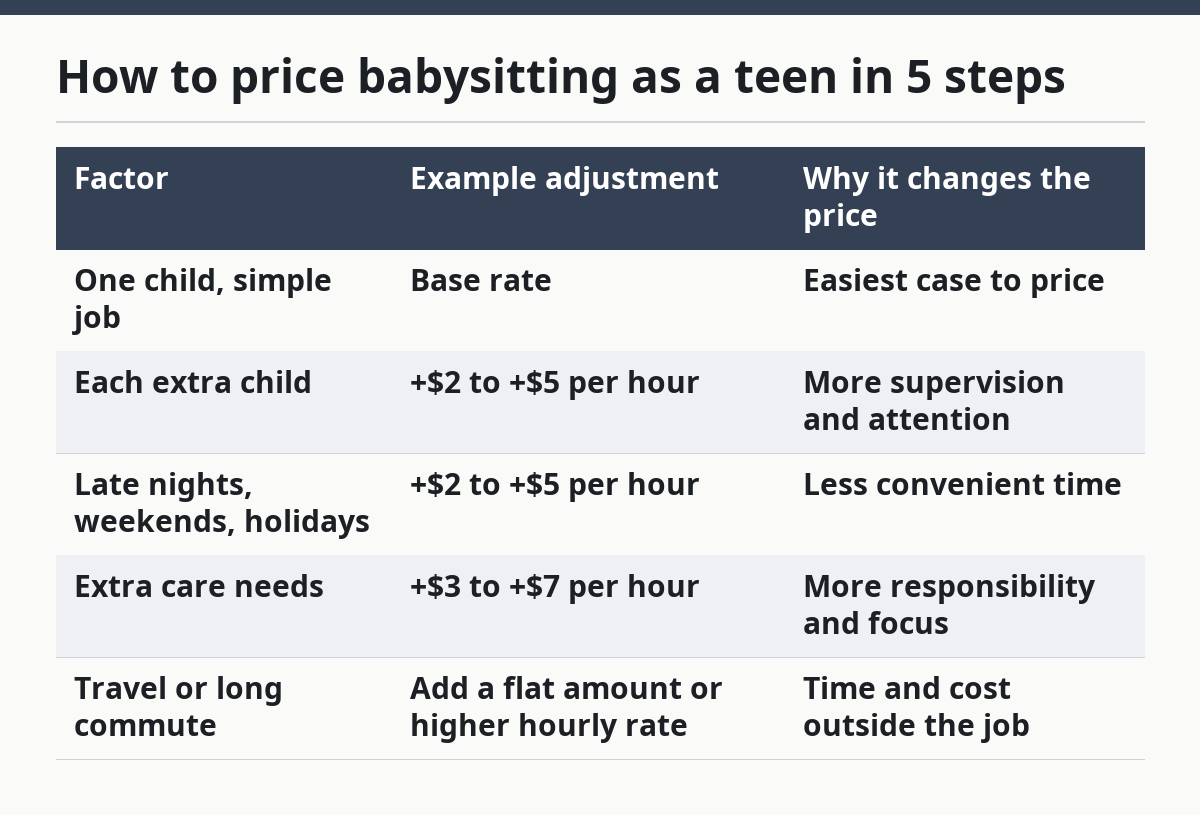
How to price babysitting as a teen starts with the job details, not with a number you heard once. The cleanest method is to set a base hourly rate, then add clear adjustments for the parts of the job that make it harder or less convenient.
| Factor | Example adjustment | Why it changes the price |
|---|---|---|
| One child, simple job | Base rate | Easiest case to price |
| Each extra child | +$2 to +$5 per hour | More supervision and attention |
| Late nights, weekends, holidays | +$2 to +$5 per hour | Less convenient time |
| Extra care needs | +$3 to +$7 per hour | More responsibility and focus |
| Travel or long commute | Add a flat amount or higher hourly rate | Time and cost outside the job |
-
Pick a base hourly rate for one child in a simple job.
Choose a number you can say out loud without apologizing, such as a round hourly rate for one child, a few hours, and no unusual needs. The result should be a rate that feels believable for a normal weeknight job, not a desperate bargain or an inflated ask. -
Add for each extra child.
Increase the rate when you go from one child to two or three, because your attention is split and the risk level changes. If the family wants you to watch siblings of very different ages, the job usually deserves more than the same rate for one child. You should see the price move upward before you send the message. -
Raise the price for late nights, weekends, or holidays.
Evening babysitting is often more valuable than daytime babysitting because it can interfere with your own plans, sleep, or transportation. If the family needs coverage after 8 p.m., on a Friday, or on a holiday, the higher rate should be obvious enough that you would not mind quoting it in writing. -
Charge more when the job asks for extra care.
If the child needs help with medication reminders, behavior support, bedtime routines, or another layer of supervision, that is not the same as hanging out with a calm older child. A higher hourly rate fits because the work takes more focus. The rate should reflect the added responsibility, not your willingness to be nice. -
Account for travel time and inconvenience.
If you need a parent to drive you, take a long bus ride, or cross town for a short shift, factor that in. A 30-minute commute for a 2-hour babysitting job changes the value of the hour. When the job is priced well, the total feels worth the trip instead of like you are working for free time on the road.
This method works because it gives you a reason for every dollar. It also gives you a clean way to explain your price to parents: “My base rate is X, and it goes up when there are more kids, later hours, or extra care needs.” That kind of message sounds thoughtful, not random.
What changes the price the most?
What changes the price the most is usually the number of children, the time of day, and how much supervision the job actually needs. Those three factors can matter more than your age alone.
Experience level matters, but it should not be your only measure. A teen who has babysat for the same family for 18 months may reasonably charge more than someone doing their first job, because trust is part of the service. On the other hand, if you are new, it can make sense to stay near the lower end until you have a few jobs behind you.
The number of children changes the pace of the job. One child who watches a movie is a different workload from three children asking for snacks, help, and attention at the same time. If the children are close in age, the work may be easier than a mix of a toddler and an older sibling with very different needs.
Evening versus daytime also changes value. A daytime job that fits neatly into a free afternoon is easier to accept than a late shift that pushes into bedtime or requires a parent to stay up and wait for you to get home. If the family needs you on a Friday night, that time slot often deserves a better rate because it is harder for you to replace.
Special needs and extra care may deserve a higher rate, and it is worth checking with a parent, guardian, or other trusted adult if you are unsure how to price that situation. If the child needs a strict routine, support with mobility, or careful attention to behavior and safety, the rate should move up. The point is not to price a child’s needs as a burden; the point is to avoid pretending the work is the same as an ordinary job when it is not.
Family expectations can change the number too. Some parents want simple supervision. Others expect light tidying, dishes, homework help, and a detailed handoff at the door. If the job description starts growing, the price should grow with it.
What should you say to parents about your hourly rate?
You should say your hourly rate before the first babysitting shift is confirmed, in one short message that sounds calm and clear. A direct note can prevent awkward money talks later, and it is wise to check with a parent or other trusted adult if you want a second opinion before sending it.
A good message says three things: your rate, what it covers, and any extra charges. For example, you might write: “My base rate is $X per hour for one child. I add $Y for each extra child, and I may charge more for late nights or special care needs.” That gives parents a simple frame and keeps the conversation focused on the job.
The timing depends on the conversation, but it is often best to send this before you lock in the exact date. If the family asks, “What do you charge?” answer in the same message thread instead of waiting until after the first hour. People make better decisions when the price is clear early.
Do not hide your rate in a long explanation. A parent does not need a speech about how hard babysitting is. They need a number, the conditions attached to it, and a chance to say yes or no. If they push back, you can decide whether to adjust or move on.
This is also where written messages help. A text message or chat message creates a record of what was agreed to, which reduces confusion about whether the rate was per hour, per child, or per night. If the family wants a different arrangement, you can revise it before the job starts instead of arguing afterward.
I would not negotiate from a place of panic. If a family says your rate is too high, you can explain the reason, offer a lower rate only if the job is simpler than you thought, or politely pass. A fair price is better than a job you resent the whole evening.
Common pricing mistakes teens make
Common pricing mistakes teens make usually come from undercharging, guessing, or forgetting the job’s hidden costs. Those mistakes can leave you tired, short on money, or stuck with families who expect more than they pay for.
The first mistake is setting the same rate for every job. That costs you money when one evening is much harder than another. A 2-hour one-child shift and a 5-hour three-child shift should not look identical on paper.
The second mistake is forgetting travel time. If you spend 40 minutes getting to a house and back, a low hourly rate can shrink quickly. The fix is to think in terms of total value, not just the time the clock is running in the living room.
The third mistake is agreeing to extra chores without changing the price. If the parents expect dishes, laundry folding, pet care, or homework help, that is no longer simple babysitting. If the job expands after you arrive, the payment should still reflect the extra work.
The fourth mistake is underpricing because you are nervous. A too-low rate can make a family happy once and disappoint you every time after that. If you start too low, it is often harder to raise the number later than to set a fair rate from the beginning.
The fifth mistake is not naming the rate in plain language. If you say “whatever is fair,” you invite confusion. A clear number is easier for parents to accept than a vague promise that everyone will feel okay about it later.
The cleanest fix for all of these is to write down your rules before you accept the job. If you know your base rate, your extra-child charge, and when late hours cost more, you can answer quickly and consistently.
A simple rate check before you send the message
A simple rate check before you send the message can be the fastest way to tell whether your price makes sense. I use a short self-check: one child, normal evening, no travel surprises, and no extra care needs.
Start by asking whether your number would still feel fair for a 3-hour shift. Then ask whether you would keep the same number if the job became two children instead of one. If the answer changes sharply, your pricing rules are probably too loose.
Next, check whether the total payment would still feel worth it after travel. If you need 20 to 30 minutes each way, a low rate may not be enough. If the family is close by and the job is simple, a moderate rate may be fine.
You should also check whether the rate is easy to explain in one sentence. If you need a long defense, the number may be too complicated. The best babysitting rate is usually one you can state as: “This is my base hourly rate, and I add more for extra children, late nights, or special care.”
This is one of the few places where being slightly conservative helps. If you are unsure, do not jump to the highest number you can imagine. Start with a rate you can support, then adjust after a few jobs if the work is heavier than expected.
The main limitation is that no single formula fits every neighborhood or family. That is why this page does not hand out one universal rate. Babysitting rates depend on the job in front of you, and a teen who learns to price the job honestly will usually do better than one chasing a magic number.
For a broader plan to earn money, the hub on [how to make money as a teen] can sit above this pricing decision without repeating it.
How do I know if my rate is too low?
Your rate is probably too low if you feel busy, tired, and underpaid after a normal shift. If parents accept immediately every time, that can be a sign too, especially if you are handling two or more children or late evenings. A rate should feel fair to both sides, not like you are giving away your time.
How much should a teen charge for babysitting?
A teen should charge an hourly rate that matches the job, then adjust for the number of children, the time of day, and any extra care needs. There is no one rate that fits every family. A simple one-child weekday job should cost less than a late-night shift with multiple children.
Should teens charge per hour or per child?
Teens should usually start with an hourly rate and adjust it for each extra child. Hourly pricing is easier for parents to understand and easier for a teen to track. Per-child adjustments make sense when the workload rises, especially if the children are young or need separate attention.
What affects babysitting pay?
Babysitting pay is affected by experience level, number of children, evening versus daytime hours, special needs, travel time, and family expectations. A job with one child and no extras is simpler than a job that includes bedtime routines, homework help, or a long commute. The more demanding the work, the more the rate should rise.
Drafted with AI; not yet reviewed by a person.